

Not surprisingly, the law of supply and demand is seen pretty clearly in the original comic book art market. Artwork drawn by popular creators tends to be priced higher than those of less well-known artists. Pages featuring popular characters tend to be priced higher than those showcasing less popular characters. Of course, other factors get wrapped up in the process as well. Is the creator still alive and/or active making more art? Was the story the page came from important in the development of the character(s)? What's the condition of the art itself?
The first piece of original comic art I purchased cost me, if I recall correctly, $300. It was by Salvador Larroca, just as he was starting to really become a "name" creator. It was a full-page splash, featuring all four members of the Fantastic Four in costume. It came from the first page of their main book, and I purchased the page a week before the issue even hit the stands. Plus it was an action shot, and not just people standing around idle. The price was set to what I would consider pretty standard, given those considerations. Even so, it was a bit steep for my budget; but, I had just had some very memorable discussions with him and I wanted something of a memento of them.
The most recent piece I bought was only $80. It was by Keith Pollard, done a few years past the high point of his popularity. It depicts a dream sequence from the middle of a generally forgettable story about Hercules, and there's not a whole lot going on. While it was from the first issue of that particular comic series, the title only lasted about a year and a half, and had been canceled for over a decade when I found it. The page itself is well executed, and I find it a fascinating study of Pollard's processes, but it's not exactly the type of thing most people would have an interest in. (Which is likely why Pollard himself still had it!)
There's certainly no hard and fast rules about pricing comic art. I've seen Steve Ditko and Neal Adams pages each with five figure price tags. I was shocked to see Jack Kirby work sitting right next to those pages going for only four figures. Near the other end of the spectrum, the guys behind High Moon are selling their pages for only $50 a pop.
But here's where my brain starts having trouble following things.
One of the most significant differences, in terms of art production, over the past decade or two has been that comic book lettering has gone digital. That Pollard page I have had has the captions and dialogue drawn right on the art by Richard Starkings. The Larroca page is free from lettering of any kind, despite the final printed version featuring the logo, the story title, dialogue and indicia.
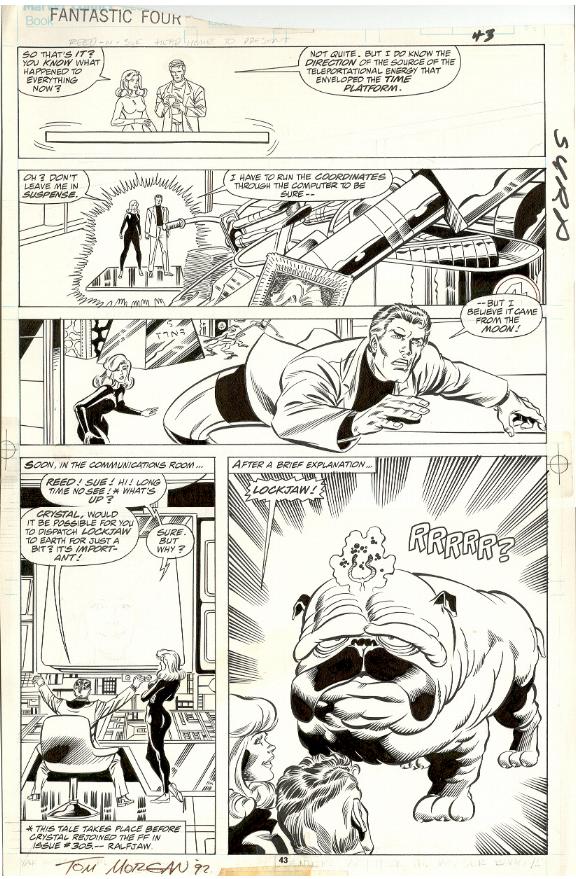 Now, to me, this is a decided negative. Personally, I'm interested in how the artist is telling the story and my interest in the original art stems from that. What sort of decisions did s/he make from a storytelling perspective? Years ago, I made note of how I tracked down a Tom Morgan page, in part, because I could not, for the life of me, understand why he laid out the page the way he did! (I still don't entirely understand the reasoning, but at least I can follow what he was doing now.) But my point is that it's that storytelling aspect that I really appreciate; the knowledge that the artwork is a step in the production process. I like the blue lines and erasures and White-Out and gutter notes and paste-ins and all of that junk that does NOT make it to the final printed page. I want to see the comic I read in a partial stage of production not a pin-up page an artist does as a commission.
Now, with digital lettering, the same process is removed a step. Without the lettering on the actual art artifact, we're seeing a point EARLIER in the production process. It doesn't showcase the story as much as the art. And I guess that's what most people want. Isn't that why splash pages sell better than story pages? Most people prefer treating the original art as a final piece of art in and of itself, as opposed to the means of producing a printed version. And wouldn't that suggest, then, that newer artwork would be more desirable precisely because it's more likely to be created with an eye towards selling the original after the production process of the comic is complete? And wouldn't that suggest that newer art could be sold for higher prices?
Or does the sheer volume of material available now negate that? Not only are more creators out there working, but fans are now more willing/able to commission specific artwork from those creators, meeting whatever unique criteria they can dream up. Readers can get a John Byrne image of Dr. Doom taking out the entire Justice League of America if they want...

I'm wondering aloud here, precisely because of that High Moon art. I know I've seen it plugged a few times in various places, but it doesn't appear to be selling very quickly, despite the (what I would consider) ridiculously cheap pricing. Granted, artist Steve Ellis doesn't quite have the name recognition of a Jack Kirby, but he's no slouch in the art department either! There are some great pages there that I certainly wouldn't mind having in my collection. (If you're looking to buy me a late birthday gift, by the way, I think page 88 is pretty slick.)
How much does the economy as a whole impact sales? Original art pretty clearly falls into the "luxury item" category, and I'm sure many sales have NOT occurred precisely because of economic concerns. But, still, I would expect that would only hamper sales on the higher priced items, not so much at the lower end.
But here's another factor to consider: High Moon is (so far) exclusively an online comic. It does have a substantial following and is generally considered one of the biggest success stories out of Zuda. But does that somehow make it "less real" than a comic actually printed with ink on paper? Is the fact that you can't frame a High Moon production page next to the original make it somehow worth less?
I honestly don't know that I have anything resembling answers on this one. What I value in original art is clearly not the same as what most other people value in original art, so I don't really understand how some works are more desirable than others. I have that cursory knowledge that stems from basic market economics, but any specifics seem lost on me. Anyone out there willing/able to shed any light on the subject?


4 comments:
I think the discrepancy reconciles if you consider the gap between the markets and the potential reach of the mediums. At his peak, CC Beck had a readership in the tens of millions, while today my understanding is that the comic publishing industry caters to maybe half a percent of that. We can think of examples of how those who benefit most from the market status quo labor to lock in the conditions to maintain the status quo, but I think it goes without saying that the market and the potential reach of the medium aren't interchangeable terms.
Everyday, there's an occasion for me to pass along Vonnegut's analogy to writing of holding a conversation in a restaurant: you speak to hold the interest of the people at your table, but clearly enough for anyone listening-in to comprehend that interest. With any public presentation, a balance between intimate and epic agendas must be settled on, even if unconsciously by the creators' tastes.
1. The public association of superheroes is to comics, and of comics to superheroes. Everyone knows what superheroes are, that you find them in comics, and there superheroes have their access to the epic/public consciousness, where High Moon does not (even though its readership could conceivably match the market of print comics itself).
2. The implication of the saying "you can't have your cake and eat it too" is that the the contrast to "having your cake" (or "keeping score") is the "cake-eating experience," and the contrast to experience is keeping score. If we understood the principle of this contrast as common sense, the cake-saying wouldn't be as ubiquitous as it is. If this contrast was common sense, people wouldn't be shopoholics, addicted to gambling, or so afraid of life that they tolerated any addiction in their lives perhaps at all.
However large, the readership right now of the various webcomic sites is almost purely on the intimate-level. A complete outsider to webcomics wouldn't know where to go to get his start. I like webcomics, but it would never have occurred to me to start with zuda. That's why it makes sense for the most popular webcomics genre to be gamer "sit-com" where they don't even register as a genre in any other medium. That readership starts with a sub-genre's intimate appeal. Any overlap between ths agendas of collecting and what may fairly be called a fetishistic-appeal simply seem to start somewhere around $50.
I'm linking my name to a recent comment I made on Web Comic Overlook encouraging El Santo to write a post challenging the webcomic-review community to reorganize their review-archives to be more outsider-friendly, rather than reiterating. I think there are steps creators can take to control how what they present is received.
I mourn the loss of lettering on the art boards. That's a big loss to the art. And, to me, lettering is a part of the art, since it must inform strytelling decisions. Not the least of which is that a good comics artist leaves room at the top of each panel for the word balloons. Without the lettering, that just looks like a lot of useless negative space. Now, there are some letterers who will recreate the lettering for you on a clear sheet that can then be placed on top of the original art before you frame it up. It's just an extra cost.
I don't know how much of the original art market will be hit by the economic downturn, though. It's always been a market for the types of high end buyers who will still have extra money. The highest of the high end is safe. It's the middle of the market that will sag. That might have been me, except I got out of the original art market a couple of years ago when I got married already.
Personally, I always collected art by artists I enjoy with characters out of their costumes. I like talking heads pages. I like LOTS of drawing on the page instead of one big costume page. Maybe that's just because it's more affordable, I don't know.
Twomorrows just published a book about collecting original art. I need to pick that up sometime. Maybe it'll help answer some of these questions.
Why "High Noon" for $50 a pop? I like Ellis' art, too, but Ellis' name isn't in the Wizard Top Ten list, or whichever popularity contest we're looking at. Art collectors has certain names they look at and certain styles that drive the prices up. Ellis isn't on that list yet. Maybe someday, after a bigger breakthrough hit. (If he draws X-Men for a year, we'll all be crying that we didn't "invest" more in "High Noon" art, for example.)
One of the things affecting prices, I'm sure, is the digital movement in comics today. I know a few artists that do everything electronically, so there's no original to sell...which leaves fewer printed pages for fans to buy.
This, I think, is coupled with an increase in fans commissioning original art. If I'm going to pay so much for art featuring the characters I love, why not make it EXACTLY what I want to see?
Love the Doom vs. JLA, by the way. That'd be something I'd like to see if Marvel and DC ever kiss and make up.
"Readers can get a John Byrne image of Dr. Doom taking out the entire Justice League of America if they want..."
Except for Batman, of course. The scene 20 seconds after this one is Bruce treating Doom like a can of sardines.
Post a Comment