Latest Posts

Here are this week's links to what I've had published recently...

Kleefeld on Comics: Marvel's Longest One-Page Story

Patreon: Webcomics Textbook: Key Texts: Questionable Content, Part 4

Kleefeld on Comics: 1936 Superman Sketches

Patreon: Webcomics Textbook: Key Texts: Questionable Content, Part 5


Superman famously leaped into the public consciousness in 1938 with the publication of Action Comics #1. Jerry Siegel and Joe Shuster, however, had been working on the idea for several years prior as is widely known. Siegel had published "The Reign of the Superman" in Science Fiction: The Advance Guard of Future Civilization #3, a fanzine of the early 1930s. The titular character bore little resemblance to the Superman we know today, possibly most notably in that he was a villain. A re-worked version of the character (now a hero) was offered to Consolidated Book Publishing, but the company stopped publishing comic books just as they sent in their submission.

1936 Superman sketches
What we're looking at today is some of Joe Shuster's early sketches of the Superman that debuted in Action Comics. But these are from 1936, a full two years before the character's public debut. This was done on the back of some scrap wallpaper. You can clearly see some of the design ideas Shuster was working through -- including giving him a more typical strong-man outfit with a tank top, and using him as a pitchman on a box of whole wheat pancakes. Also visible are lot of notes toying with some of the promotional language including "The Greatest Super-Hero of All Time!" And, is the figure that's drawn sideways Lois Lane?

Robert Beerbohm‎ posted this last night on Facebook and it's worth checking out for some of the close-ups he includes where you can really study the details.

I'm continually amazed how we can still uncover ephemera like this that sheds more and more light on the earliest days of comic books as we know them!
Over the weekend, Brad Meltzer posted a one-page story he has in Marvel #1000. I'll post it again here...
Marvel 1000 Spider-Man story by Brad Meltzer, Totino Tedesco and 
Chris Eliopoulos
It's a touching story about how many people Spider-Man has impacted and how many lives he's saved. It's really well-executed.

But it's not really a one-page story.

True, everything you need to know to understand the basic story is there. But kind of in the same way that the Classics Illustrated version of Wuthering Heights has everything you need to understand that story. You get the basic plot and structure, but just reading that leaves out a lot of details.

Read Meltzer's story again. (It's only one page, it shouldn't take long.) What are the elements that resonate with you? Most likely...
  1. Spider-Man is very casual about saving the woman's life.
  2. He acts like he's never had anyone ask for his name before when it's clearly an ongoing recurrence.
  3. He use each one of these incidents to honor his Uncle Ben.
Except... that last point is not what's in the story. Taking that story by itself, "Ben" could be taken as Spider-Man's real name. He's never identified as Peter. In fact, there's some potential confusion there in that his first caption box, he names himself "Parker" which could be either a first or last name. So, if his name is Parker, then he's clearly lying about being called Ben, but if that's the case (again within the context of this story) why would he tell people "Ben" repeatedly?

I don't really think this is a fault in the story. Meltzer wrote this primarily, if not exclusively, for a Marvel reading audience. The people reading this will recognize Spider-Man immediately and are fairly conversant with the character. They already know the "great power/great responsibility" line, and how Spider-Man learned that the hard way when his Uncle Ben was killed by a criminal that he could have stopped previously, but chose not to out of hubris. Meltzer's story very much leans into that. He knows who will read this and what level of character knowledge they're coming to the table with.

The surface level emotional weight of this story is presented as Spider-Man's impact on people's lives, but the real emotional weight is the lasting impact Uncle Ben had on Spider-Man and how Spider-Man chooses to honor that. And that requires the reader to have read at least one version of Spider-Man's origin. Whether that's the original Lee/Ditko eleven pages in Amazing Fantasy #15 or one of the many, many retellings since then. To understand this story in its entirety, you need to have read something some other comics.

Is Meltzer's piece a one-page story? Technically yes, but not really.
Here are this week's links to what I've had published recently...

Kleefeld on Comics: The Disappearance of Cadet Turner
https://ift.tt/2qo6Bvr

Kleefeld on Comics: Rituals Lost?
https://ift.tt/2Opzdwm

Patreon: Webcomics Textbook: Key Texts: Questionable Content, Part 2
https://www.patreon.com/skleefeld

Kleefeld on Comics: How Are You Getting Webcomics News Now?
https://ift.tt/3475Wgp

Patreon: Webcomics Textbook: Key Texts: Questionable Content, Part 3
https://www.patreon.com/skleefeld

Kleefeld on Comics: Cover Shenanigans
https://ift.tt/2QK5T6u

Thor Variant Cover
Last night, Joe Field posted a thread about an upcoming variant edition Thor cover...
You can click through to read the whole thread, but I think the key piece of information is this...
In order for a retailer to make any money on this variant issue -- to sell that one special cover to a single person -- they would have to purchase $2200 worth of Thor issues. A title that, even at its highest sales point in the past decade, did not sell a third of that.

Now, to be fair, this is one retailer talking about his own shop's experience. But Joe's been in this business a while and his Flying Colors is one of the better shops around. I suspect there are very few retailers selling more copies of Thor than him. I can think of exactly two that might sell as many as 1000 copies of Thor every month, and both of those have strong online sales in addition to their brick and mortar presence. (I'm thinking of Mile High Comics and Lone Star Comics, in case you're wondering.)

So why would Marvel do this? Why would they even consider a variant version of a book that they probably don't need more than five or ten copies of?

Money, of course, but how does that math shake out?

Let's say Mile High orders 2,000 copies of Thor every month, just as their regular order. They then would get two copies of the variant cover for the same price as the regular cover, and could sell them to readers for several times the cover price. Whatever percent increase they sell the variant version for over and above the regular cover price is all profit for them. They're happy.

Now, let's say Lone Star orders 1,000 copies of Thor every month, just as their regular order. They get one copy of the variant cover and make a good chunk of change selling that over and above cover price. Not quite as much as Mile High, but it was still minimal additional work for them, so they're happy.

Now, we've got someplace like Android's Dungeon. They sell maybe 15 or 20 copies of Thor every month, just as their regular order. If I'm doing my math right, that's about $56 profit for the retailer. But if they want to get that variant, they need to order 980 copies more than they usually sell. So that's a $2200 order to make $56 profit off 20 books, leaving the retailer in the hole by about $2144. It clearly doesn't make financial sense for a retailer at this level.

Ah, but it only takes one idiot for this to make sense for Marvel.

See, if there's one idiot who orders $2200 worth of books instead of their usual $44 worth, then Marvel is ahead on orders by an additional $2156. That's not $2156 in profit, mind you -- I don't know what Marvel's profits are per book -- but even at a meager 5% profit margin (about 12¢ per individual issue) that means they've garnered an additional $108 to print that one extra variant book. Even the most expensive print-on-demand services don't charge that much, and the only custom printing that would need to be done is the cover -- all the setup work and printing of the interiors is already done for the regular issue.

So Marvel stands to make a 900% profit off that one single issue, for minimal additional work.

Of course, the down side to all this is that you wind up irritating nearly every retailer in the business who either can't afford 1000 issues or isn't thinking clearly enough to realize they can't afford 1000 issues.

Which, if I recall, was kind of what got the whole industry into trouble in the 1990s.

But what do I know?
Header image of children in a classroom learning about comics
As I stated last week, I've been a bit out of the loop for the better part of the last two years. The digital landscape has changed a bit, but in review, I'm seeing less than good news about webcomics news.

When I started getting into webcomics with any degree of seriousness, it was about 2004. I had known of webcomics before then, but I didn't really start reading any with any regularity until then. I recall thinking at the time that I was coming to the webcomics party exceptionally late. I mean, guys like Scott Kurtz, Jerry Holkins, and Mike Krahulik had been working for years at that point and they weren't even really the old guard. It already seemed like a crowded market, and I was thrilled when I could find the occasional webcomic that was JUST getting started.

But what I also noticed at the time was that I was largely on my own when it came to finding webcomic news. None of the usual comics news sites were reporting on webcomics with any regularity. Hardly at all, in fact. So what news I found was generally what was being posted by the webcomikers themselves underneath their latest strip. One of the reasons I started my webcomics column over at MTV Geek was because no one else was reporting on webcomics in any capacity. When MTV Geek shuttered its doors in 2013, though, there was still pretty much nothing else. Gary Tyrrell was doing his webcomics blogging over at Fleen but that's never really been a place for news per se; some newsworthy bits do come through there, but that's not really the point of his site.

When I moved over to FreakSugar, that was still pretty much it as far as anything resembling webcomics news. Brad Guigar has been running a few outlets for webcomics discussions (notably Webcomics.com and ComicLab) but those are generally geared for people making webcomics. News there is very much geared to an audience that is NOT a typical comics reader. Tom Spurgeon would occasionally post something he came across on social media, but those were very much a small part of his focus.

With my FreakSugar contributions falling to the wayside, though, and my former Comics Alternative podcast co-host passing away early this year, I'm seeing less of a source of webcomics news than before. There's a few social media accounts that seem to have cropped up, as far as I can tell, they mostly just promote whatever webcomic updates they come across.

So what am I missing? Is there still no good source of webcomic news? Are readers still relying primarily on the creators themselves to let them know what's news? How are you learning about webcomics now?
I was reading through an old post of mine from 2007(!!!) about how I stopped going to my Local Comic Shop every Wednesday because I "needed" to get the latest issues immediately, and flipped a sort of mental switch where I would hit the shop most (but not all!) Wednesdays as a matter of ritual. That it was the act of knowing what I was going to do on my lunch hour once a week that provided a modicum of stability in a turbulent world. (And good grief, when I compare what I thought was turbulent in 2007 versus what I consider turbulent now... YOWZA!)

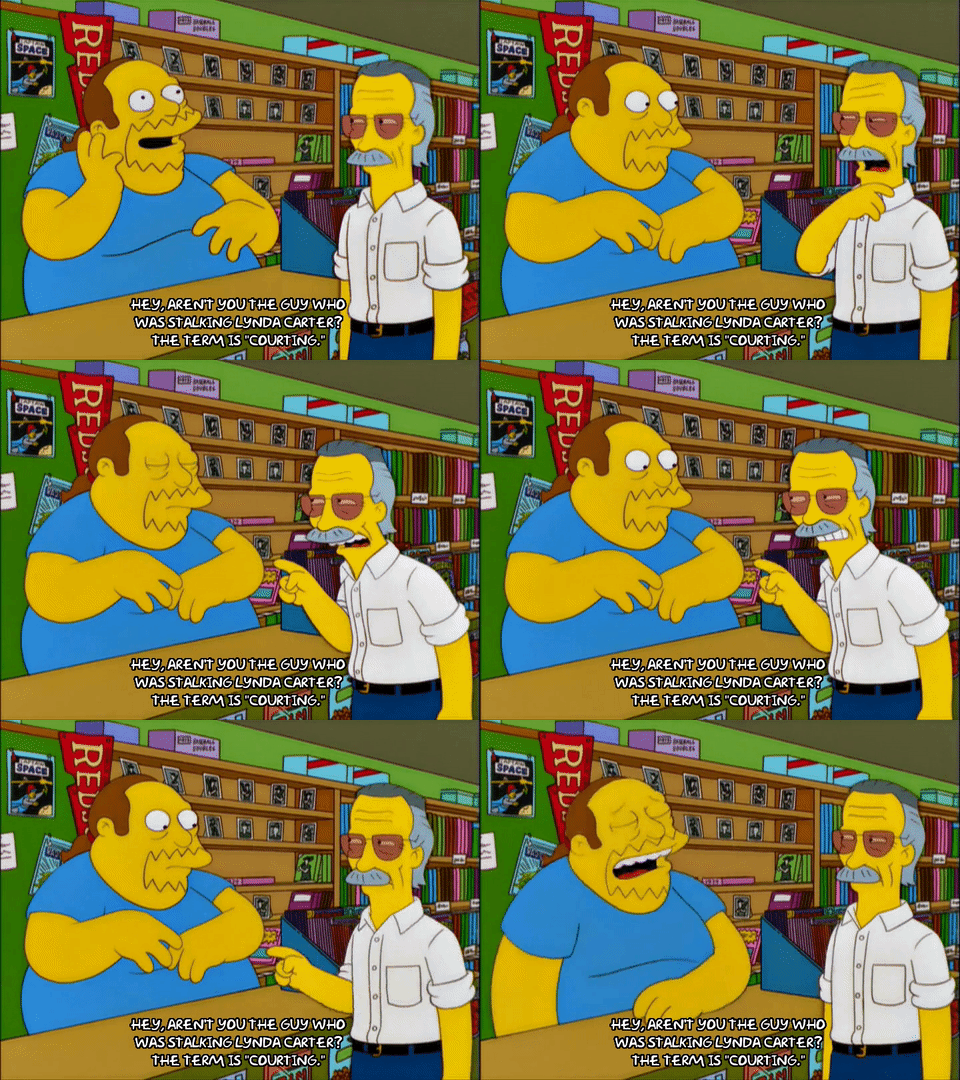
It might not be terribly surprising that my comics habits have changed considerably since 2007. When I moved up to the Chicago area in 2013, for example, I actually lived in several different places before finding and moving into a permanent residence. Because I kept moving, I wasn't able to establish my local comic shop. And unfortunately, once I did finally find a place, the physically closest comic shop is an unironic real-life version of Android's Dungeon.
Comic Book Guy and Stan Lee
It's cramped and dingy and dark and unorganized and the owner seems sketchy as hell. So I don't go in there very often.

Now, I certainly could go to any number of other comic shops. Chicago has a number of really good ones; many are closer to me now than one of my previous local comic shops was to me in Ohio. But by the time I had settled down from moving, and figured out where everything was... well, my buying habits had somewhat forcibly changed. At that point, I wasn't getting any ongoing titles any longer and the ones I was getting had been winding down anyway. Once I bought the last couple issues, I wasn't in the stores enough to see what new books might replace them. And I had plenty to still read thanks to webcomics. So between shop signings and sporadic conventions, I was still able to get all the new physical comics I wanted, with maybe an occasional order on Amazon for a good trade paperback I might hear about.

My comics ritual had dissolved entirely. It wasn't that it had changed or morphed a bit; it was just gone. I was still reading comics, but there was no ritual tied to the process at all. Whenever I had time. I mentioned in passing the other day that with my severely limited mobility last year, I started using a subscription service. (Lone Star Comics' MyComicShop for those interested.) This inadvertently created a new potential ritual for me -- receiving a package once a month with all my new comics. I could establish some new process for opening the box, checking the new issues, and reading them. Give myself a little much-needed stability to stabilize the super chaotic couple of years I've had.

But for some reason, I've never done that. Some months, the box would arrive when I was home, some months not. If I was home, the dog would usually alert me to the deliverer's presence so I could retrieve the package whenever it arrived (usually in the early afternoon) rather than always waiting until the end of the day or something. I could've set aside some special time to open each box and sort through the new issues. Also not done. I could recognize the boxes pretty much immediately, so there was no real surprise in what was in them, so they would sometimes sit on the kitchen table for a day or so before I could get to them. "Yup, I know what that is. Nothing that requires my immediate attention." Or maybe, "I won't be able to read these until the weekend, but it's garbage day tomorrow, so I can open it now and make sure the box gets in the recycling bin right away."

And that's all been... fine? I guess? I mean, I don't really miss the weekly trips to the comic shop, and I don't feel like things would necessarily better if I developed a ritual for how I read comics now. But given how stormy the waters have been -- and how I've had very little stability for the past two years -- maybe I really should make a point of making my comic book reading a more ritualistic process. To provide a period of grounding that I can give myself once a week or so. An hour or two every week that I can count on, regardless of what the most recent dumpster fire that fills up my news feed is.

I'm still trying to get my footing again. This blogging is a part of that. Maybe my reading habits should be too.