Winsor McCay was a wonderful cartoonist in the earlier days of the art form. His "Little Nemo in Slumberland" comic strip is often considered a masterpiece and, having read all them, I can't say I disagree. McCay literally pioneered the form and produced a wonderful strip that continually pushed the boundaries of what one can do with a comic. I find it fascinating that so many of the elements he originated are, when used today, still considered "cutting-edge."
To call him a brilliant cartoonist is an understatement, and I heartily suggest that you all look up his work.
What I'm going to present today, though, is a piece of his pioneer work in animation. McCay created what is generally attributed to be the first animated feature cartoon: Gertie the Dinosaur. It's an eight-minute piece from 1914 in which McCay brings a dinosaur to life. Originally, he produced it as a performance piece in which McCay himself stood in front of the animation and issued verbal commands to Gertie. In wider distribution, his portion of the performance was shot on film and presented as part of the Gertie cartoon itself -- although in 1914 it was no less astonishing.
I've actually known of the Gertie cartoon for some time and had seen five and ten second snippets from time to time. I'd even searched the Internet periodically for the past several years without seeing anything more than still shots. But today, I was thrilled to finally find that someone has posted a full version of the cartoon, which I'd like to share with you all now...
This past Sunday's edition of the New York Times featured an article about the diversity of characters in Marvel and DC's comics. I don't have much to add to it, but I thought I'd pass along a link to it...
You know, one of the things I've long thought would be cool would be to be portraye as a character in a comic book. Not necessarily a major player like Spider-Man or even someone more minor like one of the Metal Men, but just a name-dropped kind of thing. Just an acknowledgement kind of thing.
Now I might have the opportunity through Moonstone's Buckaroo Banzai contest. The first place in the contest includes being drawn into the story as one of the Hong Kong Cavaliers.
So the question I have at the moment is, should I win, would that satiate my interest in being in a comic story? I somehow doubt it. I think I might feel that I "cheated" my way in, and I would otherwise not have been considered "worthy" enough as a character.
Yeah, I'm thinking very egotistically here but, hey, this is MY blog and that's kind of the point, isn't it?
Well, as I'm sure you've heard if you're coming to read this blog, Alex Toth died on May 27. It's somewhat mandatory that I say a few words about him here, I think.
In all honesty, I'm not nearly as familiar with Toth's work as I probably should be. Oh, sure, I've seen any number of episodes of Space Ghost, Johnny Quest and Superfriends but Toth's work on those projects was largely over after the conceptual stage. He didn't write the stories that were aired, and he didn't do any of the animation. I've seen a handful of the earlier X-Men comics Toth did, but that's about the extent of his comic work that I've seen. In fact, I've seen more of his "columns" in Alter Ego than I have of his actual comic work.
And that's something that I need to correct.
From where I sit, I want to know how all of comics inter-relate. If Dan Slott says that Fabian Nicieza was an influence on him, I figure I should see what Nicieza did. If Walt Simonson says Jack Kirby was a big influence, I'm going to go back to see what The King did. (In these two cases, I was already pretty well aware of the Nicieza and Kirby before I knew of Slott of Simonson, though!) I've been trying to get my hands on a cheap copy of Steve Canyon and Pogo reprints because I've heard so many people reference those stories. And I can't tell you the number of times I've heard comic creators say that Toth was an influence on them.
But, for some reason, I've never really been able to track his work down. I suppose it was low enough on the priority list that it was never really feasible financially. There are SO many things out there I want to read and study, I can't afford to get them all. And even if I could, I've got a pretty good stack of things that I've bought but haven't read yet as it is! I think my Essential Dracula volume 2 has been sitting on the shelf since it was originally released and my Green Lantern Archives volume 3 is still shrink-wrapped! Not to mention several dozen Golden Age Marvel books that I've had on microfiche for the past two years and haven't even seen the light of day yet. So I have to say that I can't feel terribly guilty for not having studied Toth yet.
That said, he IS on my list of creators to become more familiar with. It's just that... well, I guess it should (unfortunately) become easier as companies start trying to capitalize on his death by releasing reprints of his materials.
Okay, I've officially been won over by Nextwave. I'm not a huge Warren Ellis fan and, while I definitely enjoy Stuart Immonen's art, it's not enough to win me over to a book by itself. But I'd heard good things about Nextwave and gave it a shot for a few issues to see how I'd like it. There was always JUST enough to bring me back for the next issue, but not quite enough for me to really commit to it long-term. But there was enough in #5 to really sell the book to me. To wit...
"I swear to God, nowhere on Earth do they talk like you, Tabby."
"My generic set of special super hero abilities includes a broader scale of vision."
"Moo hoo ha ha."
"Ha. Fear my robot head."
"Aaron, help them. "
"Schrodinger's death!"
Plus, we get flashbacks to some slightly twisted versions of the Avengers and X-Force, the death of "Special Bear" and a Celestial doing the "L for Loser" sign on his forehead. Great stuff all around.
Go get yourself a copy today!
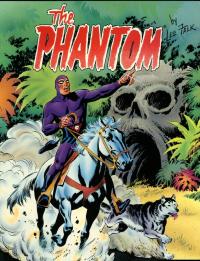
I happened to notice that The Phantom movie starring Billy Zane in the title role is going to be on the next day or two. (I set up things to record it -- I forget when exactly it's on.) I've seen the last half hour or so before, and I remember the trailers when it was originally released. And yes, I'm fully aware that it's not a great movie.
But you know, The Phantom is a great concept. You've got this adventurer-type character with a built-in longevity factor. Built-in mystery and intrigue. If you need to update it for different mediums and even genres. It's just a great concept that, I think, has languished WAY too much in the past several decades. Sure, there've been a few attempts to revive the character and he's actually got a decent comic book out now. There was the cartoon about a decade ago or so that I thought was pretty decent, but it got shafted by the network from the get-go.
To my understanding, the Phantom has actually had a fair amount of continued success OUTSIDE the United States. Why am I not surprised? Yet another great quality fiction created outside the U.S. with no real support within the United States.
* sigh *
I'm not sure which is more depressing -- that many of the great concepts I like and appreciate are generated outside the U.S. or that my so-called countrymen dismiss the concept because it's foreign.
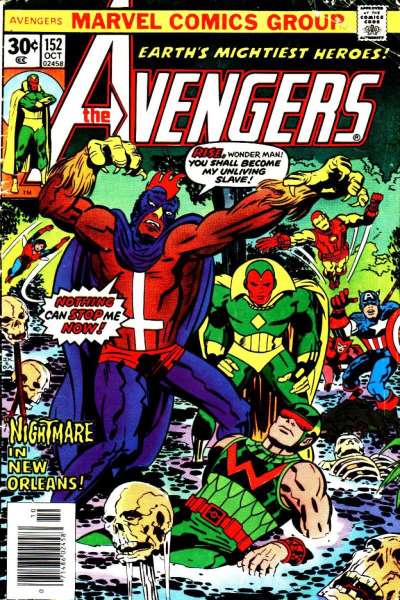
Okay, this past week I picked up some old Avengers comics from the mid-1970s. Steve Englehart and John Buscema. Talk about your classic material! And as I was sitting there reading through them, it really struck home why this stuff was so "classic" compared to what I'm reading today.
Sure, there's a nostalgia factor involved. ("They don't make 'em like they used to!") But there were certain elements that were a given in each story. For example, I was starting in the middle of some story arc, but there was sufficient synopsis and character identification that I was quickly able to pick up and run with it. There was no need for a full-page text explanation of what happened the past two or three dozen issues; everything I needed was in the story itself. Similarly, the end of the story provided some sense of closure. Yes, there was a cliff-hanger ending to entice the reader to pick up the next issue, but the main questions and plot points addressed at the start of the issue were resolved by the end of it. And, ultimately, those things made for a very satisfying read.
(Of course, gorgerous John Buscema art never hurt anyone either!)
Now your typical response to these types of notices is that the market today doesn't support serial story-telling the way it used to. Readers are more likely to "wait for the trade" and get one longer story without these definitive 22 page chapters all the way through it.
There's certainly a degree of truth there. Trade paperbacks have become much more popular in recent years, and the more traditional periodical format less so. But here's where we run into problems. The serial comic requires a certain format. You've got 22 pages to tell a whole, or part of, a story every month. That should include whatever information is necessary for a new reader to pick up and start running with it. To some degree, "writing for the trade" follows a similar format, but the main story is more self-contained and character introduction and definition are drawn out over the entire story. Which is fine if you're reading it in a trade paperback format, but it doesn't work in the monthly, serialized format because you've got arbitrary story breaks in what's otherwise treated as a continuous narrative.
I don't have a problem if writers want to "write for the trade" but it seems to me that if they're going to do so, then the results should be published as a trade and not as a serial. Ever try reading Edgar Rice Burroughs? Tarzan and John Carter? They don't work as single novels because they were written as serials. Which means that the protagonists are up against an impossible challenge at the end of every chapter. Likewise, taking a longer format -- say, a two hour movie -- and serializing it -- say, into a series of twenty minute TV episodes aired once a week -- doesn't work.
There are strengths and weaknesses to any format of fiction. I just think that writers and artists should work towards the strengths of the format they're primarily working in, and editors should not force one format into another.