Latest Posts

Today's post is mostly just me thinking out loud to work something out...

Over the past several months, I've found myself going back repeatedly to the Jodie Whittaker episodes of Doctor Who. I've been watching the show since the Tom Baker days in the late 1970s; I've enjoyed every incarnation to varying degrees and I quite like Whittaker's take on the character. But that's not why I keep going back to her episodes. I keep going back because one of her character's themes is hope, something which I find myself in short supply of lately.
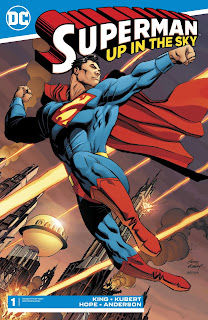
Superman: Up in the Sky #1
The more I thought about it, though, the more curious that idea became. Not that I'm looking for an expression of hope, but that I find myself more drawn to it through Doctor Who than I do through a comic book character like Superman. After all, I was reading about superheroes generally and Superman in particular for several years before seeing Tom Baker for the first time, and I'm a much bigger fan of comic books than any other medium. So why am I seeking solace somewhere other than my usual go-to?

The question is even more interesting when you compare the two characters. Superman, of course, has god-like powers and does good just because it's the right thing to do. While the Doctor doesn't have the same power set as Superman, her intellect combined with the technology she has at her disposal is pretty comparable. So while Superman might be able to physically shift the flight of a careening airplane, the Doctor might "reverse the polarity of the neutron flow" using her sonic screwdriver to achieve the same result. And she also does good because it's the right thing to do.

I don't know exactly when creators started being explicit about Superman standing for hope. I think it was Mark Waid who first used the idea of the S-shield as symbolizing hope on Krypton, but I know I've seen people talking about the hope they find in Superman before that. Certainly, Christopher Reeve used the metaphor repeatedly. For the Doctor, while hope has been mentioned before, it's become more emblematic of Whittaker's Doctor than previous incarnations. You could say there's some similarities here again, in that while both characters represent hope, that is a new (relative to how long the characters have been around) idea.

I think, though, that perhaps the two characters represent different kinds of hope.

Superman's version of hope can be summed up in part of Marlon Brando's speech used in the Superman and Superman Returns movies. "They can be a great people, Kal-El. They wish to be. They only lack the light to show the way. For this reason, above all, their capacity for good, I have sent them you, my only son."
Superman is the beacon we're supposed to be heading towards. The ideal we're supposed to be striving for. Our hopes are pinned on Superman's source of light. Follow in Superman's shoes; Superman will save the day.

And that's the part that doesn't capture my interest about Superman's hope. What's wrapped up in the character is that Superman himself is the answer. Superman is a savior character. The sense of hope that comes with Superman is that he will be the one to save the day. "Don't worry! Superman will save us!" The problem I have with that is that it's an absolution of one's own agency. You don't have to really do anything, just hang around, and someone else will catch you.
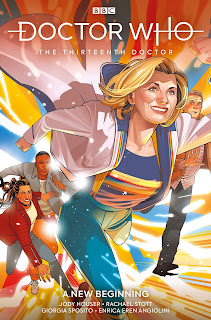
Doctor Who comic
While the Doctor certainly does come in to save the day, she acts more as an empowering agent, helping the regular folks to save themselves. There's a telling line towards the end of "The Tsuranga Conundrum" where Mabli is thanking the Doctor and her companions for their help and says, "You all were [brilliant]. Light in dark times." The Doctor responds, "People prevail. Hope prevails." What's key is that she leads with people. She isn't the beacon of light to be followed, but people themselves are their own light that just need a chance to shine. She assists in giving people agency, not in taking it away.

I could get into why that idea resonates with me personally, and how that fits into my philosophical and theological ideas, but suffice it to say that I am very much in tune with the idea of being responsible for myself. Interesting. I never really though about those two characters in precisely those terms before.
A few years ago, I noticed a couple of things. First, there was an increasing number of natural disasters that were causing larger and larger amounts of damage. Natural disasters, of course, have been around since literally the beginning of the planet, but climate change has had enough of an impact at this point that both their frequency and intensities are impossible to ignore regardless where you live. Second, the federal government is decreasingly able (or even willing!) to assist people who have been impacted by these disasters. Hurricane Katrina is kind of the poster child for this type of thing, but we're seeing it more and more. Worse still, we're also seeing clearly man-made disasters happening more and more as well. (Flint, MI still does not have clean water; a report last year classified over 47,000 of America's bridges as “structurally deficient.”) This means that you're more likely to get hit by a disaster, it will likely cause more damage than it the past, and you'll get less assistance.

Pee Wee Harris Looks at Emergency Preparedness comic
So despite not living in an area prone to earthquakes, floods, tornadoes, or any other natural disasters, I began putting together an emergency preparedness kit. A crate of supplies that we could rely on in case we're cut off from... well, anything. Matches, first aid kit, flashlight, radio, multitool, etc. After I pulled some basics together, I expanded to include bottled water, MREs, camping supplies. My wife and I each put together a bag with spare clothes we could grab if we needed to race out the door. Extra food for the pets. A waterproof/fireproof lockbox with a handle for important papers. Rain barrels for non-potable water. A small generator. Everything we can think of (and afford!) to prepare ourselves for any sort of emergency.

Some of the basics here are spelled out on variety of websites of folks like the Red Cross and the ASPCA. But I found a lot of that to be dated. I mean, they are keeping up to date by mentioning things like extra phone chargers, but the thinking behind these sites still assumes the government will come to assist you in a few hours, maybe a day at most. So to get more/better information, you almost have to start looking at prepper culture.

Preppers are the folks who take the idea that you'll be on your own to the extremes. They're also sometimes known as survivalists and are preparing for what they often call a SHTF scenario. Like, full-on Mad Max types of situations. Society is gone, and you are completely on your own. There's a lot of overlap here with gun culture. There's an entire industry built up just around building underground bunkers/fall-out shelters that caters to this community. There are some sane, pragmatic folks out there advocating prepping, but there's also a lot of deep conspiracy theorists that are genuinely fearful of a for-real zombie apocalypse.
Rhymes with Orange comic about doomsday preppers
So, for me, trying to do more than the Red Cross suggests, but who's not so paranoid as to buy and retrofit an old missile silo as a bunker (yup, that's totally a thing), there was a LOT of crap to wade through in order to get to some practical and useful information.

Yogi Bear Earthquake Preparedness comic Ready Girl comic
Which leads to my notion that someone needs to make an emergency preparedness webcomic. As far as I can tell, there's nothing out there like this currently. There have been a few emergency preparedness comics that run a basic story about preparing for an emergency and make some high level recommendations, but they tend to be light on specifics. Which I suppose is good enough to get people thinking about it, but it doesn't do much beyond that. I've also seen a few comics that try to show a prepper or some survivalists actually in a SHTF setting, but the focus there seems to be on the story of survival after the event, not on the preparations beforehand.

So what I think we need is an instructables-type webcomic that shows how to go about getting prepared for emergency situations. I'm thinking it would need to be a webcomic versus a printed one because while individual portions would be linearly narrative, the overall piece would not be; so if you had it as a webcomic, people could check out the specific portions they felt were most important and/or they were most ignorant of without having to wade through everything else. There might be some sections that just talk about some of the supplies you'd need under different emergency scenarios, or for different geographies. Another section might look at administering first aid. Another might be packing a Go-Bag versus a Bug-Out-Bag, and why you might need one over the other. Maybe something about what you think you need versus what you most likely will need. What about legal emergencies? Do you have a will, power of attorney documents? Are they secure? Financial emergencies? How much should be in your emergency fund? Digital emergencies? Is all your data backed up?

The basic point of the whole thing would be how to implement the old Boy Scout motto of "be prepared." Obviously, not everybody was in Boy Scouts in the first place, and I'm sure many who were haven't thought about some of those ideas since before they had a spouse and kids and day-to-day job responsibilities and whatever. But, like I said, in a day and age where disasters are getting deadlier and more damaging, with less likelihood of any help from the government, I think something along these lines would prove incredibly beneficial if it were done with practical steps in mind. I think there's a lot of far-out-there people in the prepper community that give them all a bad name, and turn off others from even entertaining the notion of emergency preparedness -- you wind up sorting through bizarre conspiracy theories just to see a list of items to include in a Go-Bag! There are some decent folks out there with YouTube channels and such, which is great, but a webcomic would stand out since there simply isn't anything like it out there right now. People just starting out could check it out without getting scared by the crazy tinfoil hat types.

Somebody get on this!
One of the comics I regularly bought as a teen was West Coast Avengers. After I'd been buying it a while, John Byrne started writing/drawing the book and I was initially thrilled because it was his work on Fantastic Four that really made me a comics fan. At first, I was pleased with his the story, but things seemed to get more confused as his tenure wore on. What turned out to be his last couple issues, in fact, not only included some character choices that I didn't like, but the stories seemed disjointed and didn't make much sense.

Thanks to Erik Larsen, I recently learned that one of Byrne's final issues originally was to feature Scarlet Witch giving oral sex to Wonder Man, but this was edited out as the last minute! But when he shared the page in question, I immediately recognized it as part of where I got really confused. And, in doing some digging, I think there was a lot more going on here than an adolescent attempt at naughtiness.

So the basic plot of the issue is that Scarlet Witch has become a bad guy, and has captured several of the Avengers. She taunts them for a bit until her father Magneto and brother Quicksilver show up. Then the three of them laugh menacingly until the next issue. Honestly, not a lot happens in this issue. Some background exposition and posturing mostly.

Now, here's the first page in question as it was published. Scarlet Witch has the Avengers helpless and she tortures Wonder Man...
West Coast Avengers #56, page 6
I was a naive teenager and didn't really get what the hell Wanda was supposed to be doing here. Clawing through Simon's chest and then..? I don't know, something painful, I guess. Evidently, some readers read this as her castrating him. Never occurred to me, but I was stupid that way.

Anyway, here's the art the Byrne originally submitted...
Original art for West Coast Avengers #56, page 6
Wanda's scratching is caressing, she disappears below readers' view, and Simon's dialogue is much more subdued.

Brian Cronin spoke with then assistant editor Len Kamniski about how the story got so far as to be lettered and inked like that...
During this period John's working method was to dispense with plots, scripts and etc., and just go straight to drawing the story. Obviously this saved precious time in terms of meeting production deadlines. John would send in the completed book, inked (when he inked himself, of course) [This issue was inked by Paul Ryan - BC] and lettered (his computer printed balloons already pasted down).

Saved a boatload of time, that. We managed to get the completed book into production in the nick of time every month, instead of bowel-shrivelingly late like most other stuff. And you have to give John his due, having the confidence to just charge ahead, plotting, drawing and dialoging from panel to panel.
Cut to the day the book needs to go to the printer. Kamniski reviewed it, saw this page, and went to the book's editor Howard Mackie to make sure he wasn't reading too much into things. He wasn't. Kurt Busiek was in the offices that day and recalled...
Since the book needed to get out the door quickly by that point, Kaminski himself made the art alterations and thinks Chris Eliopoulos (who was on staff at the time) re-did the lettering.

(For the record, Byrne had this to say about the sequence when asked about it in a 2001 interview: "One of my 'mutant powers' seems to be an ability to give readers lots of room for their own imaginations to work. Witness your own reference to the 'sadistic sexual scene' between Wanda and Simon. There is nothing in the scene as written and drawn to indicate her attack is sexual or, indeed, precisely WHAT her attack is. I left that to the minds of the readers. And, largely because of this, there was nothing in that scene (or many of the others fans often refer to) for the Code to reject.")

The story shifts focus to Hank Pym for a bit, but the first panel showing Scarlet Witch and Wonder Man again looks like this...
West Coast Avengers #56, page 17, final panel
Although I haven't been able to find scans of the original art from this page, I'd bet that this panel has been modified too. Wanda's hand looks too small for her head and it doesn't look to me like Byrne's style of illustration -- I suspect this was added to reinforce the clawing/scratching she was doing earlier. I don't know if this was a hand statted from another source or if this was drawn in, but I doubt Byrne had it in there originally. [EDIT: In looing at this panel again more closely, I think her hand was indeed there and drawn by Byrne but it was positioned differently. My guess is that she was wiping the side of her mouth, further suggesting she had just completed fellacio on Simon. Her hand was moved away from her mouth and claws/sharp fingernails added to downplay the sexual connotations and play up a vague sense of violence/torture.] Also USAgent's dialogue, "How could you HURT him like that??" looks like it was changed too. None of the letters in "HURT" stylistically match anything else on the page, and there seems a smidge too much space on either side of it as well, suggesting there was a different, slightly longer word there before. "Violate"? "Defile"? "Debase"?

The last page of the story, when Quicksilver shows up, also includes a shirtless Wonder Man with scratches running across his chest down to his ribs. These also must have been added by Kamniski, as they are not visible on Byrne's original art...

In looking for an explanation, I thought perhaps there were some notes on the letters page, but what I found was more curious... a drawn, one-page apology from Byrne about Tigra's appearance in that year's Avengers Annual. What struck me as curious was that it's billed as an "important announcement we promised you back on page six..." Except that now-infamous page six has no such promise. The reference is actually on page nine. Well, it's the numbered page nine -- the page numbering includes ad pages, but even if you just count story pages, it appears on the seventh story page, not the sixth one. What gives? Did the overall story come up a page too short at some point and a new page had to be added?

(For clarity, any page numbers I reference for the rest of this piece will be the story page numbers, not the published page numbers. I'm looking primarily at the original art to try to get closer to what Byrne intended before the book was published, so I'm using the page numbering Byrne included on the original art.)

Well, no, the final page of the story was numbered as page 17 on Byrne's original art... and it is indeed the 17th page of the story. It's possible that Byrne just goofed and said it was "Page Six" when it wasn't -- perhaps he just miscounted. But that seems unlikely given that each page of original art has the page number written by him at the top, so it wouldn't be hard at all to confirm where the reference is. Which suggests that somewhere between story pages 5 (the fellatio page) and 17 (the last page), the page numbering was changed. I was able to come across the original art for pages 9, 10, 12, 15, and 16; and those are all numbered accurately. So the change seemingly occurs between 5 and 9. Let's pin that for a minute.

The next issue is Byrne's last in the series. Obviously, he would have been working on his parts of #57 already by the time all the last-minute changes to #56 noted above were being thrown together. The issue is wholly written and drawn by him, but it ends rather abruptly. The next two issues are fill-ins before Roy and Dann Thomas take over writing duties and return to the Scarlet Witch story. (Additionally, Paul Ryan is then moved from inker to penciller, with Danny Bulanadi taking over inking duties.)

Why did Byrne leave West Coast Avengers? He's explained it thusly...
The departure was as sudden as it was for a simple reason: a bone-head EiC who did not pay attention. Several months before the Immortus storyline got started, we writers and editors were summoned to the EiC's office for the purpose of concocting the latest . . . shudder. . . Summer Crossover. As I had a storyline coming up in AWC that would be pretty cosmic and wide reaching, I offered it as the basis for the Crossover. The EiC said no, he didn't want to do that for the Crossover. So Howard Mackie (AWC Editor) and I returned to our jobs on the book, and went ahead with the story as planned. One month before we got to the Big Reveal, as it were, the EiC suddenly noticed we were doing the storyline he had "rejected". He ordered us to change it, immediately. Howard protested -- the EiC had not said we could not do the storyline, only that he did not want to use it for the Crossover. Finally the EiC pulled rank -- we Must change our story, as we did not have "permission" to do it. (Permission was needed only if stories caused major changes to characters or continuity. This did neither.) Since there was nothing I could do with all my months setup, other than the story as planned, I quit in protest, with Howard's support.
That summer's crossover ended up being "Acts of Vengeance." But what was the story Byrne was working on that he had to change immediately? He actually explained that as well, in talking about some unused cover art he drew for West Coast Avengers #58-59.
Unpublished cover for West Coast Avengers #58
In thinking about Scarlet Witch's powers, he reasoned that if her power was to change probabilities (as it was generally explained at that time) that meant that she would have to be manipulating time itself in order to make the probability of something happening 1:1. If an object broke, it would break along a natural fault -- but that natural fault would have to be there in the first place. So Scarlet Witch wasn't creating a fault, she was manipulating time so that the fault was always there in the first place! With this thinking in mind, Byrne further reasoned that such manipulations of the time-stream would attract Immortus' attention. And indeed, Byrne has Hank Pym discover Wanda's powers are altering time in #56, and we see Immortus metaphorically lurking in the background. In an FAQ, Byrne explains how he intended the story to play out from there...
Discovering Wanda's power, he was going to kidnap her and use her to further his plans. And the first thing he was going to do was alter probabilities so that when the Avengers battled Kang the first time, Kang won!

My story would reveal this in flashback, however, as we would open in the world long after this had happened. Pretty grim place, where most of the familiar heroes had been killed off or never become super powered in the first place. No FF, since they never took that rocket ride. No Hulk, since Rick Jone [sic] has never driven his car onto the Gamma Bomb test site. (One of the main characters was going to be Peter Parker, who had not become Spider-Man because of Immortus' manipulations.)

As the story progressed, we would learn slowly what had happened -- and also learn that we were not seeing "present day" Marvel, but rather a time a "few months" (Marvel Time) ago. The date would be just prior to when Thor, in order to save a wounded Black Knight, had used his hammer to open a portal in time and space and stuck the Knight into it. We would learn this when the Black Knight basically fell out of the air into the post-Kang's victory world. In that timeline, Thor had not placed him in the "time stasis", so when the changed world "caught up" to that moment, out popped the Black Knight. The multiverses intersected at that point, you see. Well, the Black Knight pretty quickly figures out what's going on, learns there is an underground (of course!) and helps the folk of the twisted version hunt down and stop Immortus, freeing Wanda (herself another link to the multiverse, by virtue of how Immortus has been manipulating her power) and setting everything right.

When all is restored, the Black Knight of course is back in that "hole in time", and Wanda is the only one who remembers how things were.
John Byrne's original 'dark' Scarlet Witch sketch
By the time Byrne proposed this, he had been noodling on the idea for at least a year or more. His first "Dark Scarlet Witch" sketch (seen at left) dates from 1988 -- the year before his first West Coast Avengers issue even hit the stands! (Although since it is addressed to Mackie, presumably this came from after he had been offered the gig and he was actively pitching ideas to Mackie on what he wanted to do with the book.)

This appears to be the story that then-Editor-in-Chief Tom DeFalco "suddenly noticed" just before the "Big Reveal." Now, since Byrne offered the story up as a line-wide crossover previously, DeFalco would be in a position to see where a story was going before readers. So what would have been only hints or foreshadowing to most people would be easy-to-read signposts for DeFalco.

Let's get back to that page numbering. Byrne's page six has the Human Torch asking Hank Pym about Tigra, and Pym discovering that she's escaped. Page seven has Pym relay Tigra's recent history and ends with Immortus gloating to himself that he helped in her escape. The next page, as the story is published, begins with Immortus gloating for a single panel before we get back to Hank Pym. At the bottom of that page, Pym sees a bright flash of light which is revealed on the page after that to be Quicksilver and Lockjaw teleporting in. Since we have the original art, we know that teleporting page is numbered properly, and it would have been page 6, 7, or 8 that needed reworking. Given that page 6 ends on the dramatic reveal that "Tigra's escaped!" and page 8 flows very directly into page 9, my guess is that it's page seven that is new.

The Tigra recap is largely unnecessary, and Pym's "since the Torch has never met her" explanation is a bit of clunky dialogue that's serving fans' attention to continuity more than the story itself. It also disrupts the rhythm Byrne uses throughout the issue of single-page sidebars to check in on characters not in the primary story. If this page originally began with Immortus' taking credit for Tigra's escape, it may have continued with him revealing portions of his plan. This would follow the one-page sidebar format for Immortus as well as cut the Pym/Torch sidebar to a single page. But a full-page sidebar of Immortus would have been what DeFalco saw as a red flag that Byrne was going ahead with his alternate reality story. Given that Immortus himself is still left in the story, DeFalco did not seem to have any issue with Byrne using Immortus and/or having him act as a Machiavellian villain; it seems to be more an issue with this alternate reality storyline. The remaining Immortus panel on page eight is oblique enough as to mean almost anything (Immortus' dialogue is basically him just saying the Avengers are pawns in his plan) so the intervening page could have been changed without any appreciable impact to the story in this issue.

Hang on, though! Let me pull out another section of what Kaminski said, talking about the day the book was set to go to the printer...
It arrives first thing in the morning from the colorist. Editor Howard Mackie quickly reads through it, declares it good, drops it on my desk to proofread, after which I'm to finesse it through Production and have Mark Gruenwald sign it out. I don't recall if Tom DeFalco was out that day, which technically was the only time the process was allowed to skip him, or if was one of the times you waited for Tom to go to lunch or something, then take to Mark, plead screaming lateness (usually true anyway), and get him to autograph the release forms WITHOUT READING the book.

Everything up till that last bit was Standard Operating Procedure in Editorial. But Mark NEVER skipped the final read-through; even when Tom was IN, Mark'd read it first, then pass it to Tom. Yeah, some of it was his continuity cop fixation, but there were plenty of times he'd catch a typo that got through and do the corrections himself with a pen and whiteout...

ANYWAY, Mark virtually never signed out a book without reading it, and on those occasions ONLY for guys who belonged to the Former Assistant Editors to Mark Gruenwald Club. I believe there were two. Howard was one of them.
Now while he's a little vague on the specifics of why, Kaminski is clear that DeFalco did not check these pages at this time. Nor did Gruenwald. The final art pages were only seen by Mackie and Kaminski. Mackie, as noted in Byrne's quotes above, was fine with the Immortus story and Kaminski, as Mackie's assistant at the time, wouldn't have had the authority to alter a story that radically at the last minute. Which means that DeFalco must have seen the pages (at least the penciled versions) previously if he were to put the kibosh on that story.

But if DeFalco saw the pages previously, that means he saw -- and glossed over -- the scene where Wanda is implied to perform fellatio on Simon. It's certainly not the type of thing an editor is usually looking for, especially in Comic Code Approved books at that time. If you're reading through dozens of books as part of your job, you're probably not going to scrutinize the guy who's been doing solid work on that specific book for the past year.

What DeFalco did catch, however, is the Immortus storyline Byrne had previously suggested as that summer's big crossover story. Seeing that likely drew his -- and the other editors' and creators' -- focus from any other specifics of the issue itself in order to address DeFalco's broader story concerns. I expect the back and forth between Byrne, Mackie, and DeFalco took some time before they came to a conclusion. At which point, Byrne said he'd do whatever rework was needed on #56, then finish his work on #57 and he was done. We don't know exactly when this discussion took place, however.

We know, though, that oral sex scene wasn't actually identified until the day the book was set to go to the printer, which was obviously after the discussion mentioned in the above paragraph. Which means that, by the time Kaminski caught it, Byrne had already quit. Even if they wanted to reprimand him in some way for causing the last minute panic in the office, it would've been a moot point. He had already reworked whatever he needed to for #56, was almost certainly well into drawing #57 (recall Kamiski's note earlier that Byrne skipped plotting and scripting, and went straight to drawing) and already said that would be his last issue.

So any suggestions or rumors that Byrne was fired for including a scene of fellatio/masturbation/castration aren't true. He left the book over editorial conflicts (a frequent reason he has for leaving a series) and the offending scene, which he had drawn before his conflict with DeFalco, was only discovered after he quit. And while the subsequent creative team did wrap up the Scarlet Witch/Immortus storyline, they retconned how Byrne had interpreted her powers, saying they were augmented by Immortus and explicitly reverted Wanda back to how she had been handled before Byrne. The notion of Wanda manipulating time itself was dropped, and the overall scope was downgraded considerably. It provided a resolution to the story, still involving the same players Byrne had started with, but a fairly far cry from what he had intended.
Here are this week's links to what I've had published recently...

Kleefeld on Comics: Well, 2019 Sucked!

Kleefeld on Comics: Death Wish Coffee Comics

Patreon: Webcomics Textbook: Key Texts: Stand Still. Stay Silent., Part 7  

Kleefeld on Comics: Pavelic & LeFlore v. Marvel

Kleefeld on Comics: Bodily and Financial Ailments

Patreon: Webcomics Textbook: Key Texts: Stand Still. Stay Silent., Part 8 


Kleefeld on Comics: Authenticity & Transparency
https://ift.tt/2QD8OME


Sphinx PR logo
Yesterday, Lys Galati of Sphinx PR posted a "year-end summary" of how the market looks going into 2020. She consolidates things down to two points, which I'd sort of seen happening but didn't really study enough to formalize any of my own observations. (She's speaking primarily to independent creators with her piece, I believe, but it can definitely apply more broadly.)

She first speaks to object scarcity and value. Why do people buy the THINGS that they buy? Honestly, I've mostly been looking at this from the opposite direction -- why do people seem to favor experiences over physical objects? I think there's still merit to considering that approach, but Galati has a more practical thinking on this topic. If you're making comics and selling them, what is it about the comic book object itself that might prompt someone to actually take it home? How do you, as a creator, produce something that has a tangible value that someone would prefer that object over, say, a digital version of the same? Why would someone buy a ten or twenty dollar paperback graphic novel you made when they could read the whole story on your website for free already?

I'd always addressed this issue from the experience end of things. That the object was merely a token of the interaction a person may have had with a creator. If you go back through my blog, you'll find more than a few examples where I talk about different ways to engage with a potential audience, mostly at conventions. Galati's point is that the physical object has some inherent value removed from such interactions. Read her piece and think about that idea.

The other piece she speaks to is more on the marketing end of things. I've noticed the approach she mentions particularly in sponsored YouTube videos, and it's an idea I saw webcomic guru Brad Guigar floating the idea as far back as 2015 when ad revenue suddenly dried up for webcomics. But it's now more critical than ever to take a more direct, hands-on approach. Email blasts do not work.

Galati ends her piece saying, "Authenticity + Transparency = Trust. In 2019 it was a suggested guideline. Now it’s a lifeline. Every single thing you do needs to follow that equation." She is absolutely right. Go read her piece so you can absorb everything she has to say about this; it's not long, and she has a spot-on summary of where we are right now!
I've talked about Ryan Estrada here before. It seems like he's always doing something interesting, even if that occasionally means it puts his life in peril. He's recently noted, though, that his closest brush with death came from sitting on a couch in Florida. Estrada has just posted on his site a 10-page story about how he had to undergo surgery for testicular torsion. Go over there and read about it. (Don't worry -- it's a family-friendly comics and no naughty bits are shown at any point!) Of the ten pages, the first page is basically the set-up, then there's seven pages of the story itself with a resolution on page nine. But then he has something of an epilogue on the last page, and that aspect of the story is what I want to focus on.

Panel from Testicular Torsion story
Estrada had been living in South Korea at the time, and he was only in Florida on visit. I mention that to explain A) why he didn't have health insurance, and B) why he "hid" in Korea after the events of the story; he simply returned home. The story was originally done for CORPUS: A Comic Anthology of Bodily Ailments, which came out last year. The anthology, and certainly Estrada's story in it, tie in to the growing trend of graphic medicine stories -- comics that are expressly related to medicine or illness. But while the crux of Estrada's story is indeed focused on the torsion incident itself, that last page -- the pseudo-epilogue I mentioned -- is about getting flooded with bills afterwards.

Estrada works as a freelance cartoonist. He doesn't make tons of money -- enough to live comfortably in South Korea, but he's not what you'd call wealthy. Estrada has been very open about his finances over the years. I don't know exactly when this story took place, but I think he was making about $20,000 annually around that time. Technically above the poverty line here in the US, but not by much. He noted to me that the bill for a one day stay in the hospital -- not counting any of the doctor visits, examination fees, etc. Just the hospital stay itself -- was more than that. He says he could have bought a house with the money that got racked up in bills.

And I don't think anyone familiar with the US medical system would question any of that. "Yup, sounds about right!"

The leading cause for bankruptcy in the United States is medical expenses. Roughly 2/3 of all bankruptcies in the US are because of medical bills that people can't afford. And nearly 80% of those people HAD health insurance!!

Go back and read Estrada's comic again. Out of a ten page story, discussion of medical costs/bills occur on literally half the pages. As he's lying there in a fetal position, experiencing the worst pain in his life, he's actively talking about skipping parts of health care because of the cost. His very first line of dialogue is: "Does anyone know how much it costs to go to an emergency room if you don't have insurance?" My point is that the health care system here in the US is so fucked up that there are literally no walls between discussions of actual health care and how life-shatteringly expensive it is. Estrada was asked to write a story about "bodily ailments" and half of his story is about the financial impact of it. The two are so intertwined as to be inseparable.

Estrada is certainly not unique in being in this position. But his story highlights for me two conclusions:
  1. Graphic medicine as a genre of comics will continue to expand, but will also increasingly incorporate a great deal of financial issues/concerns as well. This will require two sets of storytelling skills from artists -- the ability to relay medical information and the ability to relay financial information -- and those who are talented at both will be the stand-out artists that are celebrated. This could have the potential effect of talented graphic medicine artists (unfortunately) not getting enough credit and/or accolades because they're not as adept at relaying the fiscal side of the story.
  2. As a society, we're going to see more and more people emigrate to other countries specifically to escape medical bills. Estrada, as I said, already had made a home in South Korea, so he wasn't trying to escape the bills specifically, but he did discover something of a loophole that worked to his advantage. It will only be a matter of time before this becomes more widely practiced as an intentional means of fleeing impossible medical debts.
Both of these, for different reason, give me cause for concern. Estrada has more than once proven he's generally ahead of the curve compared to everybody else (he literally invented "normcore") and while I generally like to celebrate that about him, this is one time I hope he doesn't become a trend-setter.
C-3PO and R2-D2 on Sesame Street
Did you know that a David from Sesame Street fought a legal battle against Marvel that went all the way to the Supreme Court?

Northern Calloway, the actor who played David, had created a character called The Skyrider that he wanted to create an animated movie around. When Marvel began working on it, Calloway sued for copyright infringement. Except that Calloway had sold the rights to a company called LMN Productions who, in turn, transferred them to Marvel. Calloway's lawyers said the documents were forgeries with no evidence to that claim, and Calloway's lawyer ultimately took the brunt of the court ruling, being personally fined $50,000 basically for wasting everybody's time.

Here's how it was written up in the April 1990 issue of Entertainment Law Reporter...
United States Supreme Court upholds sanctions against individual lawyer, but not law firm, for filing meritless claims against Marvel Entertainment

The United States Supreme Court has ruled that the sanctions available under Rule 11 of the Federal Rules of Civil Procedure may be imposed against individual lawyers only, not their firms.

The issue arose, as reported at ELR 10:10:19, in a proceeding brought in 1982 by actor Northern Calloway. Calloway, best known for his role as "David" in the television program "Sesame Street," claimed that Marvel Entertainment Group infringed his copyrighted script for a proposed animated science fiction movie entitled "The Skyrider." Marvel presented contracts indicating that Calloway had sold his rights in "The Skyrider" to LMN Productions, and that LMN had transferred those rights to the Marvel parties.

A Federal District Court dismissed Calloway's complaint (with leave to refile) on the ground that the complaint did not specify the registration number of his copyright and the dates upon which the alleged acts of infringement occurred.

An amended complaint, signed by Calloway's lawyer, Ray L. LeFlore, was filed. The amended complaint remedied the defects cited by the court and also asserted that Calloway's signatures on the option documents were forged.

In 1984, LeFlore joined with Radovan Pavelic to form the law partnership of Pavelic & LeFlore; court papers in the case subsequently were signed "Pavelic & LeFLore By /s/ Ray L. LeFlore (A Member of the Firm) Attorneys for Plaintiff."

The District Court directed a verdict in favor of Marvel on the allegation of forgery. After a six week trial, a jury, notwithstanding Calloway's arguments challenging the validity of the contracts, returned a verdict in favor of Marvel.

The court, stating that the forgery claim had no basis in fact, and was not investigated sufficiently by the lawyers, imposed Rule 11 sanctions in the amount of $50,000 on the law firm of Pavelic & LeFlore, and $50,000 on Ray L. LeFlore.

A Federal Court of Appeals upheld the imposition of sanctions against the law firm and against LeFlore, but, on the court's own motion, reinstated Calloway's appeal of a separate judgment imposing sanctions of $100,000 against the actor.

The United States Supreme Court has reversed the Court of Appeals' decision with respect to the $50,000 in sanctions imposed against the law firm of Pavelic & LeFlore on the ground that Rule 11 provides that when a paper is signed in violation of the Rule, a court may "impose upon the person who signed it ... an appropriate sanction." Justice Antonin Scalia noted that the Rule "strikingly" departs from normal common-law assumptions such as that of delegability - the signing attorney represents that the filed paper is factually and legally responsible, and that "he personally has applied his own judgment. Where the text establishes a duty that cannot be delegated, one may reasonably expect it to authorize punishment only of the party upon whom the duty is placed."

The Court of Appeals judgment therefore was reversed insofar as it allowed Rule 11 sanctions to be imposed against Pavelic & LeFlore, and the case was remanded for further proceedings.

Justice Marshall, in dissent, viewed the court's interpretation of Rule 11 as overly restrictive in reading into the Rule "an absolute immunity for law firms from any sanction for their misconduct." The court's decision would result in an "unnecessary erosion of the discretion of federal judges," stated Justice Marshall, for the Rule could be read as allowing a court to impose sanctions on any juridical person, including the law firm of the individual signer. Justice Marshall concluded by emphasizing that the decision "unwisely ties the hands of trial judges who must deal frequently and immediately with Rule 11 violations and ill serves the goal of administering that Rule justly and efficiently."
I can't find any details about The Skyrider project itself, much less any concept designs or drawings of what the project might have entailed. It doesn't appear that Marvel ultimately did anything with it. I suspect this was due to the fact that it was tied up in litigation for the better part of a decade and, ultimately, everyone at Marvel who might've been interested in back in 1982 when Calloway first filed suit had either gone on to other projects and/or left the company entirely by 1990 when this was finally wrapped up. (Calloway himself passed away in January of that year.) As near as I can tell, though, Marvel still owns the rights to The Skyrider if they wanted to pursue it again in any capacity.