Latest Posts

Finally got a chance to see that PBS documentary on Herge. I have to say that I was very impressed. I've never actually read Tintin (I know... blasphemy!) but I am at least somewhat familiar with the character and his creator.

I learned quite a bit from the documentary in fact. My understanding is that Herge's life was relatively closed, so I get the impression that this made a lot of things public that were previously known only to the most devout Herge scholars. The work is largely based around some interviews conducted by Numa Sadoul in the 1971, but also has some significant pieces from his widow, Fanny Rodwell, and some Herge scholars.

What was striking to me was that it turns out that much of what is seen in Tintin is symbolic of Herge's own life. While he didn't do a great deal of travelling until late in his life, he used Tintin (and Capt. Haddock) as surrogates for himself often charting his own inner demons through them. While that's certainly true to a degree for all artists, it seems more poignent and conscious in Herge's case. Certainly moreso as he continued to work with the series.

All in all, I found the documentary very well done and very enlightening. I'm certainly disappointed that it hasn't received more press in even mainstream American comic circles as Herge and Tintin are immensely popular throughout the rest of the world. While America has largely claimed the superhero genre as its own, that's not the entirety of comics and Herge's influence on comics, especially European comics, rivals that of Will Eisner or Jack Kirby here in the U.S. That alone, it seems to me, should make him more noteworthy to American audiences.

Of course, I do tend to not be nearly as ego-centric in my worldview as most Americans.
Okay, as you may have noticed given the lack of responses on my blog here, I have this unnatural ability to subconsciously discourage feedback. It it were just here on the blog, I'd dismiss it as no one actually reading this thing, but I've been watching the effects on several fronts over the last half decade or so. Threads on message boards come to a screeching halt once I chime in, and the only time I get professional feedback on my work is when I expressly ask my boss for some. And even then, it tends to be vague and generally non-commital.

So I'd like to ask a very specific question here to see if I can A) generate some activity here and B) get some information prior to spending some of my own money.

The question at hand is: Has anyone seen the documentary Tales from the Crypt: From Comic Books to Television and what did you think of it? If you have NOT seen it, what do you think of EC comics on the whole? I've got a collected edition of Tales from the Crypt and Gemstone's reprints of Piracy but that's it. So, any readers out there old-time EC fans? Or historians who've read a lot of older EC books? Any thoughts on Gaines in general?
So, my brother-in-law gave his DVD copy of Soylent Green. He'd watched it, and decided he didn't like it well enough to keep and asked if we wanted it. I actually rather thought it was a good movie, and I tend to gravitate towards dystopian stories, so I was happy to take it off his hands.

Now, on the DVD, one of the extras is an original trailer for the movie. The big hook of the trailer is the repeated tag line: "What is the secret of soylent green?" Of course, thirty years later, there's no big secret -- Charlton Heston's memorable performance crying "Soylent green is people!" is probably more well-known than the movie itself.

Here's the thing, though: that's not the point of the story. The story was originally a commentary about overpopulation and the shortcomings of inadequate planning; indeed the notion of forced cannibalism wasn't in Harry Harrison's original novella at all. Throughout the movie, though, while the "mystery" of soylent green was part the sperficial plot, it still viewed to me like an elaborate social commentary about not taking care of our environment, the widening gulf between social classes, and the de-humanization of the bourgeois. Edward G. Robinson's tearful sobbing at how far the human race has fallen in so short a time is a much more potent and powerful message in the film, I think, than Charlton Heston's soylent revelation.

So why am I talking about this on what is supposed to be a comic book blog? In seeing the DVD again and being reminded of the completely off-target marketing of the movie, I'm reminded about why I enjoy comics over movies as a whole. Comic book marketers, by and larger, "get it." They know what they're selling and why it is (or isn't) important. When a comic sells because of the creators behind it, the creators get a lot of attention and credit. When a comic sells because it's a first issue being sold to a collector's market, the "#1" slogan is plastered all over the cover. Regardless of why you personally buy comics, you are (generally speaking) being sold a product that is exactly what you're looking for... whether that's the latest appearance of Superman, the next installment of an inter-company crossover, the latest creation of your favorite creator, or anything else. You know what you're getting into when you plunk down your three bucks. You're not going to be sold a comic on the merits of its great story if it doesn't have one, you're not going to be sold on the appearance of character that's actually absent from the title. There's marketing hyperbole, to be sure, but it's not wholly and entirely misleading as you often find in other media.
I was at an all-day interview yesterday and was pleasantly surprised to find my copies of Jack Kirby Collector #46 had arrived in the mail by the time I got home. I hadn't been paying attention at all to when it was supposed to arrive in stores, and wasn't at all expecting to see the book so soon.

Of course, it has what I consider my worst "Incidental Iconography" column so far, but I read the mag for everything else it has to offer anyway!
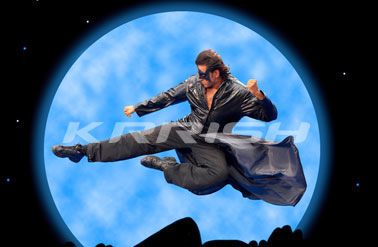
No, I'm not using onomatopoeia. "Krrish" is the name of an Indian superhero that's being featured in a Bollywood movie of the same name. It opened a couple of weeks ago in select American cities... nothing remotely close to me, though, naturally. From what I've read thus far (thanks, JF!), it actually sounds as good as -- if not better than -- Superman Returns. Though being a film that's outside the mainstream American outlets, Superman will obviously fare much better in domestic box office receipts.

I will certainly be keeping my eyes out for it to see if/when it shows up in video stores or on cable. I'm certainly interested to see how another culture handles a superhero mythology on a mass media scale. One problem I have is that, being landlocked in the middle of the United States, it's often difficult to rise above the din of American filth to see what's going on elsewhere in the world. I have some affinity for Canadian and British cultures, but I think that has more to do with the relative ease with which their media is obtainable than anything else. I often find it fascinating to see how things are done/handled outside the popular American mindset.
I happened across Fresh Air on the radio a little earlier this afternoon, and I learned that PBS will be airing a new documentary on Herge entitled Tin Tin and I. Terri Gross was actually interviewing the director, Anders Østergaard. I just caught the tail end of the interview, but it definitely sounded like something worth watching.

It's supposed to debut nationally tonight at 10:00, but my local stations don't seem to be showing it until 4:00 am on Thursday. I'm reminded of a quote from Mark Twain: "When the end of the world comes, I want to be in Cincinnati because it's always 20 years behind the times." Even with the information age, it seems that the best we can do is still two days late.

In any event, I'll post my thoughts on Tin Tin and I after I watch it, probably Saturday morning sometime.
I watched Superheroes Unmasked this afternoon, and I do recall seeing it when it came out. I was somewhat disappointed with the show's description, as it implied that there that the show would delve more deeply into the cultural mores that inspired them. That's not to say the show didn't touch on it at all, but I would've liked to have seen something perhaps deeper but not as broad in reach.

But perhaps that's too much to expect from a mainstream documentary.

One thing I did like in the re-viewing, and that I recall went over well with The Wife when she saw it a few years ago, was Frank Miller's line about giving Batman his balls back. It's a bit of freshing candor about the state of the character prior to The Dark Knight Returns.