Latest Posts

I had to pick up a few things a Target this afternoon, and strolled past their books section. At conveniently at eye level were J.M. DeMatteis' and Mike Ploog's new Abadazad books: The Road to Inconceivable and The Dream Thief. Now, I haven't read these books yet, but their Abadazad comic was incredibly well-done and I can't imagine these books as anything less than captivating.

But the reason why I'm bringing it up here is more because that this is a brilliant example of quality comic books working their way into mainstream America again. So the next time you're walking through Target or Barnes & Noble or wherever and stumble across a copy, tell whomever you're with that it was a great comic that is now a great book and well worth checking out.
Just a quick notice to say that on Sunday, July 9 at 2:00 am EST, the History Channel will air a documentary called "Comic Book Superheroes Unmasked." It's actually from 2003, but I don't recall seeing it before.

In any event, it's touted as being an examination of how superheroes -- and presumably comics by extension -- are more than just escapist fantasy. The IMDB summary reads...
Industry insiders like Stan Lee and Neil Gaiman (The Sandman) reflect on the way their colorful creations reflect society at large. They have spread from the pulpy pages of nickel comics to Saturday morning cartoons, the big screen and beyond. They have evolved from simple, All-American heroes to tortured, complicated characters reflecting the dreams, desires and fears of modern society. From Superman to The Sandman, Comic Book Superheroes Unmasked is a fascinating, feature-length look at the evolution of an art form that has proved remarkably adaptable and enduring. Filled with classic images from DC and Marvel Comics as well as extensive interviews with modern masters of the graphic novel like Neil Gaiman and Frank Miller (The Dark Knight Returns), this documentary, originally aired on the History Channel, goes far beyond the superficial escapist fantasies to probe the forces that shaped the characters who have become legend. In the adventures of The Incredible Hulk, Spider Man, The X-Men and many more are echoes of American society in the last century, and the art form continues to evolve and innovate today.
So, if you haven't seen it before, it might be worth staying up late or setting the VCR/Tivo/DVD-R.
I was just directed to the following Fantastic Four animation by Matt Gardner. It was so enjoyable, I thought I'd pass it along. I'm particularly fond of his characterization of Ultimate Dr. Doom...

Fantastic Four: Doomsday
The Wife and I were just channel surfing and landed on MASH. The episode was "The Korean Soldier" and featured comic book writer Larry Hama. (He's shown on the left in this still from the episode.) It's something of a bit part, but I mentioned it to The Wife and she actually perked up and showed some interest.

I've also seen ads that say the G4 channel will be airing live coverage of this year's San Diego Con on July 21. Superman Returns and X-Men 3 are in theaters now. Spider-Man 3 will be out later this summer, and My Super Ex-Girlfriend opens in a couple of weeks. You can flip on the TV and catch Blade: The Series or Stan Lee's Who Wants To Be A Superhero, as well as Justice League Unlimited, The Batman, Krypto, or Minoriteam. Not to mention plenty of re-runs of The Incredible Hulk, Spider-Man and His Amazing Friends, The Tick, and plenty of other shows I'm forgetting at the moment.

The key, at the moment, is to make sure that you -- as a comic book fan -- point this stuff out to your friends and family who might not be as enlightened about the significance of comic books on American culture.

Now, if you'll excuse me, I have to set the timer to record a documentary on Frank Frazetta that's going to air early tomorrow morning.
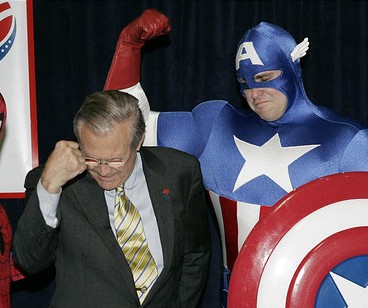
Well, it's July 4th, the anniversary of the United States, and I'm required by law to write about how wonderful it is to be an American citizen.

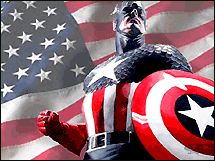
I never really liked Captain America. I'd read a handful of his comics as a child and I just couldn't "get" the character at all. To me, the concept of a person being so patriotic that they'd eagerly have experimental, completely untested drugs pumped into their system for the sole purpose of having the chance to serve their country seemed much more far-fetched than gaining super powers by being bitten by a radioactive spider. Why would anyone so willingly forfeit their life for the sake of a faceless government body?

A lot of my disbelief in the concept stems from being born decades after American patriotism faded. If the Korean War didn't disperse our collective illusions sufficiently, the Vietnam War certainly did. I was born when Americans began looking at politics and politicians with suspcision, and I'm certain that my parents -- although not particularly politically active -- were outraged at what they saw on the news every night. While I'm just a tad young to remember most of the 1970s, I do recall the emotions and impressions of that period -- when good, hard-working men were out of work, there was a seemingly impossible gulf between the rich and the working-class, and you recycled/reused as much as you could, not out of environmental responsibility, but out of economic necessity. The ideals of the American dream were giving way to the realities of life.

Growing up with that outlook, I find it astounding that Captain America survived the entire decade. I suppose that the bleakness of the situation must have been countered somewhat by America's bicentennial in 1976, and I think the then-new American cynic was gratified by some escapist culture like Star Wars and Superman: The Movie. But it remains that I, like so many Gen-Xers, grew up being cynical of government. I think we were the first generation who began questioning the American dream en masse. (I don't mean to suggest that we were the first generation who questioned it, merely the first who more or less unilaterally questioned it.)

In the mid-1990s, when I had an opportunity to get paid to review Captain America, I looked at it as a chance to try to understand not only the character, but also patriotism in general. How is that someone can pledge their allegiance so blindly to a government as to adopt its national image as their own? To so blindly follow a government as to accept it as inherently right and justified regardless of what the means or the ends actually are?

What I learned, though, through reading the comics and other independent research, was that Captain America is NOT the embodiment of America, the U.S. government, or even the American dream. He's an embodiment of the Bill of Rights: the first ten ammendments to the U.S. Constitution. Captain America -- at least the Steve Rogers character who is the most often referred to as Captain America -- is NOT beholden to the U.S. government and has repeatedly run into sharp contrast with them.

Here's the problem, though. While I now understand better where the character is derived from, and how he is generally approached by creators, his character now strikes me as shallow. Effectively, there's never really been a difference in character between Steve Rogers and Captain America, even before he let his identity be publicly known. And the extent of the character is essentially the Bill of Rights. There's no real political or religious affiliation (by design). There's no long-standing love interest (by design). There's no real questioning of his actions or his methods. He's right, he's just, and he believes that unconditionally.

Which bores me to no end.

The appeal of a Spider-Man or a Thing character is that they have internal questions that they keep asking. They question their actions and, more frequently, the consequences of their actions. They question themselves and their worth. There's a depth of character that simply isn't present in Captain America. Captain America isn't really a person; he's a set of ideas. Valid and noble ideas, to be sure, but that's not enough to make up a character in my mind.

So on this day, where U.S. citizens detonate in excess of 250,000,000 pounds of explosives to celebrate our collective two-fingered salute to the British, I'm reminded that while the Bill of Rights contains some excellent ideas and was crucial to the inception of both the United States and Captain America, the ultimate results in both cases have long since ignored the brilliant original structure and have been wallowing in hollow symbolism, relying on muscle to sanction their own self-imposed, unwavering self-rightousness.
So I caught part of a summer movie review piece on NPR this afternoon. One of the panelists posed the question: why do comic book movies all seem to feel the need to be dark and ponderous? Another panelist suggested that it was because movie-makers felt the need to take themselves overly seriously to compensate for what they thought were otherwise frivolous concepts. They dropped the subject then and moved on to some pirate movie that's coming out soon.

I might counter, though, that it has more to do with Tim Burton. Comic book movies -- prior to Burton's Batman -- were taken largely as camp. Adam West's Batman is certainly the most notable in this regard, but there's a lot in every other example. But Burton showed Hollywood that you could take the same concepts and characters and approach it differently in a manner that's more appropriate for another medium. After Hollywood saw that superheroes could be done differently (and successfully) they copied that.

It was clearly evident in the Flash and Nightman TV shows, but there's still evidence of it in everything from Justice League Unlimited to Lois and Clark to Blade to The League of Extraordinary Gentlemen.

As I thought about it, it's curiously also found in the comics themselves in a smaller, shorter scale. It was also started with Batman (in Frank Miller's The Dark Knight Returns) and was copied throughout just about every superhero comic. Fortunately for comic fans, that fad only lasted throughout the 1990s and hasn't continued like it has in the comic-based movies.
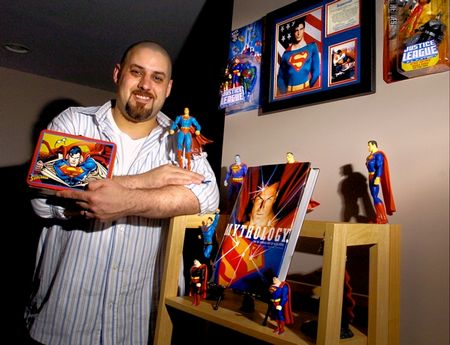
Yesterday's Cincinnati Enquirer had an article on a local Superman fan: Brad Thumudo. Well, it's not so much an article as it is a local personality profile. In any event, it struck me that it treats both Thumudo and Superman fans in general with a fair amount of respect. It wasn't what I've seen so many times before: the geez-can-you-believe-how-weird-this-guy-is piece.

Now, we as comic fans still have a long way to go to earn real respect from the outside world, but I think this is pleasantly indicative of how things have already turned around. Heh. Before you know it, it'll be the idiots who paint their bodies for football games that'll be getting derided.

But that may be overly optimistic. ;)