Latest Posts

Let's say you come up with this idea for a project. Some story that you become very passionate about telling because you haven't seen anything quite like it before. You pull together whatever resources you have access to and, to the best of your ability, produce your comic. Maybe you launch it as a webcomic, maybe you try self-publishing, maybe you shop it around to established publishers. Doesn't matter. The point is that you put tons of work into it, and you develop and polish it until you think it's as good as you can make it. Maybe you had to hire and artist or a letterer or whatever, but you're done with the whole story and you think it looks great.

Then you put it out into the world, and do your best to promote it, and the response is... nothing. No one is flocking it to it, so it's not an overnight success and no one is laughing at it/you so it's not an unmitigated failure either. You get a few people who drop you some kind notes, and maybe they chuck a few bucks your way, but it just doesn't take off like you'd hoped. It's not a bad comic; it's just not one that really excites people.

"OK," you think, "maybe the timing was off. Maybe it's just not the right marketplace for this story just now."

So you go on to produce another story. Again, you put your heart and soul into it. Maybe you try a slightly different approach, marketing-wise. Same result. Even when you go out of your way to solicit feedback, you don't get anything substantive. "Yeah, it's good. Solid work. I don't what I could tell you to really improve on it though."


So you try again. And again. And again. And each time, you get some modest praise, and gain maybe a few more fans, but nothing earth shattering. And maybe you even get to the point where your work is financially self-sustaining. Maybe not lucrative, but enough that you can squeak by.

The question I have, then, is: is it worth making sure your older works remain viable? Is it worth your effort to maintain dedicated marketing pages on your website for them, and making sure the books remain available for sale even if it's print-on-demand effort? I mean, the general idea, I think, is to set up enough decent-selling work that you can get a series of small-to-modest sales over the course of years. You might only sell one book of each title a month, but with enough different books out, that's enough to earn a living on.

So does it make sense to take one of those works that's a bit older and never sold as well, and continue to put effort into ensuring that it remains as a possible revenue stream? At what point does it take too much effort to keep updating the work relative to how much money you make on it?
One of the reasons I think diversity in comics (both diversity in creators as well as characters) is important is because it helps to enlighten readers into different ways of thinking. By coming at a problem from a significantly different perspective than the reader -- whether that's because of race, sexual orientation, nationality, whatever -- the reader can gain insight into other modes of thought. This can lead to both greater empathy with others, and more creativity in general.

But if you limit yourself to diverse voices from the United States, you're still not seeing as diverse a set of material as you could. I think the manga boom has been fantastic from this regard, helping to bring to the US not only a different style of comic storytelling but also some different cultural perspectives about people and the world. But it points to the difficulty in getting material from other cultures -- many use different written languages. In order to read those manga, most Americans would need them to be translated from Japanese into English.

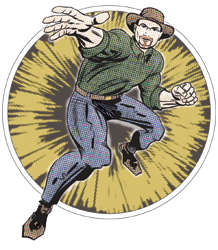
The same holds true of any language. There's a slew of French and Belgian material that's never made into English. There's a good-sized comic scene in India these days, not to mention China and Korea. And though we hear very little about it here, there's comic publishers everywhere from Russia to Brazil. The image I've included with this post is of a comic character from Zimbabwe.

One of the problems highlighted by much of the bullshit populist nationalism that seems to have been engulfing the world the past few years is, in part, rooted in a lack of understanding of "others." Whether "other" means someone born in the same country as you but wears a culturally different article of clothing, or they have a different amount of melanin than you, or they practice a different religion, or... The hatred of "others" has been played up by the likes of Boris Johnson and Donald Trump; specifically trying to capitalize on the cultural ignorance of their constituents to encourage them to fear and hate anyone not like them.

But by actively reaching out, and taking in comics (or any other media, for that matter) of those other cultures, we can gain a better understanding and appreciation of where those "others" are coming from. And by eliminating the unknown, we eliminate the fear. And by eliminating the fear, we eliminate the hate.

So maybe, when you're comic hunting for either yourself or for your friends and family, see if you can snag a comic or two from another country. While not everything is in English, many are. And that can help bridge the gap that some politicians are deliberately trying to turn into an uncrossing chasm.
Here are this week's links to what I've had published recently...

Kleefeld on Comics: The Third Person Review
https://ift.tt/Z2AdebR

Kleefeld on Comics: New vs Old Models
https://ift.tt/GJUcZLY

Kleefeld on Comics: Why Wonderland?
https://ift.tt/lJpbaLC

Kleefeld on Comics: Old Comics Storage
https://ift.tt/bDktqXi

Kleefeld on Comics: The Difficulty in Golden Age Comics
https://ift.tt/Hh9lFp8


Although I certainly have my preferences when it comes to comics and I tend to focus on particular creators and styles and genres that I like, I do try make an ongoing attempt to gain as broad an appreciation of comics as possible. So while I picked up the Kamandi Archives because I really like Jack Kirby, I got the Justice League Archives so I had a better understanding of Kirby and Stan Lee were reacting to when Martin Goodman told them to come up with their own superhero team. Consequently, I have a number of comics and graphic novels that I don't necessarily enjoy for their own sake, but appreciate them from a historical perspective and find them sometimes useful for research.

One problem, though, is actually reading older Golden Age stories to conduct the research. Setting aside the horribly sexist and racist attitudes many of them display, many of the stories are just drek. The plots are shallow, the dialogue is stilted, characterization is minimal... plot holes abound, the storytelling is confusing, the illustrations are crude...

I get it. Comics were basically a commodity item, and publishers were trying to churn out as many as they could. They hired anyone who could string two sentences together to write them, anyone who'd ever sat at a drafting table to draw them, and they had to crank out whole issues in sometimes as little as a single weekend! Making comics wasn't a craft, it was a job. It was just a notch above putting bolts on a car in an assembly line. That's why we have differentiated artists, inkers, colorists, etc. -- that was Will Eisner's idea to streamline comics' production and make it more like an assembly line.

But that also means the stories aren't as good as they could be. Which maybe wasn't so bad if you were eleven and spent a dime for a single issue every other month. There was enough of a gap between readings that you didn't notice that Batman was being drawn in the same eight or ten poses every issue. Or that Daredevil was repeating the same handful of plots. Or that Nelvana hadn't actually done anything heroic herself in a dozen issues.

But reading them in a more condensed form, whether that's in a fancy Archive edition or through comiXology or even copies of the original comics, that can be hard to wade through for extended periods. They can become a chore to push through.

I don't know that I have a real point to this, other than to suggest, if you're reading through many of these GA books, I recommend having a number of bookmarks handy! I can't tell you how many of reprint books are only part-way read because I just had to put them away for a while.
What do suppose comic fans did with their comics before long boxes? In terms of storage. Their thin and floppy nature would make it difficult, at best, to keep them upright on bookshelves. I expect some people used file cabinets, but those would be cumbersome to say the least. From what I've seen in older photographs, the answer, at least among the Big Name Fans, was stacking.

The picture here is of Larry Herndon. He was a Big Name Fan out of Texas who published a number of fanzines throughout the 1960s and early 1970s before opening his own "nostalgia store" which carried comics, pulps, movie posters, and the like. But look past Herndon. Behind him are bookcases filled with stacks of comics. That was how comics were stored by many collectors up into the 1970s.

Doug Sulipa...

Robert Beerbohm...

The Cherokee Bookshop...

An unidentified collector from 1948...

In an era before specialized comics storage materials, the only thing fans had to keep comics relatively flat was basically gravity. So stacking them made the most sense if you had any intention of holding on to your collection for a while. Although even then, as you can tell from some of the pictures, the slightly thicker spin would keep books from laying completely flat, especially the higher your stack became. (Hence the need for bookshelves: to keep many smaller stacks.)

Many of us grew up with long and short boxes as a staple of the hobby, but they're not really all that old, and fans used to have to store their collections very differently because of it.
As you may know, I'm something of a fan of Lewis Carroll's Alice's Adventures in Wonderland. I've watched many adaptations for film and television, and I have decent number of comics that also either retell the original story or take more than a few cues from it. Some go farther afield than others, but I'm not really a purist -- I enjoyed seeing Alice as a modern secret agent and the follow-up "sequel" to the Disney movie focusing on Mary Ann and the wacky adventure comedy that Roger Langridge came up with! I actually tend to find problematic the versions that try to adhere too closely to the original, and lose the element of whimsy and play that nonsense verse like Carroll's requires.

I'm not especially a fan of the "dark" versions of Alice, either, but I can apprciate where they're coming from. Honestly, it really isn't a far jump to take the story into drug-induced delusions or gothic horror or anything like that. Those particular genres and/or tonal angles never especially appealed to as a whole but, as I said, I can see where someone might be coming from with those kinds of takes and I'm cool with reading thosein comic form, provided the execution is still pretty good. I never bothered with other media, though, like the video games by American McGee.

And that brings us to the latest Alice story I'm reading: Alice Ever After by Dan Panosian, Giorgio Spalletta, and Fabiana Mascolo. Alice is a bit older here -- I don't recall seeing it specified but probably late teens/early twenties -- and her continued sojourns to Wonderland via a drug habit eventutally wind her up in an asylum. She's treated very poorly -- as were pretty much all inmates of asylums in the 1800s -- and it becomes clear that the establishment's proprietors are mostly running things to grift as much money as they can through their operation. Many of those who work at the asylum bear a passing resemblance to notable Wonderland characters, and Alice's seemingly omniscient kitties provide Greek chorus style commentary throughout. Things go from bad to worse, however, when Alice recalls witnessing some not-totally-ethtical behavior from her father after she passed, and the ayslum's matron begins to take advantage of what she's overheard.

The story isn't bad, but I find myself scatcing my head a lot at it. The first thing I noticed was that the names were all wrong. All of the Wonderland-influenced characters are changed, of course, but most of them don't seem to come from anywhere. The closest I can think of is that Tweedledum and Tweedledee have been renamed Theodore and Thomas -- all the names start with "T" -- but the Red Queen character is named Hulda and I don't get where that might come from; none of the name's origins I can find seem to match this character or either of Carroll's Red Queen characters. But more critically, while they've named Alice and her sisters Edith and Lorina, they've got all the rest of the family wrong. They've given them the family name Lutwidge (not the actual family's name: Liddell) and made the father a dentist, as opposed to an ecclesiastical dean of Christ Church, Oxford as the real Henry Liddell was. They've also drawn him with slicked back hair and a waxed mustache, whereas the real Henry Liddell had wirey, white hair and was clean-shaven. Henry's wife, unlike in the story where she has notably passed away before the narrative even begins, in fact lived until 1910, decades after Alice's sister Edith passed.

All of that information is available on Wikipedia, if not on Alice's own entry then the one about her father. Bother were notable enough figures to have had much written about them, so I don't understand why you might make up names for people that are easily Google-able. I can almost see putting the dentist angle in and killing the mother off for the sake of getting Alice into an asylum, but it seems like the story is really going out of its way to invent elements that don't need inventing. If Alice is already addicted to drugs, what more reason do you need for institutionalizing her? Wouldn't her being institutionalized be enough to blackmail a well-to-do family that wouldn't want unseemingly behaviors from their daughter? Why invent the additional ethics problems for the father? Just a lot of it seems unnecessary, especially since this is all available in two fairly short Wikipedia entries.

And for what? Even after Alice is put in the asylum, there's no exploration of her mental state. She's not psychoanalyzed in any way (to be fair, Sigmund Freud didn't publish his ideas on psychoanalysis until several years later) and there's no attempt at treating her addiction. In fact, even the poor treatment of inmates is largely only suggested via vague comments/threats from one of the doctors. And Alice's excrusions into Wonderland are brief and seem to be only there to provide a short mental escape from her current situation; she doesn't seem to gain any wisdom or insight from talking with Wonderlanders.

The story's not bad, as I said, but I don't really see the point of it. At least, I don't see a point to using Alice. They've substantially changed her family and situation; they're barely even utilizing the Wonderland references they do drop. The character here doesn't seem to be driven in any of the ways that Carroll's Alice was. The characters bear a slight resemblance to the ones John Tenniel designed back in the day, but their designs here don't see to be relevant to the story or their characters at all. The story doesn't, as far as I can tell, seem to be commenting on Carroll or his work. Really, not even the time period or anything even later associated with the Alice stories (e.g. drugs). It's lifting a few of the most superfiial elements, and not really leveraging even them. You could change the character's name to Allison, and it would still read the same.

So ultimately, it's fine, but I can't suggest it if you're looking for an Alice or Wonderland story of any sort. The Zenescope stuff -- with all its sexist depictions of women and gratuitous T+A -- is more of an Alice story than this is. The last issue should be out later this month, and I already put an order in for it but I'm not going to race to find out the conclusion.
I happened to catch this weekend that a webcomiker had set up a Patreon campaign, as many do, but despite his comic's longevity (over a decade) and seeming popularity, he was earning around $800 a month. That's not bad, certainly, but given that other webcomics I would consider comparable are in the $2000/$3000 range, it seemed a little strange. Now some of that could be explained if he had set the account up recently, but his patron comments go back over a year, so it's not new.

What he did have, though, was a shop with your more-or-less standard books and t-shirts and such. I don't know when that originally got set up, but I know it's been going for a good long while. What's more, many of his shirts speak to a broader audience than just his readers. That is, while they do reference characters and jokes from his webcomic, they still hold up as interesting/amusing on their own without the context of the webcomic. Meaning they can be appreciated by non-readers who might not care about the webcomic but like that particular illustration or joke.

Now, the first thing here is that he's diversifying his income streams. Good move, right? If you rely exclusively on one venue, it might blow up through circumstances beyond your control and then you're SOL. (Patreon might be bought out, or his t-shirt vendor might go under, or something.)

However, it seems that he's still focusing primarily on his old model: selling books and shirts and such. I get the impression his Patreon is almost an afterthought. A link thrown on the site and then mostly forgotten. If that's the case, then, great -- he's getting $800 a month for doing about nothing more than what he was already doing. Perhaps he feels he can't provide much additional value with more content specifically for patrons, so he doesn't focus on it much.

All of which is fine, but my point here is that he seems to be focusing on his old business model. Which is all well and good, but you have to make sure -- like he is -- that you're not dismissing other models simply because they're different. With as frequently as the market and the technology changes, you simply can't rely on what worked yesterday. You have to check out other options as they come out to see if they might be a good fit for you. They might not, but ignoring all of them and just keeping on as before is almost a sure-fire way to lose.