Last week, as Halloween was approaching, I looked around a bit for what local comic shops were participating in Halloween ComicFest and to what degree. One of the perks of living in the Chicago area is that there are loads of comic shops relatively nearby, which gives you as the reader/consumer a good amount of choice in selecting the specific type of comic shop you want to frequent. I've been to many of the closer ones on previous Free Comic Book Days and ComicFests, so I wanted to check out the one who seemed to be putting the most effort into the event this year. What I was surprised to discover is that earlier this year, another shop opened a little over a half hour away.
They looked like they were planning on a fair amount of celebrating for Halloween, so I thought it'd be a good shop to check out. Ultimately, my schedule didn't permit me to visit on Halloween itself, I managed to swing by on Sunday.
I knew from their website that they'd done a fair amount of remodelling work, and it showed. The place was well-lit, clean, and organized. Not cramped at all. In fact, they looked like they had more space than they knew what to do with. The manager greeted me as I walked in and pointed out some of the leftover free comics as well as the back issue and TPB sale they had going on.
As I looked around, I noticed a couple things. First, they had a large back issue selection. Nothing super old and valuable, but I think there were maybe about 40-50 long boxes of back issues, another 25-30 of back issue sets they'd bundled together, and another 20-ish that were designated as dollar bins. They had the space for them all, as I said, but what was curious (to me) was that their trade paperback and hardcover selections were limited to maybe five or six half-empty shelves in the back. There's nothing wrong with that, but it was striking to me as being the largest back issue stock I've seen in a comic shop in six or eight years. And more striking was that was the fewest number of trade paperbacks and hardcovers I've seen in probably 15-20 years.
The shop clearly catered more towards the superhero side of comics. They didn't exclude other genres -- I saw a reference to a semi-local creator signing from a couple months ago who has a series out that's kind of in the same vein as Mouse Guard -- but they didn't seem to normally stock much that wasn't from Marvel, DC, or Image. But interestingly, it was mostly superhero comics with a surprisingly limited selection of action figures, statues, and other peripherally related material. I think I saw maybe five action figures in total.
Now, given that the store is less than a year old, it's possible that's part of their business plan. Maybe they're planning to use their existing collection of back issues as stock as they slowly build up a library of graphic novels, ordering a handful every week or month. Or maybe they've done a survey of area collectors, and they're deliberately targeting people on the hunt for back issues with little expressed interest in collected editions. But, and this is just a hunch, I get the impression that they simply built a comic store because they have a lot of comics.
I'm not saying this to badmouth them. I dropped $30 on back issues while I was there. I want everyone who works in comics in any capacity to succeed. But it's curious to note when a new shop seems to operate on a model that is very much not what most shops are operating under any more. I can't help but wonder what their thinking is. I mean, I know that shops with this type of business model still exist, but they still exist -- that is, they've been operating this way for years, and just haven't changed. Stepping into the business new like this seems... more challenging than it needs to be.
The shop is far enough out of the way that I won't be able to swing by often, but it'll be interesting to see what changes, if any, they make in the coming year.
Here's last Sunday's Blondie by Dean Young and John Marshall...
Most of the fun in the strip is picking out all the character appearances. It seems that everyone from Prince Valiant to Dilbert to the Lockhorns was invited. Interestingly, about a third of the characters are from different syndicates, too!
But, of course, there's not room for everyone. There's no one from Nancy or Frazz or Red & Rover or... I'm sure you could name plenty of characters that didn't make the cut. I suppose many of those strips' creators were okay with it if they made it into the 75th anniversary strip a few years back, but Francesco Marciuliano and Jim Keefe caught wind of this Halloween party early and knew that no one from Sally Forth would be attending. So what are a couple of comic creators supposed to do? Well, you poke fun at the strip a day before it even runs, of course! Here's Sally Forth from the day before the party...
And then after the strip runs, you whip out -- or, more precisely, writer Marciuliano whips out Photoshop to do a little manipulating so Ted Forth can crash every panel of the party...
Is it rude of me to think Marciuliano's version is funnier than the original?
I'm really not much of a TV watcher, but I have to admit that I was somewhat intrigued by the promotions for new Supergirl show. Not the ads themselves -- I don't think I actually saw any of the teasers anyway -- but mostly seeing Melissa Benoist in costume. Unlike certain presidential candidates, though, my interest was in her eyes and her expression and how she held herself. Whether she was shown standing, flying, or walking with a group of kids, I saw confidence, joy, and, most significantly, hope. That's something I haven't seen a superhero embody, in comics or in other media, in a long time.
I didn't see the show until yesterday, so I had the opportunity to catch some reactions. Not much, but I did see some people seemed quite thrilled with it and others who weren't. Those that weren't were generally citing issues in and around feminism, though I didn't focus on it closely enough to catch specifics. I tried to watch the show, keeping a particular eye out for that kind of thing though.
I ended up watching the pilot twice. Once as a "well, let's see what this is" and a second time with some commentary from Executive Producers Sarah Schechter and Ali Adler, and director Glen Winter.
I did very much like Benoist in the title role; I think she did a remarkable job and continued to radiate that joy and hope that I saw in the still shots. (The confidence, not so much, but that was obviously a deliberate part of her character arc in the pilot.) I also liked the directing overall; lots of nice camera-work and there were some scenes where they made good use of how the cameras rolled through/around the sets. Overall, the visual aesthetics of the show were very good.
There were a few things that did turn me off in general. The opening narration, for starters. It's a lazy, crap way to relay information to the viewer. It might work if you've got absolutely brilliant prose to be read, but as a rule, no. Second, could the character of Cat Grant be any less dimensional? I mean, I get the notion of providing an ongoing adversary for Supergirl that she can't punch, but geez, why not give her a black cape and hat, a pencil mustache, and a name like Horrible McBadperson?
My third problem was the physics. The effects were nice, and surprising for a TV show, but the physics for everything seemed very soft. When a character crashed on something, it never looked like there was any force behind it; stuff just kind of collapsed as the person gently laid down on it. That truck-ripping-in-half bit? It looked like it was opening up so Vartox can be tossed through the opening. Basically, I felt I was too aware that I was looking at the effects when it was a practical effect where someone might have the slightest chance of getting hurt.
Now, the feminist bit. There's the scene in there where Cat names Supergirl, and Kara goes off about "girl" being demeaning. In the commentary, Schechter, Adler, and Winter agreed that early on that it had to be addressed in the story. The didn't add much more than that, however.
It's not used much anymore, but in the 1990s the word "girls" sometimes got replaced with "grrrlz." I've always liked Trina Robbins' description where she said, "Grrrl combined that reclaimed word girl with a defiant growl..." And before that, in the 1970s, "women" was sometimes spelled "womyn" to emphasize a separateness and distinctness from "men." There are plenty of other variations on that type of theme -- where people deliberately try to subvert the demeaning stereotypes tied to a word by taking it as their own, albeit in sometimes modified form. You can see it most successfully recently in the transition of "geek" over the past decade and a bit.
So while the conversation in the show isn't really completed, I think the intent is to embrace the suffix "-girl" and portray it in such a powerful fashion that the connotations around it are changed. Cat Grant clearly embraces the term "girl" and the snippets I've seen of future episodes suggests Supergirl does as well. Whether or not the show is successful in fully reclaiming the word remains to be seen, naturally.
And while that's great if that's the intent -- and with two female EPs, it wouldn't surprise me -- the show does walk a fine line in its implementation. On the one hand, there's the conceits that Vardox is a chauvanist and they try to use that against him, the mothers being the more caring and nuturing of the parents while the fathers say literally nothing, the notion that despite being in a position of power Cat Grant is still superficial enough to buy a building with a private elevator so she doesn't have to smell someone else's cologne, James coming in to save Kara's job, the very fact that Supergirl is and will always be derivative of Superman... On the other hand, we have a Superman who wants to empower Supergirl to make her own way, a mother who was powerful enough to put away hundreds of aliens in the Phantom Zone, National City's top executive being a woman, and naturally Supergirl doing some pretty heroic stuff on her own. I think, ultimately, any given show could slide one way or the other without much difficulty, and that might depend on who happens to write or direct a particular episode.
I think the thing that strikes me as the most positive and most feminist aspect of the show is how much Benoist has embraced the role. She's already done any number of events in costume, and displayed that confidence, joy, and hope that I mentioned earlier. And young girls who see that will take some of that and it will become a part of who they are, and will grow up to be stronger, more confident, more successful women because of it.
The old Wonder Woman show had more than it's share of issues with promoting feminism. But the women who were young girls when it first came on saw a powerful hero they could try to emulate. Both in Wonder Woman and in star Lynda Carter. Whether Supergirl succeeds or not, whether it resorts to tired tropes of portraying women or presents them more positively, I think its biggest impact will be from Benoist herself. I can almost guarantee that, twenty or thirty years from now, Benoist will be showing up at conventions with a line of autograph seekers, all telling her that she inspired them to become great scientists and engineers and artists and lawyers and whatever else they didn't think they had the capability to do before they saw Benoist with a giant "S" on her chest.
- Zuda Comics was still an ongoing experiment.
- None of the major publishers released their digital comics on the same day as their printed ones.
- Harvey Pekar, Joe Simon, Jerry Robinson, Shelly Moldoff, Al Feldstein, Nick Cardy, Herb Trimpe, Dick Ayers, Al Williamson, and Joe Kubert were still with us.
- The as-yet-to-be-called "Marvel Cinematic Universe" consisted exclusively of Iron Man and The Incredible Hulk.
- Neil Gaiman was single.
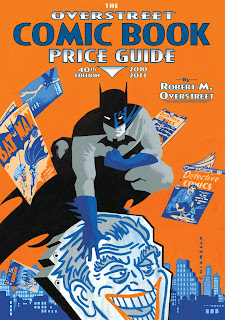
- Copies of Action Comics #1 and Detective Comics #27 were, during the year, auctioned off for over $1,000,000 each, breaking the previous record of most-expensive-comic-ever-sold by at least 300%.
- The Xeric Awards were still a thing.
- The Billy Ireland Cartoon Library & Museum had not yet moved into its current home in Sullivant Hall. Lucy Caswell had not retired and was still the curator.
- The Kenosha Festival of Cartooning had not started. Neither had C2E2 or the Chicago Alternative Comics Expo (CAKE). Mid-Ohio Con had not been purchased by Wizard World.
- Superman still wore his underwear over his pants.
- Time Magazine named Kickstarter one of "The 50 Best Inventions of 2010." Patreon hadn't been created yet.
- The iPad (also named as one of Time's "Best Inventions") was first released and included the newly created comiXology app.
How many of those items do you discuss the same way now as you did in 2010? When was the last time you had a "day and date" discussion? How often does crowd-funding NOT come up in talks about making money from your comics? How many days do you go without catching wind of something Scarlett Johansson, Chris Evans, Chris Pratt, Tom Hiddleston, etc. were doing, even if you're not paying attention? When planning which conventions to attend, how many different choices do you consider?
My point is that, in all likelihood, your thinking about the comics industry has changed pretty radically in the past five years, whether you realize it or not. What you consider normal now was viewed by many with skepticism or even outright fear just a few years ago. More significantly, however, is that these changes in the overall industry mean that individual businesses need to change as well. You can't continue to operate in an environment that's changed without making changes yourself. Remember the old adage about being the town's best buggy whip manufacturer in an age of automobiles?
What's more, while people typically think of these shifts in terms of business, they not surprisingly apply to individual creators as well. When it comes down to it, most creators are operating as small businesses unto themselves, so that makes sense, right? But it also applies to readers/consumers. How you read comics is impacted by how they're created. How you buy comics is impacted by how they're distributed and sold. How you relate to comics is impacted by how they're marketed.
Five years. Seems like a fairly short amount of time, but things can alter pretty dramatically. You don't necessarily have to jump on board and embrace each and every change that comes along -- some will be short-lived failures, of course -- but be aware that things ARE changing, and you need to think about and react to them; you can't just assume that what worked five or ten years ago will continue to work today because the environment is constantly changing around you.
I first actually became earnest in writing a book about fandom in 2006. That's why I started this blog, in fact: to have a place to record odd notes and research that I might want to use, and to start building a platform/audience from which I could be seen at least as something of a writer, and not just some schmuck who popped up out of nowhere. But my interest in fandom went back a few years prior to that -- I had actually written an article about it in 2003 that was to be included in a book project that ultimately was never published.
But at the time, there was almost nothing written on the subject. Doc Jenkins ground-breaking Textual Poachers had come out in 1992 and his co-authored follow-up, Science Fiction Audiences, was out in 1995, but there wasn't much else. At least not in terms of long-form pieces dedicated exclusively to fandom. Comic Book Fanthropology wasn't revolutionary in the space of fandom studies, but it was on the leading edge.
That's strange to me because fandom was obviously around for decades before. There had been a few histories of science fiction fandom as early as 1969, and comic fandom started getting some dedicated histories in 2000. Even in the past 2 or 3 years, the study of fandom has increased exponentially and the number of books on the subject has skyrocketed.
Where I'm heading with this is that, here we are in the latter half of 2015, and there remain only five books about webcomics ever published, and three of them are out of print. Now, granted webcomics are a quickly evolving art form, and print is notoriously slow by comparison. But how is that any different than a book about computers in general? Isn't there a big, gaping opportunity here for books about webcomics?
I think we're on the cusp of a wave of books and research about webcomics, not unlike what we saw with fandom. The question is: who will be able to capitalize it on it the best?
I was noticing yesterday women walking around downtown in some fantastic fall fashions. And as I reflected on what exactly I liked about them, I realized that a good chunk of the types of clothing I like to see on women was originally informed by the early 1970s comic artwork of Bob Oksner. His Lois Lane and Supergirl in particular. Beautifully drawn women in some wonderfully designed clothes.
In any event, it got me to thinking that I wasn't all that familiar with Oksner's work outside of that brief period. And while I'm mostly familiar with him through his superhero material at DC, it turns out that he also had a few turns as a newspaper strip artist. He co-created a short-lived (only lasting a few months) strip called Soozi in 1967 and was the writer on Dondi from 1967 (I've also seen 1965 and 1966 cited) until his retirement in 1986. But the one that strikes me as interesting as Miss Cairo Jones, which ran from July 1945 until April 1947.
Oksner and co-creator Jerry Albert had the idea for a comic strip featuring Cairo Jones, an action hero type not wholly unlike Captain Easy or Buz Sawyer. Bell Syndicate president John Wheeler liked what he saw, but seemed to have felt that there wasn't room for another action hero, so he suggested switching the character's gender. Cairo Jones was renamed Steve Racy and his girlfriend was thrust into the newly feminized title role of Miss Cairo Jones.
The strip was pretty much just straight-up action with razor-thin plots and minimal, if any, characterization. But since Oksner drew attractive women even back then, and Miss Jones would ocassionally be the victim of wardrobe malfunctions, no one seemed to mind. In fact, Albert -- who had been writing strip -- dropped entirely after about year, right around the time it went from Sundays-only to a full daily, and Oksner continued on as the sole creator.
Some of the early strips were collected in comic book form in (presumably) late 1945. Croydon Publishing put out a single issue of Miss Cairo Jones Comics. It relayed the closest thing to an origin story she had, as she tracked down her husband who was a suspected Nazi war criminal. Though she had hoped to prove his innocence, she discovered he had indeed been helping to fund the Nazi party. When she finally found and confronted him, however, he chose to hang himself rather than be taken in.
The daily strips evidently weren't terribly popular. Perhaps because there was less space to see the primary draw of the strip: Oksner's art. Bell Syndicate seems to have taken the commercial failure of the daily strip as an indication of the strip as a whole, and canned the whole thing in mid-1947. Although some conflicting dates suggest that the daily may have been canceled several months earlier. So maybe Oksner's art alone wasn't enough to keep even the Sundays going. In any event, while it was still a relatively short-lived strip, it's some of Oksner's earliest comic work and probably helped him get in the door with Sheldon Mayer and DC.


