

 Here are this week's links to what I've had published recently...Here are this week's links to what I've had published recently...
A Maxwell House ad from the November 1976 issue of Woman's Day featuring Vivian "Ethel Mertz" Vance... Vance was the spokesperson for Maxwell House for several years, and did a string of TV commercials for them.
I can't offhand find if this particular scenario was one of them, but I suspect it was and that this comic was created by just taking still shots from the commercial footage. That seemed to be a not-uncommon practice in the 1970s, presumably taking advantage of the generally costlier TV budget and leveraging that to reduce print ad costs. Here's Don Knotts (and Don Knotts) acting as a pitchman for Dodge a couple years later...
 These look to me like they were blocked and staged for television. The script got editted down for one-page brevity and the whole thing was handed over to a paid-lower-than-they-should-be graphic designer to get a bunch of individual frames cropped and fitting on a page.
Anecdotally, I feel like this approach dropped off considerably during the '80s, which I presume had to do with the diminishing impact of print advertising. Possibly also a trend in advertising more broadly to go with a more nuanced approach, and not just clobber audiences over the head with contrived situations to blatantly talk up the selling points of their product. In any event, it's an interesting time-capsule of advertising -- when TV commercial storytelling overlapped heavily with print to come up with fumetti as an entire genre of magazine advertising.
 Vance was the spokesperson for Maxwell House for several years, and did a string of TV commercials for them.
I can't offhand find if this particular scenario was one of them, but I suspect it was and that this comic was created by just taking still shots from the commercial footage. That seemed to be a not-uncommon practice in the 1970s, presumably taking advantage of the generally costlier TV budget and leveraging that to reduce print ad costs. Here's Don Knotts (and Don Knotts) acting as a pitchman for Dodge a couple years later...

Anecdotally, I feel like this approach dropped off considerably during the '80s, which I presume had to do with the diminishing impact of print advertising. Possibly also a trend in advertising more broadly to go with a more nuanced approach, and not just clobber audiences over the head with contrived situations to blatantly talk up the selling points of their product. In any event, it's an interesting time-capsule of advertising -- when TV commercial storytelling overlapped heavily with print to come up with fumetti as an entire genre of magazine advertising.
Some years back, Tom Brevoort had mentioned that that Klaus Janson (with an assist from Walt Simonson) came in to the Marvel offices to teach a course in comic storytelling to the editors. At one point, evidently, the discussion ranged into the area of "a comic with the words removed is still a story, but a comic with the art removed is not." Tom's initial reaction was to disprove that notion with the following sketch...

At the time, a couple of people -- including myself -- pointed out that, in this case, the text and the word balloons themselves are acting as art. However, I'll also point out that it's not impossible to come up with a solid example of a comic that would read reasonably well without the art. Here's a random page from Shock Suspenstories #7...

And here's the same page without the art...
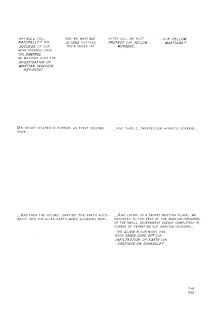
Even without the sound effects, and the fact that we're jumping into the middle of a story, it still seems to make perfect sense to me. Conversely, though, here's an example of a comic page with the text and word balloons removed...

It's from Scott McCloud's Understanding Comics and in this sequence, he's discussing nuances of language and imagry. Becuase of the specific nature of what McCloud was trying to do here, we have effectively the same image repeated six times. (Ten times, actually, since the previous page in the book has four more copies of the same panel.) But without the text, does this tell you anything? We see a man standing in front of a painting. He moves his arms a bit, but I don't know that that really conveys a story of any sort.
Or what about a sequence whose textual narrative is disconnected with the imagry depicted? Where a narrator might be telling one story but the imagery is depicting another? The "Black Freighter" sequences from Watchmen, for example...

What I mean to boil this down to is that storytelling is an art, whether you use words, pictures, sounds, gestures, whatever... Comics are a form of storytelling that can, but not necessarily always include pretty pictures and/or flowery language. Comics, despite McCloud's excellent attempt, still defy a concise definition. Or, at least, a generally accepted one.
At some point, comics cease to be comics but the question is: at what point?

At the time, a couple of people -- including myself -- pointed out that, in this case, the text and the word balloons themselves are acting as art. However, I'll also point out that it's not impossible to come up with a solid example of a comic that would read reasonably well without the art. Here's a random page from Shock Suspenstories #7...

And here's the same page without the art...

Even without the sound effects, and the fact that we're jumping into the middle of a story, it still seems to make perfect sense to me. Conversely, though, here's an example of a comic page with the text and word balloons removed...

It's from Scott McCloud's Understanding Comics and in this sequence, he's discussing nuances of language and imagry. Becuase of the specific nature of what McCloud was trying to do here, we have effectively the same image repeated six times. (Ten times, actually, since the previous page in the book has four more copies of the same panel.) But without the text, does this tell you anything? We see a man standing in front of a painting. He moves his arms a bit, but I don't know that that really conveys a story of any sort.
Or what about a sequence whose textual narrative is disconnected with the imagry depicted? Where a narrator might be telling one story but the imagery is depicting another? The "Black Freighter" sequences from Watchmen, for example...

What I mean to boil this down to is that storytelling is an art, whether you use words, pictures, sounds, gestures, whatever... Comics are a form of storytelling that can, but not necessarily always include pretty pictures and/or flowery language. Comics, despite McCloud's excellent attempt, still defy a concise definition. Or, at least, a generally accepted one.
At some point, comics cease to be comics but the question is: at what point?
Willie Lumpkin is the semi-famous mailman for the Fantastic Four, and was even portrayed in the first FF movie by Stan Lee himself. The character debuted in Fantastic Four #11 circa 1963, written by Lee and drawn by Jack Kirby, where he submitted himself for any ear-wiggling services the FF might need.
Not true.
Willie Lumpkin actually debuted three years earlier as the title character of his very own comic strip created by Lee and future Archie artist Dan DeCarlo. He was portrayed several years younger, but still a mailman. Here's one of the Sunday strips that features a benign, but perennial, subject...
It's a little hard to read here, but the stamp cancellation in the strip's masthead notes Willie Lumpkin's location as Glenville. The name actually was used repeatedly throughout the strip as well. What's interesting about that is that Glenville was the town later named by Lee as the hometown of Susan and Johnny Storm, half of the Fantastic Four team that Lumpkin would later serve. Though the age progression of Lumpkin himself would suggest that the strip occurs well before the two superheroes were born, it's possible that one could find likenesses in the strip that bear more than a passing resemblance to their parents, Franklin and Mary.
The strip lasted barely a year, most likely because it didn't stand out from other newspaper strips of the time. It's largely only notable now because the two creators went on to make big names for themselves in comic books and one of them reused some of the material in his more famous works.
I'll throw one more benign-yet-perennial Willie Lumpkin strip out there for you to digest...
Not true.
Willie Lumpkin actually debuted three years earlier as the title character of his very own comic strip created by Lee and future Archie artist Dan DeCarlo. He was portrayed several years younger, but still a mailman. Here's one of the Sunday strips that features a benign, but perennial, subject...

It's a little hard to read here, but the stamp cancellation in the strip's masthead notes Willie Lumpkin's location as Glenville. The name actually was used repeatedly throughout the strip as well. What's interesting about that is that Glenville was the town later named by Lee as the hometown of Susan and Johnny Storm, half of the Fantastic Four team that Lumpkin would later serve. Though the age progression of Lumpkin himself would suggest that the strip occurs well before the two superheroes were born, it's possible that one could find likenesses in the strip that bear more than a passing resemblance to their parents, Franklin and Mary.
The strip lasted barely a year, most likely because it didn't stand out from other newspaper strips of the time. It's largely only notable now because the two creators went on to make big names for themselves in comic books and one of them reused some of the material in his more famous works.
I'll throw one more benign-yet-perennial Willie Lumpkin strip out there for you to digest...

A nice Memorial Day piece from Joe Sinnott from about a decade ago.
Sinnott was in the U.S. Navy during World War II and lost his brother, who was in the Army, in 1944.

Here are this week's links to what I've had published recently...
(I have one co-worker who contracted COVID in January right after a week-long trip to Disney World. He's since openly complained about and gotten frustrated with a sudden problem with his memory and generally having issues thinking and processing as quickly as he used to. A problem which started immmediately after he "recovered" from COVID. Nearly five months on now, and he hasn't realized/acknowledged that it's likely "brain fog" that's associated with Long COVID.)
I live in the Chicago area and there are PLENTY of comics events that I could attend. From larger ones like C2E2 to smaller in-store signings. Prior to 2020, I would go to at least one a month, usually one every other week over the summer. It's a big city with a big comics scene, so there's always tons going on. But I have been to nothing the last several years precisely because I have not seen a single venue offer even the remotest sense of safety and security in light of COVID. A handful of folks did have mandatory masking policies briefly but those were notoriously unenforced.
The percentage of adults in the US who are fully vaccinated against COVID is less than 15%. Whatever vaccines everyone else got (the rate prior to the latest vaccine was closer to 80%) aren't very effective against any of the COVID strains that are in broad circulation any more, so there are massive spikes in the virus showing up in wastewater samples -- the only means we have of measuring how widespread it is since the government stopped counting actual cases -- during holiday gatherings and we are only just now seeing things return to a "normal" level after the December holidays. (Though we'll likely see a spike with the Victoria Day holiday in Canada last Monday and Memorial Day in the US this coming Monday.)
In light of all that -- and conventions refusal to do anything at all to help the safety of their attendees -- the Cartoonists Cooperative is trying to get a sense of how that is actively impacting professionals. Particularly those people whose livelihood is dependent on going to conventions to sell their wares, but might be even more at risk because of being immunocompromised. So take a moment, regardless if you're a creator or not, to fill out their survey and offer your thoughts on how a lack of COVID policies impacts your interactions with the comics community. We've already seen how the governments' refusal to track COVID has led to it continuing to ravage people's lives; the least we can do is help anecdotally track how it impacts the comics industry.


