Latest Posts

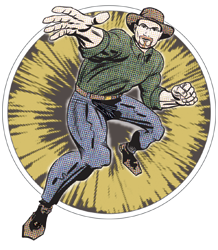
I was chatting with a coworker yesterday and she got to talking about her grandfather, noting that he had a black belt in karate and was a pretty well-known figure in the Chicago area. She then provided this 1964 flyer for the "World Karate Championship" as proof, stating that the gentleman on the left was he grandfather. However, my eyes immediately locked on to the guy doing the flying kick. Not because he was being shown in a more dramatic position, but because he looked familiar. I did a quick Google search on "John Keehan," the only name mentioned on the flyer and realized that he was more famously known as Count Dante!

"Oh, crap," I said. "You're grandfather sparred with Count Dante!?!"

"Um, yeah, they were friends. How do you know Count Dante?!"

Count Dante is a name that should be familiar to anyone who's read more than a few comic books from the 1970s. His ads ran in hundreds of books throughout the decade, and were almost as well-known as the Charles Atlas ones. For a nominal fee, you could join the Black Dragon Fighting Society and learn the secret of "The Death Touch" from the self proclaimed "Deadliest Man Alive." In hindsight, it's easy for me to spot more than a little gratuitous self-promotion and hyperbole involved, but to a seven-year-old kid reading the latest issue of Batman, Count Dante was a legend!

I won't go into details about Keehan or his life here. Not because they aren't interesting -- they absolutely are -- but because there is no way I could do the man justice. He led a pretty bat-shit-crazy life, one where you could just randomly throw in the most fantastical story elements and they wouldn't seem out of place. My coworker later added, "I was talking to my mom about it, and she said he once brought a lion cub to their house -- apparently his pet for some time? But then he couldn't afford to feed it anymore so donated it to a Lions Club or something... for unsurprising reasons, my grandma didn't like him coming around."

Apparently, there's even a comic book "sort of true" biography that's actually being published right now from Scout Comics. Five issues are out so far, and the sixth is due towards the end of November, I believe. It's written by J.C. Barbour and drawn by Wes Watson. I've no idea if it's any good or how "sort of true" it actually is, but it sounds like fun, and I'll be picking it up for myself soon.

In any event, it just struck me as a weird coincidence. My coworker only ever knew Keehan as this weird friend of her grandfather's and never expected anyone to know of him. She had just been talking about how cool her grandpa was. And, you know, if her grandpa was joint owner of a major Chicago dojo with Count Dante, I am far from being able to contest his coolness!
It's been called the Golden Age of Reprints in comicdom the last few years. It's a hard point to argue since we're getting all sorts of wonderful collections of old material. Everything from complete hardcover collections of Detective Chimp and Pogo to obscure Tijuana Bibles and a Wimmen's Comix to superhero books that showcase the original line art at actual size. Hell, we've even got books being reprinted today that were originally cancelled because they were printed illegally!

That said, this apparently newfound wealth of comics reprints has been in the making for at least thirty years now.

When I first seriously got into comics in the early 1980s, my primary book of choice was Fantastic Four. After I read a few months' worth of current issues, I got hooked and, not long after that, realized that there were around 250 issues featuring these great characters that I hadn't read yet. That's when I began hunting back issue bins, trying to dig up as many old FF comics as I could find.

Somewhere in the back half of my college years, I managed to get the number of FF comics I was missing down to less than a half dozen. They were mostly, if not all, single digit issues. That was when I realized that I didn't really need to get the actual issues any more. I could hunt down these handful of comics and pay a few, if not several, hundred dollars for each one (this was before the speculator market and "slabbing" and all that crap) and what would I get out them? I had some of those single digit issues already, and I'd only flipped through them once because A) they were fragile and I didn't want to over-handle them, and B) I'd already read those stories.

Now, when you're talking about the first dozen or so issues of Marvel's flagship title, it's no surprise they'd been reprinted. I think I had five or six reprints of #1 by then without really even trying. And those issues I was missing were all in the first Marvel Masterworks book I already had.

I got a couple more of those missing issues almost accidentally. (I was at small con and just asked to look at them -- the owner haggled them down to a quarter of his original asking price before I even said anything. It was too good a deal to pass up!) I wound up getting a few more as gifts. (My parents got me a copy of Fantastic Four #1 as a college graduation present!) But I never really hunted for those other issues. To this day, I have still never picked up #2 or #5.

But I realized back then that, for what I was looking for -- the comic stories themselves -- I didn't need the original issues. And I was went forward in my collecting from there, I kept that in mind and made a point of looking for reprints instead of originals. I created a list of where all those Human Torch solo stories from Strange Tales got reprinted, and what stories Marvel Tales contained. And Marvel Triple Action. (Special shout-out to Chris Marshall for compiling a lot of that info! I don't know how long he's been putting posting reprint info online -- I want to say he dates back to USENET -- but I know I was VERY grateful that he shared so much info that helped me read up on the Marvel Universe without spending a truckload of money!)

Not everything was reprinted, of course but even then (this would be the mid-to-late 1990s) you could find LOTS of material that had been reprinted. And that was just expanding and expanding, as publishers started to realize they could collect old stuff in book form to sell it again. DC and Dark Horse began emulating Marvel's Masterworks line. Marvel and DC both came out with cheaper black and white "phone books" lines. There were special collections based on a specific creator and/or character. (Frank Miller's Spider-Man, Neal Adams' Deadman, etc.)

The variety of formats means that, yes, it would be kind of annoying to try to read through the entirety of Amazing Spider-Man chronologically in my collection since you have to pop around between multiple titles and formats. But since I almost never read more than two or three issues sequentially, it's at least never a problem for me. I'm more prone to look for a specific issue or story as research for something I'm trying to write up. So as long as I have that at hand, I don't much care which long box or bookshelf I pull it from.

All of which is to say that this Golden Age of Reprints didn't exactly come out of nowhere. It's been something that I, for one, have been watching for about three decades now. And even with the advent and preponderance of digital comics, I quite welcome it!
So DC published this week The Detective Chimp Casebook. I believe it repints all of the Bobo (the titular Detective Chimp) stories from the 1950s, most of which appeared as backup stories in The Adventures of Rex the Wonder Dog. Each story is told anecdotally by Sheriff Edward Chase -- who somehow looks more like a drug lord from Miami Vice than a Sheriff -- but readers are still privvy to Bobo's solo outings and inner thoughts, often with a narrative sidebar from Chase about how he pieced together what happened afterwards. I won't review the stories themselves; these stories were published more than a half century ago. There's nothing new here. But I will say that these tales are all bonkers in exactly the way you would expect a 1950s DC comic about a chimpanzee detective would be.

So what's the value here? As in, why does this book exist? The charater was barely an afterthought until maybe 10-15 years ago and didn't really become a DC regular until 2018 when he joined the Justice League. And despite about five years having a greater spotlight than before, I don't know that fans have been clamoring for reprints of his original stories. After all, the Detective Chimp of the 1950s is almost an entirely different character than the Detective Chimp of the 21st century. And I believe this is the first reprint collection of any sort specifically focusing on the character in any capacity. He was in the Shadowpact series, I suppose, but that's been out of print for a while. Presumably because it didn't sell as well as anyone would've liked.

Why Detetive Chimp over, say, Wildcat? Or Dr. Mid-Nite? Or Mr. Terrific? All characters with more name recognition (and, presumably, more fans) than Detective Chimp yet all of them have never had more than their first handful of stories reprinted. And certainly not in a single volume dedicated to them. DC has a litany of old characters they could reprint for the first time, which are certainly no worse (i.e. 1950s levels of comic book logic bonkers) than these. Unless Bobo is scheduled to appear prominently in some upcoming story -- which he might, to be fair; but I haven't heard of such a thing -- I don't see why he got a nice hardcover treatment before many other characters.

Don't get me wrong. These stories are fun. They're nicely cleaned-up and the reprinting quality is excellent. I'm glad to have picked this volume up, and got exactly what I expected out it. But I'm just scratching my head over the business rationale here. Surely, there can't be that many readers with tastes and interests as mine to make this profitable, right? I would sorely love to see sales numbers for this book. I can't picture it selling more than maybe 10,000 copies which isn't nothing, but DC did a whole lot of clean-up work here, such that I can't see it being really profitable if it sells anything less than 20-25,000. But I don't know; I clearly don't have insights into their ledgers so I'm basically pulling numbers out of thin air. But still, it seems like they'd have to sell a LOT more than they likely will to make this worthwhile.

But, again, it's a fun book if you're into 1950s era comic stoytelling of John Broome. I just have trouble picturing there's much of an audience for that. Regardless, The Detective Chimp Casebook came out this week in hardback from DC. It retails for $29.99 US and should be available through your favorite bookstore or comic shop.
Digging through my archives (lots of things pulling me in different directions; it's a bit hard to focus on writing a cohesive blog post) here's a piece I wrote for my Fantastic Four fan site many years ago about how different artists' interpretations of the Human Torch could give way to a theory on how his powers work. I like to think Mark Gruenwald would've liked this line of thinking...

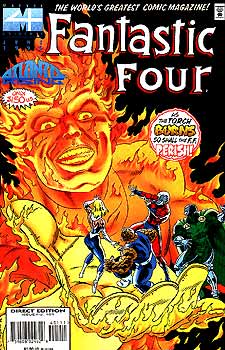
Many artists have drawn the Human Torch over the years. While nearly every character Jack Kirby designed has undergone various "transformations" (beyond simple costume designs) at the hands of different artists, the Human Torch has almost always been depicted the same way. But occasionally Johnny does undergo a treatment to alter his flaming form, and this document will explain why this can be legitimized beyond a standard "artist's interpretation" clause.

First, we need a quick analysis of Johnny's flame power. Although he is often believed to become a sort of living fire, his physical form does not alter in any way. Johnny does in fact surround his body with a red-hot plasma that gives him the appearance of being on fire. This plasma is of course what gives him his famous red hue when he is flamed on. (If he did become entirely composed of fire, he would have no physical form to be able to carry objects nor would any physical attack ever harm him.) It stands to reason that Johnny can control the depth of this plasma sheath at will in connection with his temperature, thus altering his appearance when flamed on.

Below are several interpretations of the Human Torch. You can easily see the progression of detail in each drawing as Johnny's plasma covering becomes thinner and thinner.


Fantastic Four #324
by Keith Pollard

As you can see in this first image, Johnny is at his highest intensity. In fact, this particular image portrays Johnny at a level even higher than his normal nova blasts, as he had recently underwent changes during the Inferno story arc. His plasma layer would here be at it's thickest, and nearly all of the details of his form are hidden beneath his firey sheath. Normally this depletes all of Johnny's energy, causing him to immediately flame off; therefore, he is generally only seen this way for brief periods of time.


Fantastic Four vs. the X-Men #3
by Jon Bogdanove

Shortly before this panel, Johnny had accidentally burned the mutant Storm. He was understandably upset with himself and raced through rigorous training exercises, attempting to further hone his abilities. His powers would most likely be at their normal upper limit under these circumstances. You can see his musculature and basic form beneath the flames, but the details of his costume are still obscured.


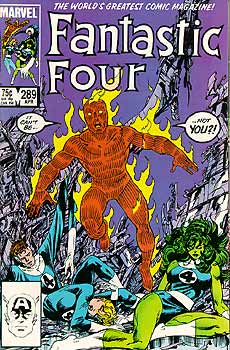
Fantastic Four #289
by John Byrne

Here, Johnny is at his normal power level. Some of the more signifcant details of his costume (gloves, boots, etc.) are seen, but anything less noticable is still hidden. Johnny claims to be at nearly 800 degrees Farenheit at this level.


Fantastic Four vol. 3 #2
by Alan Davis

By reducing the depth of his plasma covering even more, Johnny and his costume are almost completely discernible. You can easily see the "4" logo on his chest, but minutia such as his belt buckle are still somewhat obscured.


Fantastic Four #401
by Paul Ryan

Although this image does not take place within the context of the story itself, Johnny could, as depicted here, reduce his plasma sheath to such a thin layer that even the seams on his gloves are easily distinguishable. It is noteworthy, though, that the plasma still obscures his actual body enough that any individual colors are not identifiable, instead taking on orange and yellow hues.


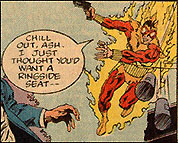
Peter Parker, the Spectacular Spider-Man #103
by Rich Buckler

Johnny briefly donned this "Blaze" costume to help Spider-Man. He abstained from flaming on entirely to conceal his real identity, but readers can clearly see his costume beneath his flames. It seems likely that such a thin layer of plasma would create insufficient heat to support him in flight, thus explaining the rarity of his using it. (Throughout the story he is only shown landing/falling in this this state.)

I believe these design differences were unintentional. It seems to me very doubtful that many artists took the time to think much about the transparency of Johnny's plasma coating. Marvel has yet to officially explain these differences, but I think my explanation holds a great deal of merit. A combination of oversights and artistic license have evolved into a plausible theory about a minor aspect of the Human Torch's power and perhaps one day I will be able to incorporate my ideas into the Marvel Universe.
I am generally not a fan of re-watching shows and movies that I've already seen; I'd rather spent my time exploring new ideas instead of revisiting old ones. That said, I do understand how people can get some measure of comfort out of returning to the familiar, particularly in times like these when it seems like reality itself is becoming more chaotic and on an increasingly faster downward spiral. One show I've found fits that spot well for me is Dirk Gently's Holistic Detective Agency from 2016-2017. The series is loosely based on the Douglas Adams books from the 1980s but departs from them in several significant ways, perhaps most notably the addition of the CIA division Blackwing which is not only central to the plots of both seasons but deeply integrated in many of the characters' backstories in ways that flatly contradict the books. That's not to malign the series -- in fact, I think the show is excellent and I wish we could've gotten a third season.

But I was reminded of these contradictions recently, after having re-watched the show and breaking out some of the related comics that were published around the same time. The Salmon of Doubt in particular acts as a sort-of prequel to the series but also highlights and explains many of the differences between the original books and the show. (They explain it as a kind of a parallel dimension thing, but not exactly.) And seeing the depiction of the "original" Dirk Gently standing alongside Samuel Barnett's interpretation, I'm reminded of another Douglas Adams character that SHOULD have been changed from the original stories but wasn't... to the detriment of the adapations.

The Hitchhiker's Guide to the Galaxy is easily Adams' most famous work and has seen several adaptations over the years. Indeed, the book many people know it from was itself an adaptation from a radio show. And the character I'm specifically thinking of is Zaphod Beeblebrox, the President of the Galaxy. In the original, he's described as having two heads and three arms and every iteration of the story includes that. But for all intents and purposes, the extra head and arm are never utilized. Adams used them as something of a throwaway gag to showcase how non-chalant people were about them. "Hi, Zaphod. The extra head suits you." (Changed to "the extra arm" in the TV series.) Aside from a couple jokes along those lines ("He only had the two arms and the one head and called himself Phil.") there's no real story need for them. But every visual interpretation of the story goes out of their way, sometimes at great expense, to create the effects of a second head and third arm, only for them to be little more than a distractingly unnatural piece of decoration. Even the comics, in which it's effectively no extra cost for a fully functional and visually consistent third head, it doesn't work conceptually. Again, beyond a cursory joke or two, the second head and third arm may as well be totally vestigial. Indeed the movie version of the story adds in a sequence to phsyically remove Zaphod's second head and, while it's an unfortunately bad scene by itself, it does highlight the uselessness of that particular design element.

Another work that I really like that's seen numerous adaptations is Lewis Carroll's Alice's Adventures in Wonderland. I've reviewed several of the comic versions here on this blog over the years and none of them capture the spirit of the original. To be fair, many don't even try to and deliberately go in a wildly different direction but, to me at least, the most successful versions are the ones that only take the spirit of the original and try to eschew the specifics. To utilize the best facets of their respective media to achieve the feel of the original, and not try to be as literal as possible. Easily the best filmed version of the book is the 1951 Disney cartoon and that varies pretty wildly from the book; it actually mixes and matches elements from both of the original Alice books and utilizes what works best visually in animated form rather than trying to interpret what was often, for Carroll, just amusing wordplay.

There's nothing wrong with the Dirk Gently comics I mentioned earlier, but they don't capture the spirit of the books. Neither does the Dirk Gently TV show from 2010 (which, seemingly oddly, isn't referenced in the comics at all. They actually make a more direct connection with The Big Lebowski than the earlier show). However, even though both are more closely aligned with the books than the 2016 show, it's the latter that does a better job of evoking the style and tone of the books, even if the specific interpretations are wildly different.

My point in all this is basically just to remind creators that, if you're adapting some other work to comics -- whether you're picking up an old fairy tale or a blockbuster film -- let the medium be your guide moreso than the source material itself. The source material should provide the basic ideas and structure, but a throwaway line about sparkling vampires might work well enough in a prose but doesn't translate in any way that makes a lick of sense when presented visually. Just something to consider.
Here are this week's links to what I've had published recently...

Kleefeld on Comics: Just So Happens Review
https://ift.tt/sEZ1td9

Kleefeld on Comics: Home Review
https://ift.tt/qczudx5

Kleefeld on Comics: Who Was Bertram A. Fitzgerald?
https://ift.tt/B4rQMqm

Kleefeld on Comics: Gordon Campbell Tells the Truth
https://ift.tt/chOrKNa


To Tell the Truth has had a solid life on television, beginning in 1956 and coming out with new episodes (in fits and starts) for over 25 of the following years. The concept is basically that three individuals claim to be the same person; a group of panelists then ask questions of them to see who seems to be telling the truth about their identity. It's first iteration was host by former Superman voice actor Bud Collyer, who I mentioned a few years back hosted an episode featuring Chester Gould.

I came across a more interesting episode, though, featuring Gordon Campbell from 1961. Campbell certainly isn't as well known as Gould was, but here's his overview story that Collyer reads on behalf of Campbell during the episode...
I, Gordon Campbell, am an authority on comic strips. My collection contains examples of some 2000 different strips, many of them no longer in existence and some of them dating from before the turn of the century. It contains such rare items as Foxy Grandpa, Buster Brown, Mutt and Jeff, vintage Little Orphan Annie, And Her Grand Old Name Was Maud, The Shenanigan Kids, and the first of all comic strips, The Yellow Kid. Mine is the largest private collection of comic strips in the world.
What I find interesting is that, while there is one reference to collecting strips being a "curious hobby" it's otherwise treated in a reasonably serious fashion. The panelists even seem eager and excited to talk about their (presumably) favorite strips.

Campbell's status is much like that of Bill Blackbeard's. His collection was indeed impressive (although I gather Blackbeard's surpassed it at some point) probably owing in large part to the fact that he spent much of his professional career as art director for the Newspaper Printing Corp. The collection appears to have gone to Steve Geppi's Entertainment Museum sometime after Campbell's death. I don't believe any of it is on display, however, so it's accessibility seems rather limited, as the Geppi's doesn't have the same type of research capabilities as, say, The Billy Ireland Museum.

I can't seem to find any particulars about Campbell's death. I found a reference to a Gordon Campbell who was born in 1928 and passed away in 1985, but that would mean he would've been 33 when he appeared on To Tell the Truth and, frankly, he looks considerably older than that in the episode. Beyond that, I can only say that he'd been gone for at least a few years by 2008, and that his estate largely went to his nephew as he and his wife had no children.

In any event, I find it interesting that Campbell and his efforts were recognized on television as early as 1961. You can watch the full show if you like, but Campbell's portion begins at the 17:19 mark...