Latest Posts

I just stumbled across a curious idea I wrote about back in 2007... coming up with an actual calculation to guage how much cultural capital a person has in the comic book industry. I'll snippet a bit of it here...
The key variables, with regard to comic creators, seem to be: number of years as a comic professional, which publisher(s) they've worked with, and what their role/s is/are in creating a comic. So you might have something like...

Y = Number of years working for any given publisher
P = 1 for DC, Image or Marvel work; 1.5 for Dark Horse work; 2 for other publishers; 3 for other publishers defunct for more than five years; 4 for self-publishing
C = 1 for writer and/or penciller; 2 for inker; 3 for colorist or letterer; 4 for editor. For multiple roles, divide the lowest number by the second lowest. A writer/artist would therefore be 1/2, but a writer/artist/inker would be (1/2)/3 or 1/6.

And then your equation might look something like...

(Y/P)/C

... for each publisher someone worked for.
At the time, I calculated Stan Lee's score at 72.5 and my own at 2.5. Today they'd be...

Lee = [77/1)/1] + [(9/2)/1] + [(2/1)/1] = 83.5
Me = [(19/2)/1] + [(2/1)/4] + {(2/4)/1] + [(1/2)/1] = 11

(Bear in mind that Lee passed away in 2018, and his output has necessarily dropped to zero since then.)

I noted some problems with the basic equation at the time. For instance, working on one comic in one year carries the same weight in the calculation as if you worked on twelve individual comics for two different titles if they were all for the same publisher. An additional calculation for each... what? Issue? Then how do you differentiate between a monthly floppy and a graphic novel? Or even just within the monthly format, is there a distinction between the regular monthly book and the occasional double- or triple-sized anniversary issue? Maybe an additional variable for page count?

And what about importance or significance of the comics in question? Should the original twleve issues of Watchmen be given the same weight as the issues of, say, Hawkman that were published at the same time? Should awards and/or nominations for awards be considered? Do Alan Moore and Dave Gibbons continue to get credit for all the times Watchmen has been reprinted?

I never did anything more with the idea after that initial post from 2007. I'm pretty sure I let it go because there are way too many variables to realistically consider. But I wonder if it's worth re-visiting? Just to play around with the idea a bit more.
Yesterday, I highlight a small set of mini-comics from Topps that parodied late '60s Marvel. I noted they were written by Roy Thomas and the art was creditted to Wally Wood and Art Spiegelman. And the question I got asked was, "Wood and Spiegelman?! What? Wait -- you just say 'art by' -- what did they each do?" (Technically, that's three questions, and nobody actually asked quite like that anyway. Just roll with it for the sake of my narrative here.)

Well, like a lot of comics in the '60s, specific art credits are often a little fuzzy. You might notice that the scans I posted yesterday don't have any credits listed on them at all, not even an artist's signature. The best definitive info I've been able to find just credits both of them. So how do we sort out who did what?

To start with, take a look at the scans from yesterday. Clearly, that is NOT Wood's inking. I'm not always great at identifying inkers based only on their brushwork, but that is very much not Wood there! Which means Spiegelman did the finishes here. And, by a basic process of elimination, that probably means Wood did the pencil work. But then we have the question of how much did Wood actually do? How detailed were his pencils and how much did Spiegelman have to embelish on his own?

Let's take a look at three pieces of Wood's pencil art that showcase differing levels of detail...
We have here a thumbnail/layout for Daredevil #7, a splash for Weird Science #4, and a cover sketch for Dynamo #4. The actual page from Daredevil uses some different panel details, but basically follows what's shown here. Wood was either working it out for himself or, potentially, wanted to sketch something out for Stan Lee to get his approval before diving in. (Wood was unaccustomed to working in the "Marvel style" and may have done the thumbnails to ensure he and Lee were on the same page.) The splash was intended to be for a 3D comic and was inked on a separate sheet to facilitate that, but this was basically a finished piece. The Dynamo cover was a sketch Wood did, but ultimately changed things for the final to center the train better and make Dynamo a little more active.

The thumbnail clearly doesn't have much detail, and is used primarily to show a basic layout. However, there is still enough there to identify individuals readily. The splash has considerably more detail, but you can also see there's a fair amount left to clean up in the inking. The main figures are relatively tight, but the background is sketchy. While any inker would be able to finish this pretty readily as it is, there's lots of room to add their personality to it. The cover, for all intents and purposes, is done. It barely needs inking at all.

Now granted, "The Meekly Thaw" is very cartoony and intentionally somewhat different stylistically than Wood's typical fare, but given how much background detail he still manages to put in his sketchy, still-needs-a-lot-of-tightening-up-in-the-inks art, I'm inclined to think what he did for "Thaw" wasn't much more elaborate, if at all, than the Daredevil thumbnail. While Spiegelman was still in his teens when these parody mini-comics came out, he was still talented (getting offered a job at Topps when he was only 15!) and I can easily see him getting to those finals from something as loose as those Daredevil thumbnails. If Wood had provided Spiegelman even the level of detail that we see in the splash, much less that cover, I think we'd see more of that reflected in the final. But instead we get little more than the figures themselves, and really only hints of backgrounds.

Can I say definitively that rough layouts are all Wood provided here? No, of course not. But I definitely get the sense that there's a lot more Spiegelman than Wood in these mini-comics!
Just an odd, little curiosity today. Krazy Little Comics: a series of 1967 mini-comics from Topps sold in packs like bubblegum cards. They actually had six titles: "The Amusing Spider-Guy," "Captive American," "Fantastic Fear," "Incredible Hunk," "Sub-Marineman," and "The Meekly Thaw." All of them were written by Roy Thomas with art by Wally Wood and Art Spiegleman. Here's what "The Meekly Thaw" looks like...
Here are this week's links to what I've had published recently...
Kleefeld on Comics: Ringo Awards Reminder
https://ift.tt/HTdthPx

Jack Kirby Collector: Incidental Iconography
https://ift.tt/yfF8SO1

Kleefeld on Comics: Don't Answer Mike Kaluta
https://ift.tt/srhwvfH

Kleefeld on Comics: Fangirl vol. 3 Review
https://ift.tt/cBVKqnr

Kleefeld on Comics: Defining a Superhero
https://ift.tt/a3oXWMF

Kleefeld on Comics: Wolf-Man Jimmy
https://ift.tt/15M4GyB


Anthony Dean and I were chatting on Mastodon, and he expressed surprise that Deadman was allowed past the Comics Code Authority. I pointed out that the character's basically just a ghost and there was never anything in the Code about ghosts, despite many undead and horror creatures being called out by name. Personally, I might wager a guess that Harvey Comics had something to do with why ghost aren't included, since the Code was, in part, directed at hurting EC Comics specifically and they didn't often do ghost stories... unlike Harvey who had a relatively popular title called Casper the Friendly Ghost.

(For the record, I have zero evidence that Harvey had any influence on whether ghosts were/weren't mention in the Code. That's strictly a guess on my part.)

In any event, we kept discussing oddities of the Code and Dean was wondering about the Jimmy-Olsen-turning-into-a-werewolf story. Here's the relavent part of the Code from 1954...
Scenes dealing with, or instruments associated with walking dead, torture, vampires and vampirism, ghouls, cannibalism, and werewolfism are prohibited.
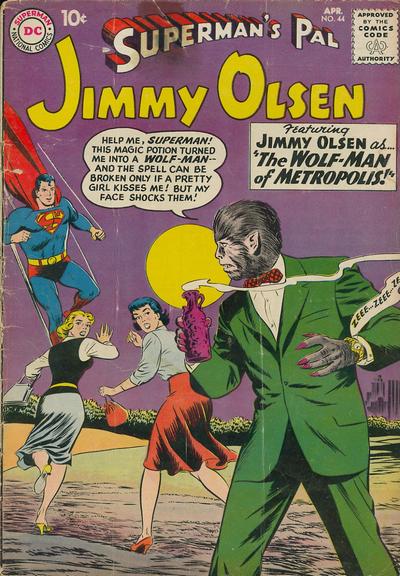
That's pretty cut and dried. This ended up causing problems several years later when a writer with the name Marv Wolfman began writing comics, and the Code got revised in 1971. (Just to be clear, they didn't change the Code just because of him; the big impetus for the change was how drug use was handled.) But despite the pretty clear prohibition against werewolves, we've got Jimmy Olsen wolfing it up very prominently on the cover of Superman's Pal Jimmy Olsen #44 circa April 1960...
Almost as curious, though, as how something so blatant could get past the CCA, but they expressly call him "The Wolf-Man" right there on the cover. The Wolf Man and his likeness are a registered trademark of Universal Pictures, yet here's DC blatantly playing off that name recognition. Granted, comics were still largely considered kiddy stuff beneath most people's notice at the time, but Universal has historically been very defensive of their intellectual property. That they didn't go after DC over this seems just as odd as the Code letting a werewolf show up on the cover of the comic to begin with.

I can't seem to find anyone referencing how/why this story managed to get published, and/or why there were seemingly no repercussions for violating the CCA and stepping on Universal's trademark. I'd be curious to hear if anyone is able to offer any explanations or insights!
I was recently reminded of a biography entitled The Secret Life of Houdini: The Making of America's First Superhero. When I first saw the book maybe 15 years ago, it was the first association I'd seen been Houdini's name and the term "superhero" and that gave me a bit of pause to consider the whole title.

I can actually see an argument for Houdini being a superhero. After all, he pulled off many seemingly miraculous escapes over his earlier career and he spent much of his later career debunking charlatan mystics who took people's money under false pretenses. But "America's First"?

If he's not America's first superhero, why? Who might be considered for that position? What would a superhero prior to 1899 (Houdini's first real performance as a magician) look/sound/act like?

In 1954, the New York Court of Appeals, in speaking of the infamous legal battle between Superman and Captain Marvel, defined superheroes as characters "of unprecedented physical prowess dedicated to acts of derring-do in the public interest." Webster's has a more broad definition: "a fictional hero having extraordinary or superhuman powers." In either case, though, we're generally looking at someone with beyond normal human abilities who acts in a socially positive manner. (And seemingly implicit in these definitions, the character must be human. Or, at least, not a literal god.)

My first thought was to go to American folklore. Pecos Bill, Paul Bunyan and the like. The first recorded accounts of Paul Bunyan, though, don't occur until 1906 and Pecos Bill wasn't invented until 1923. John Henry seems like a contender -- the latest anyone's suggested his story started has been the 1870s. Davy Crockett (1786-1836) and Jim Bowie (1796-1836) are possible, too, but their legends tend not to get too much into the superhuman category. Mark Twain's characters are all fairly solidly grounded in reality -- even the Connecticut Yankee Hank Morgan was just a normal guy caught in an extraordinary circumstance. The first Oz book appeared in 1900.

Who else can we consider? The Yellow Kid wasn't really heroic, nor super (unless you count a constantly-changing nightshirt). John "Johnny Appleseed" Chapman could be considered heroic, but not really super. Natty Bumppo doesn't really get into the super range either. What about Thomas Edison? While his feats are considered standard science today, he was called "The Wizard of Menlo Park" once upon a time. Were "his" inventions magical enough back then to be considered super?

(Note again that I'm limiting my consideration to the United States. Mostly to avoid having to go through thousands of centuries-old legends like King Arthur, Odysseus, Brunhild, and Sun Wukong! Keeping it to the US means we can limit our search to only a couple hundred years. I mean, yes, we could also consider superhuman characters from Native American tales, but that opens us back up to centuries of material, so I'm going to leverage some socio-political narcassism for the sake of putting some reasonable boundaries on the consideration.)

Any other nominations for "America's First Superhero"? Can we put these folks to a vote somewhere?
Back in 2020, I reviewed the first volume of the manga adpation of Rainbow Rowell's Fangirl. It follows Cath during her first year at college, and dealing with all the differences that separate that experience from high school. Cath's challenges also include, though, that she's pretty quiet and introverted, very much unlike her twin sister Wren. Furthermore, Levi -- the guy that Cath is interested in -- spent most of his high school career dating Cath's new roommate, Reagan. All this is against the backdrop of an in-world series called Simon Snow (which is kind of cross between Harry Potter and Twilight) of which Cath is one of the more predominent online fanfic authors.

Volume 3 picks up pretty much right where volume 2 left off, with Cath leaving a party upset because she saw Levi kissing another girl there. Cath tries avoiding Levi for the next few weeks and, to complicate matters, Cath's father has a breakdown just as final exams are getting underway. While she's ultimately able to do make-up exams and postpone her major projects to help take care of her father, she winds up getting into a massive argument with Wren about their long-absent mother. The twins stop talking to each other and, just as Cath is able to settle into a new normal as the next term starts, she gets a phone call from the mother she hasn't had any contact with for a decade...

Cue dramatic music as the "to be continued" message shows up!

As I said in reviewing volume 1, I have not read Rowell's prose novel this is based on so I can't compare it directly against that. I would presume this particular volume adheres more closely to the original because Rowell herself wrote this adapation, compared to Sam Maggs who worked on the first two volumes. But I don't know, maybe Rowell wound up changing more because she saw this as an opportunity to improve on what she didn't like about the original. This latest installment doesn't seem to flow any differently or have any appreciably different rhythms than the first two, but I can't tell if that's the result of the original story or that Gabi Nam has done the artwork on everything so far. Regardless, if you liked how volumes 1 and 2 worked, I'm sure you'll like this one as well.

Interestingly, for as much as I noted back in 2020 how much I connected with Cath despite our specific circumstances being wildly different, this didn't hit quite the same way. Not that I don't still connect with Cath, but three years ago when I first read this, it brough back a flood of early college memories I hadn't given any thought to in decades. And while we are a little over a year since the previous installment came out, those memories are still fresher now than they were three years ago when I first read it, so they don't, they can't land the same. But I'm still reminded of several early experiences from my college days, and I can still connect with Cath on many of them. If I were to lodge any complaints against this volume, I would say that
  1. I don't think we get enough of Reagan here. That's mostly a selfish complaint on my part becase I really like the character; I half-wonder if I wouldn't like a Reagan-centered series more than a Cath-centered one.
  2. The narrative periodically switches to depicting various Simon Snow stories, sometimes the canon work, sometimes Cath's fanfic. Not surprisingly, the scenes depicted generally server to underscore the main narrative at that point in the story. But there were two instances where I had trouble following along. Not because it requires some unknown Simon Snow lore or something, but just the storytelling doesn't quite work. I can't tell if that's more an issue with the art or the story itself or some combination, but I definitely had a couple "Wait, what just happened?" moments with them. Both seemed to be more action-oriented scenes, so I suspect it has something to do with that type of illustrative choreography.
Overall, it's an enjoyable series, and I'm looking forward to the next (and, I believe, final) book. I'm not seeing any suggested publication dates for that anywhere, but I presume we'd be looking at maybe late summer/early fall 2024, based on the previous releases. Volume 3, at least, came out yesterday and should be available through your favorite bookstore. It is published by Viz Media and retails for $16.99 US.