Several weeks ago, a public library reached out to me and noted that they had recently received a complaint about one of their books with the demand that it be entirely removed from their shelves. Per their policy, any written complaint required the library to re-evaluate the book in question with special consideration of the issue(s) brought up in the complaint. The library, per the same policy, brings in experts about the book -- often a combination about the topic the book discusses and the focus of the complaint itself and librarians from other systems familiar with the material -- to discuss the merits of the complaint and offer up a formal recommendation to the library's board on whether the book should remain in place, be re-shelved in another section, or removed entirely. The person who contacted me couldn't tell me too many specifics in advance of the entire group getting formalized, but she did note that I was being asked to weigh in as an expert on comic books.
Most of the cases of attempted comic book bans I've heard recently centered on the so-called "Moms for Liberty" trying to get rid of Gender Queer, Flamer, and other semi-recent graphic novels that even remotely touch on LGBTQIA+ issues. As often as not, they would try banning books just for having a non-binary character, even if the book's actual subject isn't related at all to their sexuality or gender expression. So my initial assumption was that it was something related to one of those books. As it turns out, though, the complaint was against Art Spiegelman's decades-old, Pulitzer Prize winning Maus.
I basically shook my head when I first heard that. Why are people still complaining about this? Every argument against the book has been shot down repeatedly over the past thirty years. In all that time, there has not been a single, reasonable complaint against Maus that warrants removing it from a library or school. So I thought to myself, "Fine. Whatever the actual complaint says, I can easily find loads of approaches to shoot this down." The actual complaint -- a scan of the submitted document was emailed to me -- was a hand-written note that said, using a grand total of eighteen words, Poles are depicted as pigs who turned Jews over to Nazis, and this was offensive because many Poles did in fact help Jews. (I kid you not; my 'summary' is literally longer than the actual complaint!)
This complaint is almost as old as the book itself, and it's frequently used by antisemitic groups who try to downplay or outright deny the terrors of the Holocaust. In fact, it's used so often by antisemitic groups that when that Tennessee school board banned Maus last year and people protested that it was an antisemitic attack, Spiegelman himself basically said, "No, they're banning it because of language and violence; antisemitic attacks always include the Poles-as-pigs thing." Everything about this complaint struck me as someone deliberately trying to waste the library's time and resources.
In any event, the others in this re-evaluation group and I all re-read the book to guarantee we're not mis-remembering anything and we all weighed in with our various reasons why this complaint was a load of shit. No one felt there was any merit to the complaint from any angle. No one was less than unequivocal; there was no "well, if he'd phrased his complaint this way..." or anything. This complaint had zero validity. It was not representative of the actual contents of the book and, even if it were, it would still easily fall within the bounds of the types of books the library keeps.
I'm at a bit of loss concerning the intention of the complaintant honestly. The basic complaint, as I said, is often used by antisemitic groups but this particular complaint was so badly worded and written that I can't believe it was the work of any more than a lone individual. It was a patently false accusation (literally disproven on three separate occasions within the first 35 pages); he must have known that ANY review would immediately show that and that his demand for removing the book from circulation would be rejected. If the intent was to actually have the book removed; even the most cursory Google search would turn up the aforementioned Tennessee case with the arguments they used, which were at least initially successful. The only purpose of this complaint that I can think of is to waste the library's time and resources. But to what end? Just for a laugh? Just to "own the libs"? I honestly have no idea.
But in any event, that was my adventure for the week. And on the plus side, it gave me an excuse to re-read Maus.
Here's a short story I read a few years ago on Facebook (and seems to have since been deleted) from the early days of dedicated comics shop retailing from one of it's early pioneers Jim Buser...
Here's a forgotten story in the history of the San Jose retail comic book scene. Much has been chronicled about the Seven Sons Comic Shop that opened April 1st, 1968 and was one of the first, if not the first, dedicated comic book stores in the modern era. It's also on record that Comic World (with Dick Swan, Bud Plant, John Barrett and myself) opened in the summer of 1969 and lasted almost two years. Meanwhile, Bob Sidebottom had another shop on San Fernando St. However, after Frank Scadina bought out his partners at Seven Sons and subsequently opened Marvel Galaxy, an interesting development happened. Frank was a compulsive gambler and a horrible one at that. He loved to play "hero" poker and chase inside straights and do dumb shit like that. Everyone knew that, and we actually competed to prey on him! One evening Tom Tallmon and I visited his shop and we began a poker game that lasted until the daylight the next day. Long story short, Frank gambled away 50% ownership of his store. A couple of months after that, Frank hit up his mom to buy us out. The price was $1500... $750 each for Tom and I. Hilarious that 50% of a comic book shop in 1971 was transacted for that little.
In 1989, there was an animated Beetle Bailey television special created. Per Wikipedia...
A 30-minute animated TV special co-written by Mort Walker and Hank Saroyan was produced for CBS in 1989, but did not air due to management changes at the CBS network. It has been released on DVD alongside the 1960's cartoon. Greg Whalen played Beetle, Bob Bergen portrayed Killer, Henry Corden was Sgt. Snorkel, Frank Welker was both Zero and Otto, Linda Gary voiced both Miss Buxley and Ms. Blips, and General Halftrack was Larry Storch. This special was one of a number of specials made in the same timeframe by King Features/Hearst for TV as potential series pilots; others included Blondie & Dagwood (co-produced with Marvel Productions, who had also collaborated with King Features for the Defenders of the Earth series a few years before) and Hägar the Horrible (co-produced with Hanna-Barbera Productions).
It was eventually released on DVD along with the 1960s Beetle Bailey cartoons.
And here is the special itself...
It occurred to me not long ago that, by a weird confluence of technological and business intersections, Gen X is in something of a unique position as far as understanding previous generations. I'll explain mainly through television examples; it applies across media writ large, but I think it's most easily explained via TV so I'll circle on back to comics towards the end of this post.
Let's start with this basic premise: art is a reflection of life. Or, more to the point, art is a reflection of life as it exists at the time of its creation. At a social level, art is an interpretation and reaction to what's going on in the artist's world and, at a technological level, what's capable of being created is limited by the technology that's available. For example, a caveman's art is going to be primarily about survival and created using found tools -- brushes hadn't been invented yet. Cubism, by contrast, arose in the 20th century because people were starting to see/hear about the entire world, not just their corner of it, and were beginning to understand and process how a single subject could be seen from multiple perspectives simultaneously; however, these paintings were not done digitally because computers weren't a thing yet. Art is a reflection of life.
Television was invented in 1927, but commercially wasn't widely available until about a decade later. So while the oldest members of the Silent Generation (born in the mid-1920s) could probably recall seeing television for the first time, the youngest members (born in the mid-1940s) could've grown up with TV. In either case, television was still new and broadcast options were limited and programming was relatvely crude. Boomers (mid-1940s through mid-1960s) would've grown up in a time when television was becoming pretty ubiquitous and programming was stabilized. The first televised pro football game was in 1948; the first national, nightly news program began in 1950; the first televised presidential debate was in 1960.
But there were only a handful of national networks airing (mostly) original programming. The notion of reruns didn't exist at all prior to 1953 as most shows were performed live without even being recorded.
All of this meant that anyone growing up during this time had access to whatever was being aired currently and that was pretty much it. Television, even if you were watching something set in the past like The Lone Ranger, still reflected the fasions, social mores and customs of the time it was created. Even ostensibly historical shows like Davy Crockett and Annie Oakley bore more resemblence to the 1950s than the 1800s in which they were set. So viewers tuned in nightly to whatever they wanted to watch and saw a mirror of some sort, whether that was The Honeymooners or Dobie Gillis. But it was always a mirror of life as they knew it.
Then we get to Gen X. While cable television was created in the late 1930s, it didn't really start gaining major traction until the 1970s; the number of subscribers began doubling every 4-5 years beginning in 1970. This led to a very rapid massive expansion of channels and it became something of a go-to joke in the 1980s how we went from three to five hundred channels and there was still nothing on. Of course, the reason for this was because this rapid expansion meant that you suddenly had literally hundreds of outlets looking for programming to fill twenty-four hours a day, but without the budgets to do original scripted programming like the national networks. So all these new channels did the same thing -- they got the rights to air old movies and TV shows. And they grabbed everything they could -- Three Stooges shorts, Fred Astair movies, Buster Crabbe serials, Japanese kaiju films, every sitcom you've ever heard of...
Which means that Gen X had ongoing access to not only art that reflected their life, but art that reflected the lives of everyone over the previous 50-75 years. Granted, Leave It to Beaver was never a perfect reflection of anybody's actual life, but it was a window into what that era was like. It reflected the values of that time. Gen X saw, through the proliferation of channels and long Saturday afternoons, glimpses into what it was like in previous eras. Something that previous generations simply did not have access to.
Interestingly, though, this doesn't really carry over much to Millenials (born in the early 1980s) and later generations. By the time they start coming of age enough to watch and understand television, cable companies were producing enough new content on their own that, while you could watch Gilligan's Island pretty much any time you wanted, there was a massive selection of new material that spoke more directly to current audiences. Not only were the historical national networks still producing new material, but all of these cable channels began doing so as well so new viewing options expanded at an exponential rate. The notion of watching some old movie or TV show just because "nothing else was on" fell to the wayside because there was always something new on. All of which means that Millenials weren't seeing any of those reflections of Gen X or earlier; those mirrors were available but were obscured by newer ones. This trend has only become exasperated since then, with the rise of both streaming and independent content creation -- there's nearly 300,000 hours of video uploaded to YouTube alone on a daily basis!
As I said, it's most evident via examples through television, but I think much the same applies to comics. They, too, are reflections of the times they're created and it's fairly small window in which reprint material (and, to a lesser degree, new material based on historical properties) started becoming readily available but before a glut of publishers -- later including webcomikers -- flooded the maket such that it's impossible to keep track of everything, much less actually read it all.
All that means thats Gen X had a unique perspective looking at and understanding or being able to empathize with previous generations in a way that previous and later generations did not.
It makes me wonder if one of the reasons there seems to be less generational strife from and against Gen Xers is because they have a better (though obviously not comprehensive) understanding of where other generations are coming from, as they had more opportunties to view life through others' eyes. More relfections of other eras. I don't doubt there are other generational aspects going on here as well, but I can't help but think the particular shift in the media landscape while Gen X was coming of age had a hand in things.
Here are this week's links to what I've had published recently...
Back in the early 1980s, then Marvel Editor-in-Chief Jim Shooter came up with the idea of an encyclopedia style series detailing notes about all of Marvel's characters. He handed the project to Mark Gruenwald, who himself had a nearly encyclopedic knowledge of comics, and The Official Handbook of the Marvel Universe was born. The first edition started in late 1982 and ran for fifteen issues. It was successful enough that a more expansive "Deluxe Edition" followed in 1985 and ran through 1988, with a series of eight "Update '89" installments the following year. DC followed Marvel's lead in late 1984 with their Who's Who in the DC Universe.
Marvel clearly recognized the appetite fans had for basic information about their characters and the universe they inhabited, so they came out with other books targeting the same audience. The Official Marvel Index titles began in 1985 (though writer/researcher George Olshevsky had, without Marvel's seal of approval, independently published essentially the same thing beginning in 1976) and late that same year saw the debut of The Marvel Saga: The Official History of the Marvel Universe written/researched primarily by Peter Sanderson. These later series were successful enough that they were really only canceled because they had caught up to then-current continuity, and there was essentially no more content. The Handbook itself got a "Master Edition" starting in 1990.
My impression is that, while fans generally enjoyed all of these books, the Deluxe Edition of the Handbook tends to be the one people loved the most. That could be partially because of my own bias towards that series, admittedly, but I've heard more fans talk reverently about that version than any other. I suspect a lot of that has to do with Gruenwald, and the obvious care and attention to detail he made sure was in the book, managing to not only condense each character's biography very well, but also managing to explain apparent discrepancies and correct mistakes that had accumulated over the years. It seemed like more of a deeply devoted fan effort with respect to the actual content, but the it still had the professional veneer a large publisher like Marvel brought to the table.
And while there have been more modern versions of these books recently, with multiple character-specific versions over the past five or six years, and Dorling Kindersley carving out a nice niche for themselves in comics by doing both Marvel and DC versions of the same basic thing, it seems to me unlikely that we'll see another book quite like the original and Deluxe editions again. I have several reasons to believe this.
First, of course, is the internet. Pretty much every character has a Wikipedia entry that's longer and more detailed than any of these books could hope to cover. There's no page count to worry about so things can get as detailed as they need to without concern about creating a book that's too heavy to be lifted. Additionally, being online means that all of these articles can easily cross-reference one another. Rather than including a footnote to see some other page, you can just click right over to it without even losing your place.
Somewhat related is that now, with a huge proliferation of TV shows and movies, there are many more versions of characters that might be a reader's/viewer's first look at a character. Back in the '80s, you did have a few different versions of the biggest characters, but there was little permanence to them. No one was playing the Kirk Alyn Superman serials anywhere. Even Fred and Barney Meet the Thing, which debuted in September 1979, was completely gone by 1980. (I mean, thankfully gone. It was horrible. I'm just saying that, in 1980, the only version of the Thing you even could concern yourself with was the one in the comics.)
But now, with characters showing up in a variety of shows and movies AND cable and the internet allowing those shows and movies to be called up pretty much at any time, that means the first time a person might encounter Thor is in the Avengers movies. Or maybe The Incredible Hulk Returns made-for-TV movie. Or maybe one of those old Grantray-Lawrence not-really-animation-but-we-still-call-them-cartoons shorts. Or maybe one of any number of video games. Someone picking up one of those encyclopedia style books could easily become confused since they all have their own internal continuities that only vaguely bear any relation to one another. There's no longer one "prime" version of any given character.
Further, even within the comics themselves, Marvel and DC have largely ditched long-term continuity altogether, even going so far as to completely re-set their universes multiple times. While the danger of having character entries outdated by the time they're published was certainly a concern back in the '80s, the stakes have been raised considerably. Now the whole universe can be thrown out, which would require a rewrite of the entire book, instead of just a few entries.
The more fluid nature of how Marvel and DC approach continuity, combined with the speed and capacity available online, all make the notion of publishing physical Handbooks somewhat limiting from the start. Where I think a lot readers bought and read the '80s versions because it helped make sense of a grand universe in a way that was not available anywhere else, I believe trying to replicate that today would fall short compared to other (free) materials and would only serve to confuse as many readers as not.
Which is why, although publishers may continue encyclopedic books along these lines, there's not likely to be a version as "definitive" (both from a content as well as an emotive aspect) as the originals were back in the 1980s.
Shuesha -- the publisher behind shonen magazines like Weekly Shōnen Jump, Jump SQ, and V Jump -- just announced they'll be launching Jump TOON, their own dedicated webtoon platform, to compete with the likes of Naver's LINE Webtoon. This isn't terribly surprising in that Naver has had a fair amount of success and the rise of manhwa more broadly has had manga publishers concerned about the competition, so naturally they want (argueably even need) to compete with them in this space in order to not lose their audience.
But I wonder about their approach here. While there's not a ton of details available -- and even fewer that aren't in Japanese, which I can't read and am relying on translation bots -- it sounds like Shuesha is developing this internally. Which is almost the wrong choice.
Shuesha is a publisher. They know books and magazines, storytelling, printing processes, delivery systems, and everything related to print publication. They certainly have an IT department, as this is the 21st century, to handle their infrastructure and website development and all that; but the ground-up development of a webtoon application -- whether that is a dedicated app or just a browser-based implementation -- is an entirely new/different type of project that requires a different skillset than what they would normally have on hand. There's certainly some overlap with their current IT staff, but it's different enough that you're going to want to have a different group of people working on it. A group that's got experience with developing these kinds of tools and can better anticipate potential issues that don't seem immediately obvious an can mitigate them before they require some retroactive kludge to fix them.
I'm not saying that they'll do so badly that Jump TOON will be an unmitigated failure but it's enough outside their wheelhouse that it's not going to work as smoothly as they'd like. They don't have the innate level of understanding of the user experience. I've seen this time and time again in a wide variety of industries. Probably the most comparable example I can think of is DC Comics.
Digital comics were starting to gain enough attention that they wanted in on the action. So in 2007 they launched Zuda Comics, which they had developed internally. The comics that were presented there were all good, but the platform itself had a variety of issues. Not major ones that prevented things from working, but just enough to make the user experience inelegant and uncomfortable. It was Comixology - also launched in 2007 -- that succeeded in digital comics space because they came to the table with a digital experience background, compared to DC's storytelling background. Comixology had a better understanding of the way users could/would navigate the platform, and were able to build their platform with that in mind. (Obviously, Amazon's purchase of Comixology changed the UX considerably for the worse and it no longer works as well as it once did, but in 2007, their platform was very much best-in-class when it came to digital comics.)
I don't know Shuesha's financial situation very well, nor how committed their C-suite executives to this initiative, but I don't think it will last more than a few years. There's definitely room for a manga webtoon platform, but I don't think Shuesha is the company to win that race. They might have the market cornered on manga storytelling, but I sincerely doubt they have the programming and UI expertise to build a successful webtoon platform from scratch.


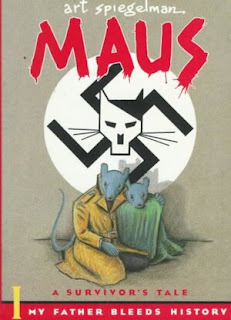 I basically shook my head when I first heard that. Why are people still complaining about this? Every argument against the book has been shot down repeatedly over the past thirty years. In all that time, there has not been a single, reasonable complaint against Maus that warrants removing it from a library or school. So I thought to myself, "Fine. Whatever the actual complaint says, I can easily find loads of approaches to shoot this down." The actual complaint -- a scan of the submitted document was emailed to me -- was a hand-written note that said, using a grand total of eighteen words, Poles are depicted as pigs who turned Jews over to Nazis, and this was offensive because many Poles did in fact help Jews. (I kid you not; my 'summary' is literally longer than the actual complaint!)


 Here are this week's links to what I've had published recently...


