

I thought I had a post explaining Marvel's job numbers, but apparently I do not, so let's take some time to rectify that. What are Marvel job numbers and why should we care about them?
Comics are, of course, a business and Marvel has long had to run their company as such, going well back into their days as Timely. One piece of evidence of this are job numbers. Job numbers were unique codes assigned to each project -- we usually talk about them in reference to the stories, but they were also used for covers, letters pages, pin-ups, and pretty much anything Marvel created for any given issue. Marvel could then use the job numbers as a running point of reference to follow a project's status and/or how an issue might be assembled. There would have been notes and spreadsheets internally saying who was assigned to each project (writer, artist, inker, etc.), what the deadlines were, and that sort of thing.
These job numbers followed a sequential pattern, but the sequence was only relevant to when a project was assigned and had no bearing on when a piece might be actually published. Consequently, job numbers tend to clump together around the creators and not necessarily the publications. Jack Kirby might go into the office, for example, and Stan Lee would assign the next issues of Fantastic Four, Journey Into Mystery, and a 6-pager for Tales to Astonish and if Steve Ditko walked in next, Lee might assign him work for Amazing Fantasty, Strange Tales, and Tales of Supsense. But by the time they all got published, there might be a month or more between them, and a bunch of other stuff by Don Heck and Dick Ayers and whomever else got mixed in as well.
The format of the numbers was a letter (starting with A and continuing throught he alphabet) followed by a number between 1 and 999. Although I don't know the extremes have ever been identified but, in theory, they started with A-1 and ended with Z-999. And because they ran sequentially, we can use them to identify roughly when a project was worked on. A story with job number M-339 (used in A Date with Patsy #1 circa 1957) was created after the one with job number L-965 (from Hedy Wolfe #1, also from 1957).
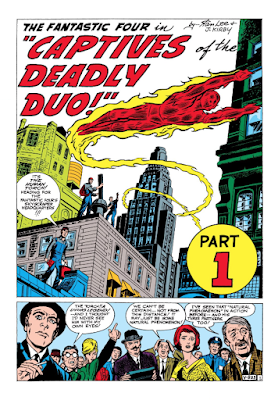
Alright, so now that we know what these numbers are, how do we know what project was assigned which job number since they were an internal identification system? Well, in many case, artists would write the job numbers on the art itself, usually on the first page of a story. If you look in the lower corner of either the first panel or the first page of issues up through the mid-1960s, you can often find a small notation about what job number that particular story is. (Job numbers continued to be used beyond the mid-60s, but their appearances on the art itself started to fall off then.) Here are the first pages of Fantastic Four #11 and #12, where you can see the job numbers in the lower left of the page (X-72) and the lower right of the first panel (X-101) respectively.


Not every story has a job number written on it, however. Not surprisingly, that was largely not a big conern for the aritsts themselves, so it got skipped sometimes and so we don't know every job number associated with every story. We do have more than what is visible, though, in large part thanks to Dick Ayers, who kept meticulous records of everything he worked on. He took advantage of the system Marvel was already using and would record whether and how much he was paid for his own work using the job numbers as reference.
There are a variety of databases that keep track of this info; the Grand Comics Database is probably the most widely used.
"But, Sean," you ask, "now that I know what these job numbers are and where to find them, why should I care? I mean, obviously FF #11 was going to be produced before FF #12! That was obvious before I even knew about job numbers!"
There's actually quite a few insights we can gain by sorting through job numbers. Take, for example, this recent "When We First Met" article over at CBR. Brian Cronin notes that Fantastic Four #12 is "tied with Amazing Spider-Man #1 as the first official crossover of the Marvel Age." FF #12 guest stars the Hulk, and the FF themselves guest star in Spider-Man. As both issues were published at the same time, the idea of them being "tied" for this honor seems reasonable. But the job numbers tell a different tale.
We already looked at the job number of FF #12 above -- if we compare that to the job number of Spider-Man #1, we can see which was created first. Well, here's the opening page of Amazing Spider-Man #1...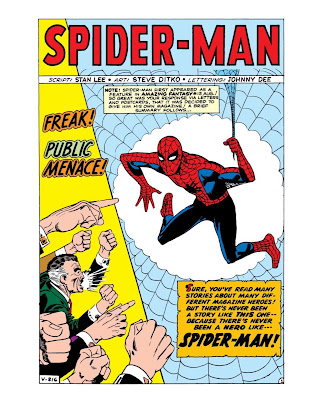 And what do we find? It's labeled as job number V-816. That seems pretty far removed from X-101. In fact, if we start checking other issues of the Fanastic Four, the closest job number to V-816 we can find is V-835 from FF #6, which came out six months before #12!
 That means Lee assigned Amazing Spider-Man #1 to Ditko a little before but still around the same time as he gave FF #6 to Kirby. So did Ditko sit on the first issue of Spider-Man for six months? Did Lee expressly tell him to wait? We can take a look at some other Spider-Man stories to glean the answer.
Spider-Man of course had actually debuted in Amazing Fantasy #15. The issue contains four stories, all drawn by Ditko and they have the job numbers V-789 (Spidey's origin), V-790, V-791, and V-792 (the other three "generic" stories in the issue). So they were all assigned at the same time, not too far in advance of when Ditko began work on what would later become Amazing Spider-Man #1 (V-816) and shortly after Fantastic Four #5 (V-735). And if we go the other direction, we see that only one of the two stories in Amazing Spider-Man #2 has a job number and it is X-171. If we start digging a little more, we can find the order in which the various FF, Spidey, and Hulk stories (because he was mentioned in that crossover) were created...
Fantastic Four #1 (V-372)
Fantastic Four #2 (V-457)
Fantastic Four #3 (V-563)
Fantastic Four #4 (V-643)
Incredible Hulk #1 (V-709)
Fantastic Four #5 (V-735)
Incredible Hulk #2 (V-781)
Amazing Fantasy #15 (V-789)
Amazing Spider-Man #1 (V-816)
Fantastic Four #6 (V-835)
Incredible Hulk #3 (V-869)
Fantastic Four #7 (V-895)
Fantastic Four #8 (V-950)
Fantastic Four #9 (V-995)
Fantastic Four #10 (X-38)
Incredible Hulk #5 (X-48)
Fantastic Four #11 (X-72 and X-73)
Fantastic Four #12 (X-101)
Incredible Hulk #6 (X-116)
Fantastic Four #13 (X-138)
Fantastic Four #14 (X-144)
Amazing Spider-Man #2 (X-171)
Fantastic Four #15 (X-191)
(We don't have the job number for Hulk #4, which is why I don't have it listed above. Presumably it was somewhere around V-950, but we don't know for sure.)
What does that list tell us? For starters, we can see both Amazing Fantasy #15 and Amazing Spider-Man #1 were created between Fantastic Four #5 and #6, and almost immediately after Hulk #2. This means they would have had sales numbers for at least the first two issues of Fantastic Four and possibly the third (or maybe just initial numbers for #3) -- enough to show that the sales on #1 weren't just a fluke. But the sales numbers on Hulk #1 wouldn't have been in yet, so they're steering towards both the longer-form storytelling and the superhero genre based almost exclusively on the strength of the FF.
Fantastic Four #12 (with a guest appearance by Hulk) was ostensibly about trying to pump up interest and save the flagging sales of Incredible Hulk but with as close as FF #12 was to Hulk #6, there's no way the former's impact could have been measured before the latter was canceled.
And, getting back to Spider-Man, look at the number of FF issues made between Spider-Man #1 and #2: nine! Certainly a big leap from the zero issues between AF #15 and ASM #1! This not only means that Lee had originally planned to launch a second Spider-Man story almost immediately after his debut, but it took several months to get ASM well enough on track that they could get around to #2. My guess as to what happened is that Lee felt Spider-Man was pretty strong and wanted to make sure Ditko was able to roll along with whatever momentum he had from Amazing Fantasy so he assigned the next Spidey story right away. Perhaps not even knowing what title it would wind up in! The problem he ran into, however, was that Marvel comics at the time were (by a weird set of circumstances that is way too much of a tangent for this post) being distributed by Independent News, owned by their publishing rival DC. Because they were direct competitors, DC imposed some restrictions on Marvel's output, one of which was a limit on the number of titles they could publish. I've seen variations on what exactly the criteria was, but the end result was that Marvel couldn't just start a new title any time they wanted. So even though Amazing Fantasy was canceled, Lee couldn't just replace it with Amazing Spider-Man the following month.
I'm sure Lee knew that even when he assigned the work to Ditko. What he was doing was getting ready. He was confident Spider-Man would go over well, but he didn't know when he would be able to squeeze it into their schedule. So by giving it to Ditko early, he could have it waiting and ready to go as soon as a spot opened up. There was probably some measure of waiting for Amazing Fantasy sales numbers to come in as well, since publisher Martin Goodman was pretty famously against the character to begin with, so it's possible Lee assigned it Ditko but still told him to wait on starting it for a few months. But that there was a delay of another three months beyond that suggests that there were some production issues that had to be worked around as well.
What this also sheds light on is Lee's cross-marketing thought process. His first crossover idea was to use the FF to draw attention to a brand new title by putting them in it, assuming the three-ish issues of their own title's sales data would've been available by then. When he gets to FF #12, he brings the Hulk over into their book instead of putting them into Hulk #6. This may have been a deliberate test, as he would by then know about when Spider-Man #1 would be coming out, so he could gauge which provided a more substanital boost -- having their biggest seller cameo in another title or having the new hero he wants to promote appear in theirs. It should be noted too that Hulk #6 was in fact published only a couple weeks after FF #12 and ASM #1, so sales of those three issues would have been directly comparable since they all would have been on the newsstand simultaneously.
This is obviously just three titles I'm looking at over a period of about a year and a half, but you can start to get a sense of how Lee, Kirby, and Ditko were starting to build up what would become known as the Marvel Universe. Start adding to that job number list how the monster books like Tales to Astonish and Strange Tales started shifting, or when Avengers started getting worked on relative to Journey Into Mystery.
You can find parallels that are more obvious than looking at publication dates, because the job numbers tell you where the creators were at when they were conceiving these ideas. The publication dates just tells you when fans got a chance to read them, at a minimum, three months later. A lot of Marvel history is mired in half-truths and failing memories and, while job numbers can't paint a complete picture, they can shed light on and provide perspective to the process that was being used by the mythical Marvel Bullpen back in the day!
Comics are, of course, a business and Marvel has long had to run their company as such, going well back into their days as Timely. One piece of evidence of this are job numbers. Job numbers were unique codes assigned to each project -- we usually talk about them in reference to the stories, but they were also used for covers, letters pages, pin-ups, and pretty much anything Marvel created for any given issue. Marvel could then use the job numbers as a running point of reference to follow a project's status and/or how an issue might be assembled. There would have been notes and spreadsheets internally saying who was assigned to each project (writer, artist, inker, etc.), what the deadlines were, and that sort of thing.
These job numbers followed a sequential pattern, but the sequence was only relevant to when a project was assigned and had no bearing on when a piece might be actually published. Consequently, job numbers tend to clump together around the creators and not necessarily the publications. Jack Kirby might go into the office, for example, and Stan Lee would assign the next issues of Fantastic Four, Journey Into Mystery, and a 6-pager for Tales to Astonish and if Steve Ditko walked in next, Lee might assign him work for Amazing Fantasty, Strange Tales, and Tales of Supsense. But by the time they all got published, there might be a month or more between them, and a bunch of other stuff by Don Heck and Dick Ayers and whomever else got mixed in as well.
The format of the numbers was a letter (starting with A and continuing throught he alphabet) followed by a number between 1 and 999. Although I don't know the extremes have ever been identified but, in theory, they started with A-1 and ended with Z-999. And because they ran sequentially, we can use them to identify roughly when a project was worked on. A story with job number M-339 (used in A Date with Patsy #1 circa 1957) was created after the one with job number L-965 (from Hedy Wolfe #1, also from 1957).
Alright, so now that we know what these numbers are, how do we know what project was assigned which job number since they were an internal identification system? Well, in many case, artists would write the job numbers on the art itself, usually on the first page of a story. If you look in the lower corner of either the first panel or the first page of issues up through the mid-1960s, you can often find a small notation about what job number that particular story is. (Job numbers continued to be used beyond the mid-60s, but their appearances on the art itself started to fall off then.) Here are the first pages of Fantastic Four #11 and #12, where you can see the job numbers in the lower left of the page (X-72) and the lower right of the first panel (X-101) respectively.
"But, Sean," you ask, "now that I know what these job numbers are and where to find them, why should I care? I mean, obviously FF #11 was going to be produced before FF #12! That was obvious before I even knew about job numbers!"
There's actually quite a few insights we can gain by sorting through job numbers. Take, for example, this recent "When We First Met" article over at CBR. Brian Cronin notes that Fantastic Four #12 is "tied with Amazing Spider-Man #1 as the first official crossover of the Marvel Age." FF #12 guest stars the Hulk, and the FF themselves guest star in Spider-Man. As both issues were published at the same time, the idea of them being "tied" for this honor seems reasonable. But the job numbers tell a different tale.
We already looked at the job number of FF #12 above -- if we compare that to the job number of Spider-Man #1, we can see which was created first. Well, here's the opening page of Amazing Spider-Man #1...
Spider-Man of course had actually debuted in Amazing Fantasy #15. The issue contains four stories, all drawn by Ditko and they have the job numbers V-789 (Spidey's origin), V-790, V-791, and V-792 (the other three "generic" stories in the issue). So they were all assigned at the same time, not too far in advance of when Ditko began work on what would later become Amazing Spider-Man #1 (V-816) and shortly after Fantastic Four #5 (V-735). And if we go the other direction, we see that only one of the two stories in Amazing Spider-Man #2 has a job number and it is X-171. If we start digging a little more, we can find the order in which the various FF, Spidey, and Hulk stories (because he was mentioned in that crossover) were created...
Fantastic Four #1 (V-372)
Fantastic Four #2 (V-457)
Fantastic Four #3 (V-563)
Fantastic Four #4 (V-643)
Incredible Hulk #1 (V-709)
Fantastic Four #5 (V-735)
Incredible Hulk #2 (V-781)
Amazing Fantasy #15 (V-789)
Amazing Spider-Man #1 (V-816)
Fantastic Four #6 (V-835)
Incredible Hulk #3 (V-869)
Fantastic Four #7 (V-895)
Fantastic Four #8 (V-950)
Fantastic Four #9 (V-995)
Fantastic Four #10 (X-38)
Incredible Hulk #5 (X-48)
Fantastic Four #11 (X-72 and X-73)
Fantastic Four #12 (X-101)
Incredible Hulk #6 (X-116)
Fantastic Four #13 (X-138)
Fantastic Four #14 (X-144)
Amazing Spider-Man #2 (X-171)
Fantastic Four #15 (X-191)
(We don't have the job number for Hulk #4, which is why I don't have it listed above. Presumably it was somewhere around V-950, but we don't know for sure.)
What does that list tell us? For starters, we can see both Amazing Fantasy #15 and Amazing Spider-Man #1 were created between Fantastic Four #5 and #6, and almost immediately after Hulk #2. This means they would have had sales numbers for at least the first two issues of Fantastic Four and possibly the third (or maybe just initial numbers for #3) -- enough to show that the sales on #1 weren't just a fluke. But the sales numbers on Hulk #1 wouldn't have been in yet, so they're steering towards both the longer-form storytelling and the superhero genre based almost exclusively on the strength of the FF.
Fantastic Four #12 (with a guest appearance by Hulk) was ostensibly about trying to pump up interest and save the flagging sales of Incredible Hulk but with as close as FF #12 was to Hulk #6, there's no way the former's impact could have been measured before the latter was canceled.
And, getting back to Spider-Man, look at the number of FF issues made between Spider-Man #1 and #2: nine! Certainly a big leap from the zero issues between AF #15 and ASM #1! This not only means that Lee had originally planned to launch a second Spider-Man story almost immediately after his debut, but it took several months to get ASM well enough on track that they could get around to #2. My guess as to what happened is that Lee felt Spider-Man was pretty strong and wanted to make sure Ditko was able to roll along with whatever momentum he had from Amazing Fantasy so he assigned the next Spidey story right away. Perhaps not even knowing what title it would wind up in! The problem he ran into, however, was that Marvel comics at the time were (by a weird set of circumstances that is way too much of a tangent for this post) being distributed by Independent News, owned by their publishing rival DC. Because they were direct competitors, DC imposed some restrictions on Marvel's output, one of which was a limit on the number of titles they could publish. I've seen variations on what exactly the criteria was, but the end result was that Marvel couldn't just start a new title any time they wanted. So even though Amazing Fantasy was canceled, Lee couldn't just replace it with Amazing Spider-Man the following month.
I'm sure Lee knew that even when he assigned the work to Ditko. What he was doing was getting ready. He was confident Spider-Man would go over well, but he didn't know when he would be able to squeeze it into their schedule. So by giving it to Ditko early, he could have it waiting and ready to go as soon as a spot opened up. There was probably some measure of waiting for Amazing Fantasy sales numbers to come in as well, since publisher Martin Goodman was pretty famously against the character to begin with, so it's possible Lee assigned it Ditko but still told him to wait on starting it for a few months. But that there was a delay of another three months beyond that suggests that there were some production issues that had to be worked around as well.
What this also sheds light on is Lee's cross-marketing thought process. His first crossover idea was to use the FF to draw attention to a brand new title by putting them in it, assuming the three-ish issues of their own title's sales data would've been available by then. When he gets to FF #12, he brings the Hulk over into their book instead of putting them into Hulk #6. This may have been a deliberate test, as he would by then know about when Spider-Man #1 would be coming out, so he could gauge which provided a more substanital boost -- having their biggest seller cameo in another title or having the new hero he wants to promote appear in theirs. It should be noted too that Hulk #6 was in fact published only a couple weeks after FF #12 and ASM #1, so sales of those three issues would have been directly comparable since they all would have been on the newsstand simultaneously.
This is obviously just three titles I'm looking at over a period of about a year and a half, but you can start to get a sense of how Lee, Kirby, and Ditko were starting to build up what would become known as the Marvel Universe. Start adding to that job number list how the monster books like Tales to Astonish and Strange Tales started shifting, or when Avengers started getting worked on relative to Journey Into Mystery.
You can find parallels that are more obvious than looking at publication dates, because the job numbers tell you where the creators were at when they were conceiving these ideas. The publication dates just tells you when fans got a chance to read them, at a minimum, three months later. A lot of Marvel history is mired in half-truths and failing memories and, while job numbers can't paint a complete picture, they can shed light on and provide perspective to the process that was being used by the mythical Marvel Bullpen back in the day!


 Here are this week's links to what I've had published recently...


