Latest Posts

Over the past 6-9 months, I have not been reading nearly as much as I used to. It's very much related to the pandemic and general collapse of everything, and probably some residual trauma from the Trump presidency. It's one of those where you can say, "Because of, well..." and then just wave your hands at literally everything, and everybody just nods understandingly.

I've actually tried writing this several times, but I keep getting bogged down in details you don't want to hear about. Suffice it to say, things have really sucked and I've fallen out of reading many of the comics I used to read. Before my Webcomics book was published, I was regularly reading over 300 webcomics. Now it's down to four-ish. Maybe as many as five or six if you count the ones that I read if they happen across my Twitter feed, but I don't really go out of my way to look for them. However, the other night I did manage to open the feed reader that I have dedicated for webcomics. First time I've opened it in... I honestly don't know how long. A year at least. I was somewhat surprised at what I saw in there, though.

For the record, the app I'm using is The Old Reader. It will present to you a list of all the feeds you've subscribed to, and next to each title it lets you know how many new entries have been made since you last read through them. Not since you opened the app, or even opened that particular feed. But how many of the invdidual entries have you not yet read. Then, when you look at a specific title, it lists out the titles and dates of each individual entry. From there, you can select which you wish to read.

What I found surprising was how little I had fallen behind. Many of the comics were not showing any updates at all. To be fair, for many of the types of webcomics I've read, that's not unusual. A creator has a great idea for a comic, starts working on it, posts it, hypes it up, makes regular updates... and then it falls by the wayside after 6 months or a year when the matter of having to pay the bills rears its head. I recall Jennie Breeden saying years ago that, in order to make it as a webcomiker, you're going to need to set aside and commit to five years minimum to get established. Most comics don't last nearly that long. There were probably several dozen webcomics in my feed that had already stopped updating well before COVID was a thing, and I simply hadn't gotten around to deleting the feed yet.

But many of the others that did still have updates? Those updates were few and far between. In the year or more since I'd opened the app, they'd maybe have 20 updates? That's once every three or four weeks. And if I went in to look at the dates, I'd see one of two things. They either had a wildly sporadic updates; like, three in one week then nothing for two months and then one and then another one two weeks later and then nothing for four months and then four days in a row... Or else they had a slowed, but sort of consistent schedule up through the end of 2020, but haven't posted anything since.

Now there are a few stand-outs. There were maybe five comics that have had hundreds of updates in the time I was away -- basically keeping up with whatever schedule they were on before. There were another ten or twelve that had 50-ish updates... suggesting they were keeping (or switched to) a weekly schedule.

But the vast majority of comics in my feed -- even many of the ones that had been consistent stalwarts of the medium -- weren't keeping up any longer. And many of the ones I did read, they were clearly dealing with a lot of stress. Depression was a recurring theme in many of them.

I'm sitting at my desk in my house as I type this on Thursday night. I can hear my wife in the other room. The power is on, the A/C is keeping things comfortable, and I just had leftovers for dinner. I've got a comfortable bed to sleep in tonight, and tomorrow I'll get up and go to work. But since I've been working from home for the past year and a half, the commute is maybe 30 seconds. My paycheck will hit my bank account hours before I even get up. I've got one Zoom call, but it's an internal team meeting where things are a little more casual; I could wear the t-shirt and boxers I go to sleep in tonight and it'd be fine because they're only going to see my head and shoulders anyway. My point being that I've been exceptionally privileged throughout this pandemic. And despite that privilege, despite being about as comfortably removed as possible from the day-to-day struggles many people have been facing, despite not having to overly worry about my actual survival, it's been hard to muster... well... anything. The pervasive sense of dread and doom from almost literally everything has been incredibly draining, and I've had to forgo things I enjoy (like reading!) in order to focus what little energy I have on doing my job (so I can get paid, and continue having food and shelter).

In light of that. In light of the stress I see on the faces of the people working at grocery stores, driving Amazon delivery trucks, and flipping mass market hamburgers. In light of the tenuous career choice webcomics was even before all this bullshit started. In light of all that, I want to send an extra thank you out to the people doing webcomics. The ones that have kept at it throughout the pandemic, but also the ones who had to set it aside for whatever reason. Creativity is hard under the best of circumstances, and we are about as far from that as we've been in many, many years. So thank you for however much creativity and entertainment you've been able to wring out of your brain over the past year and a half. Whether that's 365 comics, or just one. Know that I deeply appreciate your efforts, even if I haven't even been able to keep up with them, because I can only imagine how challenging that must be for you. More power to you!
I'm not much of an actual collector of comics. I prefer the stories themselves to the artifacts they were originally printed on. But there was a long time where those two approaches were one and the same. For most of my years as a comics fan, reprints just weren't that widely available for a lot of older books. So I do have a few older comics in my collection that I've picked up over the years.

For no other reason than it struck my fancy, here are the oldest three comics in my physical collection, all of which were published about a quarter-century before I was born...
WHIZ Comics #114 circa 1949. My copy is actually coverless. It was actually my dad's and I picked it up when he gave me his comic collection several years ago. No idea where he got it or why, but I expect he picked it up just for the Ibis story.

Classics Illustrated #10. This is the reprint from 1947, not the 1943 original. My copy is in bad shape; lots of water damage. It was found by a relative in the back of a garage with a handful of other Classics Illustrateds and given to me. Why this particular one was so much earlier than the others, I don't know.

Green Lama #5. May 1945. I found this in a consignment shop for a couple of bucks maybe 15-20 years ago. (Well before the Golden Age revival stuff that Dynamite and Image have put out since.) I'm not a big Lama fan but I'd heard about him when reading about Lou Fine, so I figured this was a good way to see some of his work first-hand.
I'm a big fan of Genesis from way back. It was originally because the front man for the band when I first discovered them was also the drummer, Phil Collins. As a budding drummer myself, I really appreciated that. They haven't come out with any new albums, much less any new music in years. But I've been thinking about them a bit more lately because they're planning one final tour. (And despite many rock stars doing farewell tour after farewell tour, it's hard to imagine Collins' health will hold out for that. He's recently stated he can't hold his drum sticks to even attempt to play, and his vocal range and intensity have radically diminished. This last tour, with Collins being limited to singing from a chair for the entire show, will undoubtedly be their last tour. At least with the 'traditional' line-up for the band. I suppose they could try bringing Ray Wilson back for vocals and letting Collins' son Nic continue to play drums, but with Mike and Anthony in their 70s themselves, that seems unlikely. But I digress...)

Soon after discovering Genesis, I was thrilled to soon discover they paid tribute to Winsor McCay with the song "Scenes from a Night's Dream" from their 1978 album …And Then There Were Three… But one of their songs that soon caught my (and popular!) attention was "Land of Confusion" from their 1986 album Invisible Touch. It did well on the charts (#4 in the US and #14 in the UK). It spoke to a lot of the concerns and fears I know I had in the mid-1980s, but one thing that struck me was the Superman reference in the lyrics...
Superman, where are you now?
When everything's gone wrong somehow
The men of steel, the men of power
Are losing control by the hour
This was emphasized in the video as the Ronald Reagan character dons a Superman style suit and races off to the save the day... only to get distracted by the television.

(As an interesting aside, the visuals pay tribute to another Superman reference in a song by a different artist. Jim Croce's "You Don't Mess Around with Jim" includes the line "You don't step on Superman's cape!" Which is precisely how Reagan is halted in the "Land of Confusion" video.)

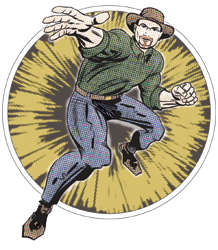
Seemingly to reinforce the comic connection of the song, the metal band Disturbed did a cover of "Land of Confusion" in 2006 and hired Todd McFarlane to create the video. McFarlane's visuals were decidedly less comedic and much darker, despite using many of the same visual ideas. In this version, the protagonist is based off "The Guy" mascot of the band's previous albums and given super powers, including super strength, flight and an energy punch. Despite this, however, the Superman reference in the lyrics is largely dismissed -- a scrap of paper with an "S" flies across The Guy's chest during the lyric and he quickly discards it.
The Guy's original character design was by David Finch, and the cover art for Ten Thousand Fists that was used as the basis for the video was by Todd McFarlane and Greg Capullo. McFarlane talked about the development of the video in a short making-of documentary. (This link is only to part one, but you can follow through to the other parts easily enough from there.)

One more comic connection for the song. It was even more recently covered in 2011 by Katzenjammer, a Norwegian band whose name is directly a tribute to the Katzenjammer Kids, who they felt they resembled. (Presumably more in spirit than in physicality.) While their video is primarily live action shots of them playing, it also features cartoony animations and some classic visual idioms from comics. Including (most of) the iconic "S" shield.
While "fumetti" is just the Italian word for "comics" it's generally understood in America to mean comics that are created using photographs. So while "comics" are defined without a particular set of tools needed in their creation, "fumetti" (at least by the American definition) requires the use of a camera of some sort. Meaning that fumetti could not have existed prior to the 1800s. But what was the first fumetti? Who was the first person to put together a series of photographs to display a narrative?

The Wikipedia entry goes back as far as 1927 citing the New York Daily News utilizing photos of Ziegfeld Follies stars Eddie Cantor and Frances Upton telling jokes with speech bubbles superimposed. However, it seems to treat these more as proto-fumetti, suggesting that it didn't really "count" as its own thing until showing up in Italy in the 1940s and '50s. (I suppose this is to justify using a Italian term for something that isn't especially Italian in origin.)

But that seems a bit late, as people were experimenting with commerical photography as early as the 1860s. While there may be earlier examples that have been lost to time, I think a strong argument could be made for Eadweard Muybridge's Sallie Gardner at a Gallop from 1878. You might be familiar with the sequence, at least nominally so. Leland Stanford hired Muybridge to figure out if all four of a horse's feet were ever in the air simultaneously while it galloped. It was the subject of some debate as the human eye couldn't process things fast enough to see in person, and so Muybridge went about trying to capture the image of a horse running while all of its feet were in the air.

Muybridge in fact did manage, through trial and a lot of error, to get a single photo of a running horse with its feet off the ground in 1877. A print was sent to the local press (this was, as I said, something of a debate after all) but there was evidence that the photo negative had been retouched and it was generally dismissed.

The following year, Muybridge tried a different approach. Rather than using a single camera and hope for a great shot, he set up a series of 24 cameras, mounted about 2½ feet apart alongside a race track. He then rigged the camera's shutters to tripwires laid across the track. Using this method, as the horse ran over the tripwires, the camera it was attached to would automatically take a picture. He then directed one of Stanford's jockies, a man by the name of Domm, to run Sallie Gardner at about 36 miles per hour on the track. The result was that Muybridge got 24 photographs of Domm riding Sallie Gardner, each taken about an eighth of a second apart. Indeed, several of the pictures show Sallie Gardner with all of her feet off the ground.

Now, this is often showcased as a precursor to film. The images are put together as a flip-book of sorts, and showing all 24 images in the span of about three seconds gives the illusion of motion. That's basically how movies work. Muybridge figured out a way to create movies before movie cameras existed.

But pause a moment. Muybridge used 24 individual cameras. Each camera took a single image. The point of the exercise was to capture a still image of a horse mid-stride, and the images were circulated as a sequence of still images like I've included here. Muybridge was trying to capture motion, but for the express purpose of slowing it down to a series of still images, not in order to replicate the motion itself.

The series of images doesn't have a plot, but there is a very deliberate sequence here. That's comics. Created using photographs. That's fumetti.

Muybridge went on to do more movement studies in a similar fashion, largely funded by the University of Pennsylvania. Those studies amount to around 20,000 additional images, which made it into an 1887 book called Animal Locomotion: An Electro-photographic Investigation of Consecutive Phases of Animal Movements.

So, any other earlier candidates for first fumetti?
A few years back back, I bought some comics from trans creator. I know she was trans because many (though not all) of her comics were autobiographical in nature. I don't know exactly where she was on her journey when I met her, but she had transitioned enough at that point where she had x-ed out her dead name on older books, and hand-written her current name in its place. I'm sure the cost of reprinting those books factored into that decision, but the way her dead name was crossed out -- so that you could still pretty easily read it, and you clearly weren't looking at a typo she was trying to hide -- gave me the impression that, while she wasn't ashamed of her past, she was very proud of where she stood and where she was going.

Maybe I was reading too much into that. I talked to her about her comics, not her gender identity.

But I'm thinking about that a bit today. When she made some of those older comics, her identity, at least from an outward social perspective, was that of a man. Regardless of how she felt, she presented herself as a man and, I suspect, was largely treated as one. The comics she made during that time would have been reflective of that, directly or indirectly. Her later experiences as a woman may have led her to approach the comic differently. Not that she'd be a fundamentally different person, of course, but A) she (theoretically) wouldn't be wrestling with her gender identity on a daily basis which is bound to free up some head space for thinking about comics, and B) the people around her would likely be treating her differently, which would likely impact her day-to-day mood. So does changing the credit on her comic make sense?

Yes and no.

Wilton of the West by Fred Sande
When Jacob Kurtzberg first started doing comics professionally, he used a number of pseudonyms: Jack Curtiss, Curt Davis, Ted Grey, Charles Nicholas, Fred Sande... He used different ones for different reasons. In some cases, he used them simultaneously in order to hide the true size of the company he was working for. In other cases, he was ghosting comics and was trying to match a particular style. But the name he used most often, Jack Kirby, was chosen in part to obscure his Jewish heritage. That was the name he ultimately became successful under and, although he fully owned up to the comics he worked on under other names, he never went back to change them. This was partially from little of his work being reprinted during his lifetime; much of the Kirby ouvre we enjoy today are only seeing their first re-publication (in some cases, first publication at all!) after his death. From the perspective, why bother re-tagging the material? He was still saying he made it, he just didn't bother updating the credits page.

On the other hand, today's Kirby-related materials all use "Jack Kirby" regardless of what name he originally worked on the piece under. That's a marketing decision since "Jack Kirby" is a much more famous name than "Fred Sande." Likewise, if you're still selling/promoting work that you originally developed under another name, you're in the process of trying to build that type of reputation. As long as you're still proud of the work, you'd want that associated with your current name, the one you're putting on material today. So if someone buys and likes your older work, there's less of an issue trying to track down your current work.

Furthermore, the person you are today isn't the same person you were five, ten, or more years ago. Even if you have the same name you've always had, you've got several more years of experiences and personal contacts that have influenced you. You're currently the culmination of your lifetime, and your decisions and choices today are based on a history that you didn't necessarily have before. So if none of us are who we used to be, but still use the same name to identify ourselves, why should a person who has consciously and deliberately changed their name/identity be expected to be called, retroactively, by a name that they no longer use?

The decision is, of course, a personal one. If a creator feels that their previous work was done under an identity so different from their own as to be a different person, there's no reason to expect them to update the credit. But if instead, they still feel the work is valid and representative, there's no reason to expect them to continue using an identity that is no longer in existence.

I don't know that I ever expressly seen people who claim to have problems with this kind of thing (though, at least in comics, it's pretty rare, certainly when you're talking about books with sales that number more than, say, 1000) but, if anyone does raise a concern about it, it seems to me that that is more of an issue with person voicing the opinion than anything else. It's your comic; credit it however you want. If anyone balks, you can rest assured that they're complaining not because you're being disingenuous with the credits (e.g. see my Kirby example above) but that they're uncomfortable with the idea that they're not able to define your gender identity for you.
Here are this week's links to what I've had published recently...

Kleefeld on Comics: Ahead of Modeling... Again
https://ift.tt/3jNgRpR

Kleefeld on Comics: Comics to Radio
https://ift.tt/3BJ5vJy

Kleefeld on Comics: Guest Appearances in Heathcliff
https://ift.tt/2WUFt7b

Kleefeld on Comics: Foxy Grandpa
https://ift.tt/3hikC4X

Kleefeld on Comics: The Day the Klan Came to Town Review
https://ift.tt/3niKl19


The Day the Klan Came to Town
I think there are a number of prevalent myths surrounding the Ku Klux Klan. I think a lot of people believe that they limited their activities to the Southern US. I think a lot of people believe the only group of people they acted on was the Black population. I think some people believe stories about the Klan killing people pretty indiscriminately are overblown. I think some people STILL believe the Klan to be a benevolent, civic organization comprised of "many fine people."

All of those beliefs are bullshit. The Day the Klan Came to Town rips up every one.

Back in 1923, the KKK held a 30,000 person rally in Carnegie, PA for the express purpose of slaughtering the minorities that largely populated the area. (The total population of Carnegie at the time was around 11,500.) Blacks, Italians, Hispanics, Jews, Irish... pretty much anyone not deeemed sufficiently Ayrian was fair game. The Klan had police members on their side who steadfastly refused to protect the citizens of Carnegie, directly opposing the orders the local Burgess. The town's various ethnic groups banded together to try to halt the Klan's march through town, but that quickly led to a full-scale attack. Several people were injured, and it only ended once one of the Klansmen was killed and the group retreated.

That's the story that's told here. It focuses primarily on Primo Salerno, an Italian immigrant who fled to the United States after having been conscripted by the Italian governmnt to fight in WWI. His wife, Gianna, came over some time later (as we learn through some flashbacks) and at the time of the main story, she is heavily pregnant with Primo's child. Because of his time in the war, Primo is reluctant to fight but he readily understands the stakes involved and doesn't hesitate to join forces with the others. But while Primo and the other men of the town gather in the streets, the women move to the rooftops. Including Gianna and the elderly Irish woman, Marta, who's helping to look after her. They mostly fight with clubs and bricks, but once Primo fires a dropped pistol to help his friend Marcu, the Klan flee in fear. And while Marcu rejoices in what others will remember they managed to accomplish, another reminds him that "Americans love forgetting." The book closes with a single image of a contemporary "ethnic" woman, handcuffed, in an ICE cage noting that she was actually born here.

Writer Bill Campbell is upfront with the fact this account has been fictionalized. It to be because there are so few contemporaneous accounts of what actually happened that weren't expressly from the KKK's perspective. But the rally and subsequent attack on the "Irish and others" happened, and was soon swept under the rug as KKK-sympathizers skimmed over details that made them look bad. Which is to say, they skimmed over virtually everything. Campbell also notes that he actually grew up in Carnegie and never learned of any of this until many years later. That makes telling the story now even more important, to ensure everyone knows just how awful and racist shitbags Klan members are.

Artist Bizhan Khodabandeh does a good job with the storytelling, and ensuring characters are distinct and identifiable even among larger groups and even minor characters that have little, if any, dialogue. The drawings aren't overly detailed and tend to fall on the more cartoonish side, but I don't know that's an issue. In fact, having the more simplified figures probably helps for readers to identify with the characters.

The echoes between the events in this book and today are impossible to miss. I haven't checked, but I think Campbell even swiped some dialogue from people talking about the 2017 Unite the Right rally in Charlottesville where Heather Heyer was deliberately run over and murdered. This is the history we're never taught in school. (Campbell calls what we are taught "American fanfic" -- a term I am totally going to use myself in the future!) And that we're never taught this is why so many bullshit myths get generated. It's only by confronting our own history honestly and directly that we even have a hope of overcoming its ongoing legacy.