Latest Posts

The sad and untimely death of Darwyn Cooke over the weekend consumed much of comic people's attention, and that masked some other bad news. Here's Caelyn Ellis to explain...
Fowler confirmed the story herself and added that writer Kurtis Wiebe had been trying to get the original artist (the one who was abusing his wife) back via Image's management and, when Fowler confronted him about it, he flatly lied to her, only to back-peddle later. Fowler has repeatedly said online that it's a really shitty way to do business, but this was just "the weird cesspool underbelly" of comics and she's strong enough to deal with it.

Fowler's actively and repeatedly told her fans that there's no need to pull out the torches, real or metaphorical, but Matt Santori-Griffith smartly pointed out that whoever thought that most fans of Rat Queens would be okay with a known abuser returning to the book is seriously misjudging the book's audience. Not surprisingly, a number of fans have said they wouldn't return to the book whenever it gets back off hiatus.

I get that there's going to be an appeal to some people to want to have the original creative team back on the book. They were the ones who created the characters and, arguably, know them better than anyone else. I get that. But the whole theme of the book centers around strong, independent women, so bringing back an artist that has demonstrated that he's very much against that concept in real life by beating his wife and then telling her that she made him do it is anathema to the book itself.

My understanding in how Image contracts typically operate is that they actually don't have much say in who the creative team is. So Fowler's comment about Wiebe talking with "management" is probably more along the lines of informing them of his decision rather than asking them to facilitate that. Image might be able to cancel the book outright, but they might be hamstrung by the contract there too if it says cancellation can only occur if sales don't meet a certain level. Putting the book on hiatus for any length of time is always good for a drop in sales in the first place, but then trying to return with artist Roc Upchurch on top of that strikes me as the makings for sales between #16 and #17 dropping off the face of the Earth. So even if Image can't do anything about the situation at the moment, I think Wiebe and Upchurch are doing plenty to get the book cancelled on their own.
Here are this week's links to what I've had published recently...

Kleefeld on Comics: On Business: There's Your Problem!
http://ift.tt/1rKRjLT

Kleefeld on Comics: On History: Ohio History Mini-Comics
http://ift.tt/1rPQOAk

FreakSugar: Spotlight: Curio & Co.
http://ift.tt/1TCn0NQ

Kleefeld on Comics: Weekly Comics Links
http://ift.tt/1YlF3MB

FreakSugar: Webcomics Wednesday: Language Disadvantage
http://ift.tt/21WBL4x

Kleefeld on Comics: On -isms: Wyatt Wingfoot
http://ift.tt/27gqn7t

Kleefeld on Comics: On Strips: St. Jude's
http://ift.tt/23Nc45J


You know, I've seen Jeff Keane's support for St. Jude's over the years in passing -- usually just some custom artwork for them featuring one or more of the Family Circus kids -- but I'm just hearing about this wide-spread cartoonist support from Cartoonists United for St. Jude Kids. On May 26, there will be an event featuring "20 A-list artists confirmed" with a silent auction and dinner, all to raise funds for St. Jude Children's Research Center. The formal invitation reads...
Come mix and mingle with nationally-recognized cartoonists, while supporting the mission of St. Jude Children's Research Hospital: Finding cures. Saving children. The evening will feature special presentations such as Cartoonists Improve and a St. Jude program. Host cartoonists will be seated at VIP tables. Enjoy festive food and spirits at this one-of-a-kind event. All proceeds to benefit St. Jude.
The only cartoonists they've formally named so far are Steve McGarry, Jeff Keane, Bill Morrison, Lynn Johnston, Hilary Price, and Maria Scrivan. Although, presumably, all of the cartoonists seen in the Tom Richmond cartoon at the right will be there too. Given that it seems to have the official support of the National Cartoonists Society, I expect a few more NCS members will be there as well.

If you're able to get to the Memphis area by May 26, I think it'd be a worthwhile effort to check this out. The tickets aren't cheap, particularly if you want a guaranteed seat next to a cartoonist. But it's for a good cause. If it's a little too steep for your personal budget, they have some formal sponsorship opportunities as well; maybe you can convince your boss to spent a little of their marketing budget!
Black Panther gets a lot of attention as the first mainstream Black superhero. He's been getting more attention than usual lately thanks to his appearance in Captain America: Civil War. I think, in part, because of Panther's debut, it's often overlooked that Jack Kirby introduced Wyatt Wingfoot in Fantastic Four a mere two issues earlier, at the tail end of the Galactus Trilogy. Wyatt perhaps never got the same treatment as T'Challa, but it's a significant milestone, I think.

There were, of course, other Native Americans depicted in comics before Wyatt. Some even titled their own books. And, as noted in the panel I'm including here, Wyatt isn't super-powered. (As far as I know, he's never been given super-powers. Even temporarily.) But that's part of what makes him that much more impressive a character. Here's this ordinary guy, and he befriends one of the most well-known heroes on the planet. (I mean the Marvel version of Earth, mind you.) And in no short order, the two of them are off on an adventure to Wakanda. And then they go globe-trotting, looking for some way to break through the powerful barrier that is keeping the Human Torch from his girlfriend, Crystal. Wyatt is not only able to roll with all of this with ease, but he holds his own very well, getting FF and the Torch in particular out of trouble more than a couple times.

Furthermore, Wyatt eschews a lot of the pretty standard "Indian" stereotypes. He's very intelligent and rational, and not especially spiritual. While he's built like a brickhouse, he generally doesn't take much to athletic displays. Although that Tomazooma story a little later is unfortunately rife with stereotypes, Wyatt doesn't really fall prey to them. He's always shown as almost a good-two-shoes hero, not unlike Roy Crane's Captain Easy. The main difference is that Wyatt's heroism is less noticeable when he's always surrounded by superheroes.
I think that speaks a lot to Jack Kirby's thinking. Both Wyatt and T'Challa debuted in 1966, right in the heart of the Civil Rights movement. T'Challa's appearance makes a lot of sense in that context. Jack was obviously seeing various Civil Rights items on the news and in papers, and he later said that he realized that he hadn't been drawing Black characters in his stories, even though he himself grew up alongside many of them in the Lower East Side of Manhattan. But Jack didn't limit his thoughts to Black people.
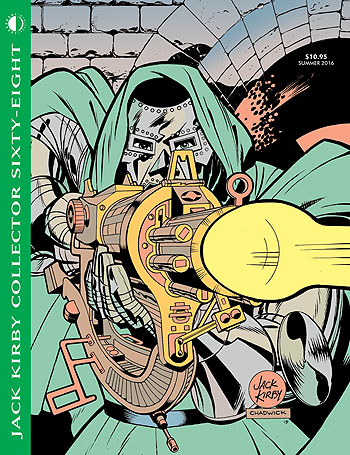
He was seeing these issues, and realized that many races were not very well represented in comics, including Native Americans. Despite the Civil Rights movement not focusing on Native Americans, Jack made the connection and added Wyatt while he and Stan Lee ironed out some details of Black Panther. (The Jack Kirby Collector #68, due out in July, will feature a column by me where I talk about Black Panther's visual origins -- it's more than that one drawing of Coal Tiger you may have seen!)
It's a pity that Jack experienced a pretty high degree of dismissiveness soon after, as he began keeping more and more of his ideas to himself until he got himself set up over at DC a few years later. He could've forged a lot more ground in the depictions of minority characters had he continued to turn his character ideas over to Marvel. While he still did some of that later, the height of the Civil Rights movement had passed by then and the ideas he had held on to didn't carry the same weight.

But how many other creators were doing that kind of hard work in the mid-1960s? Yeah, maybe Wyatt Wingfoot wasn't then and never became a headliner in the way Black Panther has, but that he exists is still a significant achievement in the world of comics. Who else was putting Native American characters as central protagonists in their biggest selling books? For that matter, who's even doing that today?
There were a lot of creators at SPACE that I hadn't heard of before, but one of them that particularly caught my eye was Lee Smith, who does mini-comics covering various aspects of Ohio history. The concept isn't new -- Jim Baker began working on Ben Hardy & the Ohio Adventure back in 1952 -- but comics that are geared specifically towards education are surprisingly few.

Whereas Baker tried covering the settlement of the Ohio Valley and the region's path to statehood, Smith tackles a variety of "smaller" subjects. Very specific individuals or events, relevant to the state as a whole. President Taft's re-election run. The Land Ordinance of 1785. The Millfield Mine Disaster. That kind of thing. He goes a step further in that, with his teacher's background, he also makes teachers' guides available for each book as well, so that educators don't have to develop their own materials from scratch to make these comics useful in the classroom. He also makes a point of not white-washing history, providing biographies of several Black and Native American people as well as not excluding the additional hardships thrust upon them by white settlers.

The books are only sixteen pages each, so they clearly don't have room to go into great detail, but Smith's intent is, I think, just to provide a high level overview that's engaging enough to encourage people to read more on their own. To pique a reader's interest enough to get them interested in the topic, and show that history is more than a string of names and dates that we're so often taught in school. The illustrations are cartoony, which helps to make the subjects more approachable, and the shortness means that reading them doesn't require much of a time commitment.

I don't know if Smith is making any money on these, or if he's doing it exclusively out of his love of Ohio and education. I'm continually kind of amazed that more people don't tap into history as a source of comics stories. There's loads of great stories out there, and comics is a medium in which is easy to tell a wide variety of them fairly easily. I'm all for seeing more, whether they're in the form of mini-comics, webcomics, graphic novels...
If you've read my pieces here on the business of comics -- or any my webcomics pieces in various venues -- for any length of time, you've probably seen me talk about how working in comics isn't just about creating comics. It's selling and marketing and social media this host of other things that aren't directly about making comics. Naturally, not everyone is going to be equally adept at all things, so the trick is to play to your strengths as much as possible, and bring in whatever help you can for your weaknesses.

But that requires three things. First, you need to know what you want to do in a broad sense. Second, you need to know yourself well enough to know which portion(s) you'd need assistance with. Third, you need to know/find people who can do those things. The second and third pieces seem pretty obvious, I think, but let's look at that first bit: know what you want to do.

"What do you mean, Sean? I want to do comics!"

Well, yes, but along what path? Where do you want to end up within comics? Is your goal to draw The Amazing Spider-Man or is that just in service of becoming an editor or even publisher? What do you want to say/do with your comics and is that something that can be done within an existing structure, or would that have to be something you create from scratch?

Many years ago, I wanted to write a book about comic book fans. My desire didn't go much further than that. I wasn't out to become some fandom expert, or sell a million copies of this book, or anything like that. All I wanted was to be able to say I wrote this book. I eventually got around to writing it, did a little shopping it around at publishers, and ultimately just published it myself just to have it out in the world. You can now go on Amazon and buy Comic Book Fanthropology. Yay, me!

But since then I've mostly just putzed along without much of a plan. That's not to say I haven't done anything, but my work hasn't been very focused. At least not in terms of my "career" in comics.

Which goes back to that question: where do you want to end up within comics? If you haven't addressed that question, if you haven't given thought to where you want to be, you can still make progress but not go anywhere.

Think about this. At many gyms, they provide a free consultation after you sign up. You meet with a trainer or fitness expert, and they walk you through a general workout to assess your current fitness level. And one of the questions they inevitably ask is: what are your fitness goals? Are you trying to lose weight? Build muscle? Improve your endurance? Are you training for a race? What exercises they might recommend are going to be different depending on what your goals are. What you need to do train for a race is different than what you need to do to bench press 250 pounds which is different than what you need to do to lose your stomach flab. There might be some overlap in individual exercises, but they're going to be different routines with each set of goals.

The same thing with comics. If your goal is to draw Spider-Man, that requires a different set of efforts than if you want to tell an amazing comics story about a kid who loses their uncle. If your goal is to do a comic that's so awesome it wins an Eisner, that's a different set of efforts than trying to make a living off a webcomic. That's not to say these are all mutually exclusive, but they don't overlap completely either. Just like those exercises.

There's nothing wrong with just striving towards general improvement without regard to where that takes your career, but that approach does make it more difficult to determine if you are indeed making progress if you don't have a final goal to measure that progress against.