

Bob Ingersoll used to write a column in The Comics Buyer's Guide called "The Law is a Ass" in which he analyzed how the law is portrayed in comics then explained how it would really work. (He's since moved the column over to ComicMix.) In 1983, he took a look at the Fantastic Four as a legal corporation and how they would have had to have incorporated and why it made sense. For today's "On History" installment, I thought I would re-run this older piece that originally caught my eye because of my interest in the FF...
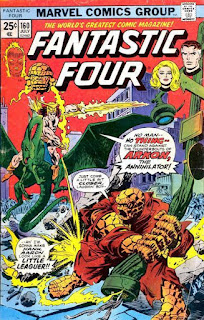 I first learned about it in Fantastic Four #160, Page 16 Panel 3, to be precise. Sometime, several months before that issue and at Reed Richards' suggestion, the F.F. had quietly incorporated. Even at the time, though I was but a lowly college student and unknowledgeable about the ways of the real world, I wondered why. Why after years of existence as whatever type of organization it had been, did the Fantastic Four suddenly incorporate? (I knew the reason had to be more than that the writer had a story line or two whose actualization required that the F.F. incorporate. Comic writers wouldn't have their characters suddenly do something which the characters had, until that point felt, totally unnecessary, simply to advance a plot, now would they?)
Now I know the reason. One law school course on corporate law revealed it. So, in the honored comic book tradition of the secret origin of Flash's masked identity and the untold story of Warlord's helmet, I offer the untold story behind the secret origin of the Fantastic Four's incorporation. Besides, I'm a peach of a guy. Rather than force any of my loyal readers to cough up the tuition for law school and suffer through a corporate law class for the answer, I'll give it out free for nothing. All I ask is that you name your first born male child after me. (Not too difficult, really, it's already far too late to name him before me.)
The F.F.'s incorporation has to do with money, first making it and then keeping it. I know that talking about money is plebeian, even crass, and that super-heroes should be above that sort of thing. But they're not. It takes money to keep Johnny Storm stocked with hot sauce or to maintain Reed Richards' one hundred pairs of stretch socks.
The F.F. has no trouble making money. Reed's patents, which supply the money, are of such number and quality that the Fantastic Four-or a small army in Bolivia-can live off of their sales and applications. Considering the F.F.'s expenses, however-the electric bill on the Negative Zone portal alone must he staggering and the Fantasti-car can't get good mileage-one can only conclude that Reed Richards has a patent on the letter E.
Keeping the money the F.F. makes is another matter, one in which incorporation would help considerably. First incorporation creates tremendous tax advantages for the Fantastic Four. Exactly how the advantages come about is complicated, so you'll just have to trust me on this one. I can't explain it to the lay public; mostly because I don't understand it myself.
(I beg your pardon, Don and Maggie? I won't get what if I don't come across with a legitimate reason? Paid? I won't get paid for the column? Okaayyy...)
It has to do with who is liable for the taxes owed by a corporation versus those owed by a partnership. Partners in a partnership share the profits and are individually liable for paying the income taxes on said profits. A corporation, on the other hand, is a separate legal entity, a fictional person which is liable for the taxes on all corporate income. Thus, it is Fantastic Four, Incorporated which pays the taxes on the income generated by Fantastic Four, Incorporated, not Reed and the gang.
The tax advantage that this situation creates comes with the realization that along with a patent of the letter E, Reed Richards obviously has political clout. Lots of political clout. Remember we're talking about a man who was able to swing enough zoning variances to permit jet plane landings, rocket ship take-offs, and nuclear generators in the Baxter Building, a mid-town Manhattan address only a few blocks from the United Nations building. All of that in mid-town Manhattan requires more pull than a Coney Island taffy concession. Reed must have enough connections, that he could get Congress to Vote itself a pay cut. With such pull working for him, Reed would have no trouble in getting the F.F. declared a non-profit organization. As a matter of fact, they are. Check The Amazing Spider-Man #l.
The point of all this is that non-profit corporations do not have to pay income taxes, because they don't have any income. So if it is Fantastic Four, Inc. which is liable for the income taxes-not Reed, Sue, Ben, or Johnny-and if Fantastic Four, Inc. is a tax exempt non-profit organization, no one pays the taxes. Indeed, there are no taxes. And if you don't think there's a tremendous tax advantage on not having to pay the taxes on fifteen quintuplatillion umptuplatillion multiplatillion impossibidillion fantasticatrillion dollars, you need to study H&R Block's 17 reasons again.
Saving on taxes isn't the only advantage that the corporate structure offers the Fantastic Four. There's an even bigger one in what's called limitation of liability. Your average super-hero/super-villain contest produces repercussions that don't go away, when the gendarmes cart off the bad guy. To quote from John Byrne in Fantastic Four #260 Page Panel 1, "Leaving [the site of the battle] will not prove quite so easy, the consequences of a major battle in the middle of a highly populated area being many. There are accounts both economic and emotional that will take years to settle." In other words, your average super-hero/super-villain contest levels your average city block. So when the F.F. trashes a supermarket, freeway and a taxicab in one issue, someone's got to pay far all that damage.
Damage to someone's property due to a super powered fight, has always been a problem, especially at Marvel, where the heroes are more destructive. If you don't believe me there, take the same test Don once gave me: picture a closed door and imagine how the heroes would go through it. Flash would vibrate through. Atom would shrink and walk between the atoms. Batman would pick the lock. Even the DC hero most likely to break down the door, Superman, you know would return later and repair it at super speed, because we've all seen him do it several times. (Which brings up a side complaint from the movie Superman II. At the film's beginning Clark Kent jaywalks and carelessly allows a taxi to smash into him. The result is a large V shaped dent in the front end. Superman never fixed the damage he caused, a fact I know, because the same damaged taxi appears later in the movie. Its dent, incidently, giving a new meaning to the term V-8 engine.)
Now imagine the Marvel heroes going through the same door. Iron Man would blast it with Repulsor Rays. Thor would smash it with his hammer and not even have to retrieve the hammer. Cyclops, Iron Fist, Power Man, Hulk, Thing and virtually everybody found in The Official Handbook to the Marvel Universe, volumes 5-11 would break down the door.
This problem of destruction has reached epic proportions under John Byrne's run of the Fantastic Four and The Thing. Case in point Thing #6. Pages 18, 19, and 20, where Ben Grimm seems to have taken out one-third of mid-town Manhattan. Only the destruction to Tokyo in Toho Production's classic, Godzilla Vs. Mecha Ruta-Baga rivals Ben's clash with Puppet Master for pure mindless destruction.
Now, someone has to reimburse the owners, so that they can restore their rubble. And it's probably not Nationwide that's on their side. If the insurance companies were smart they would already have incorporated clauses in their policies specifically exempting damage caused by super powered battles from coverage. Even if the owners do have a peace of the rock, the insurance companies wouldn't sit on their losses. No, the Rock would sue the persons responsible for the damage for what we lawyers call indemnification. (Don't ask, we had to call it something and what's coming to me was already taken.)
Your average super-hero/super-villain fight leaves your average super hero with a big law suit on his hands. Many times the hero would have a defense, the Doctrine of Emergency. This is a common law doctrine which most, if not all states, have adopted. It says, if a person causes property damage or personal injury while acting in an emergency-particularly a life threatening emergency-said person is not liable for said damage or injury. Constant reliance on this doctrine, however, is impossible.
Remember the hero must be acting in an emergency and what was an emergency once might not be so forever. I can just picture Judge Wapner's ruling. "I'm sorry, Mr. Richards. I realize you destroyed Sea World of Orlando protecting the Earth from Galactus's recent attack. But this Court must also take judicial notice of the fact that Galactus has already failed to eat the Earth some forty-seven times to date. This Court rules that Galactus has proven himself to be ineffectual, incompetent and not an emergency at all. Judgement for Shamu."
Even if the Doctrine of Emergency could he invoked over the damage caused fighting such notables as the Ringer or Leapfrog, the Doctrine does not cover all super hero caused damage. How many times have you seen the Thing get mad and rip up a Rolls? Or the Torch slag a pike in a pique? Several, right? So, when Ben Grimm levels Levitown in a jealous rage, because Silver Surfer was having tea with Alicia again, that wouldn't count.
Reed Richards must have seen several persons whose property had been so destroyed file suit against the Fantastic Four, even if Smilin' Stan and Jolly Jack didn't show us the suits. Perhaps that's why the F.F. went bankrupt back in Fantastic Four #9. And, maybe they were feeling another monetary crunch in issue 160, paying for all the property the Thing and the Torch destroyed.
Reed is, if nothing else, an intelligent, farsighted man. He saw that he had to insulate his personal fortune from the antics of this two-man wrecking crew under his command, before someone successfully sued him for not controlling them better.
Incorporation provided the perfect insulation. A corporation, such as F.F., Inc. is a legal entity, which can be sued in a court of law. Moreover, the corporation, not the board of directors is liable for the wrongs committed by its employees. In other words, when your Chrysler blows up, because of a faulty frammistat-Frammistat? I'm a lawyer, Jim, not a mechanic-you could sue Chrysler. Inc. and win all its assets. You might even win its debt to the Feds. But you couldn't collect a cent from Lee Iacocca, because he's not personally liable. This nifty little legal loophole is, as I said, called Limited Liability and is the reason so many "suits" incorporate. In the event of a lawsuit, it saves them the shirts off their backs. (After all what good is a suit without a shirt?
In the same way the Yancy Street Gang could sue Ben Grimm for the injury he caused them. They could sue Fantastic Four, Incorporated. But they could not sue Reed Richards. Reed gets to keep his one hundred pairs of stretch socks.
So there you have it, the untold story behind the secret origin of Fantastic Four, Incorporated. Maybe next time I'll tell you the real reason that Bruce Wayne abandoned the Wayne Foundation. But if you think about it you should see. I mean would you want to head an organization that sends its top executives into an eastern European country just forty-eight hours before a major revolution. The liability potential there staggers the imagination.


