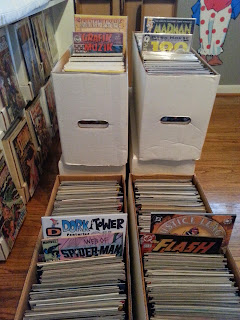
Do you recall a few weeks ago when I found six long boxes of comics out by the curb? What I didn't mention here on my blog was that a week later I found another six long boxes. Then last week, I saw another six out by the street, although by the time I was able to get back there with a car, they were gone. But last night, I came across another five boxes, which I was able to pick up. That's 23 long boxes in total, in case you've lost track. Of the 17 that I picked up, they were primarly Marvel and DC, mostly dating from the early 2000s to about 3-4 years ago, but there were a number that went back to the mid-1980s. All of them were in excellent condition, many of them bagged and boarded.
Doing some back-of-the-envelope math, I figure the guy (I'm assuming it's a guy, judging by the contents of the collection) spent somewhere in the neighborhood of $20,000 on these over a five-to-ten year period. From what I can tell from the collection, he was mostly just buying new stuff off the racks as it came out to the tune of $150-$200 a month (that is, most of the major titles both Marvel and DC would put out) with an ocassional bulk purchase of some 1980s runs.
What's interesting is that there doesn't seem to be a slow build-up into a regular collector. It doesn't look like he happened across some random issue of Batamn, started picking up that and eventually spread out to Detective Comics and then all DC titles and then all Marvel titles. The collection, rather, seems to suggest he just dove in pretty quickly. Like he walked into a comic shop and started pulling everything off the "New This Month" shelves, and immediately set up a pull list with all of those titles. To me, this suggests one of two possiblities. Either A) he was a lapsed comic reader who was excited to rediscover comics as an adult or B) he was a speculator hoping to fund his kid's education later. In either case, since the books generally don't track back further than the early 2000s, I suspect his interest was kindled, at least in part, by the Spider-Man and/or X-Men movies that started coming out around then.
I'm inclined to think we're looking at a lapsed comic reader here. At most, maybe half were bagged and boarded. And while there were duplicates of some anniversary and first issues, and the books were pretty much all in excellent condition, they seemed to be that way from a lack of negligence than any particular care and attention given to them. By that, I mean that the books appear to have been read once, filed in a long box, and left alone; they weren't read and re-read and thumbed-through. Further evidence of that can be seen in the handful of non-bagged issues that were filed a little carelessly, and wound up curling beside or underneath other issues. If this were the collection of a speculator, I should think more care would have been given to the books' preservation in a pristine format.
The collection seems to stop a few years ago. Given that every title seems to end pretty abruptly, I would venture to guess this was due to outside factors, rather than any dissatisfaction with the content itself. If it were just Marvel and DC, I could see perhaps a weariness with event-driven stories and company-wide crossovers, but he also dropped Savage Dragon, Usagi Yojimbo, Invincible, and other stand-alone titles. So perhaps the birth of a child, or medical bills, or some other significant change in where his money needed to go forced him to quit.
I get all of that. I think I have a pretty clear picture of where this collection came from, who built it, and why.
What I don't get is the sudden need to purge a collection of several thousand comics that aren't that old by throwing them out. He clearly put some decent amount of emotional investment in these stories by not only keeping current with all of them, but picking up some runs of back issues as well. Not to mention the indication that he enjoyed many of the characters as a younger reader as well, whether that was via Saturday morning cartoons or actual comics or both.
I could understand just getting rid of a collection like that if there were some significant emotional distance. The notion of "Man, I haven't even looked at these in over a decade; they're just taking up space!" There's some personal removal from the version of yourself that was spending $200 a month at the comic shop; you're no longer that person and you've had time to reset your identity. Because even if you stop being "guy who spends $50 at the comic shop every week" you typically don't make a conscious decision to stop identifying yourself that way. It's only in retrospect as other forms of self-identity take over that you realize, "Hey, I'm not that guy any more."
So how does that happen? That a guy who's has self-identified as a comic book fan for at least two significant portions of his life, just suddenly decide he's going to literally throw that part of his life to the curb? What would prompt so abrupt a change and one in which he evidently no longer sees even the monetary value of trying to resell his collection?
I'm certainly not the first person to make note of the growing number of comics/pop culture conventions that we've seen spring up in recent years. In fact, last week Tom Spurgeon pointed out that there were note-worthy comic cons in Austin, Brooklyn, Chicago, London, Manhattan, Memphis, and Munich all just this past weekend. And I know he missed one in Olympia on top of those! These aren't just signings or store events; these are full-on conventions with panels and workshops and the whole works.
Now, comics are getting more attention and respect, so some of this makes sense. I mean, the folks who might go to a London con probably don't overlap much with the folks who might go to one in Austin. But Brooklyn and Manhattan?
I was talking a bit with Kevin Budnik at CAKE this weekend, and I think he hit on an excellent point. He was a bit nervous going into the show this year because his table is waaaaay far in the back corner of the space. Argueably, the worst table there: the very last table in the corner farthest away from the entrance. Yet he was doing pretty well sales-wise -- possibly better than SPX, but he hadn't done a firm tally on that when I spoke with him -- and he attributed that to walk-ins. The CAKE show is only a couple of blocks from Wrigley Field; there's plenty going on in that area even when there isn't a game. So a number of people who stopped by just happened to be passing by and stopped in because it looked interesting. This is a show, too, that doesn't cater to a "mainstream" crowd so there aren't any cosplayers parading around to attract attention. It's just in a densely-enough populated area that a fair number of people are able to just happen across it.
That wouldn't be a solid business plan from CAKE's perspective, of course, and they don't rely on that, but I think it has helped to expand the show significantly every year since its debut in 2012. This year, I talked to and saw several creators at CAKE -- certainly more than a dozen -- that sold out of some or all of their books. If one or two people sold out, I'd blame that on them for not bringing enough, but over a dozen? That's something else. I talked to organizer Max Morris, and he was saying that their preliminary count for Day One was 1500-2000 and the half-day numbers for Day Two looked to be half that, but given how many people were selling out, I suspect the final two-day tally is closer to 5,000.
As of right now, I don't know how well the other cons did. A cursory glance over my Twitter feed suggests things went well all over. I expect a lot of the specific reasons why vary with each location, but it's hard not to come to the conclusion that comics are an accepted part of the media landscape, and people like and appreciate them whether they feature muscle-laden superheroes in spandex or screen-printed, intensely personal autobiographies with covers hand-cut with an X-acto knife. For as much as the larger cons seem to be driven by Hollywood movies and Silicon Valley games, there seems to be an appreciation of comics as an art form unto themselves.
Obviously, there's an upper limit to how sustainable that is, but it would appear that we haven't reached it yet. CAKE, as I said, is only in its fourth year. The Kenosha Festival of Cartooning only started in 2011. By pretty much all accounts, they're both doing fantastic, even with neither of them charging an admission fee. Spurgeon is also making some news himself by starting by CXC later this year; I'm sure he wouldn't pursue this if he didn't think it was financially feasible. I'm also seeing expansions on several more local shows in my area, with more guests and activities.
I suppose there's some level of independence shows can capitalize on just due to geography (again, someone from London isn't terribly likely to attend a con in Austin) but even there's enough variations in the types of shows you can put on to avoid overlap too. You're not going to find Yeti Press at a Wizard World show, for example, and you're not likely to see William Shatner at a con being held in a library like Comic Book Mania. That all seems to be working right now, as people are able to play in their own respective spaces. The over-saturation will come when we start getting regular conflicts. We've seen some of that already, certainly (without checking, I seem to recall some early issues between a couple of Cincinnati area shows last year) but it's not a regular problem.
Yet.
Naturally, we'll all be keeping an eye on this, if only for the self-interest of seeing which conventions we can attend, but the thing to watch for more broadly will be recurrences of conflicts among dates, regions, and audience make-ups. When those notices start becoming regular, that's when you'll know we've collectively pushed things too far.
Of all the comic strips that I would never, ever, ever have expected to make the transition to animated cartoon, I would think Gary Larson's The Far Side would be at the top of my list. I don't recall hearing about it at the time, but apparently it as indeed made into a Halloween special for CBS in 1994, directed by Marv Newland of Bambi Meets Godzilla fame.
Much like Larson's strip, there's no single cohesive story, or even recurring characters; it's just a string of largely unrelated gags mostly only with tenuous connections to one another. Which strikes me as a difficult premise to sell for television. Even sketch comedy shows have recurring actors and characters. But even more strangely for a network special, there's almost no dialogue throughout the entire half-hour. I have no idea how that snuck past network executives.
And yet, it somehow was greenlit for a sequel! But not until 1997, nearly three years after Larson's last new Far Side comic ran in papers. However, that sequel was only broadcast in the UK. Both eventually made it to DVD in 2007, but they have long since sold out.
Continuing with the strangeness of all this, after the first special aired, Larson made any number of changes to the piece. Not just a bit of re-editting or changing the order of the gags, but he added several entirely new sequences as well as changed the animations on some of the existing material. I've only seen the home video version but based on the descriptions of the original, it seems to me that all the changes were done for the sake of improving the humor.
Ultimately, the whole endeavor of producing an animated version of Larson's singularly absurd comic is almost a tale as equally absurd itself. Although I'm grateful for it, I really don't understand how any of it actually happened.
In any event, here's the home video version so you can see it for yourself: Tales from the Far Side...
A year or two back, I bought some comics from trans creator. I know she was trans because many (though not all) of her comics were somewhat autobiographical in nature. I don't know exactly where she was on her journey, but she had transitioned enough at that point where she had x-ed out her previous name on older books, and hand-written her new name in its place. I'm sure the cost of reprinting those books factored into that decision, but the way her old name was crossed out -- so that you could still pretty easily read it, and you clearly weren't looking at a typo she was trying to hide -- gave me the impression that, while she wasn't ashamed of her past, she was very proud of where she stood and where she was going.
Maybe I was reading too much into that. I talked to her about her comics, not her gender identity.
But I'm thinking about that a bit today. When she made some of those older comics, her identity, at least from an outward social perspective, was that of a man. Regardless of how she felt, she presented herself as a man and, I suspect, was largely treated as one. The comics she made during that time would have been reflective of that, directly or indirectly. Her later experiences as a woman may have led her to approach the comic differently. Not that she'd be a fundamentally different person, of course, but A) she (theoretically) wouldn't be wrestling with her gender identity on a daily basis which is bound to free up some head space for thinking about comics, and B) the people around her would likely be treating her differently, which would likely impact her day-to-day mood. So does changing the credit on her comic make sense?
Yes and no.
When Jacob Kurtzberg first started doing comics professionally, he used a number of pseudonyms: Jack Curtiss, Curt Davis, Ted Grey, Charles Nicholas, Fred Sande... He used different ones for different reasons. In some cases, he used them simultaneously in order to hide the true size of the company he was working for. In other cases, he was ghosting comics and was trying to match a particular style. But the name he used most often, Jack Kirby, was chosen in part to obscure his Jewish heritage. That was the name he ultimately became successful under and, although he fully owned up to the comics he worked on under other names, he never went back to change them. This was partially from little of his work being reprinted during his lifetime; much of the Kirby ouvre we enjoy today are only seeing their first re-publication (in some cases, first publication at all!) after his death. From the perspective, why bother re-tagging the material? He was still saying he made it, he just didn't bother updating the credits page.
On the other hand, today's Kirby-related materials all use "Jack Kirby" regardless of what name he originally worked on the piece under. That's a marketing decision since "Jack Kirby" is a much more famous name than "Fred Sande." Likewise, if you're still selling/promoting work that you originally developed under another name, you're in the process of trying to build that type of reputation. As long as you're still proud of the work, you'd want that associated with your current name, the one you're putting on material today. So if someone buys and likes your older work, there's less of an issue trying to track down your current work.
Furthermore, the person you are today isn't the same person you were five, ten, or more years ago. Even if you have the same name you've always had, you've got several more years of experiences and personal contacts that have influenced you. You're currently the culmination of your lifetime, and your decisions and choices today are based on a history that you didn't necessarily have before. So if none of us are who we used to be, but still use the same name to identify ourselves, why should a person who has consciously and deliberately changed their name/identity be expected to be called, retroactively, by a name that they no longer use?
The decision is, of course, a personal one. If a creator feels that their previous work was done under an identity so different from their own as to be a different person, there's no reason to expect them to update the credit. But if instead, they still feel the work is valid and representative, there's no reason to expect them to continue using an identity that is no longer in existence.
I don't know that I ever expressly seen people who claim to have problems with this kind of thing (though, at least in comics, it's pretty rare, certainly when you're talking about books with sales that number more than, say, 1000) but, if anyone does raise a concern about it, it seems to me that that is more of an issue with person voicing the opinion than anything else. It's your comic; credit it however you want. If anyone balks, you can rest assured that they're complaining not because you're being disingenuous with the credits (e.g. see my Kirby example above) but that they're uncomfortable with the idea that they're not able to define your gender identity for you.
Ray Bottorff offers up some 1940s documents from George J. Hecht, President of the Parents’ Institute, "about printing comic books aimed at African Americans in order to include and encourage their participation in the war efforts."
Not directly comics, but certainly applicable, Natalie Zutter summarizes the "In Our World and Beyond" panel from BookCon 2015 where they "discussed the obstacles to depicting full representation of marginalized characters in SFF."
Here in the United States, we really don't have a good knowledge of Korean comics. Manhwa are generally lumped in with Japanese comics, and the distinction is lost, I think, on even most comics fans. Further, I don't think we have a good sense of the history of Asian comics in general. Aside from being able to name one or two creators like Osamu Tezuka, I suspect most fans couldn't cite any notable works or creators much earlier than the 1970s.
That's been changing in recent years. Mara Lina Thacker has gotten some attention recently surrounding the work she's been doing building up a huge collection of South Asian comics at the University of Illinois Urbana-Champaign. And now Columbia University has amassed (and continues to grow) a very large collection of manhwa. These types of endeavors, I think, will go a long way towards expanding our collective knowledge about comics in general and will help us move away from seemingly always focusing on the US market.
In this video from an event last month, Hee-sook Shin speaks for about 25 minutes on the collection of manhwa at Columbia University, and then Dima Mironenko speaks at length about "official" North Korean comics from the 1950s and '60s and how they were often deliberately misread for a narrative counter to what the government producing them had intended.
I've bought more than a few comics over the years that were... not great. Ones that I knew were not great when I bought them. Ones where the art looked sub-par, and the creator(s) pitching me the comic from across a rented table didn't make the story sound all that good either.
But, you know, I get that not every artist is going to be able to draw like Bryan Hitch right out of the gate. And I'm sure that Neil Gaiman's earliest stories could use more than a little polish. And I know that comics is a hard business. An astoundingly hard business. An incredibly, amazingly, profoundly hard business. So if a creator's got a good hustle, is clearly passionate about what they're doing, and it's not something I've seen tried a million times before (Listen, do we really need another straight, white, male superhero? Marvel and DC really have done that ad nauseum, and I'd wager that your version -- no matter how inspired you think it is -- is not actually covering any new ground), I'll try to help out if/where I can.
What surprises me, though, is when creators -- even these new folks who are clearly trying to make their own comic for the very first time -- make some seemingly mind-bogglingly even-rookies-should-know-these mistakes. Let's cover a few of them...
Credits -- Include the names of everyone who worked on the book. I just looked at two entirely different comics I picked up back at C2E2 where no one was creditted at all anywhere in the book. You want to use a pseudonum or something to protect your identity, that's fine, but put something in the book!
URL -- If you list a website in your book -- and you absolutely should! -- make sure it works. Yeah, I get that there can be technical glitches that can cause sites to come down unexpectedly and you might not want to keep old sites up indefinitely but, again, I found multiple books that only came out a few months ago that A) used bad web addresses or B) used none at all.
Website -- It's fairly easy to get a decent looking website these days even if you're not a designer or programmer. It's even fairly easy to set up an online shop. But I'm not encouraged to buy something if your website A) doesn't cite credits anywhere (see Rule #1), B) has links to pages that were set up in a template but you never bothered to fill in with actual content, or C) provides zero manner in which to contact you. Again, problems I found from recent purchases.
Timing -- I know you're excited about your book and you think it's going to be the next Walking Dead. And I know you've read up about world-building and transmedia and marketing. But if this is your first book, you really don't need all that yet. Just work on the comic itself for now. You work on all those angles right at the start, you'll have a lot of extra shit lying around when your comic doesn't take off right away. I've got a goodie tote bag here with a promo comic, a white paper explaining a huge backstory, a button, five wrist bands, and a poster. But their Kickstarter for a $100,000+ animation project raised less than $10,000. It may eventually be awesome, but you're doing too much, too soon, guys!
Tabling -- Also, recalling where I saw some of these folks on the convention floor, I might suggest you probably paid WAAAAY too much for a booth, given your skill-set and level of notoriety. I don't know exactly what any of you were actually charged, of course, but I'm betting a table in Artist Alley would have been cheaper and you would've been more likely to make a profit. Or at least break even. I mean, if you see creators like Scott Snyder and Gail Simone -- who are currently popular and have lines of people waiting for autographs -- if you see them with just an Artist Alley table, what makes you think your book is going to move so many copies that it warrants a full booth?
Like I said, I've bought a lot of books to help struggling creators out. It's a tough market, and I want their voices to be heard. But if you're not even able to get some of these fundamentals down, I definitely won't bother trying to help again.


 What's interesting is that there doesn't seem to be a slow build-up into a regular collector. It doesn't look like he happened across some random issue of Batamn, started picking up that and eventually spread out to Detective Comics and then all DC titles and then all Marvel titles. The collection, rather, seems to suggest he just dove in pretty quickly. Like he walked into a comic shop and started pulling everything off the "New This Month" shelves, and immediately set up a pull list with all of those titles. To me, this suggests one of two possiblities. Either A) he was a lapsed comic reader who was excited to rediscover comics as an adult or B) he was a speculator hoping to fund his kid's education later. In either case, since the books generally don't track back further than the early 2000s, I suspect his interest was kindled, at least in part, by the Spider-Man and/or X-Men movies that started coming out around then.


