Here in the United States, it is Martin Luther King Jr. Day where we try to honor the civil rights leader. Often with a sale on mattresses. And every year, various comic blogs and news sites trot out the either The Montogmery Story comic and/or the MLK-focused issue of Golden Legacy. I've done it before myself, so I'm not judging here.
But since I've started devoting Mondays to writing about webcomics, I thought I should take a look at some webcomics that talk about or feature Dr. King.
Problem is: I'm not finding much. There's a handful of one-offs where King is referenced, but these all seem to be gag-a-day strips with no real sense of continuity. And I can't seem to find any instances where a creator actually brings it up more than once. So it's not treated like, say, Christmas or any other annual holiday. To be fair, Martin Luther King Day is considerably more recent; it wasn't officially celebrated at all until 1986, and it wasn't observed by all 50 states until 2000. So it doesn't even have the legacy of smaller holidays like Labor Day.
Not surprisingly, I'm writing this before I've had a chance to check many webcomics today to see if there are any references, but I've not seen much historically. What's more interesting is that I don't recall seeing hardly any webcomics that really tackle civil rights issues, either contemporary or historical ones. Certainly nothing on a regular basis.
And I find that really odd, considering that a person can do that type of series as a webcomic that might not be viable in other formats. I mean, there are comics out there where people discuss issues about their weight, chest size, hair, deafness, alcoholism, suicide, sexual identity... and that's just what I read regularly.
But civil rights? Not seeing it. (Again, as an ongoing theme.) Secret Asian Man did address racial issues, particularly around stereotypes, but that's been on hiatus for a year now, and most of the storyline just before then focused on a more metatextual interplay between the creator and his protagonist.
I wonder if something like Questionable Content or Templar, AZ are more the modern standard bearers for civil rights? Because creators Jeph Jacques and Spike Trotman make it a non-issue. There are people of color in inter-racial relationships, and none of the characters has made a thing of it. (At least, not yet. And not a race thing.) After all, King preached in his most famous speech, "I have a dream that my four little children will one day live in a nation where they will not be judged by the color of their skin but by the content of their character." And that's exactly what we're seeing in these strips.
There're still vast amounts of work to be done with regards to civil rights in this country. King's dream has not been fulfilled. But I wonder if his legacy lives on in webcomics like Questionable Content. Where that ideal is presented as the reality, and gives us a place to strive towards. Where it's not brought up because it doesn't need to be. It's just part of the background. We can look into a world like King saw, and see that it's really not so different than our own world; there's just one less thing people hate on each other about.
A few years back, I bought and read an excellent biography of Bill Mantlo. While reading it, I realized that many of the earliest comics stories that stood out for me were written by him. (This was back when I was too young to be concerned about creators.) And I thought that, since his work did resonate with me, maybe I should pick up Rom and Micronauts as he worked on both of those titles, which I'd always heard good things about. But when I thought about it, I came to the conclusion that they weren't anything I could simply wait for a trade collection of, since the rights to the characters are not owned by Marvel, the company who first published the books. That's not to say they'll never be reprinted, of course, just that there's a larger legal challenge there than if Marvel wants to collect any of the characters they actually own.
But, due to a variety of circumstances, I haven't been terribly active in looking for these back issues. I think I've scanned eBay only a handful of times, and I was immediately dismissive of anything that wasn't a complete run. And, even then, I've really only given consideration to a collection if my out-of-pocket exspenses amount to maybe a dollar a book. From what I'm seeing, that's not only not unreasonable, but it's only just shy of what some of these collections go for. Rom tends to run a little pricier than Micronauts but overall they even out.
Here's the thing, though: I'm interested in these for the stories. I don't really care that they're the original comics that were on newsstands back in the day. I don't want the artifacts for their own sake; I want to partake of the content.
Retailers, of course, have seen this trend for some time. That's why so many comic shops have switched from rows of long boxes to bookshelves of trade paperbacks. But while there are some interesting things going on here econimcally, there's also something interesting that's happened from a fandom perspective. Namely, comics fandom split in two.
To be fair, there wer any number of splits in comics fandom before then. You had Marvel versus DC, Superman versus Batman, American comics versus European versus manga, newspaper strips versus pamphlets, etc. But this was another significant rift, and one that would be difficult to bridge.
Back in the day, if you wanted to read the first appearance of, say, Wolverine, you had to track down original copies of Incredible Hulk #180-181. That story simply hadn't been reprinted. Which means that if you were an early Wolverine fan, you were scouring back issue bins looking for a first (i.e. only) printing of those two issues. A decade or two later, and it would be reprinted half a dozen times in various formats, and a year after that, it would become available digitally. But in the mid-1970s, a person just looking to read that first story had to do the exact same thing a person who had to have a complete run of Incredible Hulk did: they had to scour back issue bins. The Wolverine fan and the Incredible Hulk completist look the same.
But now? Why should a Wolverine fan ever bother looking for that issue? It's been reprinted almost two dozen times, and is available in multiple electronic formats, all of which are far cheaper than the original issue. The Holy Grail for him/her isn't having the issue, but reading the story.
When publishers started focusing on trades several years back, retailers saw their back issue sales drop and they had to drop prices on what they were selling. It became less profitable, hence their move to bookshelves. Now we've seen digital comics come to the fore and, while they have markedly not cut into pamphlet sales as many retailers feared, I wonder if anyone's looked into pricing on the back issue market that remains. After all, digital back issues for Marvel tend to run only $1.99, cheaper than even the cheapest reprints out there! (Although, now that I look, that particular Hulk story strangely does not seem to be available yet on comiXology.)
But that collector looking to have a complete run? S/he is still hitting the back issue bins, leaving the Wolverine fan to wonder what the hell his/her problem is. Which is unfortunate because that split between the two groups creates a mental barrier that separates us further than is necessary. Part of the joy of fandom is connecting with other people, and if we're seeing a split within fandom... well, that's not very connecting, is it?
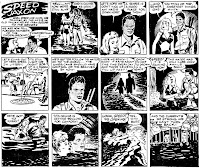
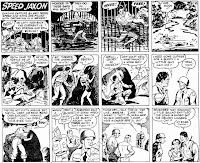
I considered running this as an On History segment, but I think the social message is more significant than the historical one here. Speed Jaxon was a WWII-era comic strip by Jay Jackson (sometimes under the pseudonym Pol Curi) that ran in some African-American newspapers like the Chicago Defender. They were kind of similar to Buz Sawyer with a focus on wartime adventures, with the notable exception being that the titular hero was Black.
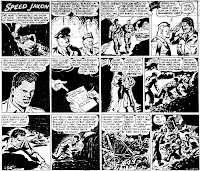
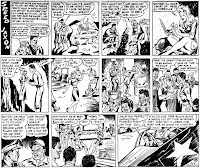
The other significant difference was that Jackson regularly wove in a message of inclusion and equality. In the examples below (all of which are slightly modified scans taken from the Billy Ireland Museum) you can see a number of examples where white American officers express very negative attitudes towards Speed which, in turn, he repsonds to with a mixture of resignation and quiet strength. He repeatedly tolerates the poor behavior, and then tries to prove how wrong people are about Blacks by just being a better hero than the white soldiers.
Of course, just being a better hero is a whole lifetime of issues to unpack. To those who've had to deal with it at all, the notion of having to do twice as much 200% better than their white counterparts in order to be given half as much is a refrain they've had to live their whole lives with. From what I've seen/read of the strip, though, Jackson himself didn't address that other than it was a simple matter of fact. I can only guess that in the 1940s, Jackson didn't feel he could hope for a loftier victory than just even having the chance to be treated as an equal. The dialogue is often a bit ham-fisted, but only in the same way many comic strips of the time were.
But there's another element at play here which seems to be handled with much greater subtlety. Speed's girlfriend in the initial installments was a Black schoolteacher named Carmen Brooks. I don't know what happened to her, but by the time we get to the sequences below, he's found a new love interest in Minta Washington. I can't find an instance where her actual heritage is expressly named (other than she's not Italian) but she's clearly identified as a European blonde. So she's not an American, but still decidedly pretty white. And she's seen here first holding hands (in the fifth piece I reproduce below) and then kissing Speed (in the eighth)! And in neither instance is any particular attention drawn to it; it's just two people interacting somewhat romantically.
Now, that Minta isn't American probably assuaged some possible concerns about showing an interracial couple (not to mention the fact that the strip only appeared in African-American newspapers) but Jackson still threw it out there as a completely normal and casual thing. In 1943, nearly a quarter century before Loving v. Virginia. Amazingly progressive, and extremely deftly handled, I think.
Maybe some of Jackson's overt messaging was a little over-the-top, but I wonder if that was done deliberately to slip these other elements in more surreptitiously. Distract readers with an obvious issue, and slide another one past them while they're complaining about the first. Maybe? I don't know. Frankly, I can't find hardly anything written about Jay Jackson, and even less on Speed Jaxon. I've only been able to find about 30 strips online, and can't even pin down when it first started or stopped. Which is a shame because Jackson seemed to know what he was doing, and creating an entertaining and progressive comic strips besides!






- As of last week, Wowio is now a publicly traded company. Well, not quite, I don't think. They've got all their paperwork in, and now they need to be assigned an official trading symbol. I'm honestly not quite sure on that grey area between getting the red tape sorted and a formal IPO.
- You've heard about the old Fantastic Four film that Roger Corman produced but never released from the mid-1990s, right? As an old school FF fan, that was a Holy Grail for me for many years, and I was thrilled when I finally got a half-decent (obviously bootleg) copy. (Hell, I was the one guy who bought a copy of Carnosaur just so I could get the official trailer of the movie!) So I was thrilled when I discovered the other night that they're producing a "Making of" documentary about the film. I would've been the first person to back this if it were a Kickstarter, but they're just doing it old school. Making the movie and selling. Here's the documentary trailer, now go pre-order the frickin' thing! (Point of Pride Sidebar: One of the fonts they're using throughout the piece is the Fantasti-Font that I designed back in the late '90s!)
Back in late 1943, newspapers debuted the rarely discussed comic strip, Lois Lane, Girl Reporter. It was a direct spin-off of the Superman strip running at the time.
Evidently, Jerry Siegel and Joe Shuster, who were working on the Superman strip in addition to their comic book work, were having difficulty keeping up with the ongoing syndicate deadlines. This was probably partially exacerbated by them working through DC instead of with the syndicate itself. Regardless, the McClure Newspaper Syndicate started growing increasingly concerned that newspapers were going to cancel the popular character's strip if it couldn't appear regularly and on time. Since McClure had already, for all intents and purposes, farmed out the strip's editing to DC instead of keeping it in house as they normally would, they went back to DC to demand a way to get a more reliable source of content.
Where the exact idea came from seems to be unclear, but DC basically went behind Siegel's and Shuster's backs to create a "topper" comic strip spin-off. It was essentially filler material, not directly related to the main Superman storyline but still somewhat tied to the Superman universe. So when Siegel and Shuster were running behind, a topper strip could be dropped in to cut some of the slack. These were done at no additional cost to the newspapers, of course, but I'm certain they were a pain point for both McClure and DC.
The strips originally ran sporadically between October 24, 1943 to February 27, 1944. As far as I can tell, only twelve were produced and the only paper I've been able to confirm ran all of them was Cleveland's Plain Dealer. Despite the credits, the art appears to be (at least primarily) by Wayne Boring.
Who better to discuss getting paid in the world of webcomics than an actual webcomics artist? Ethan Young, the writer/artist on Tails, posted this piece late last week on being a working cartoonist. He has some great points worth sharing and, with his permission, I'm re-running it here. Take it away, Ethan...I just read a very interesting and sobering article over at The Beat; a mini-expose of what it's like to be a working cartoonist. And it also got me thinking a little; I want to express my feelings about being a comic-centric freelancer. I also wanna discuss money, which is a difficult subject to broach for cartoonists because those who make less become envious and those who make more take a little pity (though not maliciously). But here goes with my rant:
I make a pretty decent living with cartoons and comics...and it makes me feel super guilty. Guilty because I see and/or hear about other cartoonists struggling. Guiltier still, when it comes to comic books, people generally think that a more famous/popular cartoonist makes more -- that fame commands money. It becomes reinforced within the comic culture: you can charge more for your work when you become famous. Well, that's actually complete bullshit.
I'm not famous at all. I have a pretty small but fairly loyal fanbase for Tails, but I'm also an obscure artist to most of the comic-reading public. But I get paid very, VERY well by my clients from the advertising and marketing world. Doing comics.
See, in the real world, clients don't give a shit if you're famous. They don't have that internalized HERO WORSHIP with artists that comic fans have. They just want to see talented work delivered at a reasonable time with professionalism and tact. I've always told aspiring freelancers: Clients don't just pay for talent, they pay largely for experience.
But in the comic book world, well, the old rule applies: you get paid more when you become famous/popular. Most of the COMIC projects I've been offered have been with fairly standard beginners' rates or really low rates. (Sorry, but I've been freelancing for almost 10 years, I'm not a beginner; I'm just unknown because my life goal isn't to draw someone else's creations at a big company.)
Low pay for journeyman cartoonists is the accepted norm in comics.
And yes, before you try to correct me, I know, the comics world is different than the real world. "Stop complaining and shut up, Ethan!" But here's the thing: IT SHOULDN'T BE!
The comic book world, like everywhere else, is inhabited by ADULTS! Adults who should understand that creators deserve a living wage. Not everyone can do what we do. Not only is talent a rare thing, but it takes a LIFETIME of practice and honing to turn that talent into a real SKILL. You can't just take a 6 month course in Human Anatomy and expect to understand anatomy when you leave. (Heck, I still see 40-year-old artists who don't have a grasp on anatomy)
Have you ever had a plumber come to your house? I have. And it cost me $500 for a job they didn't even do right (no offense to all the competent plumbers out there). But guess what, I can go to a convention and get a super talented artist to do a super awesome, professional sketch for $20. Try getting your plumber to come to your house for $20.
You can make the argument that plumbing is more essential than art, especially as a homeowner, but that would be beside the point.
Professional service should always come with a professional rate.
Annnnnnnnd THAT is why I felt bad reading this article on The Beat; reading about super talented comic artists who are struggling. Because (I'll say it again), we have reinforced the idea that low pay for journeyman cartoonists is the accepted norm in comics.
And we have to change that.
I am 41 years old. Depending on who you ask, I'm either at the upper end of comic publishers' target demographic, or a bit beyond it. Well, at least those publishers who make the most money in comics. If, then, I'm outside comics' target audience, am I still relevant?
If I go out and buy the latest issue of Amazing Spider-Man, I don't doubt that Marvel would be happy to take my money, but if I choose not to buy it, isn't their opinion going to be, "Meh"? They're not trying to sell Amazing Spider-Man to me; it's not written and drawn for a 41 year old who's been reading comics as long as he can remember. It doesn't speak to me because it's not supposed to. It's geared towards a younger crowd, and it's their opinion, as shown through their dollars, that Marvel is interested in.
Some could argue that a 41 year old is still relevant if s/he can influence the target demographic with, say, a blog. But then the question is: how much influence would even a popular blog have relative to the marketing campaign dollars of a large corporation?
I read a book a little while back on the failure of the John Carter movie from 2012. As the movie launch neared, the existing John Carter fans -- the ones who'd read all the books a dozen times over, and were genuinely excited to see the character succeed as blockbuster movie -- put together a pretty massive (as far as coming from fandom is concerned) campaign to promote the film. Fan-made trailers, fan-made screen wallpapers, fan sites extolling the characters' history and lineage... But Disney's marketing machine behind it did a phenomenally poor job, seemingly completely oblivious to both the film's story and the potential audience.
I haven't seen the movie myself, but reviews seemed to be generally okay. Not great, but not bad. But the marketing did such a poor job of selling the movie, that it's generally considered a massive failure. The fans simply could not overcome that. It's not that Disney was trying to market a bad movie, they were trying and failing miserably to market an okay one. And the die-hard fans who wanted John Carter be successful enough to warrant at least a sequel, if not a franchise, could not move the needle no matter how hard they tried.
And, hey, look at that! The same company that made John Carter also happens to own Marvel!
It's not that fans have zero impact, but their influence only extends so far. And the influence of folks outside the target audience is even more limited. Why should a 25 year old care what an old geezer like myself thinks after all?
A-ha, but can I be relevant somewhere else? Like maybe a publisher whose target audience is middle-aged? Someone who is making comics that are aimed at someone just like me? Now there's some opportunity for influence!
So if your interest and concern in comics is having your voice listened to, keep in mind who the target audience of your favorite stories actually is. If you, as a 41 year old, are trying to tell DC that they're not doing a good job with Superman, they're probably not going to hear you. But if you tell them that as a 25 year old, they'll at least listen.


 I wonder if something like Questionable Content or Templar, AZ are more the modern standard bearers for civil rights? Because creators Jeph Jacques and Spike Trotman make it a non-issue. There are people of color in inter-racial relationships, and none of the characters has made a thing of it. (At least, not yet. And not a race thing.) After all, King preached in his most famous speech, "I have a dream that my four little children will one day live in a nation where they will not be judged by the color of their skin but by the content of their character." And that's exactly what we're seeing in these strips.


