Latest Posts

I got home from work last night, and there was nothing on the porch. I stayed in all evening, and never heard the anyone knock or ring the doorbell. But as I was leaving for work this morning, I saw a package leaning up against the door. I grabbed it, drove to work and opened it once I got in to find birthday gifts from my brother and his family...
Fantastic Four by Jonathan Hickman and Dale Eaglesham
After a quarter century of buying the comic every month, I finally stopped buying this comic monthly shortly after Marvel's "Civil War" storyline. The book just wasn't fun any more. And, although I haven't really been paying attention to it at all since then, I heard a few good (if vague) things about Hickman's run on the book. It'll be interesting to see not only what he's done here, but also what my reaction to my old favorite will be after a multi-year hiatus.
Fear Agent: Hatchet Job by Rick Remender, Jerome Opena and Kieron Dwyer
I've got the first three TPBs of this from a little while back and enjoyed the character of Heath Huston and storyline. I'm interested to see how things progress after all the reality-changing and whatnot from the previous work.

Thanks to my brother and his fam!
My dad was passing through town this weekend and stopped overnight with some slightly early birthday gifts from Mom and him. Certainly not necessary, but much appreciated. The comics related stuff you might be interested was...
The Creeper by Steve Ditko
I'm still not entirely sure what DC was thinking in the 1970s when they got Jack Kirby and Steve Ditko to just do whatever weird and wacky stuff they wanted. I missed all of it the first time around (I was a bit too young to be reading those back then) and am grateful that they're being reprinted now. I've never read any of Ditko's Creeper stories, so I'm eager to get into this.
Perhapanauts: Second Chances by Todd DeZago and Craig Rousseau
I read the first volume of Perhapanauts a little while back, shortly after discovering Alex Grecian's and Riley Rossmo's Proof. I'm intrigued by the vaguely similar concepts and how different they're turning out. Both series are very good, though I am a tad more partial to Rossmo's illustration style.
Planetes Volume 4, Book 2 by Makoto Yukimura
I'd read the first three volumes of this and was summarily impressed with everything in them. I've had difficulty tracking down the last two books, though, so this is a welcome addition. Now, I just need to get Volume 4, Book 1 and I'll have the complete series. I'm still left with the question of why they opted to have five books total, and label the first three as Volumes 1-3 (which seems obvious and straightforward) but then the last two books are BOTH labeled Volume 4 but broken into two parts. Why not just Volumes 4-5? In any event, great reading here!

Thanks much to Mom and Dad!
Ben Costa's been working on his webcomic, Shì Lóng Pàng, The Wandering Shàolín Monk, for a little while now but he won a Xeric award late last year to get the book into print. He's got it listed in the August issue of Previews for an October release, and was kind enough to send me an advance copy for review.

Now, if you've read my blog for a reasonable length of time, you might know that I'm admittedly biased towards Xeric-winning comics. I haven't read every Xeric winner, but I've had more luck using that as a measure when looking out for new material than just about anything else. What's interesting to me this time, though, is that I had sampled Costa's comic a while back online and decided not to follow it. When I first picked up the printed copy, I couldn't recall the reason why and in fact thought it rather strange since it looked very much like a book I would enjoy.

The story takes place in 17th century China. It centers around a ShĂ olĂ­n monk by the name of PĂ ng who is in search of his fellow monks after the destruction of their temple at the hands of the Qing dynasty. It is said that Qing feared the ShĂ olĂ­n's power and tried to wipe them out, so now PĂ ng is left essentially as a refugee in his own land. Coupled with the fact that he's lived a sheltered life as a monk for his 20-ish years, PĂ ng really does have a difficult road ahead of him.

The destruction of the temple and how PĂ ng finds himself homeless is mostly told through flashbacks. But despite flipping between time periods regularly, Costa does a good job of telling the reader where they are in the story. He also eschews, from time to time, the conventional Western storytelling technique of reading right to left, and adds directional indicators to guide the reader with how he wants the page to be read. I don't think these are always 100% successful, but they work more often than not and make for some interesting reading arrangements. Serious kudos for taking up some difficult storytelling challenges and making them work.

The book is filled with a great deal of Chinese history and culture. While the characters generally have their dialogue written in contemporary and colloquial English, Costa maintains Chinese names and sayings, and provides footnotes for extended explanations. It turns out, I think, that this is why I opted to discontinue reading it online.

The footnotes are presented like you'd expect footnotes to be presented. A little superscript number after an unusual word or phrase, and an extended explanation at the bottom of the page. Since Costa posts a full page at a time online, this means that a notation cited at the top of the page can't be shown on your computer screen along with the explanation. And for me, who reads all footnotes as they come up within the body of the text, that meant that I'd have to scroll down and back up several times with a page that might have one or two footnotes. With the number of footnotes provided in the first 30-40 pages, that got annoying really quickly.

The printed version solves this entirely by allowing the reader to see an entire page at a glance. PĂ ng, The Wandering ShĂ olĂ­n Monk in printed form very much seems how Costa intended the book to be read from its inception. Unlike many webcomics that get made into print products, PĂ ng seems very much more at home in this format. You certainly CAN read the whole thing online for free, but I think you definitely get a greatly improved presentment in printed form.

(It's worth noting, though, that the regularity of footnotes drops off dramatically after those first 30-40 pages. Costa mostly uses them for background since Westerns are, by and large, extremely unfamiliar with Chinese history at all. Of course, if you don't read footnotes in the first place, this is all totally a moot point!)

Now that I've read through the story, it's easy to see why this was a Xeric winner. It's charming and entertaining and educational. It's got a good mix of action, drama (not the same as action!) and some fun light-hearted moments. It's an excellent read, and that it's couched in a significant historical context make it that much more worth your time and money!

You can preorder the book through Diamond Comic Distributors using order code AUG101056 or directly from Costa online for $20. Do the latter before August 16 and Costa will sign and sketch in your copy for free!
A friend of mine had the following thought this morning and posted it on Facebook just to get it out of his head:
The lure of nostalgia is safety. You already know the outcome; you survived. Find someone who yearns for yesterday and you've probably found someone who is afraid of tomorrow.
He quickly received a number of positive comments, and elaborated a bit...
... I think there is a distinct difference between appreciating something, remembering it fondly, and yearning, which connotes, to me at least, an aching quality. We can ache for a past that includes loved ones we miss or happy events without necessarily feeling fear of what tomorrow may bring. But I think the less specific way in which some people view the past in a nostalgic way -- that vague sense that it was all better yesterday -- is fueled by the comfort of knowing we made it through the trials and tribulations we faced and the fear of not knowing whether we will be able to do the same with today's or tomorrow's challenges. That's really what the thought was all about.
How much of that plays into reading comics then? How much of reading the same title month in and month out for decades on end is an appreciation of the character, and how much is an appreciation of what those stories helped you with when you first started reading it? I mean...

If you read Detective Comics because you think Batman is cool, that's one thing. But if you read Detective Comics because you really related to the stories that were being told in the title years ago when you were feeling alone and alienated in high school and you don't think the current creators really get Batman the same way that they did back then, that's something else entirely.

The problem, of course, is being able to recognize that distinction (or one like it) in yourself. Because an emotional shift like that tends not to happen overnight. It's a gradual process, and not one that's easily quantifiable either. So you wind up reading the same comics for decades with only the vague sense that the stories aren't nearly as good now as they used to be. It takes some time for you to stop and consciously contemplate why you're reading the books you're reading, and whether or not that's based on the actual (and current) merits of the book or it's primarily a holdover from days gone by.

You could still enjoy the book, and even enjoy it for very different reasons than before, but if you're enjoyment is based more on nostalgia than anything else it might be time to see what's going on in your life NOW and what you might respond better to.
Tribute to Mark Gruenwald...

(Link care of Tom Brevoort.)
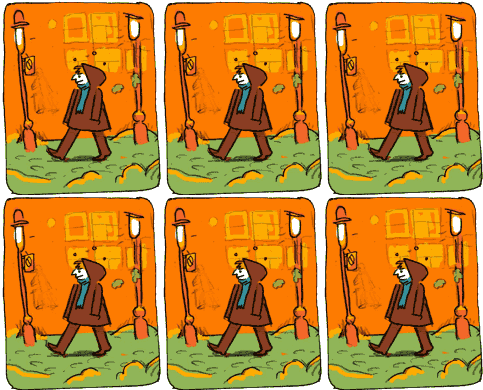
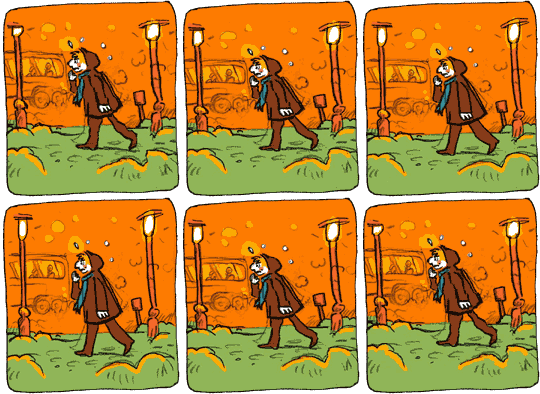
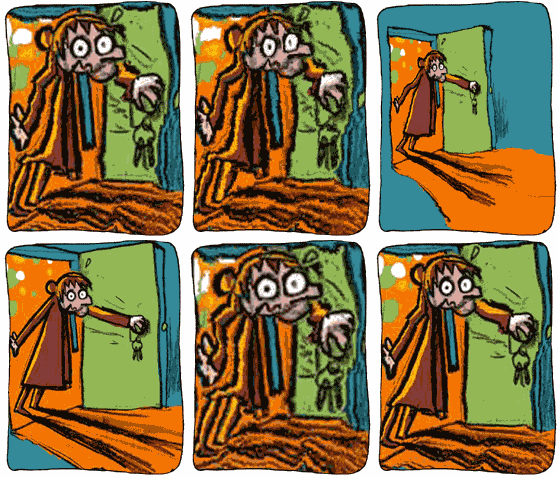
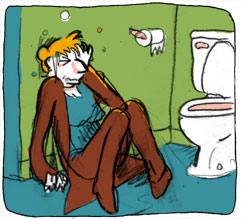
French artist Vincent Giard has apparently been playing around with comic-animation hybrids. The basic story is laid out and structured like a comic, but he adds animation to highlight the mood. Check out this silent comic he posted back in May...
01 02
030405
06
07
080910

Note that none of the animations actually depict motion at all, the typical use for animation. Instead, the animations are used to enhance the feel of the individual panel. Not all of his online comics use animation, and there are a few panels that use it for the purpose of conveying motion of some sort, but by and large, he uses animation judiciously and to specific emotive effect. Probably the most interesting/unique mix of comics and animation that I've seen. Cool stuff and makes me wish I'd take French in high school instead of Spanish.

(Hat tip to the S.O. for pointing this out to me!)
The Fantastic Four was my first permanent hook into comics. It was a great book, filled with everything that I was looking for in my entertainment.

There was one thing, though, that... I don't want to say "puzzled" but it never seemed to sit quite right with me. When people talked about the essence of the Fantastic Four, they always said it boiled down to "family." That always struck me as an odd notion because "family" -- as it was generally defined in the 1970s and '80s in America -- was Dad and Mom with their 2.5 kids. Which the Fantastic Four clearly were not. People would use the Thing and Human Torch as euphemisms for the kids, but that always seemed a bit of stretch for me. Sure, they acted juvenile on occasion but I saw them as adults who just weren't as serious as Mr. Fantastic.

I looked at the relationships there as they were presented. Reed and Sue were married. Johnny was Sue's brother, but had no real relationship to Reed. And Ben was just a friend of everybody's. And then you had these orbiting friends who stopped in frequently like Alicia Masters and Wyatt Wingfoot and Crystal, who weren't actually related to anybody, but everybody knew and liked.

What that did for me, back in the day, was re-define "family." It didn't mean Dad, Mom and the kids. It didn't have anything to do with blood relationships or marriage vows. Family was the people you loved and spent the majority of your time with. The notion of a stereotypical nuclear family didn't make sense in the context I was seeing it. Family was defined by the individual.

That concept took deeper root with me as I continued reading the book. The Thing was replaced by She-Hulk. Ben returned, but Reed and Sue left to be replaced by Ms. Marvel II and Crystal. When Reed and Sue came back, Ms. Marvel stayed on as a fifth member, much like Nova II had done years earlier. It reflected life in that individuals move in and out of your circle over the course of time -- sometimes for extended periods, sometimes shorter ones. But you embrace those who you care about, bring them into your home and make them a part of your life. Your family.

And isn't that how all families work at some level? Maybe your brother comes to live with you while he's looking for a new job or you spend all your free time with your co-workers or you maintain close ties with your armies buddies for years after you're out of the service. That's family, right? Maybe not a direct blood-line between people, but a direct emotional connection.

So how is gay marriage any different? They're just trying to make a family like the rest of us. No, it won't be Dad, Mom and 2.5 kids but that rigid definition was never really even valid in the first place. That's one of the themes I picked up from The Fantastic Four and something I go out of my way to look for in other fictions, and something I'm always striving for in my real life.

(Interestingly, I was once told by a gay friend of mine (and I can't find where he cited this from originally) that Fantastic Four #251 by John Byrne features the first instance of homosexuality being mentioned in a mainstream comic book. Juliette D'Angelo pines for actor Grey Landers, but then dismisses the notion by thinking that he must be gay.)