

Anybody have a copy of Radical Breeze's comic book reader/organizer RadicalCodex? Is it any good/useful?
I've been thinking about high school a bit lately. Mainly because a former classmate has recently been gathering many of us together for a sort of virtual reunion on Facebook. As I noted the other day, I didn't find high school particularly enjoyable so, aside from a few folks, most of my interest has essentially been seeing how far off I was in my predictions of their lives. (I haven't taken a complete survey of my accuracy, but I seem to floating around 50/50.)
 With that introduction, I recently finished reading Alex Robinson's Too Cool to be Forgotten. It's about a 40-year-old who undergoes hypnosis therapy to try to quit smoking. While he's under, he winds up reliving his high school days shortly before he had his first cigarette. He comes to the conclusion that if he's able to avoid having that first cigarette, that will snap him back to reality and he'll have no further cravings for nicotine. He eventually comes to realize, though, that it wasn't just the first cigarette that has kept him smoking for so many years, and it's some other unresolved issues from that same period that are the real cause. It's not until he confronts those that he returns to the present.
At face value, the book is confronts a philosophical question: how much different would your current self be, if you were able to change one aspect of your past? The deeper underpinning, though, is more intriguing, I think, in that it asks what are the REAL causes for your contemporary problems and insecurities. In the case of protagonist Robert Wicks, smoking was an escape from parts of his teenage home life. Although we don't see it, we learn that his younger sister responded to the same situation with sexual promiscuity. Our motives in adulthood are not always as obvious as we might expect, but the rationale is there. It's just buried deep sometimes.
The story flow is very good. There was never an issue figuring out how one panel moved to the next, even though Robert's appearance would fluctuate from his gangly teenage self to his older, slightly saggier frame. Even though those appearances would change in detail to reflect the intensity of emotion of the scene. Robinson always seemed to know how to best handle change-ups like that to ensure the reader was never left confused.
The sole exception, though, is the intentional typo on page 84. (There's a note about it at the end of the book, making a point to absolve the editors from any blame for missing it.) I was able to figure out the Freudian slip Robinson was attempting there, but the placement of said typo within the word balloon made it look more like a word was omitted, not that an existing one was spelled wrong. It actually took me several readings of the page to figure out how that was supposed to be read. I think something as simple as moving the word to the previous line would have alleviated the problem entirely, and may have made the foreshadowing it portends more subtle.
That said, it was really the only issue I took with the story. One problem with one word's placement in 128 pages? It's an absolute nitpick, but the rest of the work runs so smoothly that it does stand out. The book is excellent and well worth your time, and I suspect most people won't even notice the one word.
And hopefully, some of you aging Gen X-ers might learn something to boot. Robert's cigarette smoking is a form of regret over not having done what he wanted to do when he was 15. Me? I don't have regrets. I've always been happy with who I am as a person, and that person is the sum total of everything I've experienced in my life, good and bad. I am who I am because of who I was and, if anything about who I was changed, I would be a different person today. Maybe better, maybe worse, but definitely different. But since I like who I am right here and right now, there's no reason in the world I'd want to change that.
I don't begrudge the bitches and bullies who gave me whatever emotional scars I received because those people no longer exist. They're 20 years older now, just like I am, and have 20 years of life piled on. And at the same time, the people I might have called friends aren't around either -- they've been replaced by responsible, respectable adults. I can't change that, and I don't want to. I live in the present (and, when I can, the future) -- the past is over and done with, and there's nothing I can do to change that. You can either wallow in the what ifs and coulda beens, or you can take what you have right here and right now and work towards the future, because that's the direction of the time line you can change.
My goal has always been being/doing better than the day before. I'm not always successful, admittedly, but regret is just a way of looking in the rear view mirror; I'd rather see what's coming up ahead.
 With that introduction, I recently finished reading Alex Robinson's Too Cool to be Forgotten. It's about a 40-year-old who undergoes hypnosis therapy to try to quit smoking. While he's under, he winds up reliving his high school days shortly before he had his first cigarette. He comes to the conclusion that if he's able to avoid having that first cigarette, that will snap him back to reality and he'll have no further cravings for nicotine. He eventually comes to realize, though, that it wasn't just the first cigarette that has kept him smoking for so many years, and it's some other unresolved issues from that same period that are the real cause. It's not until he confronts those that he returns to the present.
At face value, the book is confronts a philosophical question: how much different would your current self be, if you were able to change one aspect of your past? The deeper underpinning, though, is more intriguing, I think, in that it asks what are the REAL causes for your contemporary problems and insecurities. In the case of protagonist Robert Wicks, smoking was an escape from parts of his teenage home life. Although we don't see it, we learn that his younger sister responded to the same situation with sexual promiscuity. Our motives in adulthood are not always as obvious as we might expect, but the rationale is there. It's just buried deep sometimes.
The story flow is very good. There was never an issue figuring out how one panel moved to the next, even though Robert's appearance would fluctuate from his gangly teenage self to his older, slightly saggier frame. Even though those appearances would change in detail to reflect the intensity of emotion of the scene. Robinson always seemed to know how to best handle change-ups like that to ensure the reader was never left confused.
The sole exception, though, is the intentional typo on page 84. (There's a note about it at the end of the book, making a point to absolve the editors from any blame for missing it.) I was able to figure out the Freudian slip Robinson was attempting there, but the placement of said typo within the word balloon made it look more like a word was omitted, not that an existing one was spelled wrong. It actually took me several readings of the page to figure out how that was supposed to be read. I think something as simple as moving the word to the previous line would have alleviated the problem entirely, and may have made the foreshadowing it portends more subtle.
That said, it was really the only issue I took with the story. One problem with one word's placement in 128 pages? It's an absolute nitpick, but the rest of the work runs so smoothly that it does stand out. The book is excellent and well worth your time, and I suspect most people won't even notice the one word.
And hopefully, some of you aging Gen X-ers might learn something to boot. Robert's cigarette smoking is a form of regret over not having done what he wanted to do when he was 15. Me? I don't have regrets. I've always been happy with who I am as a person, and that person is the sum total of everything I've experienced in my life, good and bad. I am who I am because of who I was and, if anything about who I was changed, I would be a different person today. Maybe better, maybe worse, but definitely different. But since I like who I am right here and right now, there's no reason in the world I'd want to change that.
I don't begrudge the bitches and bullies who gave me whatever emotional scars I received because those people no longer exist. They're 20 years older now, just like I am, and have 20 years of life piled on. And at the same time, the people I might have called friends aren't around either -- they've been replaced by responsible, respectable adults. I can't change that, and I don't want to. I live in the present (and, when I can, the future) -- the past is over and done with, and there's nothing I can do to change that. You can either wallow in the what ifs and coulda beens, or you can take what you have right here and right now and work towards the future, because that's the direction of the time line you can change.
My goal has always been being/doing better than the day before. I'm not always successful, admittedly, but regret is just a way of looking in the rear view mirror; I'd rather see what's coming up ahead.
We had the brief discussion at work on Friday, but I totally forgot this was daylight savings weekend until I read today's Frazz...
Seeing as I don't get a newspaper any longer, I unplugged my TV over a month ago, and my main source of news is listening to NPR on the car ride to work, this will likely be the ONLY reminder I'll get today. So a special thanks go out to Jef Mallett, who just kept me from being late to work tomorrow!

Seeing as I don't get a newspaper any longer, I unplugged my TV over a month ago, and my main source of news is listening to NPR on the car ride to work, this will likely be the ONLY reminder I'll get today. So a special thanks go out to Jef Mallett, who just kept me from being late to work tomorrow!
 I got a chance to read the collected edition of Caliber: First Canon of Justice this afternoon. It's from Radical Publishing and reprints the five issues of last year's comic by the same name.
 The first thing I noticed was the high production values. The cover felt surprisingly solid, given its light weight and the paper stock used inside was excellent. I don't normally notice those types of things unless they're problematic or decidedly inferior, so I was pleasantly surprised to notice the quality here.
The story is essentially a take on the King Arthur legends, but set in the American West. I didn't see anything to date the story specifically, but it appears to be late in the 1800s. A Shaman named Whitefeather is in possession of a powerful handgun that can only be fired by one man who is the living embodiment of the law. The book opens with Whitefeather searching for whoever this might be. Whitefeather finds his man when an illegal gunfight draws the attention of one Arthur Pendergon, who's rage of the injustice prompts him to grab the weapon and blast a bolt of blue lightning through the criminal. The corrupt town officials are soon after Arthur and Whitefeather. On the run, the two accumulate a decent circle of friends and are able to return to the town to bring law, order and justice to it.
Some of the Arthurian allusions are pretty obvious. Arthur's buddy is named Lance; his girlfriend is named Gwen. There's a tarot card reader named Morgan. The aformentioned gun is clearly a substitute for Excaliber. I started reading it with no knowledge of what it was about, and it didn't take long at all to realize it was a Western version of King Arthur. (Naming the main character Arthur Pendergon is a bit of a giveaway if there were ANY doubts by the time you got to the second chapter.) But, fortunately, the book is NOT just a straight re-telling of the original myths. The basic structure is there, and there's plenty of direct and conscious nods to the source, but the story takes some different turns. Having the climactic battle hinge on the rage and almost ninja-like skills of an indentured mistress named Sheng Yi was a bit of a surprise, for example.
By and large, it was a good story. Well plotted and decent dialogue throughout. I did find a couple of instances of the gun being fired somewhat discongruous with its stated abilities; while there's some in-story dialogue to acknowledge those instances, they still seem to slide over the explanations a bit.
The art was excellent throughout. It actually read surprisingly well given the darker and muted colors used everywhere. I was never at a loss for following the action. There were a couple instances where I felt the word balloons could've been placed better, but those couple of times were the exceptions and not the rule.
One thing about the art bothered me, though. All of the figures were drawn very well, and maintained a solid consistency throughout the story. Even characters who bore similar facial features were pretty easily distinguishable from one another. However, the character of Lance was clearly modeled after actor Colin Farrell. It's actually a very good likeness in every depiction of him, but that he's the only character that's directly based on a famous actor, it was slightly distracting. The images of Gwen, too, had a quality that suggested she's based more directly on a specific individual, but I couldn't place who that might be.
Despite those nitpicks, I actually enjoyed the book quite a bit. It's very well done overall, and was a pleasure to read. I don't think I've liked the Arthurian legends that much since Mage.
Question: How do you make a make four-decade-plus comic modern and relevant to this very week's headlines?
Answer: Just change a little dialogue in the last two panels...

From Amazing Spider-Man #1.
Mostly.
Answer: Just change a little dialogue in the last two panels...

From Amazing Spider-Man #1.
Mostly.
Today's Peanuts...
(Well, I say "today" but it was originally published back on March 8, 1962.)
I'll be the first to admit that I probably haven't read as much Peanuts as I should -- especially given the sheer volume Schulz produced in his lifetime -- but I don't recall many in which he made active use of the comic strip format to comment on the strip itself.
What strikes me first is that there's very little in the way of comics here. We've got two heads talking. It could easily have been accomplished in one (admittedly long) panel, like so...
Although, by Scott McCloud's definition, we're no longer looking at a comic. There's no sequence.
Of course, that starts to ask the question of approach. What if the same art had been used throughout this particular strip?
In content, it's scarcely different. After all, Charlie Brown remains motionless in the original anyway, and Linus does nothing more than turn his head a couple times. But since we're seeing exactly the same thing throughout, the implication isn't any different than the single panel version. Does that mean it's not a comic (again, using McCloud's rarely disputed definition)?
Schulz didn't take this approach, though. (I daresay he would've considered it cheating.) He confirmed the panels do follow a series of actions, albeit minimal ones.
What this also does is highlight how unconcerned Charlie Brown is with the conversation. That he remains perfectly motionless throughout Linus' speech, despite Linus' obvious attempts at engaging in a discussion by repeatedly attempting to make eye contact. In Charlie Brown's estimation, the subject is not really worth worrying about.
Which brings us back to the meta-textuality of the joke. Schulz is using the strip to respond to concerns about comics being too driven by the text and not really being a marriage or words and pictures. He parodies the concern by using fairly minimal movements. And that he deliberately took the time to draw each panel separately and distinctly differently (two different poses, each shown from two different vantage points), he's shown that he's not saving himself any time or effort in his work. It's just as time consuming to draw someone standing as it is to draw someone kicking a football.
So Schulz's minimal changes to each panel actually serve multiple purposes here. Within the context of the comic itself, it highlights the character differences between the two kids. But at a meta-textual level, it reinforces the commentary on the subject of overly verbose comics.
You know, I'd never been a huge fan of Peanuts growing up, but the more I study the strips, the more impressed I become. Schulz's simplicity of line belies his sublime mastery of the craft.

(Well, I say "today" but it was originally published back on March 8, 1962.)
I'll be the first to admit that I probably haven't read as much Peanuts as I should -- especially given the sheer volume Schulz produced in his lifetime -- but I don't recall many in which he made active use of the comic strip format to comment on the strip itself.
What strikes me first is that there's very little in the way of comics here. We've got two heads talking. It could easily have been accomplished in one (admittedly long) panel, like so...

Although, by Scott McCloud's definition, we're no longer looking at a comic. There's no sequence.
Of course, that starts to ask the question of approach. What if the same art had been used throughout this particular strip?

In content, it's scarcely different. After all, Charlie Brown remains motionless in the original anyway, and Linus does nothing more than turn his head a couple times. But since we're seeing exactly the same thing throughout, the implication isn't any different than the single panel version. Does that mean it's not a comic (again, using McCloud's rarely disputed definition)?
Schulz didn't take this approach, though. (I daresay he would've considered it cheating.) He confirmed the panels do follow a series of actions, albeit minimal ones.
What this also does is highlight how unconcerned Charlie Brown is with the conversation. That he remains perfectly motionless throughout Linus' speech, despite Linus' obvious attempts at engaging in a discussion by repeatedly attempting to make eye contact. In Charlie Brown's estimation, the subject is not really worth worrying about.
Which brings us back to the meta-textuality of the joke. Schulz is using the strip to respond to concerns about comics being too driven by the text and not really being a marriage or words and pictures. He parodies the concern by using fairly minimal movements. And that he deliberately took the time to draw each panel separately and distinctly differently (two different poses, each shown from two different vantage points), he's shown that he's not saving himself any time or effort in his work. It's just as time consuming to draw someone standing as it is to draw someone kicking a football.
So Schulz's minimal changes to each panel actually serve multiple purposes here. Within the context of the comic itself, it highlights the character differences between the two kids. But at a meta-textual level, it reinforces the commentary on the subject of overly verbose comics.
You know, I'd never been a huge fan of Peanuts growing up, but the more I study the strips, the more impressed I become. Schulz's simplicity of line belies his sublime mastery of the craft.
High school was a difficult time for me, like it was/is for many people. The feelings of ostracization and solitude that came from being an outcast (to some degree, even among my friends) made Life seem very trying. I was never so miserable that I gave suicide any real contemplation, but miserable enough that I can empathize with those kids who shot up Columbine High School.
 So around this time of feeling like crap, I stumbled across a copy of New Mutants #45. The story was a self-contained one, wholly unrelated to the anniversary cover. I found the following synopsis of the story online...
The story, by Chris Claremont, was exceptionally well-written -- even by Claremont standards -- and did a phenomenal job of speaking to the fear and loneliness that's almost inherent in high school. Kitty Pryde's speech at the end was preachy, but the rest of the story was so powerful that the epilogue really was pretty ancillary to the tale.
The story, as you've no doubt surmised, touched me very deeply. It helped put the crapfest that is/was school in perspective. It helped make me a stronger person and believe in my own self and my own integrity, despite the name calling and pranks and any host of other emotionally distressing events. I learned that I don't need validation from others if I know I'm being true and honest with myself. I don't need to cater to others in an effort to win their respect or approval if I respect and approve of myself.
I haven't actually looked at the issue for several years now, and I'm sure I'm inflating it's prowess a bit more than is truly warranted. But, ultimately, a critical analysis of the book would be meaningless to me because I found so much meaning in what it meant. I think I carried that issue around with me to school and back every day for a month when I first found it. It's certainly the most well-read individual issue in my collection to this day, despite not having read it recently.
And, really, for the analytical eye I turn to Jack Kirby and Art Spiegelman and David O'Connell, none of them can compete with the comic that kept me going throughout high school and taught me how to keep going throughout Life.
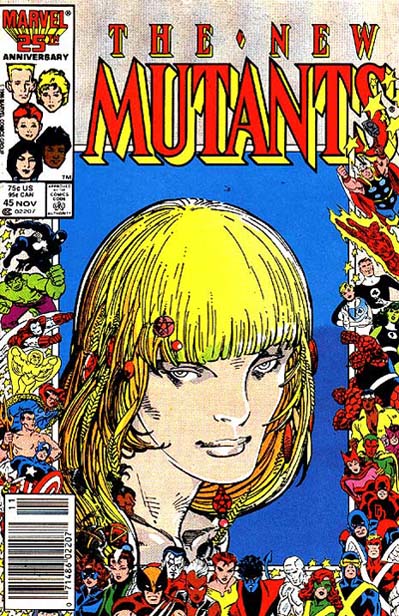 So around this time of feeling like crap, I stumbled across a copy of New Mutants #45. The story was a self-contained one, wholly unrelated to the anniversary cover. I found the following synopsis of the story online...
The New Mutants go to a dance at the Salem Center High School. Larry Bodine sees Dani leave on Brightwind, and reveals to the reader he too is a mutant. Bodine, a victim of verbal bullying, is threatened that they'll call X-Factor on him as a prank by the 'popular' crowd. Larry goes off with the New Mutants back to Xavier's for a bit, but wears out his welcome by telling the new joke going around school, which is about mutants. He goes home alone to sulk. Rahne, however, trusting her instinct, follows him home and sees his light sculpture, and rushes off to tell the New Mutants. Just then, the bullies call Larry's home, and tell him they called X-Factor. Afraid of X-Factor, he commits suicide. The next morning at breakfast, Rahne is about to let everyone know he's a mutant when Magneto interrupts to let them know he committed suicide. Dani and the others talk Rahne out of killing the people who caused Larry's death. Shadowcat gives a speech at an assembly at Salem Center High School to urge people to be careful how they label others.
The story, by Chris Claremont, was exceptionally well-written -- even by Claremont standards -- and did a phenomenal job of speaking to the fear and loneliness that's almost inherent in high school. Kitty Pryde's speech at the end was preachy, but the rest of the story was so powerful that the epilogue really was pretty ancillary to the tale.
The story, as you've no doubt surmised, touched me very deeply. It helped put the crapfest that is/was school in perspective. It helped make me a stronger person and believe in my own self and my own integrity, despite the name calling and pranks and any host of other emotionally distressing events. I learned that I don't need validation from others if I know I'm being true and honest with myself. I don't need to cater to others in an effort to win their respect or approval if I respect and approve of myself.
I haven't actually looked at the issue for several years now, and I'm sure I'm inflating it's prowess a bit more than is truly warranted. But, ultimately, a critical analysis of the book would be meaningless to me because I found so much meaning in what it meant. I think I carried that issue around with me to school and back every day for a month when I first found it. It's certainly the most well-read individual issue in my collection to this day, despite not having read it recently.
And, really, for the analytical eye I turn to Jack Kirby and Art Spiegelman and David O'Connell, none of them can compete with the comic that kept me going throughout high school and taught me how to keep going throughout Life.


