Question: How do you make a make four-decade-plus comic modern and relevant to this very week's headlines?
Answer: Just change a little dialogue in the last two panels... From Amazing Spider-Man #1.
Mostly.
Today's Peanuts... (Well, I say "today" but it was originally published back on March 8, 1962.)
I'll be the first to admit that I probably haven't read as much Peanuts as I should -- especially given the sheer volume Schulz produced in his lifetime -- but I don't recall many in which he made active use of the comic strip format to comment on the strip itself.
What strikes me first is that there's very little in the way of comics here. We've got two heads talking. It could easily have been accomplished in one (admittedly long) panel, like so... Although, by Scott McCloud's definition, we're no longer looking at a comic. There's no sequence.
Of course, that starts to ask the question of approach. What if the same art had been used throughout this particular strip? In content, it's scarcely different. After all, Charlie Brown remains motionless in the original anyway, and Linus does nothing more than turn his head a couple times. But since we're seeing exactly the same thing throughout, the implication isn't any different than the single panel version. Does that mean it's not a comic (again, using McCloud's rarely disputed definition)?
Schulz didn't take this approach, though. (I daresay he would've considered it cheating.) He confirmed the panels do follow a series of actions, albeit minimal ones.
What this also does is highlight how unconcerned Charlie Brown is with the conversation. That he remains perfectly motionless throughout Linus' speech, despite Linus' obvious attempts at engaging in a discussion by repeatedly attempting to make eye contact. In Charlie Brown's estimation, the subject is not really worth worrying about.
Which brings us back to the meta-textuality of the joke. Schulz is using the strip to respond to concerns about comics being too driven by the text and not really being a marriage or words and pictures. He parodies the concern by using fairly minimal movements. And that he deliberately took the time to draw each panel separately and distinctly differently (two different poses, each shown from two different vantage points), he's shown that he's not saving himself any time or effort in his work. It's just as time consuming to draw someone standing as it is to draw someone kicking a football.
So Schulz's minimal changes to each panel actually serve multiple purposes here. Within the context of the comic itself, it highlights the character differences between the two kids. But at a meta-textual level, it reinforces the commentary on the subject of overly verbose comics.
You know, I'd never been a huge fan of Peanuts growing up, but the more I study the strips, the more impressed I become. Schulz's simplicity of line belies his sublime mastery of the craft.
High school was a difficult time for me, like it was/is for many people. The feelings of ostracization and solitude that came from being an outcast (to some degree, even among my friends) made Life seem very trying. I was never so miserable that I gave suicide any real contemplation, but miserable enough that I can empathize with those kids who shot up Columbine High School.
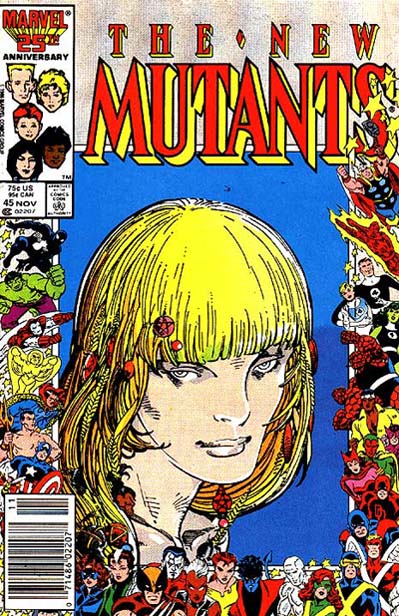
So around this time of feeling like crap, I stumbled across a copy of New Mutants #45. The story was a self-contained one, wholly unrelated to the anniversary cover. I found the following synopsis of the story online...
The New Mutants go to a dance at the Salem Center High School. Larry Bodine sees Dani leave on Brightwind, and reveals to the reader he too is a mutant. Bodine, a victim of verbal bullying, is threatened that they'll call X-Factor on him as a prank by the 'popular' crowd. Larry goes off with the New Mutants back to Xavier's for a bit, but wears out his welcome by telling the new joke going around school, which is about mutants. He goes home alone to sulk. Rahne, however, trusting her instinct, follows him home and sees his light sculpture, and rushes off to tell the New Mutants. Just then, the bullies call Larry's home, and tell him they called X-Factor. Afraid of X-Factor, he commits suicide. The next morning at breakfast, Rahne is about to let everyone know he's a mutant when Magneto interrupts to let them know he committed suicide. Dani and the others talk Rahne out of killing the people who caused Larry's death. Shadowcat gives a speech at an assembly at Salem Center High School to urge people to be careful how they label others.
The story, by Chris Claremont, was exceptionally well-written -- even by Claremont standards -- and did a phenomenal job of speaking to the fear and loneliness that's almost inherent in high school. Kitty Pryde's speech at the end was preachy, but the rest of the story was so powerful that the epilogue really was pretty ancillary to the tale.
The story, as you've no doubt surmised, touched me very deeply. It helped put the crapfest that is/was school in perspective. It helped make me a stronger person and believe in my own self and my own integrity, despite the name calling and pranks and any host of other emotionally distressing events. I learned that I don't need validation from others if I know I'm being true and honest with myself. I don't need to cater to others in an effort to win their respect or approval if I respect and approve of myself.
I haven't actually looked at the issue for several years now, and I'm sure I'm inflating it's prowess a bit more than is truly warranted. But, ultimately, a critical analysis of the book would be meaningless to me because I found so much meaning in what it meant. I think I carried that issue around with me to school and back every day for a month when I first found it. It's certainly the most well-read individual issue in my collection to this day, despite not having read it recently.
And, really, for the analytical eye I turn to Jack Kirby and Art Spiegelman and David O'Connell, none of them can compete with the comic that kept me going throughout high school and taught me how to keep going throughout Life.
Despite a fairly hectic schedule recently, I did manage to weasel out some time to read American Widow by Alissa Torres and illustrated by Sungyoon Choi.
This is a difficult book to review, I think. Not that I have any particular connection to the creators, or anyone mentioned in the story, but because it's about 9/11. I think it'd be exceedingly difficult to tell a personal story about someone who died during the attacks on that day and NOT turn out a very powerful story. That day is still wrapped with a great deal of emotional baggage that everyone who watched that day unfold has not fully distanced themselves from. (Although it might be worth noting that, for kids in middle school, that day is already ancient history; they were at most only 3 or 4 when it happened.) So reading the story of how one woman lived through that experience -- her husband having started work in the World Trade Center only the day before -- it was very difficult to not be gripped by the story.
"Of course it's a powerful book! How could it not be?"
What's easy to lose sight of, though, is that it's very well crafted. The book opens shortly after the first plane hit the World Trade Center. It's a somewhat obvious opening -- almost a mandatory one -- but from then on, the story hops from past to present repeatedly, as we piece together the life that Alissa and Eddie had, and the life Alissa has to continue on with. And that's where, I think, the excellence in craft is most evident. Although the overall story is told more-or-less chronologically, it does a lot of jumping back and forth. And while this could easily get pretty confusing, it never really is. Yes, there are dates captioned when necessary to provide a specific "historical" context, but they're back of the subject matter and flow smoothly. Torres has smartly chosen to tell the story as it makes the most sense, not necessarily in the order that everything happened.
Life is what you make, the saying goes. And the story here is a heartening one; it's the story of Life, and how we cope. It's the story of adversity in all its forms, and how we can choose to deal with it. It's how someone can experience the worst that can be thrown at them and still stand tall and walk onward, despite whatever scars they might accrue.
This story could've been a "gimme." It could have been simply one person's cathartic re-telling of what happened to them because of 9/11, and it would've sold reasonably well. But American Widow is much more than that; it's a well-crafted tale of tragedy and the human spirit, and is only made all the more visceral by the emotional weight of 9/11 that we still carry.
OK, this is TOTALLY not comics related...
"Sean, the recession has hurt my budget and I haven't been able to purchase comics and DVDs like I used to. What can I do to keep myself entertained?"
"Well, friend, you can do what I do and create your own video of a story you don't think will ever be professionally made!"
"Huh?"
"I'm pretty sure the BBC isn't going to produce an actual Time War story that supposedly preceded the recent Dr. Who revival, so I made my own, based on what I'd like to see!"
(Yes, this post is exclusively to show off my first real attempt at video editing.)
Say, who's that standing guard behind the Sergeant and Prof. Skeary Winslow? Why, if not for the extradimensional sensory organs and purple eyes, I'd have to say it was... well... me!
What can we learn about ourselves by examining our past? More to the point here, what can I learn about myself by examining some favorite superheroes of my youth?
Well, let's take care of some obvious things first. All of the characters I cited were actively being published in the 1970s and early 1980s. No surprise there, since that's when my childhood took place. All of the characters were also published by DC. That's not much of a surprise either, since that's primarily what I was exposed to back then. Most of what I knew back then came from a small collection given to me by an acquaintance of my folks, who happened to be fan of the DC characters in general. I don't think I even saw an issue of X-Men until I was 12 or 13.
In terms of visual themes running through the group, let me provide some summary info...
7 of the 7 characters wear gloves
6 of the 7 characters do not have capes
5 of the 7 characters do not have a centered chest emblem
5 of the 7 characters utilize the color yellow
5 of the 7 characters wear masks
I might also note that the costumes in question were designed by George Pérez (Cyborg), Paul Norris (Sandman, Aquaman), Dave Cockrum (Wildfire), Jerry Robinson (Robin), Carmine Infantino (Flash), and Gil Kane (Green Lantern).
Sadly, there don't seem to be any really cohesive themes here that I can see. Most of the categories I noted are fairly broad and could also include the likes of everyone from the Vision to Apache Chief. (Both of whom I was aware of, but had no real interest in.) The costumes original designs range over the course of decades, and have vastly different styles.
The closest thing I can suggest as a common thread is that these costumes are not especially "typical" for what you might think of as a superhero uniform. "Typical" being, I suppose, based somewhat on the Superman/Batman model. There's still the skin-tight spandex feel to them (even Cyborg) but they're executed in somewhat surprising ways.
"Where's Green Lantern's belt?"
"Are Flash's gloves supposed to be the same color as his sleeves?"
"Why is Robin's chest emblem off-center?"
Of course, the key is being able to make changes to the standard without going too far. As cool a character as Speedball is, and as much as I like Steve Ditko, that costume design was not attractive.
Of course, superior drawing skills help immensely too. The Blackjack costume I came up with in high school wasn't any good largely because I didn't have that much artistic talent to pull it off well. In the hands of someone like, say, Alex Ross, I'm sure it'd look great.
I suppose that, speaking visually, it's something that everyone is looking for. Your eyes look for the familiar and expected, but having something slightly off that expectation is a pleasant surprise. If it were totally expected and predictable, it'd be boring.