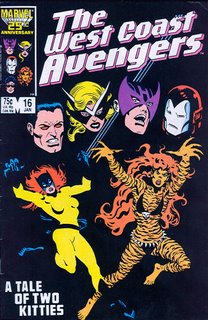
 One of the earliest comic covers that captured my interest at an intellectual level was West Coast Avengers #16 by Al Milgrom. (At right.) It stuck out because, as you can see, it has what might be considered a more graphic approach to depicting characters. If you examine the artwork, you'll see that most of the visuals are conveyed with colored shapes and NOT the black outlines we're so accustomed to seeing in comics. I thought this was wildly clever at the time (1987) and was pleased to see the idea repeated (albiet somewhat less successfully) about a year and half later on the cover of WCA #35.
This was, of course, before I studied graphic design at all, and just as I was beginning to study comic book history. At the time, I was still wholly unfamiliar with the work of Jim Steranko and Frank Miller had just begun experimenting with the idea of removing linework from his work.
I went to college not long after this to study graphic design, and I learned a great deal about color, line and form. The program was rather different than the fine arts program, although we still shared a studio in our foundation drawing classes. In fact, though, very little time was spent on drawing and illustration even compared to photography. We were taught how to depict objects with forms. Minimalism was often encouraged and I particularly enjoyed working on a project where I had to stylize/iconify images from Star Trek, Star Wars, Dr. Who, Flash Gordon, 2001, Alien, Metropolis, Forbidden Planet and War of the Worlds. They were all done entirely using shadows and provided an interesting (for me) examination of how to illustrate without lines.
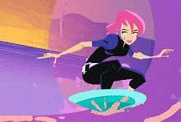 It occurs to me though that now, twenty years later, we're still seeing very little in the way of non-line-drawing comics. Even after Miller's brought the idea to such high prominence with Sin City. It's not entirely absent, certainly, and you can see forms of it, to varying degrees, in the work of Mike Mignola, Time Sale, and Frank Espinosa but I would think Miller's work especially would have inspired more people by now. Given the seeming popularity of esurance's TV spots, which utilize the same basic idea visually, I should think that more comic book artists would be taking up the idea to stand out from the crowd of more intricately detailed art that covers just about every other book on the market.
C'mon! Cool graphics and decent marketing concept? Who wouldn't want that?
 Ah... the first Tuesday after the first Monday in November! The day where millions of U.S. citizens around the world say, "Election day, eh? I don't know, it's mildly inconvenient for me... maybe I'll just vote next year."* Naturally, it's got me thinking about elections and politics in general, so I thought I throw a few thoughts on the blog about how that relates to comics.
The interesting thing about politics in comics is that, by and large, you don't have any. Well, nothing substantial at any rate. Comics -- as a mass medium -- need to pander to all political (and religious) stripes, so they generally don't address politics at all for fear of alienating a decent segment of the population. Going back through the politicians/politics you see in comics, they are either presented in an apolitical venue (i.e. a superhero receiving a generic commendation from the President or the Mayor) or as in an obviously non-partisan, although often shady, way (i.e. a generic, fictional politician being indicted for accepting bribes). Politics -- real politics -- are largely absent.
"Civil War" presents something of an exception to that. There's an attempt to portray both sides of the argument. Or, at least, there was. It seems that as the story has progressed, the writers' own opinions have slipped through, and we see the proponents of the Superhero Registration Act being cast in the role of the Straw Man. That probably also caters to the notion -- whether or accurate or not -- that comic book fans tend to be more liberal than average.
There are a few other exceptions, as well. There was a storyline in the original New Warriors title that spoke to the complexities of government actions. Steve Englehart took a good stab at things during his run on Captain America, although he admits to censoring himself slightly by not outright saying Nixon himself was a crook, but even that was an attack on an individual, and not a political statement per se. And, as the two covers I've published represent, discussion of the presidency as a position in general has been brought up on occasion.
 That real politics aren't discussed is a shame, really. Even religion gets more "air time" than politics do within the comics medium. To some degree, a good writer should write to the characters they're working with. Captain America, for example, is NOT going to turn around and start spouting Communist sympathies. So, in that sense, a writer is limited in what they can say. And I'm not advocating that writers take it upon themselves to make their comics a mouthpiece for political propaganda either. I'm just saying that, since drug use and alcoholism and AIDS and homelessness and other relevant social issues show up in mainstream comics from time to time, with relatively "real" discussions about the topics, why not politics? Green Arrow was made mayor of Star City several months back and we haven't seen him address any political issues at all!
Despite my deep cynicism in our political system, and deep distrust of government in general, I think it's relevant to bring some of these issues to the table in comics. I don't expect solutions, certainly, but politics, whether we like it or not, are part of our lives and it's seems a waste to not address it in a (somewhat) popular art form.
* Believe me, I know full well WHY so many people don't vote. I only began voting after I had been eligible for well over a decade. And today, after having participated in several elections, I have yet to feel that my votes have made a difference. With the exception of candidates who ran unopposed, my district's results for both candidates and issues went opposite to what I voted pretty much unilaterally. If I'm so uniformly and completely out of step with my community, my lone voice will carry next to no weight and I'll be watching this year's results closely to see whether it's worth bothering to vote next year.
 Marvel issued a press release today saying that a new Hulk movie will be released in theaters on or about June 27, 2008. In the release, they go on to cite that it will be directed by Louis Leterrier and written by Zak Penn... two gentlemen who had nothing to do with the 2003 movie.
And here's where things get even more strange. There's NO mention of Eric Bana, Jen Connelly, or Nick Nolte who starred in the 2003 movie and there's a note that "Marvel Studios is currently casting the project."
So what I'm hearing out of Marvel is that they were very happy with the Hulk movie and feel that a sequel is warranted. However, the movie also stunk to high heaven and they don't want anyone who had anything to do with it back.
Admittedly, they never actually call this new movie a "sequel" in the press release. Indeed, the 2003 movie is only referred to once, and even then in the most oblique way. But the movie was publicized well enough that I'm certain everyone will remember it, and there will inevitably be comparisons between that film and the 2008 version. It seems to me that, if they wanted and entirely new group to work with, they'd do a different movie with another one of their properties -- they could still even stay within the Hulk family and do an Abomination flick, which could be thematically very similar to a Hulk one. Or if they're looking to simply capitalize off the Hulk name, how about a She-Hulk movie? Wouldn't have to have any substantial relation to the original, and could go off in its own direction so that there wouldn't be the jaded (pun intended) memories of the Ang Lee movie.
But, hey, what do I know? I'm just a schmuck sitting here in the blogosphere spouting how I could do such an infinitely better job at this than anyone else. Sure, I'm playing armchair producer here, but it just strikes me that there must have been some very curious decision-making going on in some California studios.
 I picked up Pirate Tales #1 from Boom! Studios this past week. Somewhat thicked than your average comic; consequently a bit pricier than your average comic.
Ah, but the question is: was it worth it?
Well, it was for me. The book is in an anthology format, so most of the stories were only six or eight pages. Many different styles and formats within the pirate genre. The stories ranged considerably, so they weren't all just ship battles and canons firing all over the place. The first story focused on some pirates who's ship had been destroyed and they were left floating adrift on the open sea. Another occurred in the aftermath of an attempted mutiny. Still another was a love poem with the pirate battle running in a distinct counter-point to the narrative of the poem.
I think my personal favorite, though, was the story of a captain of a contemporary ocean liner. While dealing with irate shuffle-board players and equally inane problems, the ship is attacked by modern day pirates with speed boards and machine guns forcing the captain to respond in the name of his ancestors. Particuarly interesting in that it addresses the idea that there are still pirates out on the seas to this very day and that they employ some of the same tactics that were in play 300 years ago.
The stories and art were all of decent quality, and I can't see anything to really complain about. I don't know that it's the type of thing everyone would be into, though. I enjoyed it in large part because of the pirate theme, but I don't know how well-received that theme is across the U.S. -- unless, of course, Johnny Depp and/or Orlando Bloom are involved!
Sign me up for the next issue, but I only give it my recommendation if you enjoy a good pirate yarn in the first place.
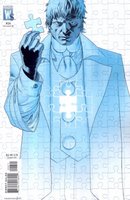 I came to Planetary late in the game. I had heard about it, certainly, but it wasn't until issue #14 or 15 was out that I started hearing people who's opinion I trusted really start raving about it. I picked up the first two trades, and was absolutely floored. Not only was it an excellent comic series in and of itself, but the sub-texts were impressive as well. Commentary on the fictional characters I grew up with, and simultaneous commentary on the comic medium and industry as a whole. Metaphors and anagrams abound in the series for those who wished to see them, but the story itself was still amazingly solid and well put-together at more superficial levels if the reader had no interest in really delving into the material.
In reading the series, I make a point of avoiding any material about the issue until after I've read it. With most books, I'm not overly concerned about previews and minor spoilers, but Planetary is my ongoing test of literature, cultural, narrative structure, storytelling. I sit down to read Planetary, make up my own mind about each issue with no preconceived bias, and try to decipher the themes, analogies, and foreshadowing for myself. Only afterwards do I start to look for confirmation of my thoughts and/or elements I overlooked. Each issue has been thought-provoking on several levels, and it's one of the primary reasons I enjoy it.
A week ago Wednesday, Planetary #26 was released and I just had a chance to read it. The superficial plot of the series was, by and large, resolved leaving only an epilogue or a coda for #27, which Warren Ellis has stated will be the final issue. The story was summed up neatly and concisely, without the need for a slugfest that typifies so many comic book stories. Indeed, not one punch is thrown in the issue. But in the end, Elijah Snow destroys what's left of The Four and promises that the real work is just starting.
Personally, I pulled out some interesting quotes from the issue that I, at least, attach a deeper meaning than may be readily apparent. In dealing with Professor Dowling, Snow says:... I won't stand in your way when your alternate-universe partners come to collect. In the long run, you see, none of that matters. I've seen Heaven, Dowling. And it's not a place where you exercise any power. In the long run, we are all three-dimensional side-effects of a two-dimensional universe existing in a multidimensional stack.
Ellis seems to be saying, through Snow, that all of the big super hero comics that are popular in the industry are ultimately meaningless. He has no intention of forcing fans to stop collecting the stacks of super hero books. As entertaining as they may be, they don't really say anything significant; they don't hold any real information; they don't have any power. At the end of the day, they're just fictions to which fans ascribe three-dimensional properties.
Shortly after that conversation, Snow talks to his companions...Everything we've learned about him says that he wants to be a big man, and that he'll destroy anything that makes him look small... He had to sell out the planet Earth to gain what the likes of us were born with.
Seems to me to be a shot at Marvel and DC's (and probably any other publisher's) perpetual licensing of what are essentially archetypes. And the population at large can't recognize that because they do such a good job at smashing the competition.
Then, after finally defeating The Four, Jim Wilder sums up the current situation to Snow...Look around, Mr. Snow. A crew of superhuman ancestors of the City Zero survivors, saved by you and Miss Hark to pilot a sailing ship of the multiverse itself.
Why bother create new heroes over and over again? We've got a plethora of existing ones to work with that all have rich histories and still plenty of potential in every genre that we know about.
And in Snow's final monologue...It's just starting. The real work. We have so much to show people, now. And so much more to sift from the ground.
There is a lot of great material already out, but no one knows about it. We need to work to bring all these great characters back to the masses, and introduce them around the world.
Now, that's MY reading. It's probably colored in no small part by the Propaganda of the Deed story I've got rolling around in my head. But isn't that a large part of ANY piece of art? The viewer's interpretation. Planetary is only significant insomuch as I make it significant for myself. It's only relevant if I make it relevant. If I had never picked up the series, it would have almost no impact on my life. Certainly no direct impact.
I used to think Ellis was over-hyped and I choose to largely ignore his work. But I see now why he has such a devoted following, and I'm definitely going to have to start searching the back issue bins for his work.
Okay, somewhere out in the blogosphere (and I can't seem to retrace my steps now) I stumbled across an image of Batman backhanding some woman who... well, I don't know who she was or what the context of the story was. But the image showed Batman swinging his right arm out in an arc behind him, tagging her on the jaw; she was falling back to her right and some blood/spit/liquid was arcing out of her mouth.
Let me repeat that: "she was falling back to her right".
That just annoys me to no end. If someone gets punched or kicked or otherwise physically assaulted, they will NOT -- let me repeat: NOT -- fall into the direction of the attack. Let's take a look at two covers that feature people getting hit:


In Sub-Mariner #40, we see that Namor is getting whacked across the jaw with a large ball and chain. We're shown the arc of the ball and where in it's arc that it struck Namor. This makes sense given the positions and stances of Turalla and Namor. However, you will note that Namor's head -- indeed, his whole torso -- is twisting towards the viewer -- that is, INTO the path of the swinging ball. You've heard of people "rolling with the punch" to help lessen an impact? Sub-Mariner #40 (and that Batman image I described above) are the opposite of that.
Silver Surfer #18 shows how it should work. Galactus has taken his left fist, swung from his left to right, and struck the In-Betweener. Again, we're shown exactly what the arc of his fist was and exactly where along that arc that In-Betweener was struck. The In-Betweener's head and torso are twisting toward the viewer not unlike the Sub-Mariner. The difference, though, is HOW they are struck. Galactus' fist is effectively pushing the In-Betweener's face toward the viewer with the In-Betweener's body following along, whereas Turalla's attack should be pushing Namor away from the viewer.
This is rudimentary science that most of us learned as kids on the playground. Sure, I could get into an extended essay on Netwon's third law of motion, but there's an inherent "naturalness" to the world that everyone recognizes at an instinctual level. If you push an object, it moves in the direction you pushed it. That trained comic book artists screw this up EVER bothers me to no end. That it happens with any regularity is downright frightening!
So, do me a favor: if you see artists drawing unnatural fisticuffs, let them know they're screwing up. They might not like to hear the criticism, but if they take a moment to actually listen to it, they'll become better artists and we'll all be better off.


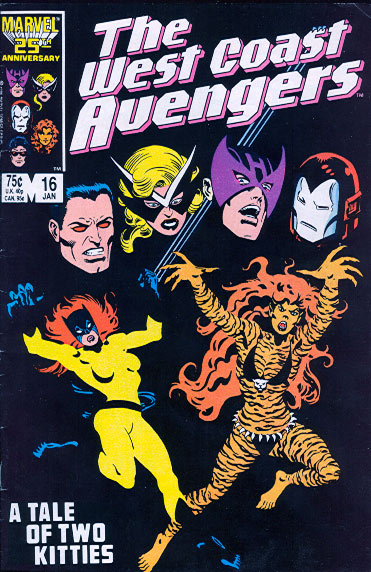 One of the earliest comic covers that captured my interest at an intellectual level was West Coast Avengers #16 by Al Milgrom. (At right.) It stuck out because, as you can see, it has what might be considered a more graphic approach to depicting characters. If you examine the artwork, you'll see that most of the visuals are conveyed with colored shapes and NOT the black outlines we're so accustomed to seeing in comics. I thought this was wildly clever at the time (1987) and was pleased to see the idea repeated (albiet somewhat less successfully) about a year and half later on the cover of WCA #35.
 It occurs to me though that now, twenty years later, we're still seeing very little in the way of non-line-drawing comics. Even after Miller's brought the idea to such high prominence with Sin City. It's not entirely absent, certainly, and you can see forms of it, to varying degrees, in the work of Mike Mignola, Time Sale, and Frank Espinosa but I would think Miller's work especially would have inspired more people by now. Given the seeming popularity of esurance's TV spots, which utilize the same basic idea visually, I should think that more comic book artists would be taking up the idea to stand out from the crowd of more intricately detailed art that covers just about every other book on the market.