Latest Posts

Now, who have we here...?
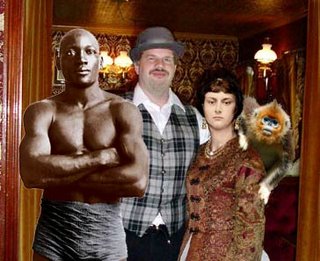
I mentioned the other day how I was kicking around some ideas for a comic pulling together some characters from existing fiction. Well, I've been giving it a lot of thought the past couple of days, and had some intriguing notions on the concept.

First, all of the similar existing ideas I've seen thus far (The League of Extraordinary Gentlemen, the "Wold Newton" universe, etc.) have a tendency to focus on Western literature. Sure, bringing Captain Nemo in gives adds Indian to the group so it's not totally homogeneous, but the fictions themselves were all based on Western literature. Stevenson was English, Verne was French, Twain was American... I think it would be more interesting if you pulled in a more global flavor. How about a character from Japanese or Chinese mythology? Where does South America get represented? Hey, what about getting an African in there? True, you don't want to alienate your largely English-speaking audience with characters and concepts they're wholly unfamiliar with, but that's why you still include some Western literature.

Next, what's wrong with mixing significant fictional and historical figures? I've seen all fictional, and all historical, but how about merging the two to allow for a little more realism/believability?

So, who do we have here anyway?

From left to right, my current "team" (and I'll explore why I use the term in quotes later) consists of John Henry, John Watson, Alice Liddell, and Sun Wukong. Henry was an early African-American who's a part of American folklore, Watson of course is the famous sidekick of Sherlock Holmes, Liddell is the famed character from the Alice in Wonderland stories and Wukong is from Chinese legend. I know I still need a few other international folks to round out the group, but this who I've come up with so far.

I have to cut this short at the moment because of time restraints, but I'll let you mull that over for a while.

And, hey! Any artists out there who might be interested in helping to develop this concept? The more I kick this idea around, the more interested I am in actively pursuing this.
New comic day again, and I picked up a variety of things. What I'm sure will top the list once I get to it is Neil Gaiman and Dave McKean's Mr. Punch. (Gaiman stated a year or two back that it's the work he's most proud of.)

But in lieu of finishing that, I'd have to nominate Nextwave #9 as the best book I've read this week. In order of the story's unfolding, we had such great moments as...

Elsa and Tabitha's banter about how the French-Canadians hate the U.S.
Tabitha's subsequent running around like a Warner Brothers cartoon.
The floating, upside-down castle.
The floating, right-side up faux city beneath the floating, upside-down castle.
Forbush-Man!
A monkey in a fez and surgical mask.
Creating an entire team of super-villains from the pages of Not Brand Echh.
The supremely cool art of Elsa taking a shot at Charlie America.
"You have been getting insulted by nextwave."

One of the things that definitely appeals to me about this comic is the decidedly not as U.S.-centric as everything else in this mass of unoriginal, incestuous drivel we call American culture. Ellis (a Brit) and Immonen (a Canuck) are putting together a great, entertaining comic book that's as much a commentary on American culture as it is an improvement over it. And I hardly find it surprising that it's not selling as well as it should.

At any rate, I've enjoyed Ellis' work in the past. I've enjoyed Immonen's work in the past. But if I see they're working on something together again, I will be the first one lining up to get a copy.
I've seen a number of works lately that try to bring together several children's stories under one umbrella. Often Alice in Wonderland and The Wizard of Oz, but sometimes Peter Pan and The Chronicles of Narnia as well. I certainly enjoy the stories, but they have to start with a conceit that the characters lived as children at the same time. Alice was nearly 100 years before the Narnia children and 40-50 years before Dorothy and Peter Pan. So I thought, "Why don't I actually look up what was going on in literature and history around that time to see if I might create my own ersatz Leagure of Extraordinary Gentlemen?"

So I started a spreadsheet of dates looking at famous works of fiction and when they supposedly took place. I started with the above and soon started pulling in the works of Arthur Conan Doyle, Mark Twain, Jules Verne, Charles Dickens, Edgar Rice Burroughs, Rudyard Kipling, A.A. Milne, Richard Outcault and just about everyone else I could think of in a hundred-or-so year timeframe. Then I added some real people (William Bonney, Harry Blackstone, the Wright brothers, Abraham Lincoln...) and events (the American Civil War, World War I, the Great Chicago Fire, the Model T...), until I've got this huge timeline of real and fictional events.

(In the process, I learned that Philip Jose Farmer essentially already did this with his Wold Newton family premise, hence the title of this post.)

Anyway, I saw some interesting connections. Alice Liddell, the real life girl that partially inspired Alice in Wonderland, was born in 1852. Supposedly, Dr. John Watson (from the "Sherlock Holmes" stories) was also born then. Real-life gunslingers Pat Garrett and Doc Holliday were born in the preceeding two years.

Now, any story I might write about Alice would have to have her as something of an adult, so I would need to jump to around 1870 at least to start looking for historical references of things to use as springboard. Hmmm... what have we here?

The 19th Phantom became active in the 1870s. John Reid, who would later become the Lone Ranger, finished law school around 1872. The Great Chicago Fire: 1871. Tonto's family is killed: 1873. Around the World in 80 Days published: 1872. The Adventures of Tom Sawyer: 1876. The Battle of Little Big Horn: 1876.

So my first thoughts are something like...

Come to think of it, maybe that's where Reid got the idea for a mask!

Any artists out there who'd like to take a crack at a new comic book?
I've talked before about pulling comics down from the Internet. At the time, though, I was speaking about relatively new comics that were well within the copyright of the original owner being shared through a Torrent-type service.

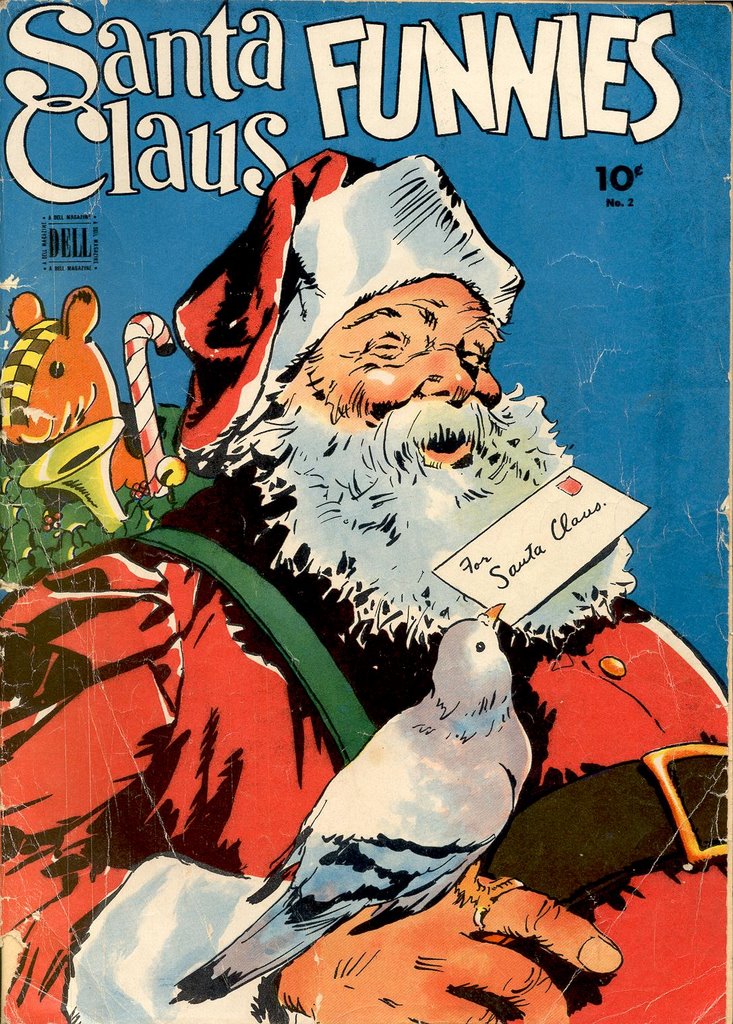
Recently, though, I was looking for some information about Lewis Carroll's Alice in Wonderland and -- quite by accident -- stumbled on a couple of comics that were simply posted to a web sit as a series of image files. One of the issues was Santa Claus Funnies #2 and it features a story in which Alice takes Santa Claus to Wonderland. It's a relatively banal story, especially given the source material, but I thought it was curious that it could be posted online. The publisher has long gone out of business and no one has tried securing the copyrights to the original art. Since the characters themselves are in the public domain, there's nothing to stop anyone from posting this material online.

That got me thinking. There must be hundreds of comics that fall into that same legal area. Wouldn't it be cool if people who happened to have copies of those issues were able to scan them and put them online for everyone to see? Think of how many more comics you could read yourself. Think of how much more comic history fans would know about just by being able to read some of those old books.

Now, if only I could up with a viable business model behind that!
"Neal Adams changed the face of comic books forever. With a strong cinematic sense, Adams worked light and shadow to create worlds that were both believable and fantastic. His groundbreaking illustrations resurrected Batman when the campy '60s TV show threatened the comic's credibility. And his iconic work on the X-Men and others continues to influence comic art and film to this day. Like the work of Adams, Cougar stands as an icon in its field. For 34 years, its brilliant whiteness, consistent runnability, and superior opacity have set the standard for many to imitate. Or at least try."

That is the copy from an ad for Cougar Paper that was in Creavitity magazine recently. There's some accompanying artwork of a man climbing down into a cave, only to find some cougar artwork on the cave walls, shortly before turning into a cougar himself.

I just point it out because of how cool it is that they're using comic books to advertise something else. Doubly cool that they got Adams to do artwork for it.
I was able to pick up The Five Fists of Science by Matt Fraction and Steven Sanders a week ago and just got a chance to read it. The basic plot is that Nikola Tesla comes up with a giant robot, which his friend Mark Twain decides is an ideal way to end war. In the process, though, they run afoul of some masters of the dark arts: J.P. Morgan, Andrew Carnegi and Thomas Edison. It has something of a League of Extraordinary Gentlemen feel about it, except that characters here are based (loosely) on real people instead of fictional ones.

Overall, I enjoyed the book. Although there are some obvious analogies to League, they're fairly superficial, I think. For one, League is designed more as an action-adventure series and the characters were chosen, in part, because they are no longer known entities in American popular culture. (This is most evident in Allan Quatermain's name being consistently mis-pronounced in the movie. I think it's also why producers insisted Tom Sawyer was to be included in the film.) With Fists there are more known quantities: Twain and Edison, certainly, and to a lesser degree Tesla, Morgan, Carnegi and Guglielmo Marconi. (Indeed, Tesla has received something of a resurgance in notarity in recent years thanks to films like The Prestige and TV shows like MythBusters.)

On another level, since League deals with fictional characters, their personalities are more mutable. There's a decidedly finite amount of work written about, for example, Mina Harker so writer Alan Moore had some freedom to reinterpret how she might act. Fraction, though, is dealing with people who's lives were under the spotlight for most of their adult lives and we know quite a lot more about. While there are some liberties taken -- I believe he used the phrase "gross character assination" with regards to Carnegi -- the protagonists at least have some reasonable basis in historical fact. While that might seem limiting, I should think it would provide greater freedom to develop character moments.

I've seen allusions to the story being in the steampunk genre, which I suppose it technically is. But that's really not the focus. The interest isn't so much in the fact that Tesla created this giant robot, it's in how Twain and others react to it. The character interactions are much more interesting, I think, and take up a larger portion of the book. What kind of man would go Yeti hunting? How would Twain talk with government officials when he was trying to sell an entirely new concept? Could Twain really manipulate crowd reactions that easily, and that blatantly? How would a man like Tesla try to apologize for a social faux pas? Those are the bits that stand out more prominently for me.

There's a style of pitching comic books that starts off: WHAT THE STORY'S ABOUT. The author then proceeds to outline the basic plot structure. That's where this steampunk element comes from. The next part of the pitch is then: WHAT THE STORY'S REALLY ABOUT. That describes the emotional connection that readers will get out of it. That's where I enjoyed this book -- the character interactions and their reactions to circumstances around them.

(For the record, the next section of the pitch is WHAT THE STORY'S REALLY, REALLY ABOUT, which gets into the fundamental themes that are addressed.)

All in all, I found it an enjoyable read and it's got my interest piqued in other vaguely historical fiction. I recently learned of a 2000 AD storyline called "Necronauts" that sounds interesting, as well...
Well, here we are in the middle of October, and I finally realized that Halloween is just a couple of weeks away. I never got much out of dressing up for just the one day, so once I was looked at as too old to go around begging for candy, I lost just about all interest in the holiday. Still, I have no desire to have my house egged (or worse) so The Wife and I generally oblige the neighborhood kids by having candy available.

About five years ago, I heard an idea which I thought was absolutely brilliant. Instead of giving away candy for Halloween, why not give away comic books? They're just about as cheap, last longer, and are more interesting than candy. After the first year or two, I had kids who only knew us as "the people who give out comic books" -- often said with some degree of enthusiasm.

Obviously, I try to stockpile cheap issues over the course of a year and I have a short box set aside with comics that I'm going to part with. I fill the box with the occasional duplicate, some Free Comic Book Day leftovers, and whatever 9, 10 or 12 cent issue that's come out in the past year. This year, though, I missed Free Comic Book Day and there were no cheap new issues. Since I was staring a pretty low number of on-hand issues, I needed a relatively quick way to increase my stash.

Fortunately, one of the local comic shops was trying to unload some back issues they had cluttering up their long boxes and made a couple of discount boxes. Any issue in the box for only a dime! Some halfway reasonable stuff, too: X-Men, X-Force, Warlock... I counted off 110 issues and carried the box up to the cash register. The manager was happy to get rid of the books so he gave me everything in the box and the box itself for only ten bucks!

Of course, then I went through the box more carefully at home...

"Oooh, I don't have these. Or this one. Or this. Or..."

I ended up pulling out about ten issues for myself, and felt that was just a little too close to call for the number of trick-or-treaters we usually get. So today, I went through my regular shop's FCBD leftovers and pulled out a dozen or so Transformers and Archie to round things out.

So, come Beggers' Night, the Kleefeld Household will be ready to hand out comic books to everyone who stops by. What better way to celebrate the medium and get more people interest in comic books?