Latest Posts

Showing posts sorted by date for query context. Sort by relevance Show all posts
I've happened across more than a few instances recently of comics fans who are out there talking about their favorite hobby online. They've got their own channel/outlet and they're doing their own takes on Jimmy Olsen and Jack Kirby and the Eternals and Wally Wood and any/everything to do with comics. There's nothing new with this, of course; fans have been talking about comics LOOONG before the internet was even a thing, so it makes sense that it would translate online. In fact, many -- if not most -- of my interactions online back in the late '90s centered around talking about comics. I began my own Fantastic Four themed site in 1996, and I spent time discussing characters and creators and issues both past and present on a variety of message boards. Several of the people I talked with back then are still in my circle, and I still talk with them about comics.

But these folks I've come across more recently are a bit different. Beyond the obvious things like their using social media, which wasn't even a thing back in the day, but rather... well, basically that they weren't even there back in the day. I don't mean that as a slight or anything; they're simply too young (probably not even born in some cases) to have been part of the conversations I was having back in 1996. For them, Jack Kirby has always been a legend that already passed away, Chris Claremont has always been a former X-Men writer, Image Comics has always held a significant piece of the comics market, mega-crossover events have always been the norm, Wednesday was always New Comics Day, etc. The people who I've been discussing comics with have obviously aged with me and, while there may be as much 10-15 years between us in age, there was still enough overlap that we saw many of the same comics experiences in real time. We read Watchmen as a monthly serial, we watched as Judge Dredd get juggled from Eagle Comics to Quality Comics to Fleetway Comics, we saw DC run a 1-900 kill-your-partner hotline to vote on Robin's life, we debated whether Marvel Comics would sell off some of their characters to help get them out of bankruptcy, we saw comics drawn on a computer for the very first time... Even there were several years between us, we had those touchstones that were part of our comics background and makeup.
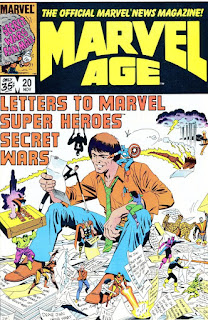
By contrast, I just caught a video providing an overview of the original Secret Wars series. It wasn't a review exactly, it didn't reveal any previously hidden background details, it didn't have any new interviews with the original creators; it was just an overview of what happened and some of the context around it. That's a piece that would never have occured to me to write because... well, why? Everyone I know read it as it came out back in the '80s. More poignently, I would never think to write a piece like that because there's little for me to learn in the process. I read the comics back then, I read articles about the comics back then. From a strictly fact/content basis, I could've dashed off the same info of the video I watched without even doing research.

But then, there's the real key difference. These people I'm talking about? They've got the perspective of someone in their late 20s/early 30s. Meaning a) they're reading these stories in a notably different (post-Y2K, post-9/11, post-comiXology) context, and b) they have a different form and style of communication than we older folks do. The most obvious differences are a much heavier dose of snark and the regular use of (borderline reliance on) cutaway gags. I'm not opposed to these ideas, mind you; I'm conversant enough in their language that I get it, even though it's not engrained nearly enough for me to sound natural or casual with it. Those are both styles that really didn't show up on my radar until I was an adult and had a writing/communicating style already pretty firmly established; they're just not an inherent part of my media background.

That combination of things is what I find striking. That they're talking about comics that are just part of my background growing up, as well as having a better set of language components to speak to a younger crowd. I haven't noticed much of a difference between myself (firmly planted in Gen X) and Millennials, but I do see a much more pronounced break between Millennials and Gen Z. (Well, as pronounced as these type of broad generational classifications allow; I expect several of these people I'm seeing are technically Millennials, albeit ones from the tail end of that period.) There's a markedly different approach they're taking, one that's more media-literate, where digital editing has always been the norm and remixing content is something they've been doing they're whole lives.

To a degree, this has always been how aging works, right? Folks get older and start seeing how younger people are doing things differently? "These kids today..." and so on. I think it's much more noticeable now, though, because younger folks have access to a much wider platform than literally any generation before them. My initial thought when I saw some of these videos were out there was to question why they were doing them; the topics they're spelling out in the titles have been covered to death already. Which they have, but by older people who don't speak Gen Z fluently. These younger folks use a different media language, and it takes someone speaking in that vernacular to connect in a way that an old fart like myself wouldn't.

Ultimately, my point is that, while it's easy to dismiss "these kids today" as being wholly unoriginal and simply re-hashing the discussions we had decades ago, they're actually having different talks. Ones that come from a different media landscape. Ones that come with an entirely different way to unpack its baggage. Ones that still rely on and reference those discussions we had on USENET, but with emojis and memes and Snapchat filters instead of just, you know, Courier.

Maybe it's easier for me since I was never "with it" in any capacity, and no one listened to me even when I was a marketable demographic. But don't dismiss "these kids today" as just covering the same ground you covered decades ago. There's some new and interesting approaches out there, and I'm eager to hear more of what these folks have to say.
I've seen a fair amount of general press coverage over the past month or so for a crowd-funding campaign for a new Rat Queens game, based on the comic created by Kurtis J. Wiebe and Roc Upchurch. Mostly the fairly usual "just republishing the press release" stuff, but the occasional interview and side commentary and such as well. Clearly based on some relatively aggressive PR work.

And all of it completely uncritical of the creators.

A quick recap if you're unfamiliar... Wiebe and Upchurch first launched Rat Queens in 2013. It's a sword-and-sorcery fantasy about four loud, raucous, sometimes drunk adventurers. That's part of the appeal -- that it feels like a group of friends sitting around the table playing Dungeons & Dragons. The other part of the appeal is that they're all women, so the whole book plays against the stereotype and showcases a form of female empowerment. It sold reasonably well (for an indie type book) when it launched and it quickly developed a devoted following. However, after about a year, Upchurch was arrested for domestic violence.

This was not a matter up for dispute. His wife had visible injuries, and he admitted his wrong-doing. He was ordered to go through six months of a counseling program by the courts. Wiebe "fired" him from Rat Queens, and got Tess Fowler to take up art duties. This is all a matter of public record.

In 2015, Upchurch solicited an interview with CBR in which he admitted -- using mostly passive, third-party language -- that he committed domestic violence and he was trying to do better. It came across to me like a poor man's "mea culpa tour" in which he would say "I'm sorry" and everything would be forgiven so he could return to his career. Except it was only the one interview, and given that Upchurch himself reached out to initiate it -- specifically with a female interviewer -- and that he never actually apologized for his behavior, it fell very short for me. Even moreso when his wife responded on her own blog citing several instances in the interview in which he said things that were provably untrue or misleading with deliberately no context. Contrary to his claim, she noted he'd had almost no interactions with their kids and certainly hadn't offered any financial support, and he hadn't talked at all about how he'd also cheated on her. Upchurch talked a lot about "moving on" and "doing better" but she saw no evidence of that.

One thing Upchurch was upfront about was that he was hoping to use that interview to get back into comics' good graces and start working again. And what came out indepenently later was that Wiebe had been working to get him back on Rat Queens. Which makes sense conceptually, as they were friends and co-creators of the series, but Wiebe was doing that initially without telling Fowler and -- once she learned about it third-hand and confronted him -- he flatly lied to her about it and only tried to back-peddle his words later when he couldn't otherwise weasel out of the lie. She left the book in digust and sold all of the original artwork for it super-cheaply so she could get rid of it and not have to look at/be reminded of that experience ever again. Probably at the insistence of the publisher, Weibe took a year off to give the book what's listed in Wikipedia as a "soft reboot."

(None of the details about Upchurch are mentioned in the Rat Queens Wikipedia page, by the way. It just says "Upchurch left the book after issue #8." There's more information about Fowler's departure and the 'controversy' there than about Upchurch!)

Now, that was all a decade ago at this point. I can't find any other comics work Upchurch has done in comics since then besides a single Rat Queens special in 2023 and a few covers. Upchurch's two oldest kids are in their 20s now and the youngest from that marriage, I think, must have just graduated high school. I don't know if he re-established regular contact with them, or what their relationships are like today. I presume the divorce papers he seemed unbothered to sign initially eventually made it through the courts, but I have zero clue whether or not the woman he left his wife for is stil in the picture at all.

Could Upchurch have genuinely and sincerely changed since all that went down? Sure, it's possible. I can't find any evidence one way or the other more recent than 2016. Did Weibe learn a lesson about open communications from his debacle with Fowler? I hope so. The original Kickstarter campaign for a Rat Queens game ended in 2021 and, while it hasn't been delivered and the originally contracted manufacturer seems to have gone AWOL, Weibe himself does seem to have at least been relatively consistent in ongoing monthly updates. But in the two years since he said, "I have rescinded the Rat Queens rights from Ox Eye Media and their partners" he hasn't delivered anything for that game either.

People are inherently fallible. We all make mistakes and do/say things we shouldn't. Over the course of ten years or more, one would hope that people would learn lessons from their bad choices though. But simply saying "mistakes were made" without any effort to own up them, much less offer any evidence that you've tried to correct for them does not cut it. It's just lip service offered in lieu of anything substative. Businesses do that kind of bullshit to avoid legal liability; individuals do that kind of bullshit to prop up their pride. Are you willing to wait a decade or more for someone to learn from their mistakes?
The original Thundarr the Barbarian cartoon debuted in 1980, part of ABC's Saturday morning lineup that fall. In retrospect, it's timing was very strange. It largely pre-dates two of the pop culture trends of the '80s: post-apocalypses and sword and sorcery fantasies. Mad Max: The Road Warrior came out in 1981 and the first Conan movie with Arnold Schwarzenegger debuted in 1982. Obviously both genres did exist prior to that, but that a network cartoon was preceeding a cultural zeitgeist of sorts instead of following well behind one was decidedly unusual.

Needless to say, it was one of the most unique shows on television at the time, certainly the most unique cartoon. The opening narration starts by explaining how civilization was totally destroyed, and new creatures evolved to live in the ruins. Yes, the basic story structure tended to be fairly straight-forward good-versus-evil fights, but it was always over the backdrop of the still-recognizable detritus of then-modern civilization. And except for a few very learned individuals (notably the female protagonist, Ariel) everyone was completely clueless as to the origins or even purposes of these now-ancient relics. A simple pocket watch might be seen as mystical talisman, or a shrine might be built up around a data processing center. (These types of ideas got more wide-spread/popular attention in Mad Max: Beyond Thunderdome a few years later.)

It would only be years later that I learned about the show's creators. It was conceived of and headed by Steve Gerber, with the original character designs by Alex Toth. Jack Kirby provided most of the villains' designs, and scripts were written by the likes of Marty Pasko, Roy Thomas, Mark Evanier, and Buzz Dixon to name a few. Boatloads of talent at the helm and, despite working for what was ostensibly a kids show, they never talked down to their audience.

Now, does any of that background matter when it comes to the new Thundarr the Barbarian comic book by Jason Aaron and Kewber Baal? No. The first issue lays out the basic background (I haven't checked directly, but it's nearly if not completely identical to the opening narration from the show) before dropping readers into the story. And like the show, there's sufficient exposition to give readers the gist of what's going on immediately, while filling in details as Thundarr comes into the picture and requires additional context. We start off with humans being subjucated and auctioned off as slaves to the various clans of lizard- and ape- and rat-peoples. The story then leads the heroes to fight the Council of Wizards to stop their larger plans.

Aaron does a good job of throwing readers right into the story, but catching them up with any necessary history/context as it moves along. There's a good mix of action and exposition to keep things moving. And Baal does a good job communicating how exactly the action moves along. I'll also make note in particular that he draws a pretty good Ookla, which is one of those characters that seems like he ought to be easy enough because of his visual simplicity but, in fact, is really hard to get just right.

What struck me, as a fan of the show as a kid and having studied it more conscientiously as an adult, is how much of the show's lore is packed into the comic. There's the opening narration, as I noted earlier, but the majority of the cast are characters that appeared in show at some point. Including Sabian and a winged monster he conjured -- who only appeared in the show's opening credits and not anywhere in any episode. They also go to offering a more detailed backstory for the protagonists -- which is only hinted at in the show itself -- and manage to logically weave in the various elements of the story that had been known. Clearly, both creators are fans of the show and have done more than their fair share of homework to honor what other fans liked four decades ago.

There is some element of nostalgia being peddled here, without a doubt. However, the story thus far is done well enough that it can stand on its own for any readers who've never heard of Thundarr before. The TV show was well-received in its day but only lasted two seasons, and never won any awards. It was fun but offered viewers more to think about than just simple high-adventure excitement. I think the comic very much continues in that same vein. It's solidly entertaining in its own right, but offers more than a simple run at nostalgia. Worth a read if you have any interest in a post-apocalyptic sword and sorcery adventure, and DEFINITELY worth a read if you were a fan of the show back in the day!

The first four issues are out now from Dynamite Entertainment, and #5 is scheduled to be released on June 17.
I was speaking with a comics creator this past weekend who had only "discovered" Jack Kirby a couple years ago. He said he was certainly aware of Jack's work for years, but it only really "clicked" (his word) for him a year or two ago. Perhaps not so coincidentally, he'd only been drawing comics for about five years, so his appreciation might well come from getting a more visceral understanding of the comics creation process, whereas previously, he may have been stuck on the overt aesthetics.

We ended up chatting a while, and I threw out a few bits that he hadn't really been aware of. Like that Jack was writing and drawing comics professionally at age 20, doing rip-offs for the Lincoln Syndicate. And that he worked most of his career out of his home. And that he was in his 40s when started Fantastic Four and in his 50s during its peak period.

None of what I said was revelatory, really. It was new to him, certainly, but that Jack lived next door to Joe Simon is an interesting anecdote but hardly changes how you view his work on Captain America Comics. How old Jack was when he worked on any given comic isn't really a huge deal, other than perhaps how it may have come before or after some other book he worked on.

But, at the same time, there's a better sense of the whole picture.

"Wait, Jack wasn't some crazy kid throwing wild ideas out when he created Galactus -- he was 50!"

"Wait, Jack didn't go into an office every day?"

"Wait, that would explain how Jack drew 8-10-12 hours a day, but still managed time for his wife and kids!"

And what all that does is put your own work in perspective. Jack worked on comics for nearly a quarter century before he started getting to the stuff that he's best known for; maybe the five years you've been working isn't so bad after all. Sure, Jack had a tremendous output, but he didn't have to leave the house for 10-11 hours a day just to earn a living. That difference is bound to impact your output!

Comparing your work/your success/your fame/whatever against anyone else's is something of a fool's game in the first place. After all, you're not them and have a different set of talents and goals and circumstances than they do/did. But if you want to make any sort of comparisons, even if it's for superficial purposes, it helps to have some context so you know what exactly you're comparing yourself against!
Atlas, Sive Cosmographicae Meditationes De Fabrica Mundi title page
The name "Atlas" shows up fairly frequently throughout comics' history. There are number of characters that go by that name, multiple publishing companies, many specialty comic retail shops and countless references within the comic stories making sly background references to the name. My question is: how did it become so ingrained in comics' lore?

Well, the short answer is Martin Goodman and I expect many of you will have mentally gone there already. But let's explore this more deeply...

An "atlas" (lower case) is essentially a collection of maps. They're generally of very large regions, often the entire Earth, and often printed and bound. The earliest items we would consider atlases date to around 150 AD and were put together by Claudius Ptolemy. Though already outdated by the time they were released, they sold very well and he produced several revised editions.

It wasn't until 1595, however, that the actual term "atlas" was used in connection with these collections of maps. It was Flemish cartographer Gerardus Mercator who entitled his book Atlas, Sive Cosmographicae Meditationes De Fabrica Mundi which translates to Atlas, or Description of the Universe. It was actually published after his death in December 1594 by his son Rumold.

Contrary to popular belief, however, the name was NOT chosen after the mythical Atlas who bore the weight of the heavens on his shoulders. Rather, it was in reference to King Atlas of Mauretania (roughly corresponding with modern Algeria and Morroco) who was allegedly the wise philosopher, mathematician and astronomer who made the first celestial globe. An image of King Atlas is in fact on the title page of Mercator's book.

Royal Palace in AmsterdamA century later, Dutch merchants were using Atlas (the Greek) as a sort of patron saint. (A statue of Atlas adorns the top of the Royal Palace in Amsterdam to this day.) Thus regional map makers of the time began using images of the titan on their collections of maps, making a direct association between the two.

The symbolism does make sense. Although the original myths held that Atlas bore the weight of the heavens, which was generally depicted as a globe, it would be easy to mistake/substitute the Earth in its place without altering the meaning substantially. It's certainly a more compelling visual than a mere portrait, and it's little wonder that map-makers would use the titan's likeness to grace the covers of their collections. Indeed it was a likeness that was compelling enough to write comic stories about! Without doing exhaustive research on this point, I found comic book stories that feature the classical Atlas as early as 1948, pre-dating Goodman's use of the term for his company by 3 years. (Curiously, though, he remains relatively untapped as a source of comic stories compared to other Greek heroes.)

Atlas Comics "debuted" in 1951. It was really just the same company Goodman had been running for years under a few dozen different names. The question that strikes me, though, is: why "Atlas"? Why not "Zenith" or "Red Circle" or any of the other names he'd been using to publish comics?

The reason why Goodman used so many company names at first was a hold-over from the 1940s. It wasn't uncommon for one publisher to use multiple company names to skirt any number of laws, one of the most obvious being paper rationing. A publisher was only allotted a certain amount of paper they could use, but if one person ran two publishing interests, he could obtain twice the amount of paper. Thus, many publishers of the time would run one company under several names simultaneously to get the benefits of multiple corporations.

But that approach didn't make as much sense going into the 1950s, as World War II ended and things got back to "normal." Goodman also saw the benefit of having a single brand identity, one banner under which he could promote the likes of Patsy Walker, Captain America, and Kid Colt. There was no reason to hide behind multiple company names, and plenty of reasons to coalesce under one. But, again, why "Atlas"?

The reason is Goodman's other business as a periodical distributor. Goodman believed he could make even more money by distributing his comics and magazines; why pay a middleman to do that? So he ditched his current distributor, Kable News, and established the Atlas News Company. In this context, "Atlas" begins to make sense. Goodman didn't publish just comics; he also had several lines of general interest and adult (but not that adult!) magazines. He was in several fields and probably paid little attention to the comics end of things. The name "Atlas" for a distributor would imply that his reach covered the entire globe; all walks of life, all corners of the Earth. That wasn't necessarily accurate, of course, but it gave an immediate implication that his operation was bigger and more grand. Goodman then simply applied the "Atlas" name to everything, including his entire publishing arm. Thus "Atlas Comics" were born.

Atlas News Company lasted until 1957. Goodman basically took a look at the finances and decided that he really wasn't making all that much money on distribution, so he closed that business to focus exclusively on publishing. It was ultimately a huge mistake from his perspective, though, as the new distributor he partnered with -- American News Company -- folded only a few months after they began distributing Atlas-published books due to a Justice Department lawsuit. With his own distribution setup eliminated and the country's largest distributor (American News) gone, Goodman was left with few options but using Independent News, which was owned and operated by his business rival, DC Comics (then National).

The Atlas brand that Goodman had spent the better part of a decade establishing was almost wiped out overnight. Independent would only distribute eight of their comics (down from 30+) a month. But in those years that Atlas was producing comics, there was some great and innovative work from the likes of Jack Kirby, Joe Maneely, John Severin and John Romita Sr. to name just a few. It's in honor of those great works that so many comics-related businesses are named.

Now, I could go on to explain where "Marvel Comics" came from, but that's another story that's probably longer than you'd expect!
I was recently reminded of the classic "Judgment Day!" story from Weird Fantasy #18 (March 1953). The story, if you've never actually read it, is reproduced below...
Now here in 2026, there seem to be no end of racial tensions. But, despite those tensions, we live in a world where some of the highest paid actors and actresses are Black. Where many of the greatest sports stars are Black. Where many of the most-loved musicians are Black. Where CEOs of major corporations are Black. Where mayors, senators, Supreme Court judges and other politicians are Black.

That's not to suggest we've reached any level of racial parity in our culture, but only to point out that today, in 2021, it's not particularly unusual to see a people of color in positions of power. When Black parents tell their children they can grow up to be anything they want, they can point to very real examples in pretty much every profession.

That wasn't the case in 1953. Jackie Robinson had only broken the color barrier in professional baseball in 1947. The first Academy Award to go to a Black man -- Sidney Poitier -- wasn't until 1963. It wouldn't be until 1966 that Robert C. Henry became the first Black mayor of a U.S. city. So the very idea of the protagonist being Black in "Judgment Day!" was novel; the "hero" of every story was a white man back in 1953. "White male" was very much the default for everything, so putting a Black man front and center in this story -- this story about prejudice based on superficial qualities -- said something very powerful. The character, up until the very last panel, would have been assumed to have been a white male and taking off his helmet to reveal otherwise was very much a story twist.

Particularly with the casual way it's done. Read the script closely. It does cite the color of his skin in the text, but merely as a description of his visible appearance; there's no comment or even hint of a suggestion at any cultural baggage based on his skin color. That is only brought to the table by the reader in the context of the times it was written. It's only in the backdrop of 1953 that his skin color holds any real significance.

So does "Judgment Day!" hold up in 2026? Is it still relevant beyond it's historical significance? The original story was aimed at kids in the 1953; would their contemporary counterparts get it? Or would they get to the end, shrug and say, "So he just leaves? What the heck kind of ending is that?"

Or am I too optimistic in that thinking? After all, Fuckface Trump has spent much of the past year trying to indecriminately elimiante people of color all over the world. Sending Americans to concenration camps, blowing up civilian ships in the Caribbean, starting wars with predominately Islamic nations... And many of the people specifically perpetrating those heinous acts in Trump's name are those ostensibly sworn to serve and protect everyone! Would kids still get that same 1953 impact if they read "Judgment Day!" today? I don't have any kids and make a point not to spend any time with racist asshats, but if you have access to either, try showing them those seven pages and ask them to read it in front of you. I'm honestly curious what their reaction would be.
One of the first books I had that discussed comics in anything resembling a historical context was The Encyclopedia of Collectibles, Children's Books to Comics. It was part of a Time-Life series from the late 1970s; I've seen a couple other volumes but this was the only one that held any interest for me. It only had 13 pages devoted to comics, and most of those were filled with imagery, but it was still the only thing I had back in the day that looked at comics comprehensively, talking about them as a medium specifically and noting both comic strips and comic books in equal measure.

It was, for a long time, the most significant source I had about comic strips. I came to learn of other, more detailed books' existences, but my interest back then was in comic books, particularly superheroes, particularly Marvel, particularly the Fantastic Four. I put my resources towards learning about those in order of narrowest interest to widest, so I didn't really start looking at comic strips with a serious eye until I was well into my 20s, if not early 30s.

But one piece from The Encyclopedia that stood out for me was a photo of "Al Capp's Dogpatch Band" in the sidebar on toys based on comic properties. The gadget was a wind-up toy from the mid-1940s featuring characters from Capp's strip, Li'l Abner. The image struck me for two reasons. First, I had never actually seen Li'l Abner anywhere before. It wasn't carried in our local newspapers at the time, and the book didn't show any instances of the strip itself anywhere. I was largely at a loss for what the strip was about. While I was familiar with the Shmoo via some Saturday morning cartoons, that had almost no relation to the strip where the character originated.

The second thing that stood out for me was the complexity of the mechanics. Even though I only had a still picture to look at, it wasn't hard to figure out what the basic movements of the figures were. I realized, even as a kid, that the engineering to tie all of that movement to a single gear was an impressive feat. It was only recently that it occurred to me that someone might have posted a video of the toy in action, and I could finally see how it operated. It turned out to be even more impressive than I imagined, with some clever use of deliberately loose joints to facilitate even more movement. And seeing (in the above photo) that it came partially disassembled makes it even more impressive still! I can't find out who designed this, but it's a brilliant piece of mechanical engineering and I can't imagine Capp not being absolutely delighted with it!
When I was writing Webcomics, I made a point to include some space to discuss Tatsuya Ishida and his Sinfest comic. I made a point to include it because he had radically shifted the tone of the strip from a pretty sexist male-gaze-pandering to a radical feminist message, and I wanted to note how his audience reacted. In most cases where a creator wants to shift their messaging substantively, they'll stop one strip and introduce a new one. With clear jumping off and jumping on points for readers. But Ishida offerred the rare opportunity to see how a tonal shift can affect readers and readership over an extended period.

Shortly after Webcomics was published, I was challenged for not including mention of Ishida's hard tonal shift to an expressly trans-exclusionary radical feminist (TERF) message. The reason I didn't include it was simple -- my final draft of the book was turned into the publisher before this newer shift was fully realized. Ishida had indeed begun dropping TERF messafing into the strip, but there was, at the time, ongoing discussion on his own message boards what his overall intent was. Was he actually demeaning the trans community or was he poking fun at the fact that there's even a debate about them? Longer-term fans gave him the benefit of the doubt for a long time, and Ishida himself wasn't saying anything outside of the strip itself. So the is he/isn't he question wasn't really resolved until after my manuscript was out the door.

I re-visited the strip again in late 2023. I tried following it for about six months but found myself pretty lost. I initially thought it was because I was trying to jump into the middle of some larger storyline but it seems he'd taken another turn from TERF messaging to anti-semitism. What was hard for me to parse at the time was that his visual metaphors were so strained that they didn't make sense, using symbols to represent things 180 degrees opposite of what they actually mean.

A few weeks ago, I was told Ishida had gotten worse. I was a little dumb-struck honestly because... how? I mean, Ishida had already taken a pretty firm stance against every group imaginable -- he's anti-gay, anti-Black, anti-Jew, anti-women, anti-capitalism, anti-communism, anti-every-spectrum-of-politics... what more could he possibly come out against? Well, it turns out, he's not aligning against anything new or different now; he's taken a stance on something he's actually supportive of!

Hitler.

I shit you not; he is now praising Adolf Hitler.

(This is why there're no images with this post; literally every strip I might use as an example for anything I'm talking about today has something blatantly offensive in it.)

His current storyline, which started back in December, is all about re-framing Hitler as a hero. Which he justifies by saying that if Hollywood can re-frame villains like Cruella, Maleficient, and Elphaba as good guys, why not Hitler? He then proceeds to relay how all of World War II was in fact a plot by the Rothchilds, who had Winston Churchill and Franklin Roosevelt as their pawns, and Hitler trying to save the world from transgenderism, child sex workers, and physical emasculation. It's so absurd in its positioning, it almost seems like he's satirizing the villain-as-protagonist concept, but there are enough 'tells' to confirm that he's indeed pretty genuine in his beliefs here.

It's certainly not unheard of to present a well-known story from alternate perspectives. Back in the late 1990s, Mark Waid wrote an issue of Captain America almost entirely told from the Red Skull's perspective. Red Skull himself was the narrator and spoke about how oppressed he was by non-Ayran races. How he was the victim, and he his acts of violence against them at the behest of Hitler were only a form of justice. But what was key was that Waid also included a scene at the end told not from Red Skull's perspective, but Kang's and he clarified that what we had seen was specifically Red Skull's version of things and he was contemptably evil. So readers were afforded an immediate perspective that even the most vile villains see themselves as heroes in their own stories, regardless of what the rest of the world sees. But it only worked because of that point of contrast in the last two pages.

(As a point of clarification, the issue that was ultimately published was changed by editorial pretty substantially to the point that Waid asked for his name to be removed from the book. But his original script was later put online, and shows what his original story was. I've got more background and tried to recreate Waid's version of the story here. And to further make clear, the officially published version of the comic with the editorially-revised script takes the same basic approach, but is just considerably less nuanced.)

Here we are, nearly half of a year into Sinfest's current storyline -- still running in daily installments! -- and there's been no indication that everything isn't 100% sincere. He's not presenting any counterpoints in any fashion.

A second key indicator that he's sincere is that his re-imagining of World War II not only places Hitler as a hero, but THE hero against literally everyone else. Ishida has had no issue caricaturing various world leaders but he's notably left Hideki Tojo and Benito Mussolini out of the story entirely. In fact, Ishida has shown Japan as a whole under Jewish influence with only their previous culture to protect them. So he's not coming from the idea of "the Allied powers were in the wrong" but rather "Hitler was the only person working to save the entire world."

Further, the current story make explictly clear that World War II was not only the fault of Jewish people broadly, but the Rothchild family in particular. It's not just anti-semintism -- which Ishida has been displaying for several years already -- but conspiratorial anti-semitism. Ishida portrays Churchill, Roosevelt, and Stalin as golems under the direct control of Baron Henri de Rothschild in particular. (To be fair, I only think it's supposed to Henri. He's not been given a first name I can find, but it does look more like him than any other Rothschild as far as I can tell.) And they're relying on the "Kalergi Plan" -- a "Great Replacement" style conspiracy theory based on a deliberate mis-reading of Richard von Coudenhove-Kalergi's Praktischer Idealismus. This all goes well beyond "Hitler was just misunderstood" and requires not only an understanding of Jewish and WWII conspiracy theories but an appreciation and affection for them.

For the sake of argument, let's assume for a moment that Ishida doesn't hold any Nazi sympathies and he's trying to use this storyline only to satirize various attempts of Hollywood to turn well-known villains into heroes. (We'll also ignore that Wicked was originally a 1995 novel that was turned into a 2003 Broadway musical before it finally got to Hollywood in 2024. I'm sure many people who only saw the film version don't know it's origins.) For these types of stories to work, they need to keep the source material intact. To keep the audience following along, they need the source material as common touchpoints, so the audience understands and appreciates how it can be interpretted in multiple ways. Ishida is not doing that here. He's inventing wholecloth new elements that provably never existed. Ishida is not illustrating Hitler responding to external events he may have viewed differently or in a different context than the rest of the world; Ishida is having Hitler respond to external events that never happened. Provably. You can't have readers sympathize in a "well, if you put it that way..." point of view if your "that way" is completely inevented from nothing. No one even heard of the so-called "Kalergi Plan" until it was coined in 2001 by Gerd Honsik -- a neo-Nazi and author of the book Hitler Innocent? in which he tries to justify Hitler's war crimes -- long after Coudenhove-Kalergi himself had passed away.

In 2024, when I last talked about how Ishida shifted Sinfest's focus, I mentioned that it was demonstrably alienating his readers. The forum on his own site had become a virtual ghost town from 2018 when readers at least still logged in to chat with each other, even if they didn't really discuss the strip itself very much. From what I can tell, the last thread took place between May and July 2024 and consisted of exactly three messages: one poster saying he was back after being gone for a year, another responding 30 days later saying "Get ready to watch Tat completely go off the deep end," and the original poster coming back two weeks after that to say he enjoyed the schadenfreude. It looks like Ishida removed the forums altogether a couple months after that; I strongly suspect no one noticed.

I'm still at a loss on how he's surviving; it sure as hell ain't on money he's making from Sinfest. The site has zero advertising on it any more (which largely dried up for all webcomics back in 2016 anyway). He does have some merch available, but he also has a note on his home page from January indicating that both Redbubble and Spreadshirt rejected his designs entirely. Of the nine designs he posted up on Fourthwall, it looks like four of those have been rejected. (There are spots indicating a design with a name for each was there, but they don't actually display anything.) With his radical politics, I have trouble believing he would be hired in any position above minimum wage, and I'd be surprised if he would tolerate dealing with a just-above-minimum-wage manager for long. I have to believe he's got someone (parents? wife? a generous trust fund?) effectively subsidizing his entire life.

I don't know where he gets any information; this stuff is more bonkers than anything I've seen from Fox or OAN. He only uses social media to post his latest strips; he certainly doesn't respond to readers' comments and I don't think he even sees them. Some of the references in his strip suggest he's still interested in media generally -- I've seen him draw elements from The Sixth Sense, Pulp Fiction, Jurassic Park, Saw, A Clockwork Orange, Nosferatu, and That Mitchell and Webb Look in just the past few months. Although he seems to have completely missed the point of each and every one of those, but he has clearly seen them. And just prior to his current Hitler storyline, he was making overt references to various current events. Although here again, he seemed to have a very distorted view of some of the basic facts.

I am by no means a psychologist but at this point, I think Ishida is legitimatly disturbed. Not just because he's had an increasingly overt message of anti-semitism for several years or because he's started praising Adolf-fucking-Hitler. I don't see evidence of any human contact any more. He seems increasinly out of touch with reality. The conspiracies he's subscribing to are increasingly unhinged, fueled by whatever worst common denominator rabbit holes the algorithms have thrown him down. I don't think anyone would be surprised at this point if he shows up at some public Jewish festival with a loaded automatic weapon. Or he blows up a temple. Let me be clear that I have no knowledge or intel that he's actually planning something like that, but reading through and thinking about his most recent work has me legitimately concerned.

Maybe I'm wrong. Maybe Sinfest is an outlet for all his worst instincts, and doing the strip allows him to vent enough that he can still go around like a regular guy. Or maybe he views everything around/about the strip as a giant piece of performance art where he does a big reveal on the strip's 30th anniversary that he's actually a very nice guy and he donates billions of dollars he earned from selling his life story to Steve Spielberg to help Jewish refugees. Occam's razor, though, suggests he's really just a mentally unwell piece of shit and wants to eradicate literally everyone who isn't a cis hetero white Christian, and he might be far gone enough to acting on it one day.
So I was watching some old clips of The Electric Company on my lunch hour yesterday and saw a few spots featuring Spider-Man. As many of you may remember, the "Spidey" stories on Electric Company couched all of his adventures within the context of comic books. The introducing song ran over a clip of someone opening a Spidey comic, the episode itself was framed within a comic book panel, and the series ending with the closing of the comic.

Something I noticed in watching the clips was the artwork used for the covers...
Obviously, these two covers were mocked up specifically for the show but they should look familiar to long-time fans of Amazing Spider-Man and/or John Romita and Gil Kane...


Then there's this next cover, which is obviously a bit more generic and was used for multiple show introductions...

This was actually based on another piece of Romita art that was used, not on a comic, but on the cover to the Spider-Man: Beyond the Grave album from 1972. It was essentially an audio drama but the album cover included what were kind of like storyboards, i.e. comics but with no actual dialogue or captions. It featured Rene Auberjonois as the voice of Spider-Man. At the time, Auberjonois was probably best known as portraying Father Mulcahy in the movie version of M*A*S*H. He would later go on to memorable roles in the TV shows Benson and Deep Space Nine. Here's the first chapter...
Webtoon recently released their fourth quarter 2025 results. The short version is that recorded an operating loss of $13.2 million US in the quarter. And while they tried to spin that as an improvement over the fourth quarter of 2024, it's an increase from the $11.6 million US they lost in the third quarter 2025. They also had a decrease in revenue from Q3 -- $378 million US in Q3 versus $330.7 million US in Q4.

Not surprisingly, their statement tries to spin everything in a very positive light, heavily leveraging the recent agreement with Disney and talking up a number of upcoming projects. Aside from the agreement, though -- which was announced back in August -- they don't really have anything to actually show. Just the repackaging of seven Disney/Star Wars/Marvel titles from the past several years, all of which, I believe, had already been converted to a digital format for Amazon. Most of what they're promoting in their reporting is about all the grand plans they have in place for later.

Despite all the positive vibes they try to give off, it doesn't seem like the market is buying into it. Their stock price dropped ~10% almost immediately, and has lost another 10-ish% in the days since. As of this writing, it currently sits at the lowest it's been since just before the announcement with Disney, meaning that they've completely wiped out all the gains they got from the agreement in the first place and they're once again sitting at about 40% of the IPO price from June 2024.
Now a company doesn't live and die by its stock price, and plenty of companies operate at a loss for several years while they try to set themselves up for longer term success. Indeed, their 2024 annual report expressly states, "We have a history of net losses, and we anticipate increasing expenses in the future, and we may not achieve or maintain profitability. If we fail to control our content-related costs, the expenses we incur may exceed the increase in revenues."

Back in September, I wrote...
I don't wish ill against Webtoons, and don't want to rain on their parade exactly, but I think it's worth keeping some perspective here too... I think what we're looking at here is a company trying very hard to make things work, and they've thrown a crudload of time and money at it. But given their current operations, I don't think there's anything to be particularly excited about. This Disney deal doesn't strike me as likely to bring in a ton of opertaing capital -- if the licensing costs themselves don't increase their quarterly losses -- and I would just urge any creators posting through Webtoon to make sure that that isn't their ONLY venue for posting/earning money from their webcomic. You should never rely on a single source to begin with, and this setup with Disney doesn't strike me as being able to change Webtoon's direction.
In that 2024 annual report, they cite several potential risk factors. (Detailing risks in an annual report is pretty standard; don't read too much into the fact those are there.) They list three things that they'll need to nail down in order to grow their business and become profitable: attract high quality creators and their comics, attract more users, and "innovate and expand our advertising business." (The wording is a bit ambiguous there; I'm not sure if they talking about innovation broadly or specifically within the context of advertising.) That report is from March 2025 and I'm not sure I can say they've really done anything they mentioned about growing their business. I mean, you coudl argue they have high qualities creators by virtue of the already-created comics from Disney/Star Wars/Marvel, but that's a bit of a stretch, I think. Their "Monthly Paying Users" has remained pretty flat year-over-year, as has revenue. And I'm not aware of any innovations -- either within the context of advertising or without; indeed, my understanding is they've actually stripped away functionality.

I found a quote on GlassDoor from a former employee who was laid off in early 2024: "I thought the strategy, as it was communicated to me, was muddy and often changed radically with little or no notice... it's still unclear what direction the company is headed." I think that sums up my opinion as well. They really don't seem to have a sense of what to do with their platform to make money. Argueably, everyone who's tried making a "single source" platform for webcomics has failed, and the only reason Webtoon is still around is because they had several years being propped up financially by Naver. With them no longer in the picture, I have to wonder if they'll remain around long enough to discover that elusive formula for success.
The letter you see here is one that came to light back in 2009. It's dated March 1, 1939 and was sent from Grace Everett. That's Everett as in the mother of Bill Everett, creator of the Sub-Mariner. Although if you check your history dates, this would've been after Everett had created the first Sub-Mariner story, but before it actually saw print.

While the letter has a lot of personal updates which likely have no interest or context for anyone today, towards the end of the letter she talks about this new Superman character and how she's helping Bill to do research for ideas that might compete with it. When this letter surfaced, the discussion at the time generally agreed that that is ultimately what led to the creation of Amazing-Man for Lloyd Jaquet and debuted in the fall of 1939. (Interestingly, while the Sub-Mariner was created and technically published first, his debut in Motion Picture Funnies Weekly got almost no circulation. So when Amazing-Man saw print later that same year, it actually preceded the general public's first view of the Sub-Mariner in Marvel Comics #1 by an entire month!)

The scan is a bit small, so I've reproduced the full text below. This was originally posted by Daniel Best on his now-defunct 20th Century Danny Boy blog, so full credit to him for sharing this in the first place.

14 West 118th Street,
New York City.

Darling:

Carlton’s letter to Bette, which arrived yesterday told us your proposed trip to Clearwater. I wanted to write you yesterday but was so busy on some typing for Professor Barzun that I got no chance until today.

I am delighted that you are going away at last, and to so delightful a place. To have Flodde and Gail with you will mean a great deal -- that I know, and it is lovely for them that they can have some sunshine and warm weather now.

I am wondering how you will make the trip. If you go by train -- and I presume you will – shall you come through new York? If you do, and want to break the trip so that you can get a little rest, I’d love to have you come here. We have plenty of room for all three of you now, and of course we’d be overjoyed to have you here.

Let me know if there is anything at all that I can do for you or for Flodde.

We are all well again and all busy. Professor Barzun is revising part of his book and gives me a little typing now and then. Bill has a lot of work to do on his present three comic strips, and Centaur Publications wants him to do a new one. Lee is entirely recovered, back and work, and busy as a bee.

I had a visit from Lois ten days ago, just for an evening; and Dorothy Dalzell and Rachel Blanchard were in new York for a few days, so that I saw them twice. Bobby Fisk – you will remember him as the little boy who was with us so much when we lived on School Street – will be in town this week end, and we are looking forward to seeing him again.

Lois is in Miami, and writes me that she is very lonely and nervous. Her uncle, who is a surgeon, sent her down there to get some sunshine, warm weather and bathing; but she is all alone and I she is not happy there. She returns on the 17th.

I heard an interesting conversation on the bus the other day. It was about the book “Rebecca”, which I know you have read but which I have not. Did you realize that it was written in the first person, and that the person’s name was not mentioned in the book once? It seems that a reader in new York, which noticed the circumstance, telephoned London, to ask author what the name of her character was; but the author was then in Hollywood and the reader didn’t get the information. A New York newspaper carried an item about the telephone call. Interesting, isn’t it?

I’m feeling very well indeed, and keeping busy as usual. Last week I went out to luncheon once, and to the movies one evening. That’s wild excitement for me in one week.

I’m going to spend all day tomorrow at the Public Library, doing some research work for Bill. He has a new character, for a strip which Jaquet wants him to do in competition with the new one now being syndicated – called the “Superman’ I think. We’ve wracked our brains for a new kind of character; and all I can think of now is to back over some old folk tales, foreign ones if necessary, and try to find some unusual character around which we can build an unusual story for these modern times. Bill is rushing through another strip and two covers, so I am going to help him in this research. I course I love to do it.

By the way, the "Superman" thing I spoke of above was considered to good that it was bought and syndicated before it was ever published. The people I know who have seen it are not impressed, but I suppose children would love it. It’s a story of a man with superhuman strength in these modern times, who can pick up an elephant with one hand – lifts trolley cars off tracks, etc. If you have any brilliant ideas for a competitive strip, for heaven’s sake let us know. Jaquet is on Bill’s heels about this.

I finally got a permanent wave, and it certainly helped my morale. Now if I can pick a new suit and hat out of the All-Encircling-Good, I’ll be all set to knock ‘em Dead! Tho where I shall ever find a hat that I’ll dare to wear – or even consider wearing – I really don’t know. I’ve not seen a single hat yet that wasn’t simply horrible, for me at least.

Carleton wrote that he would let us know has soon as you had definite plans for your trip, and I shall be hoping that they will include a stop-over in new York. This little jaunt, I am absolutely certain, will be the one thing needed to start you on the up-grade. And even though it may take a super-human effort on your part to get there, any discomfort will be well worth while in the improvement that you will certainly make.

My dear love to Carleton, Mardie and Flodde; and a million kisses to Gail.

Ever devotedly,

Grace
Let me drop this perhaps unconventional idea on you: Mad Magazine was/is a fantastic educational tool when it comes to media literacy.

Well, what is media literacy? Media literacy is the ability to critically look at and analyze media. It's being able to sit down to watch TV or a movie, and understand why it's written the way it is, or why the actors are portraying their parts in a certain way, or what the broader socio-political context of the piece is. It's the ability to understand the media you're consuming, not just consume it.

So how does Mad teach media literacy? Primarily through their parodies and satires. The films and shows they lampooned frequently contained heavily meta-textual references. The one I immediately recall is in the parody of Indiana Jones and the Temple of Doom. I had enjoyed the movie as a child when it came out, but the Mad version contained a scene in which Steven Spielberg and George Lucas appear about 2/3 of the way through. The two talk about the progress of the film as its creators and dream up the mine car chase as a way to keep the action moving along so fast that nobody will realize that they don't have much of a plot. It wasn't until reading that that I realized just how flimsy a premise the movie had, and how a film's creators can add in big, flashy sequences that aren't anything more than big, flashy, hollow sequences.

The other thing Mad did for my media literacy, particularly when I was even younger, was to provide a cultural touchstone with pop culture. I didn't actually see all the movies they made fun of, but I was aware of them, their basic plots, and probably a particularly scathing analysis of the them through the pages of Mad. Other cultural references seeped in as well. I recall a Mort Drucker piece in which he created the "perfect" politician by taking bits and pieces of particularly famous ones. Lincoln's beard, Ted Kennedy's shock of white hair, Carter's lips... I got a civics lesson in notable politicians YEARS before I paid attention to politics. (The punchline, by the way, was that all the parts, when assembled properly, looked like Mr. T.)

The fact that Mad kept poking fun at American culture in a critical and intelligent way (admittedly, amid some sophomoric gags and general sillyness) it required its audience to look at what it was parodying with the same critical eye. "It's funny because it's true" is a kind of verbal shorthand that speaks to how a good comedian can cast light on the absurdities of a culture through exaggeration, but that phrase could also well be applied to Mad. They regularly skewered media of all sorts through comic exaggeration, and the only way to really understand what they were doing was to understand what they were really criticizing.

You know, I read Mad as a kid only sporadically. But I have to admit that I did not realize until well into adulthood just how significant even those few issues I read really were!
When I reviewed Lucas Wars back in September, I relayed a bit about reconciling some family lore with functional timelines to estimate that I probably first saw Star Wars in the spring of 1978, which would've been part of the film's original theatrical run despite debuting a year earlier. Yes, it was legitimately in first-run movie theaters for that long! Despite seeing it during its initial run, though, I've never actually seen the original movie. See, while George Lucas famously made a slew of alterations to the movie in the late 1990s, he had actually begun making changes in the first weeks and months after its May 1977 opening. If you didn't see the movie until August of that year, you got some altered special effects from some of the lasers and a different audio track with minor dialogue changes.

When the movie got re-released to theaters in 1981, Lucas added the "A New Hope" subtitle to the opening crawl and made some additional effects updates on the opening scene with the ships in space. When the movie came out on VHS in 1985, there was yet another new audio track (mostly with just slight changes in the timing of dialogue) and the accompaying LaserDisc version was sped up by 3% to keep the entire movie on a single disc. The 1993 LaserDisc version cleaned up the prints and made some color corrections. So even before the "Special Edition" version hit theaters in 1997, Lucas had been modifying his film. Admittedly, he was mostly just tightening things up around the edges before, but my point is that unless you saw the movie in theaters in the first two, maybe three, months that it was out, you have never seen the original version.

I find myself thinking about this because I've spent the past couple weeks setting up a home media server to host movies and TV show files locally. I had set something up for music a year or two back, but I wanted to expand that to video after seeing and increasing and accelerating news tidbits about this or that show being suddenly removed from one of the streaming services. I don't want to hunt through a long list of brand names with a plus on the end of them just to find a show I was already in the middle of watching. So I managed to salvage and repurpose an old laptop with a new 8TB plugged into it, and started throwing MP4s on there for shows and movies I either already enjoy or have been on my TO WATCH list.

And what struck me was coming across some 'oddities.' Spider-Man and His Amazing Friends, for example, has been on my TO WATCH list on Disney+ because I want to see how well it holds up after several decades. But when I went to download it, the episode count was wrong. It turns out they don't have the Red Skull episode because it features some Nazi symbolism. OK, fair enough, but they also then re-ordered half the episodes. So the collective experience is different than what was intended. Once I got copies of everything, I had to manually re-order them and find a bootleg copy of that Red Skull episode if I want to see what the original series looked like.

And when I went to check out Daria -- which I'd seen clips of but never got around to watching -- I learned that it originally used a variety of then-popular songs as incidental background music. Due to copyright and licenses problems, they opted to simply remove all the music rather than either A) pay the appropriate royalties or B) add in similar-sounding-but-less-expensive alterantives. The show, as it's been seen since the original broadcasts have effectively been without a soundtrack. It shouldn't surprise you, though, that some enterprising fans ripped the DVD releases and went about adding all the original music back in. That's obviously not up for streaming anywhere, but you can find digital copies if you know where to look.

I bring this up because comics do this kind of ongoing tampering as well. I first saw this back in the 1980s when I was initally getting into the Fantastic Four. I was trying to learn as much as I could about their history, but the reprints were few and far between back then. But I was pleased in 1984 when I found Fantastic Four Special Edition #1 which reprinted the old and hard-to-find (i.e. expensive when you're 12) Fantastic Four Annual #1. Except it's not really a reprint of FF Annual #1. The original page 18 was removed, and John Byrne provided a brand new five-page sequence that expanded that portion of the story. It's done reasonably well, with Byrne doing a fair job mimicking the original style of Jack Kirby inked by Dick Ayers but my point is that it's not the original.

But we see that in virtually every reprint. In the case of anything originally published before, say, 1995, the reprints are being re-colored. Maybe they're trying to adhere closely to the originals, but maybe not. I made a post not quite a year ago about how the Masterworks had changed the racial diversity of background characters by making some of them Black. And for particularly old reprints where even the original line art isn't available, they'll scan actual finished comics and try to manually strip out the color. These days, that generally involves scanning the page and digitially erasing everything that isn't black but there's some inevitable touch-ups that have to happen as well. And this was even more significant before computer work became the norm -- Greg Theakston used to bleach comics pages to get rid of the color, but this would also lighten the black marks pretty considerably as well and he'd wind up having to re-draw/re-ink not insignificant portions again.

In many -- probably even most -- cases, these changes are insignificant. They have zero impact on the vast majority of readers' thoughts about the story. I've watched more than a few reaction videos to the original Star Wars and, while people will not infrequently comment on how good the CGI is for 1977, not realizing the actual CGI portions are from two decades later, they're very much more invested in the story. They laugh at the banter between C-3PO and R2-D2, and take great interest in the potential love triangle set up between Luke and Leia and Han, and cheer when the Death Star blows up. So who are we to say that Lucas was wrong?

But the question you need to ask yourself is: why am I trying to get into this story? Is it just to get the general gist of it, so I have a vague notion of what people are talking about? Or are you interested in what exactly readers got back in the day? For me, personally, I tend to be more interested in the original. Even if it is a technically inferior version, because I want to see the piece with as much context as I can. And that necessarily includes whatever artifacts -- whether of the materials used or the imposed limitations from money-holders -- were present in the original.

Which is part of why I have a huge library of physical comics. In most cases, I want to experience the story in the same way a fan did originally. That often means the original floppies. I obviously can never experience the full cultural/social context those issues were published in/during/around but the closer I can get to that, the better for my purposes. But that obviously requires more effort on my part, trying to track down originals and/or reprints that alter nothing.

Just something to keep in mind the next time you reach for a shelf full of trade paperbacks instead of rifling through the dollar bin.
I've reviewed a couple of First Second's History Comics books here and read several more. I find it a fascinating series on the whole for a couple reasons. First they tend to cover topics that haven't been done to death in comic form already and second, they seem to largely take a "just hire talented creators and let them do their thing" approach. So today, I'm looking at The Great Depression: From Hard Times to the New Deal by Tim Stout and Joe Flood.

The story centers around siblings Alex and Kassie. They're apparently out of school because of some local wild fires, which is also keeping them indoors. In addition, the fires have been causing some line problems and their mom asks them to stay offline so she can have a clear connection for an online meeting she has to attend for work. They both complain about the inevitable boredom of not being online, and Kassie suggests playing a game. After dismissing all the others they've played to death, she pulls out one called The Great Depression Game. Almost as soon as they start playing, they find themselves transported back to 1929. In a sort of Jumanji-esque fashion, they have to play the game to its completion within the Depression itself in order to get back home.

The game consists of tasks that need to be completed in the game world, provided to our protagonists via cards that magically appear in their pockets. Some of the cards offer some historical context for when/where they are. (Time flows in a haphazard fashion, often jumping several years in a matter of seconds.) But the tasks they need to complete are generally vague and require some connection with the on-the-ground experiences to understand. It is largely this framework in which Alex and Kassie learn about the Great Depression from a more on-the-ground perspective.

They both wind up living (more like "surviving") from 1929 through 1941, having mostly separate adventures relative to the ages/genders. They finally find the 'key' and are transported back home. But rather than just get back online as their mother finishes her call, they go out to offer the firefighters water and snacks, putting the lessons of helpfulness and humanity they got from the Depression to good use.

The book feels strangely timely. The specific events and areas of focus from the book (Stout notes in the afterword that he had to leave a lot out due to space limitations) are largely unique to the 1930s, but it's hard not to see parallels with today. The solutions the kids use to accomplish their tasks remind me of efforts people are moving to today to divorce themselves from enshittified technology. Some of the massive mis-steps from President Hoover can be seen in echos from Trump. (Although Hoover's efforts seemed largely misguided, whereas Trump's are vindictive.) If this had come out any later, I'd have thought it was written directly as a response to current events, but with publishing lead times and such, I can't believe this wasn't started before the 2024 US elections even happened.

I'm unfamiliar with both Stout and Flood, but their work here is solid. While the stoty's conceit of having to live through a game is hard to mentally divorce from Jumanji, they handle it differently enough that The Great Depression doesn't feel like a re-hashed Jumanji. There's a time-travel element here, too, to potentially confuse readers -- on top of this trying to be educational -- and they keep everything pretty straight-forward and clear throughout the book. Which is saying a fair amount, I think, given the storytelling complexities they're dealing with here. Kudos to both Stout and Flood on that front.

The one element that bugged me a little was the time jumps within the game. From a storytelling perspective, the jumps themselves were all clear enough. But the first one is expressly noted to go from 1929 to 1932 and Kassie finds herself suddenly jumping from age 11 to age 14, which includes a growth spurt and forces her to find new clothes. (Or, more precisely, make new clothes out of an old potato sack.) This scene is handled well and all, but the problem is that that's the only time we see anything like that. Following the in-story logic, Kassie should be 22 at the end of the story, and Alex should be in his late 20s. But neither look any different. To be fair, Alex is never given an actual age, so if he were maybe 17 or 18 at the start, then he might not look appreciably different eleven years later, but Kassie should very much not look like she's still fourteen.

A bigger concern of mine is actually what isn't covered. As I noted, Stout does acknowledge that he had to skip a lot because of space limitations and he does provide a couple sentences on a half dozen areas he either skimmed past or didn't include at all. The one I think is a big miss, though, is the racial distinctions. There are only a few darker skinned characters shown in the background at all anywhere, and they seem to be presented on equal footing with their white counterparts. Nothing about any Asian or Native American groups. The version of the Depression that's presented is not a pleasant one, certainly, but it's a very Caucasian one.

This struck me for two reasons. In the first place, they do touch on gender-related differences, so there's some level of consideration there. Secondly, I think the Depression is a topic that gets at least some coverage in grade school so kids are already getting a Caucasian-focused version of events. Of all the other books that are in this line, I think World War II is the only other topic that's really covered in schools, so the vast majority of these books for a large portion of their audience are seeing/hearing this information for the first time. But with a topic they likely have at least heard something about, there's more opportunity to cover aspects that are in your seventh grade textbook. There is some of that here, I think, but I think how race played a factor would've been much more significant/noteworthy than the symbology used by kids who 'ride the rails.'

The story this book tells is well-done, make no mistake. My biggest gripe is almost more of a missed opportunity to do something more impactful. Race issues are clearly not a subject First Second hides from -- they've got a book on Claudette Colvin for Pete's sake! -- so I think presenting the Depression as either a whites-only problem or an everybody-got-impacted-equally problem (depending on how you want to read this) is a mis-step.

The Great Depression: From Hard Times to the New Deal came out in October from First Second and should be available through your favorite bookstore. It retails for $13.99 US in paperback and $21.99 US in hardcover.
Over the weekend, I came across this post on LinkedIn, referring to a recent quote by one of TikTok's brand managers...
Dr. Carroll is right, of course. Even just a cursory knowledge of fandoms highlights this. Honestly, even if you don't study fandoms at all, did you not see news of late night release parties for every one of the Harry Potter books? Did you not see coverage of all those "weirdos" who dress up in costumes and travel to San Diego every year? Are you completely unaware of fantasy football leagues?

I did think, "OK, maybe I'm taking that one statement from Dean out of context." It's part of a larger article, after all. But when I went back to read the original piece, I saw that Dean is also quoted as saying, "We are already seeing broadcasters and streamers provide quick and easy access to data — ball-tracking, player speeds, distance travelled."

Yes, because box scores in baseball haven't been a thing since 1859! Because announcers never mentioned every player's key stats when they came up to bat. Because the back of every baseball card doesn't have any metrics on it. Because fans wouldn't sit with notepads in stadiums and update that information for themselves in real time during games! Yes, those stats are available more quickly and easily to a general population that doesn't pay close attention to every game than they used to be, but for the types of people we would generally call "fans," they've been doing exactly this for over a century!

I don't mention this to call out Dean specifically. I don't know him at all, nor have I ever had even the remotest interest in TikTok as a platform. But this is ultimately the problem with the vast majority of corporations that own/manage brands have trouble with: the people they generally have working at that level aren't fans. And I don't mean they're not fans of that particular brand that they're trying to promote, but they're not fans of anything!

The specifics are different from baseball fans to comic book fans to Star Trek fans, but the root passion of it is all the same. You don't have to understand why an individual loves a particular Lord of the Rings character, but it's not hard to relate if you say they love them in the same way you might love your favorite football player. But if you don't have that type of passion for anything, then you get comments like Dean's, which show a complete obliviousness to the idea. Which is maybe fine if your job is the accounting department or in production or something, but not having a base level understanding when your job is engage -- either directly or indirectly -- with the folks using your product or service seems to me like a massive failure.
"Write what you know" is pretty typical writing advice. You'll find many authors not surprisingly using elements from their own lives in their work, often going so far as to essentially write thinly veiled, if not explicit, autobiographies. This is how the best stories "feel" true if you know they technically are not -- the emotions behind them are genuine even when the events might be distorted from what really happened.

This has been evident in Ryan Estrada's solo efforts going back for over a decade as well as the books Kim Hyun Sook has been writing since she started a few years ago. I've reviewed Banned Book Club and No Rules Tonight here previously, and Good Old-Fashioned Korean Spirit follows in a similar vein. Once again we have a book that's not exactly a sequel, but still takes elements from Kim's life in the 1980s under the authoritarian regime in Korea and uses them as the backdrop for this story.

And what is the story here? It's set around Daeboreum, a holiday celebrating the first full moon of the year. There's food and drink, of course, but also several traditions around warding off malevolent spirits and putting your wishes for the coming year into the ether. Taehee is forced by her parents to help her grandmother with some of the physical labor (mostly tied with harvesting persimmons) and performing some of the more musical rituals, but she manages to 'trick' several of her friends and acquaintences to go as well, although pretty much everyone goes with the ulterior motive of getting out to the country and away from the crowds of people in the city who could have them arrested (or worse) for their contrarian views. While they're all out with Taehee's grandmother and her friends, they inadvertently learn that they're all out there for the same reason -- to get away from authoritarian figures -- and that the older generation is not nearly as stuffy and conservative as they had believed, despite their attendence to old traditions. The older generation shows they hold many of the same beliefs the younger ones do, but it just manifests differently. And the book ends some decades later with younger generation both honoring the older ones by entertaining many of their traditions and bringing in the newest generations by adapting and adding to them.

One of the recurring themes in the book is that the words and actions of an individual, if you don't understand the context behind them, can be misconstrued. A character who might be acting secretly could be up to something sinister... or they might just want to surprise someone with a good deed. Someone's bitterness at one situation might be reflective of a similar one they had to deal with decades earlier. Heck, just the technologies available to a newer generation might offer up alternatives they take for granted that previous generations simply did not have. Everyone's actions and reactions are going to be different based on their lived history, and if you're unfamiliar with that history, those reactions might not make sense.

Now, that's not to say everyone is justified regardless of what they say or do! Kim has to deal with an agitator who sneaks his way into their "book club" specifically to incite violence against the police and artifically justify a legal crackdown. Manhee's parents perform an exorcism on him because he's trans and they actively reject his attempts at being happy. Suji is kicked out of her home because her mother won't accept her as gay. People have a right to their opinions, but if those opinions actively hurt someone physically or emotionally, they can't be justified.

Despite having some context and character overlap with Banned Book Club and No Rules Tonight, Good Old-Fashioned Korean Spirit is thematically different than both of those. The backdrop of fighting against Korean authoritarianism is present in all three, but they still touch on different themes. Which makes sense. They're based on real-world events and Kim's lived experiences; if you're living your life in such a way that you have to be taught the same lessons over and over, you're not learning anything. You're not growing as a person. You should have adventures in your life, and you should learn something different from each of them. Be like Kim and Estrada; they're sharing some excellent life lessons and doing so in a fun and entertaining way.

Good Old-Fashioned Korean Spirit came out last month from Penguin Workshop. It retails for $24.99 US in hardcover and $17.99 US in paperback. You should be able to pick up either from your favorite book retailer now.