As this Dennis the Menace comic notes, it's National Preparedness Month. The question is: are you prepared? If you're like most Americans, probably not.
A few years ago, I noticed a couple of things. First, there was an increasing number of natural disasters that were causing larger and larger amounts of damage. Natural disasters, of course, have been around since literally the beginning of the planet, but climate change has had enough of an impact at this point that both their frequency and intensities are impossible to ignore regardless where you live. Second, the federal government is decreasingly able (or even willing!) to assist people who have been impacted by these disasters. Hurricane Katrina is kind of the poster child for this type of thing, but we're seeing it more and more. Worse still, we're also seeing clearly man-made disasters happening more and more as well. (Flint, MI still does not have clean water; a report last year classified over 47,000 of America's bridges as “structurally deficient.”) This means that you're more likely to get hit by a disaster, it will likely cause more damage than it the past, and you'll get less assistance.
So despite not living in an area prone to earthquakes, floods, tornadoes, or any other natural disasters, I began putting together an emergency preparedness kit. A crate of supplies that we could rely on in case we're cut off from... well, anything. Matches, first aid kit, flashlight, radio, multitool, etc. After I pulled some basics together, I expanded to include bottled water, MREs, camping supplies. My wife and I each put together a bag with spare clothes we could grab if we needed to race out the door. Extra food for the pets. A waterproof/fireproof lockbox with a handle for important papers. Rain barrels for non-potable water. A small generator. Everything we can think of (and afford!) to prepare ourselves for any sort of emergency.
Some of the basics here are spelled out on variety of websites of folks like the Red Cross and the ASPCA. But I found a lot of that to be dated. I mean, they are keeping up to date by mentioning things like extra phone chargers, but the thinking behind these sites still assumes the government will come to assist you in a few hours, maybe a day at most. So to get more/better information, you almost have to start looking at prepper culture.
There's a lot of overlap here with gun culture and there's an entire industry built up just around building underground bunkers/fall-out shelters that caters to this community. But there are some sane, pragmatic folks out there advocating prepping, once you filter out the deep conspiracy theorists that are genuinely fearful of a for-real zombie apocalypse.
I would personally recommend ThePrepared.com They have a pretty comprehensive, but practical approach and they aren't just looking at things from a pure survivalist mentality. They really do have an interest in actual preparedness, and include a fair amount of information about getting your finances and legal paperwork in order.
As far as I can tell, though, there's nothing out there currently in comic form. There have been a few emergency preparedness comics that run a basic story about preparing for an emergency and make some high level recommendations, but they tend to be light on specifics. Which I suppose is good enough to get people thinking about it, but it doesn't do much beyond that. I've also seen a few comics that try to show a prepper or some survivalists actually in a SHTF setting, but the focus there seems to be on the story of survival after the event, not on the preparations beforehand.
So what I think we need is an instructables-type webcomic that shows how to go about getting prepared for emergency situations. I'm thinking it would need to be a webcomic versus a printed one because while individual portions would be linearly narrative, the overall piece would not be; so if you had it as a webcomic, people could check out the specific portions they felt were most important and/or they were most ignorant of without having to wade through everything else. There might be some sections that just talk about some of the supplies you'd need under different emergency scenarios, or for different geographies. Another section might look at administering first aid. Another might be packing a Go-Bag versus a Bug-Out-Bag, and why you might need one over the other. Maybe something about what you think you need versus what you most likely will need. What about legal emergencies? Do you have a will, power of attorney documents? Are they secure? Financial emergencies? How much should be in your emergency fund? Digital emergencies? Is all your data backed up?
The basic point of the whole thing would be how to implement the old Boy Scout motto of "be prepared." Obviously, not everybody was in Boy Scouts in the first place, and I'm sure many who were haven't thought about some of those ideas since before they had a spouse and kids and day-to-day job responsibilities and whatever. But, like I said, in a day and age where disasters are getting deadlier and more damaging, with less likelihood of any help from the government, I think something along these lines would prove incredibly beneficial if it were done with practical steps in mind. I think there's a lot of far-out-there people in the prepper community that give them all a bad name, and turn off others from even entertaining the notion of emergency preparedness -- you wind up sorting through bizarre conspiracy theories just to see a list of items to include in a Go-Bag! There are some decent folks out there with YouTube channels and such, which is great, but a webcomic would stand out since there simply isn't anything like it out there right now. People just starting out could check it out without getting scared by the crazy tinfoil hat types.
This strikes me as a huge missed opportunity!
I originally posted this back in 2014. And despite talking about webcomics and social media and all sorts of things that are updated/overhauled/disrupted on a daily basis, I think this all still applies 100%.
I am pretty bad when it comes to social media, I think. I mean, sure, I've got my Twitter and Facebook accounts and all that, but I do a phenomenally bad job of engaging with people. Not for a lack of trying, mind you! But for whatever reason, my trying to participate in discussions, much less start them, generally ends with my being ignored and/or the conversation just stopping abruptly. I have no idea what it is I say (or don't) that causes this, but it's something I can trace waaaaay back to my BBS days. It was a little disheartening at first, but I've long since gotten used to it.
But that also means that there is about zero chance anything I create is going catch anyone's interest enough to pass along to reach a broader audience.
Which relates to webcomics how, you may ask. It relates to webcomics because, as a general rule, that's exactly what webcomikers have to do. Creating the webcomic itself is only a small portion of the job; they also have to market it. And if you don't have a huge advertising budget, that generally means a more grass-roots campaign of talking to readers and essentially convincing them to share your material with others, building up an audience slowly and organically.
What ends up happening, then, is that readers begin to follow the comic as much for the creator as for the strip itself. This is more obvious in autobiographical webcomics, but it holds fairly true for fiction as well. I have as much emotional investment in some creators as I do their creations. So even if the strip hits something of a dry spell, I'm willing to overlook that because I like the person who's working on it, and am willing to give them the benefit of the doubt.
One of the big reasons I like comics in general is something I call "singularity of vision." The voice of any given comic is pretty closely tied to the one or two (or maaaybe three) individuals making it. What the creator wants to say is entirely up to them, and the resulting comic is entirely theirs. Compared to, say, a TV show or movie where you've got the writer, director, director of photography, cast, composer, lighting director, special effects people, etc. all contributing to a piece that ultimately (in my opinion) severely dilutes the message of the original story.
So when I'm reading a webcomic, I'm seeing the work of (generally) one person. Whatever message it is that they're trying to get across is entirely on their shoulders. Naturally a piece that has only been created by a single individual is more reflective of them as a person than a work that's had dozens of people contributing. So it makes sense that a webcomic often has a stronger, more personal voice.
And it's precisely that more personal voice that readers often respond to. They might like the style of humor, or nuance of linework, or the overall theme, or the protagonist's character arc... whatever it is, it's the work of that one creator and thus provides an insight into their personality. So it stands to reason that a webcomic reader is going to feel more directly engaged with its creator than they might with a movie.
But that means that a webcomiker isn't really promoting their comic after all. Superficially, it might be a comic about six zebras and a monkey, but it's really one person's persona filtered through the lens of six zebras and a monkey. I don't care if your strip is set in outer space, or in some faux-medieval land. I don't care if your main characters are all humans, or abstract squiggles. I just want to see what each creator is trying to tell me. About the world, about themselves, about their thoughts... What a webcomiker is really promoting, when they're promoting their strip, is themselves.
It's possible to promote a webcomic while not presenting much of a personality outside the strip itself, but there are VERY few people who can pull that off. I think I've only seen one. So when looking at a webcomic ad or Twitter feed or whatever promotions are being used, think about how much of the promotion is selling the webcomic, and how much is selling the creator. If it's just the former, I'd bet it's not nearly as successful a promotion as it should be!
I originally posted this over a decade ago, referring to documents that were themselves close to a decade old. I'm disappointed that A) Phil and Kaja Foglio don't still support this (I'm sure it got untenable as the Girl Genius fanbase grew) and B) I can't find any other comic creators doing this type of thing. I still think it was a brilliant marketing strategy!
I stumbled across these two pages, documenting some of my time at Transylvania Polygnostic University, and thought I'd share... 
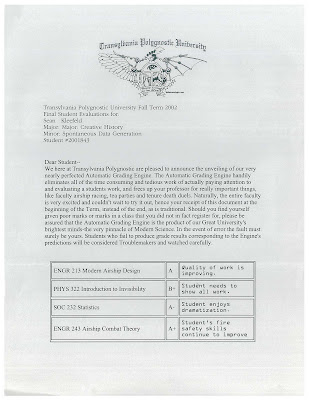
If you're not able to discern as much from the contents of the first letter, this was during the time when Girl Genius was only a printed pamphlet comic and hadn't been migrated to an online one. Sadly, the TPU website is no longer online; I never heard exactly what happened but I suspect it had something to do with the increased funding that had been given to the Department of Death-Ray Physics.
When I first discovered webcomics in the late '90s, I had two "problems" with them. First, I wasn't finding any that I particularly enjoyed. That's not a slag on any creators working back then or what they were creating, I just had trouble finding webcomics that struck my particular interests at that time. At least as far as being interested enough to try to continue reading long-term. Which actually leads to the second problem I had: reading them long-term.
At the time, the only real option most webcomics had was... well, you had to just go to their site every day. (Or week, or whatever their update schedule was.) This was a problem because few webcomics even had their own domain names at that point -- they'd be hosted on GeoCities or other similar free hosting services, which meant they had long, arcane URLs. And while those could be bookmarked, you would have to return to the same browser on the same computer in order to use those bookmarks. You couldn't "carry" the bookmarks from your home computer to your work computer or the ones at the library. Furthermore, few (if any) webcomics had gotten to the now-standard practice of putting the latest comic on their home page. So once you got to the site, you had to remember which installment was the last one you read and click through to the one after that.
All of that was certainly doable -- and there were indeed some work-arounds to make that whole process a little easier -- but that was still a fair amount of effort if you weren't particularly excited about any of the webcomics you found in the first place! Think if you had to jump through all those hoops just to read, say, Beetle Bailey. Do you really like Beetle Bailey that much to go through that on a daily basis?
When I came back to webcomics around 2003, there had been a couple significant improvements that had been made. First, webcomics were starting to regularly get their own domains, making them easier to remember. Second, they also got the message that putting the latest installment on the home page was generally a good practice. Third -- and most importantly for me -- was that many of them had begun adopting RSS. This allowed a single reader application to get notified whenever the comic had updated and, depending on how it was configured, even deliver the comic itself! I could now go to a single location to read whichever webcomics I wanted, and I was even told which installments I had/hadn't read!
 I was reading so much that I spent a fair amount of time studying and developing an "optimal" (for me) setup for reading all my favorite comics. I had several blog posts back in the day talking about various aspects of this, but my "final" version was using the iGoogle portal with Google Reader embedded in one of the tabs, and several gadgets that I custom-coded myself. That was a really enjoyable setup for me.
But then Google Reader was shut down in 2013, and iGoogle was killed only a few months later. There have been alternatives to both since then, but I've never come across anything as smooth and integrateable as those two platforms. I've got The Old Reader that can pull in and display RSS feeds from comics pretty well, but there's nothing available for some of those other comics that don't have RSS feeds. And NetVibes is a serviceable portal platform, but they don't have a way to integrate my Old Reader setup into it. Further, neither work well on a phone, nor do they have apps available. (There is a third-party app that somehow bootleg-pulls-in your Old Reader account, but it's definitely not supported by The Old Reader, and the interface is a bit clunky.)
So what do I do now?
I sit down at my computer in the morning, and I type in the URLs of the webcomics I want to read. Just like I had to do back in the late '90s. And necessarily because I have to remember to do that every morning I want to read some webcomics, I'm not currently reading nearly as many I used to. I think I stopped counting how many webcomics I was reading when my title list in The Old Reader got north of 300. But now, I check two websites regularly. Two. And then there's about a dozen or so more that I read through more sporadically -- mainly through following the creators on social media and happening across one of their "I just updated the comic" notices every week or three. But then I have to go back and figure out where I left off, and all that. It's a decidedly less-than-ideal system.
How annoying is it that, for as many advancements as have been made in webcomics, and for as many more cool, well-done webcomics there are out there now, there's still not a good system for just sitting down and reading them?
It used to be that everyone would sit down to watch Jackie Gleason or Lucille Ball on television, and then everybody would talk about how funny it was the next day. Media options were limited, so there was a set of shared cultural touchstones. Even if you didn't watch Rawhide, you heard about it through other media outlets -- magazines and newspapers and such. Even as recently as the mid-1980s, there were comic strips like Garfield which everybody read and, even if you didn't, you probably caught a segment about it on 20/20 or an article in People.
But media has spread out to such an extent now that those common touchstones aren't there. There are thousands of cables channels replacing the three networks that used to dominate everything. There are hundreds of thousands of webcomics where a couple or a few dozen might have populated any given city's newspaper. There are multiple TV shows even within a single sub-genre like Real Housewives or CSI. You can't reference a comic strip, even popular ones like PvP or Penny Arcade, and assume your audience knows what you're talking about. In fact, you can't even name-drop a lot of popular webcomics and expect even an audience of cartoonists to know what you're talking about.
I don't know that's a bad thing though.
See, the touchstones we used to have were built on largely artificial ideas of geography. Pretty much every newspaper did carry Garfield but just about anything less popular than that was hit or miss. My newspaper growing up carried Andy Capp but I can't say the same about the next major city over. The commonality I shared with others, where we could superficially unite, was over an accident of where we both happened to be. Even if I did like Andy Capp, the next person might not.
"Hey, did you see the strip today? It was really funny!"
"No, it wasn't."
With the proliferation of webcomics out there being disseminated on the internet, I'm not limited to the handful of options that were singularly curated based on an individual editor's preferences. I can go out and find a variety of strips that I personally find entertaining or engaging.
Moreover, I can then share that entertainment and engagement with other people who share my sensibilities. As a fan, I'm not limited to the people who might happen to share a physical space with me. I don't have to share my engagement of something I really enjoy with the only other person in town who kind of likes the same thing but for different reasons and that's really the only thing we share in common and he's always awkward to be around and he has bad breath. I can instead share my engagement of that comic with a group of people who not only like it as well, but like it for many of the same reasons I do. We're not going to all have the exact same opinions, or come to the table with the same backgrounds, but we can share in that strip in generally the same way.
Not to mention the joy of sharing that same strip with a friend who you think might enjoy it as well, but hasn't seen it yet because there's so many things out there.
Now, some would argue that that lack of cultural lodestones has in part gotten us to where we are today as a society. Things have become so fractured that we might not share ANY common touchstones with the person next door. Depending on which news outlets they stick to, it's entirely possible that they don't even recognize the same reality that you do!
But, really, that's always been the case. For generations, "American culture" was defined through a lens of the white, cis hetero male gaze. But the lived experiences of a good chunk of the population didn't line up with that. Black people didn't see their lived reality reflected anywhere. Asian people didn't see their lived reality reflected anywhere. Gay people didn't see their lived reality reflected anywhere. The country accepted -- not entirely willingly -- that "American culture" looked pretty much exactly like what was shown on Leave It to Beaver or The Andy Griffith Show. But that was not what everybody experienced. Ask yourself this... what moniker do you associate with June and July 1967? "The Summer of Love" with hippies and music festivals and flower power? Or "The Long, Hot Summer" with nationwide race riots and the FBI's illegal targeting of the Black Panther Party? Your answer probably depends a lot on your cultural background, not necessarily America's.
Those shared touchstones were never as widely shared as people claimed. They circled within segregated geographies. So when somebody started talking about how much they loved the comic strip Torchy in Heartbeats, they would probably get very different reactions, depending on where they lived. Because that comic strip circulated in Black newspapers and was never run next to Blondie or Dick Tracy.
What's happening today isn't that the touchstones are slipping away; what's happening is that people are starting to see that what they thought were touchstones never were anyway. Sure, there's a gazillion more options just generally than there were a half century ago, but you're no longer at all limited by geography in finding people who you can share your touchstones with. I can be the only person who reads a webcomic in the entire state, and still connect with like-minded fans half a world away! So I can build up a more natural culture of shared ideologies, instead of an artificial one based on where the roof over my head is.
Today is the official launch day of my book on Webcomics! I can't tell you how excited I am! This is the first textbook on webcomics, and it's only one of three books about webcomics that are currently in print! (The other two are both how-to books by Brad Guigar. Well-worth picking up if you're interested in creating webcomics, but they are for a pretty specific audience.) My book is intended to be be more broad in scope, and has more of an academic framework. I've tried very much not to write it in academic-ese, though, and it hopefully has a more approachable style that virtually anyone can embrace.
There is something of an irony in publishing a pulped tree version of a book about an exclusively digital media. I go into a little more detail on this in the book's introduction, but essentially the benefit I think this format has is that it puts all of the information about webcomics within the confines of a readily available unit. Just by the nature of the internet, there's almost certainly bound to be more up-to-date information online, but it has to be sorted and filtered from a huge collection of sources that would need continual maintenance to keep it organized at all. I tried to write the book as timelessly as I could, so it might not go out of date as quickly as the previous few books on webcomics have. (Which is one of the reasons why so few remain in print! The others are very much of their time!) I've actually been keeping up with webcomics news generally, and I am pleased that there's nothing blatantly outdated in it yet -- which is saying something, considering that I turned in my first draft a year and a half ago and I haven't been able to make any substantive changes since last November!
I'm really proud to see this get out into the world. 80,000+ words was really daunting when you consider most of what I write is in the 500-1000 word range. I'd like to think I pulled something together that's worthwhile and will contribute to people's understanding of a medium that not nearly enough people talk about! Of course, it also terrifies the shit out of me as there's a lot of people whose work I know and respect will likely read this, and I'd hate for them to walk away from it thinking, "Damn, Sean, that really wasn't all that good. I'm disappointed." Or just as bad, a bunch of webcomic creators read it and think, "What the hell?! Sean clearly doesn't know what he's talking about!" My various webcomics columns over the years never generated much feedback, good or bad, so I really don't know how this will be received. I did put a lot of work into it, so I obviously hope it's received well but, like I said, I'm also terrified it won't be.
While I wait to find out, I'm still happy to ramble on about webcomics with everybody! If you're interested in talking with me, I'd be happy to chat! I'm open to interviews, podcasts, AMAs... whatever outlet where you've got a webcomics-interested audience! (Which, frankly, should be ANY audience! If you're online, you're probably reading webcomics whether you know it or not!) Shoot me an email at sean@seankleefeld.com and we'll get the details sorted! I've spent a LOT of time thinking and writing about webcomics, and I'd love to share what I've discovered with everybody!
I recently stumbled on the old Land of the Lost TV show. I know I had seen it as a kid back in the '70s but I remembered almost nothing about it, other than the general notion of the effects being laughably horrible. So I sat down to watch the very first episode, curious to see how they set up the show at launch.
Like many shows by Sid and Marty Krofft, the premise is described in plain detail in the opening theme song. Dad and his two kids are out rafting, the river gets out of control, and they wake up in a land of dinosaurs without a way to return home. The show is then about them surviving and trying to find a way home. From jump, though, things are awful. The theme song is this banjo-driven number -- which seems tonally way out of step with the show -- and they apparently couldn't afford actual acoustic effects as the singer's actually sings the lyric "Land of the Lostlostlostlostlostlost..." fading his voice out in place an actual echo. The visuals are kind of absurd, too -- the river the family careens down is clearly a miniature model set with a live action shot of the raft crudely super-imposed on top of it, the historically inaccurate dinosaurs are a mixture of stop-motion and puppets which I suppose in and of themselves aren't terrible for a 1970s Saturday morning kids show but trying to superimpose the live actors over the shots really didn't work well. The show continues on in that vein with a clunky combination of live action imposed over miniature sets, stop motion sequences that are repeated several times even in a single episode, and sets that look like they were pulled from the bins after they'd been used on Star Trek almost a decade earlier.
So by the time the opening credits were done, I'd more or less written the show off. I figured I'd watch that episode, still curious to see how they set up the initial story, and then go about my life without thinking about it again until I come across a comic con guest list that includes one of the actors.
But what struck me as I watched, though, was that the story was actually pretty solid. They dispensed with additional exposition, and there was an immediate assumption that the family had searched for and found a cave suitable for shelter and had already begun building tools they'd need in day-to-day living. The story actually starts with the family encountering the a primitive race called the Pakuni and making friends with one in particular, Cha-Ka. The writing was actually pretty solid, with a good plot and strong characterization. And despite the bad effects, the actors all committed pretty heavily to their chroma key performances. And interestingly, it didn't include the Sleestaks at all, which is one of the few concepts from the show that I know of. (I couldn't tell you if I actually remembered that from the show itself, or it was something I primarily remember from later pop culture references to them.)
Still curious, I watched the second episode. Another solid effort, this time introducing the infamous Sleestaks. The third episode featured a baby brontosaurus that the daughter rode like a pony. The fourth episode caught my eye because it was written by Larry Niven, a favorite author of mine, and the story dropped the idea that time displacement was not linear -- that you could fall into the Land of the Lost from 1974... or 1862.
As I kept watching, what I saw was some actually reasonably sophisticated storytelling. While each episode was a stand-alone adventure, they kept building on each other. Small character elements are picked up and capitalized on -- the daughter makes a passing comment about being afraid of falling down a deep crevasse in one episode and in a later one, she's shown her deepest fear -- which is mostly her screaming and crying, but it does include a quick line about "I don't want to fall!" That kind of thing isn't huge, but it suggests to an overarching concern on the part of the writers for the characters. They're following each other's lead and building elements to strengthen what the others have put together. I expect there was a show Bible that charted an overall plot structure and major character points, but some of what I'm seeing strike me as small touches individual writers lent to the series.
Where I'm going with all this is that not having the best visuals for a creative piece of storytelling are not necessarily a reason to limit what you do in comics. While the effects in Land of the Lost absolutely do NOT hold up in 2020, the actual storytelling pretty much does. Which I suspect why the show has a following to this day.
There's no reason NOT to start working on your webcomic right now. You might think your drawing ability isn't as good as it should be, or you don't like your coloring or what-have-you. But that's not what captures your audience. It's the storytelling -- separate from the art! -- that draws people in. Andy Weir actually wrote and drew Cheshire Crossing as a webcomic starting way back in 2006 (I wrote about it here!) but he took the same story and had Sarah (Sarah's Scribbles) Andersen redraw the whole thing. The story holds up as well as it did a decade and a half ago, and it's only been visually updated to better fit the newer format. Weir said in the book's preface...I'm a terrible artist. Always have been. That didn't stop me from making the comic, though. I wanted to tell the story so I gutted it out...
Be like Andy and don't let your own talents stop you. Tell your story. If you improve, great! If you don't, you can still bring people in if you're telling your story earnestly and sincerely. Get a new artist later if you need to sell it to a wider audience! Just grab your pencil or stylus and get going!
We are less than two weeks away from the official publication date of my book, Webcomics! The official release date is June 25 (for both the US and UK!) and it's already available in the Bloomsbury Collections eBook library!
Tom Spurgeon had the chance to read it shortly before he passed away, and had this to say...I've always been a great fan of Sean Kleefeld's writing: its clarity, its circumspection, and the measured quality of his tone. Kleefeld is an ideal writer to chronicle the rise of modern webcomics. He patiently explores not just the nascent realities of an industry in flux but all of the roads not taken, all of the false starts and dead ends, with the perspicacity an unformed future demands. In Kleefeld's hands, defining what comics looks like today is less a sorting out process for the ages than a mad crash down a steep hill hoping to scoop up some village's bouncing wheel of cheese set loose on the valley below. By the time you're through, you'll know just what set of circumstances won the day, and what set didn't and what might be yet to come. The longer you take to find and read your own copy is the amount of time I get to be smarter than you.
I would've loved to have talked with him in person about it. He always had an astute view of the comics industry as a whole, and I can't tell you what it means to me that Tom liked it. I still miss him.
But I still like talking about webcomics with everybody! If you're interested in talking with me, I'd be happy to chat! I'm open to interviews, podcasts, AMAs... whatever outlet where you've got a webcomics-interested audience! (Which, frankly, should be ANY audience! If you're online, you're probably reading webcomics whether you know it or not!) Shoot me an email at sean@seankleefeld.com and we'll get the details sorted! I've spent a LOT of time thinking and writing about webcomics, and I'd love to share what I've discovered with everybody!
I'm still not really in a good headspace to be writing about comics, but there was a snippet of news I caught over the weekend that Nate Powell was kind enough to remind me that he had created a fairly detailed analysis about it a year earlier.
The incident was that, over the weekend, Cincinnati police raised a thin blue line flag at the justice center downtown. It's significant for a couple reasons. First, the flag design was originally created in direct opposition to the Black Lives Matter movement; it's a racist symbol every bit as much ass the Confederate flag is. They're openly calling themselves a racist organization by flying it. Second, Powell pointed out... "A key signpost toward fascist control: replacing national symbols w/ parallel alternatives, as official military & law enforcement are supplanted by paramilitary alternatives. These are fascists."
He then linked to a webcomic he did last year called "About Face" which he describes: "This is about surface and style normalizing the language of force." It's a powerful and enlightening piece on some of the aesthetics that surround right-wing paramilitary group, including the Confederate and thin blue line flags, as well as the (almost always illegally appropriated) Punisher skull logo. Even if you've read the comic before, it's worth checking it out again.
If you've not been paying attention (which is totally understandable given all the bullshit we collectively have to hear on the news every day now) my book on Webcomics is less than one month away from publication! The official release date is June 25! (For both the US and UK!) I just got confirmation from my publisher last night that we're still on schedule and there shouldn't be any pandemic related delays!
It's the first textbook on webcomics. There's some history (only one other book has ever really discussed webcomics history at all, and it's been out of print for over a decade), lots of discussion of the social and cultural impact -- their relative ubiquity, impacts of/by technology, how they can be used for education and social causes, the rise of a functional business model and the subsequent ancillary industries... -- questions that need to be asked in addressing webcomics as a whole, in-depth examinations of several specific titles... I even spend a good chunk of time just defining what webcomics are relative to digital comics or other comics that might appear online! This book goes into more depth and breadth about webcomics than any other book before! I don't say that to just be hyperbolic either -- there are VERY few books on the subject (literally six) and only one of them isn't some version of "how-to make webcomics." (The one that isn't is just a straight history.) I'm not saying that I'm covering areas no one has ever covered before, but this book is the first one to look at all these areas together as they pertain to webcomics.
Not surprisingly, with a new book coming out in the near future, I would like to drum up some interest for it and try to get some PR buzz going. So I'm going to be plugging the book here on my blog a bit more than usual, and hopefully in some other venues as well. I just recorded a videocast that will go live in the near future, and I'm working on some guest posts for some other outlets now.
But my dance card isn't filled yet!
If you're interested in talking about webcomics with me, I'd be happy to chat! I'm open to interviews, podcasts, AMAs... whatever outlet where you've got a webcomics-interested audience! (Which, frankly, should be ANY audience! If you're online, you're probably reading webcomics whether you know it or not!) Shoot me an email at sean@seankleefeld.com and we'll get the details sorted! I've spent a LOT of time thinking and writing about webcomics, and I'd love to share what I've discovered with everybody!
I happened across two bits of webcomics info that make for an interesting contrast with one another. First, yesterday Scott Kurtz started what he's calling PVP 3.0 -- a "new chapter in the lives of the PvP cast." Second, artist Garth Graham announced that they'll be ending the long-running Star Power comic at the conclusion of the current chapter. Let me start by quoting some of the reasoning they've given. Here's part of what Kurtz said...I've tried writing PvP as if there was no pandemic but it feels disingenuous. Drawing the characters together feels like I'm lying. They're not together right now. They're isolated, scared, uncertain of the future. That's just where they live in my head, I don't know how else to explain it.
I'm hopeful for the future. I believe we'll not only get through this, but we'll be better for having survived. And I know that I'll be excited about writing PvP again. I just don't want to wait. So I thought, screw it. I won't wait. I'll just jump ahead. Let's just skip this bad part and pick up with everyone after we've all gotten through it. When I put myself in that head-space, the ideas really started to flow and I got very excited about writing and drawing PvP again. Which was exhilarating and scary at the same time.
He's basically doing a "time skip" to jump over a chunk of storytelling. This isn't unheard of in comics, of course. Tim Batiuk did in Funky Winkerbean, Eiichiro Oda did it in One Piece, and DC Comics did it for their entire line of comics back in 2006. The specific motivations can vary from instance to instance, obviously, but it frequently comes down to creators wanting to make significant change to their characters without having depict the potentially thousands of sometimes small incidents and actions that led to the changes over an extended period. Batiuk wanted to bring his characters out of high school and make them adults, Oda wanted his protagonists to "level up" and be radically more powerful, and DC wanted to allow its creators to reimagine their heroes without worrying overmuch about continuity. Kurtz, as he says, wants to skip the depressing pandemic stuff of now and see his characters grown (or broken) because of it.
Graham, by contrast, has more practical considerations in mind...Comics are exceptionally labor intensive. We’re no strangers to the staggering amount of upfront work necessary to get a comic to the point that it’s making money. We saw some really promising growth in the first three years of this project, but that growth plateaued and never reached truly sustainable levels...
We’ve had to reduce our update schedule from 3 days a week to 2 so that I have time to take on extra commission work to keep things in the black. Much to my delight, my skills as an artist are proving to be in high demand. I have more clients asking for work than I can comfortably take on while maintaining anything like an update schedule with Star Power. Much like with my days of Finder’s Keepers I am forced to choose between telling a story I love and focusing on the work that pays the bills.
This is, sadly, a reality of many webcomics -- that if a creator isn't able to make a living from it, they'll eventually be forced into deciding whether they can continue to produce it or have to instead focus on something that does, as Graham says, pay the bills. (I actually talk about this dichotomy at much greater length in my Webcomics book, due out next month!)
Kurtz is explicit in his explanation that the current pandemic is very directly related to his decisioning. Graham does not say this, but it's hard not to believe the radical cultural shift the pandemic has caused gave him reason to think more seriously about where the comic was headed. I suspect he, like many of us, knows friends and relatives who have lost work -- lost income -- because of various shut-downs. Does it make sense to put so much effort and work into a project that is losing money when friends are scraping by? I could well be reading far too much into Graham's motivations here (and I apologize to Graham if I am) but I am certain the radical change we've all experienced in the past few months has given rise to re-evaluating what is/isn't working in his life. I think everybody has done this to some degree.
This kind of re-evaluation is common around large, dramatic changes in people's lives. Graduation, marriage, birth of a child, death of a loved one... What we're experiencing now, though, is a dramatic change that impacts virtually everyone across the globe more or less simultaneously. And this particular dramatic change is of a type that the planet hasn't seen in a century so, unlike just about every other life changing event that we might experience, we really don't have anyone to provide guidance on what it's like to experience it. (There are people alive today who lived during the 1918 flu pandemic, but there are VERY few of them left and they were only children when that pandemic broke out in the first place.)
We're seeing a lot of people re-evaluting their approach to comics right now. In many cases, notably the entire direct market, there's a lot of practical considerations surrounding the physical distribution of comics to shops that, in some cases, aren't even allowed to be open. In other cases, we might be seeing creators who have to shift focus onto their webcomics or independent books because they got laid off at their day job. But in a lot of other cases, people are just taking some time to reflect on what's working and not working in their lives. Maybe that's creators who still want to create but need to shift their focus because the current reality is too depressing. Maybe that's creators who need to find paying work. Maybe that's readers who wonder why they'd been buying a title that they really haven't actually enjoyed in several years anyway.
Not everybody's re-evaluations will necessarily mean they will change things up. And they won't all come at the exact same time. But don't be surprised if you see more than a few creators making announcements like either Kurtz's or Graham's.
Several years ago, Greg Cravens included in his webcomic Hubris! an outdoor sports festival. The basic plot before was that the title character owned a sports shop, and the story mostly revolved around him selling sporting equipment to an unusual array of customers. Or occasionally, one of his unusual friends selling sporting equipment to regular customers. Then he had the idea to host an outdoor festival to promote the shop, and the festival story lasted over a year and Cravens seemed to have fun with it, throwing in all sorts of zany (and often comicly dangerous!) sporting events. He had a number of teams competing: one of just all doctors, one of all cryptids, one from the nearby big box sports store...
And then he had a team where he drew in some of his readers: Team Us.
It was a fun bit. As a reader, you could find yourself in a crowd of people listening to an event's "rules" (more often "guidelines" or "suggestions") or maybe actual participating in one of the events. I got written in a couple of times, most notably winning a pile of useless crap in a raffle. But the Team Us bit was, I thought, a clever title. I seem to recall him mentioning at some point that the idea was that we, the readers, were part of tribe of sorts. That we were all in this together and were generally good people who tried to support each other. But that we were this hodgepodge of runners and hacky-sackers and kayakers and cyclists and general sports enthusiasts and people with no coordination to save their lives but dang it they like the comic anyway and... Even though we all came to the table with our differences, we were all in this together. There was no "them" in the equation, just "us." Hence, Team Us.
Interestingly, when Cravens was putting the strips together for a book, he found some pages required a little extra art as filler because some of the strip layouts didn't translate super-easily to the page format. So he'd throw in some new one-off gags or humorous illustrations, and in one of those he featured both my wife and I.
Now, my wife isn't a big comics reader, so when the book arrived, she kind of ignored that I got it. (Honestly, it might not have even registered at all.) But I later paid Cravens to send me the original art for that piece, and she did happen to notice when that arrived. And that's when she first saw the "Team Us" name, on the t-shirt my cartoon avatar is wearing. She had no context for it -- knew nothing of the comic or the festival storyline or how "Team Us" represented Craven's readers -- but she immediately understood, appreciated, and adopted the idea. My wife and I use it in casual conversation all the time now. Any time we're able to tag team on some home project or whenever one of us gets a 'win' in life that benefits us a couple or anything along those lines, we will literally high-five and shout "Team Us!" It's a kind of ongoing confirmation that, as husband and wife, we're in this together, and that we're both trying to make life better for us on the whole. We're a team and have each others' backs.
While there's a bit of levity and maybe a smidge of sarcasm in the name "Team Us" I think it's a great concept. Despite being introduced in a comic -- or maybe even because it was introduced in a comic -- it seems like an idea that more people should embrace. There is no "them" to worry about, it's just always "us." Regardless of who's actually on "Team Us."
I remember as a teen, having read through my own meager comics collection, checking out whatever my father had purchased for himself. This would have been in the mid-to-late 1980s, so there was a lot of things like Judge Dredd, Scout, and American Flagg. I didn't read everything Dad bought -- some of it just didn't look appealing at all -- but one I picked up was Mirror Walker where the main character (drawn in a very cartoony style) stepped through a mirror to wander around in the real world (depicted via photographs). The notion of a cartoon figure walking through the "real" world wasn't totally new, of course, with Who Framed Roger Rabbit? coming out the year before, and the concept of passing through a mirror to get to an alternate reality was lifted from Lewis Carroll. But there were two things that struck me about the book at the time. First, it was written by Marv Wolfman, who had a long history of writing mainstream superhero comics. That he was now doing an indie book that wasn't at all superhero related seemed very strange to me; it had an almost greater sense of walking through a mirror than what was depicted in the story itself.
Second, there was only the one issue before Now Comics folded, leaving the story decidedly incomplete. I recall asking my dad about the second issue -- I think I had noticed the publication date was from some substantially earlier time -- and he explained that the publisher closed and there wouldn't be a second issue. Despite being a teenager who should've been able to understand this, I recall being confused by the notion of the story remaining unfinished. "Why don't they just get someone else to publish it?" It took me a disappointingly long time to really process things. But I really started thinking about the economics of comic books as a driving factor in their production, frequently over-powering whatever creative energy might be behind the stories themselves.
(Side Note: I believe one of the artists -- either Barry Daniel Petersen or Erich Schrempp -- published the completed story on the web a few years back. However, I can't seem to find it now.)
I was reminded of this tonight as I was looking through some notes and realized there were several webcomics I haven't read for a couple years now. When I was in my accident in 2018, everything -- yes, even reading comics --went on hold while I was in the hospital and the subsequent rehab, and I just never got back to some of those comics. But now, going back to those website, I'm finding the comics are not only gone, but the domains have been snapped up by things like Japanese porn.
This is basically why I started trying to support as many independent creators as I could several years ago. I've seen far, far too many comic creators that did excellent work, only to have to put it aside in order to earn a living. Many of which left their stories unfinished. In an early draft of my upcoming Webcomics textbook, I had a blind review that suggested I focused too much on money and financing. While I did tone it back a bit, it still seems to me a very significant aspect to making webcomics. Not that a creator necessarily makes a living from the webcomic, but that they're only able to continue working on the webcomic so long as they can afford to. If they have to work two or three crap jobs just to make sure the rent is paid, they're not likely going to have any extra time to work on their webcomic. That would then take the lower priority, and eventually fade far into the background.
As much as I'd love for creators to have the freedom to pursue their comic to its natural conclusion (if there even is one!) the practical impact of the real world means that sometimes those stories have to be left unfinished in order to pay the bills. I don't know that I can solve that, even for a single creator, but I can hopefully at least make my small contribution to keeping their dream alive a little while longer.
I'm currently going through the final-final digital proof for my Webcomics book. The one where the editor has said, "OK, this is your absolute last chance to make any changes and, really, you're pretty much just limited to typos." Since the last proof I went through, I did have a slight panic attack that was along the lines of, "What if people read this and think it's awful? Like, really awful. Like, laughably pathetically awful. Like, who-let-this-guy-anywhere-near-a-keyboard awful." And it wasn't the random readers I was thinking about, but the people who I actually know and study or create comics for a living.
Reading it again in this proof did put my mind at ease a bit, actually. The language isn't terrible. It seems to flow reasonably well. I don't think I've made any glaring errors or posited any absurd theories. But I had another slight panic attack when I realized that I finished most of the writing for this over a year ago now -- an eternity in internet time. I had made a very conscious effort to avoid tying the manuscript too much to specific technologies that would likely be outdated very quickly, so I'm not overly concerned there. But what about new research? What research have people done and written about and presented that might back up or, worse, contradict what I've written about?
So for the past couple of days, I've been trying to dig around and see what articles and papers about webcomics have been written up in the past year. What about that one doctoral candidate I heard present back in 2018? She was more forward-looking than anyone else I heard that weekend. What about comics journalists? Comicsgaters have surely harassed more women and minority webcomic creators to the point of newsworthiness!
But, there's... nothing.
I mean, yeah, Gary Tyrrell is still keeping up with news nuggets* over at Fleen and Brad Guigar is still providing advice to other webcomikers on Webcomics.com but I'm not really seeing anything else. No change in broader coverage, no new thesis papers, certainly no printed volumes. I had to halt my webcomics column over at FreakSugar (mainly because of health issues -- I was hit by a car and was in rehab for over a year... which put me seriously behind schedule in writing my book!) and no one has stepped up to fill that void. On FreakSugar or anywhere!
Back in 2013, I had someone tell me they were trying to do research on webcomics for his academic work, and one of their biggest stumbling blocks was not finding anything. They said that any searches they did turned up pretty much only my work. I was writing for MTV Geek at the time, and banging out a weekly column that tended to be in the 500-1000 word range. Not particularly long, and certainly not rigorous enough for academia. But that was all he could find.
We're a better part of a decade later, and there's still nothing.
On the one hand, I do appreciate that having a pretty much wide open field means that my book will be the first of its kind. Even if I'm off base on aspects of it, I'm waaaaay out in front just by virtue of no one else trying. But on the other hand, WHERE THE HELL IS EVERYBODY?!? I've said this before but when I started seriously looking at webcomics in 2004, I felt like I was already pretty far behind the curve. And yet, fifteen years later, everyone else seems like they haven't even gotten that far yet.
My hope now is that, regardless of how good or bad people think the book is, it finally kickstarts the conversation. I've been complaining for over a decade now that I'm one of the few people out here talking about webcomics, and it seems like no one's been listening. But with an actual publisher behind this, and their aiming at an academic audience, and the sheer volume of words I put down in one place about the subject -- with all that, I'm hoping it sparks enough people to start seeing, thinking, and talking about webcomics.
And if people think it's good, too, I'll be that much happier! :)
* No disrespect intended to Gary by calling them "nuggets." He is reporting on what's going on, but he mostly just hits some highlights and sends readers over to creators' websites and social media posts. Even though there's not a lot of journalistic digging going on or anything, that's still far more than anyone else is doing. I know I certainly appreciate his efforts.
One of the big pieces of comic strip news in the past week or so has been the return of Gary Larson's The Far Side. Well, "return" might not be the best word per se. Larson has fired up a new website to host his comics, they will primarily be reruns of his older material. (Although Larson did note, “I’m looking forward to slipping in some new things every so often.”)
The strip initially ran for 15 years, and ended 24 years ago. There has not been a new Far Side cartoon in the entire time my college student niece has been alive. I daresay anyone under 35 probably has never read a new Far Side comic either. Not that the comic is unknown -- the book collections have been in constant publication since 1982, and I suspect there's still more than a few newspapers that are re-running old strips alongside Cul de Sac and Peanuts. I'm reminded of a Tweet from Iron Circus publisher Spike Trotman...
What I find particularly interesting in seeing The Far Side online, in light of Trotman's observation, is that Larson is deliberately running the site in order to "take control" of his comics online. They've been pirated for years, in part because there wasn't an "official" site hosting them. So fans would take scanned copies and post them themselves. What Larson is doing with his new site is, in effect, re-syndicating them. His comics used to go viral before the web was even a thing; people would clip them out of the newspaper, photocopy them, and post them up next to the water cooler at work or wherever. Now that they all have (or will have) a central home online, readers will be able to quickly and easily share them via social media.
And since there's at least a couple generations now that haven't grown up with The Far Side, Larson's comics will be introduced to a new audience. Online. Competing with other comics online. Like, potentially, webcomics.
Now, you may be thinking, "How is that competition? Aren't Garfield and Beetle Bailey already online? Those aren't really competition for webcomics, are they?"
True, but The Far Side almost bears more similarities to webcomics than to other newspaper comics. First, the strip is vertical, not horizontal. That means it's better suited to be read on smart phones. Second, as suggested earlier, the lack of characters or continuity aids in the potential for any given strip to go viral. Not only are the jokes self-contained, but so are the characters and situations and everything. There's never any external knowledge about the strip needed. Third, since the strip's text is almost always in the form of captions underneath the art (as opposed to dialogue balloons as part of the art itself) they can be automatically translated by browser software, giving the strips (potentially) a more global reach than most traditional strips. Perhaps most importantly, though, The Far Side was funny. Most newspaper strips are pretty bland, by necessity as they're trying to reach the broadest of broad audiences. Larson frequently turned in comics that were legitimately funny, even if only to a smaller audience who appreciated his absurdist humor.
Does that mean Larson is now a threat to other webcomikers? Well, probably not a huge threat -- after all, while there's a couple generations who haven't seen his cartoons, there's also a lot of folks like me: people old enough to have seen his comics in the newspaper, but young enough that we spend a fair amount of time online. In fact, as I'm sitting here typing this, I've got eleven Far Side collections (originally bought back when they were first published) on a bookshelf not five feet away from me. But there are a fair number of webcomikers out there whose style of humor is similar to Larson's and he has a 15-year catalog of solid material already.
I don't think this will create some seismic shift in the online landscape, by any means! But I do think that it could potentially chip away at some income streams, as people buy one of The Far Side collections instead of a book from some up-and-coming webcomiker. It probably won't be a huge amount and it almost certainly won't be directly attributable, but on the razor-thin margins some webcomikers live by, that could mean the difference between making a living off their comic and having to go back to working at Starbucks.
As I stated last week, I've been a bit out of the loop for the better part of the last two years. The digital landscape has changed a bit, but in review, I'm seeing less than good news about webcomics news.
When I started getting into webcomics with any degree of seriousness, it was about 2004. I had known of webcomics before then, but I didn't really start reading any with any regularity until then. I recall thinking at the time that I was coming to the webcomics party exceptionally late. I mean, guys like Scott Kurtz, Jerry Holkins, and Mike Krahulik had been working for years at that point and they weren't even really the old guard. It already seemed like a crowded market, and I was thrilled when I could find the occasional webcomic that was JUST getting started.
But what I also noticed at the time was that I was largely on my own when it came to finding webcomic news. None of the usual comics news sites were reporting on webcomics with any regularity. Hardly at all, in fact. So what news I found was generally what was being posted by the webcomikers themselves underneath their latest strip. One of the reasons I started my webcomics column over at MTV Geek was because no one else was reporting on webcomics in any capacity. When MTV Geek shuttered its doors in 2013, though, there was still pretty much nothing else. Gary Tyrrell was doing his webcomics blogging over at Fleen but that's never really been a place for news per se; some newsworthy bits do come through there, but that's not really the point of his site.
When I moved over to FreakSugar, that was still pretty much it as far as anything resembling webcomics news. Brad Guigar has been running a few outlets for webcomics discussions (notably Webcomics.com and ComicLab) but those are generally geared for people making webcomics. News there is very much geared to an audience that is NOT a typical comics reader. Tom Spurgeon would occasionally post something he came across on social media, but those were very much a small part of his focus.
With my FreakSugar contributions falling to the wayside, though, and my former Comics Alternative podcast co-host passing away early this year, I'm seeing less of a source of webcomics news than before. There's a few social media accounts that seem to have cropped up, as far as I can tell, they mostly just promote whatever webcomic updates they come across.
So what am I missing? Is there still no good source of webcomic news? Are readers still relying primarily on the creators themselves to let them know what's news? How are you learning about webcomics now?
As you probably know, the Kleefeld on Comics blog has been on hiatus since March of last year. I originally put the blog on hold to give me some time to work on my webcomics textbook manuscript. Interestingly, only a couple weeks after putting things on hold here, though, I was hit by a car and found myself in the hospital for several weeks, with another couple months wheelchair-bound after that. So all of my other projects -- literally everything I was working on -- came to a screeching halt. When I had recovered enough to start getting back to working on anything, I was woefully behind on... well, pretty much everything. The physical therapy for the rehab I needed obviously took up a good chunk of time, too, and it's only been the last month or two that I've felt I'm starting to get caught up. So between that and wanting to start reminding people that I'm still around before my book comes out next year, I thought it would be a good time to get back to blogging.
I've already managed to mention my upcoming book twice in the first paragraph, so let me get some of that info out of the way. Bloomsbury has a Comics Studies series of textbooks focusing on different types of comics. Mine will be the fourth in the series and examines the broad spectrum of what we call webcomics. The handful of books about webcomics so far have primarily been how-to focused, with one looking at webcomics' history up through its 2006 publication. This one does include some history, but it's more of an analysis of the whole medium: the technology, the financing, the creative styles... what makes webcomics different and unique from printed comics?
Here's what Tom Spurgeon has to say about it...I've always been a great fan of Sean Kleefeld's writing: its clarity, its circumspection, and the measured quality of his tone. Kleefeld is an ideal writer to chronicle the rise of modern webcomics. He patiently explores not just the nascent realities of an industry in flux but all of the roads not taken, all of the false starts and dead ends, with the perspicacity an unformed future demands. In Kleefeld's hands, defining what comics looks like today is less a sorting out process for the ages than a mad crash down a steep hill hoping to scoop up some village's bouncing wheel of cheese set loose on the valley below. By the time you're through, you'll know just what set of circumstances won the day, and what set didn't and what might be yet to come. The longer you take to find and read your own copy is the amount of time I get to be smarter than you.
(As a brief aside, I saw the above quote and wrote this literally less than an hour before learning of Tom's passing. I'll post something more substantial about him tomorrow.)
The book is getting prepped for the printer now, and it should be available in June 2020. You can pre-order a copy now on Amazon or through Bloomsbury's site.
Clearly, I'm going to be trying to encourage people to buy a copy (or two!) over the next several months. But part of what makes for good marketing is just getting my name out there. I've been largely out of the comics-writing circuit for almost two years now, and I need to remind folks that I actually know a thing or two about comics. So I'm going to try to return to my daily blogging and see if I can catch some folks' attention with something clever here. The RSS feed is still available for those who still use them, and I'll try cross-posting on social media if you follow me there.
In the meantime, you can check out the Patreon I still have up and running. I've actually been serializing an early draft version of my webcomics book there, and if you scroll back to 2018 or earlier, you can find archives of some of what I had written for MTV Geek and is no longer readily available elsewhere.
I'm looking forward to getting back into more regular (and public!) writing about comics. I know blogging went out of fashion a while back, but I hope you'll join me anyway for whatever insights I can come up with about our favorite medium!
When I was a kid in the 1980s, my dad bought a lot of independent comics. So when I finished the small collection of superhero comics I could afford at the time, I would move on to his books and read all these weird things that I wouldn't normally have had access to, or even known about, until years later.
I recall more than a few stories that bopped around from publisher to publisher for reasons I didn't understand at the time. Groo went from Pacific to Eclipse to Marvel, and eventually on to Image and then Dark Horse. Judge Dredd was at Eagle and Quality and Fleetway and SQP and DC -- now it's at IDW. There were others, but those are probably the most recognizeable that I recall.
I was lucky in that Dad was able to follow from one publisher to the next, so I would come to each publisher's version with an understanding of the characters and backstory. I'm sure not everyone else had that same luxury and, particularly with bigger publishers like Marvel and DC who had larger promotional budgets, many readers were seeing these for the first time. It's been a while since I've gone through and re-read any of them, but I suspect that in most cases, an editor was conscious of the fact that they were hitting a potentially new audience and they had to start fresh in many ways, providing new introductions for characters and such.
More recently, I've seen something similar in webcomics. What starts as a webcomic, for example, might get self-published in a trade paperback, and then go on to get picked up by a name publisher, and then sourced back to comiXology under the original creator's aegis. Offhand, I can think of PvP, I was Kidnapped by Lesbian Pirates from Outer Space and Runners that have done this to various degrees. Again, there are others, but I'm drawing a blank on them offhand.
But!
Those ones that I'm drawing a blank on? One of the reasons I'm drawing a blank, I think, is because I didn't find them as engaging. And the reason I didn't find them engaging? Because I didn't come across the original versions -- I came across one of the subsequent iterations and there was an implicit assumption that you had read everything that came before. I couldn't really get into the story because I couldn't follow what was going on.
So here's the thing: if you, as a webcomic creator, have an ongoing story that develops over an extended period, you can't make it so convoluted that new readers can't follow along. I understand that in webcomics, doing one page at a time is the norm, and you can only provide so much backstory in that amount of time, but you need to provide enough information as you're continuing the story to get new readers up to speed fairly quickly. I've stopped reading more than a few webcomics because I couldn't figure out what the basic plot was after several months. The storytelling on individual pages was fine, and I could follow what was happening easily enough, but the larger context what was driving all the characters, what the overarching conflict was, was never communicated.
And that is a big problem!
Depending on the story and the plot, there's no one easy answer to say how often a creator should reiterate critical plot details, but I'm thinking once every chapter (however "chapter" is defined in a given webcomic). If, as a creator, you're not doing that, I think there's a more than fair chance that you're alienating readers who come to your story from somewhere other than the original venue.
David Gallaher and Steve Ellis recently launched The Only Living Boy as a webcomic. But it's not an entirely new story. It launched as a Kickstarter back in early 2012, and went on comiXology later that year. But what Gallaher and Ellis are doing now is running the story for free online to draw in more readers and generate more interest in the story. It's still pretty early in the webcomic's run, and I haven't talked to either of them about it yet to see if it's working or not, but I think it's good idea. After all, the work's already done, and they've probably made most of what they can get out of the individual issue sales.
The pages are definitely not designed for a webcomic format, and I'm sure they would've laid the story out differently if it were originally intended to run online like this, but it still works well enough and it's by far not an unusual format. Plus, they've got the added benefit of being able to tell people, "Hey, if you like it well enough here, think of how much better it will read as a printed comic!"
Now, Gallaher and Ellis can obviously do this since they own the story and all the characters. Any creators working for Marvel or DC wouldn't be able to. But how many other creators out there could do this? How many guys tried their hand at an independent book back in the 1980s, only to have it flop because there was a huge glut of indie comics coming out at the same time?Or underground artists in the '70s? Or even some of the more recent (say, post-2000) independent books that have come out?
With very few exceptions, these are stories people aren't really looking for. And what they are finding is in a secondary market, so the original creators aren't getting money from their books. When was the last time, do you suppose, there was a demand for a new printing of Shatter or Maze Agency or Lost Planet? There was some good stuff there, but I don't think any of them lit up the sales charts. But couldn't they run these as webcomics? The stories are still valid enough.
The biggest hurdle, I'm sure, would be getting all the original art and formatting it for the web. I don't doubt a lot of originals have been lost to time, and many of those would've been made in a time when having them scanned into the computer just wouldn't have been done, so they'd have to all be done. So, yeah, there'd be some work involved under even the best circumstances but not so much as to make it infeasible.
So what's the upside? Renewed interest in the story primarily. But what that renewed interest can come two things: demand for a new printing or trade collection, and/or a continuation from the original. Both of these are basically income generators. Maybe not huge (unless, of course, it happens to catch on virally or something) but it'd be more than nothing, which is what those stories are making currently.
Seems pretty obvious to me, but I've only seen a very few people try this. Why aren't more?
Here's a challenge I personally have in checking out webcomics. As you know, getting a webcomic started is ridiciously easy. There are no editors or publishers doing any real curation to weed out "obviously" inferior work, nor are they around to help the creator improve their craft by suggesting ways to improve. This is why some people look down on webcomics; there's simply no one to ensure that any given webcomic meets any sort of criteria pertaining to "quality."
Personally, I'm cool with that. A lot published work that's been vetted by editors and publishers is crap, clearly showing that their presence alone is by no means a guarantee of any measure of quality. So I'm all for supporting the little guys and seeing what they have to say.
But there are some webcomics out there that really test the limits of what I can tolerate. I read a lot of them (I think I'm in the 300-ish range these days) in order to keep up and do columns like this one, but some of them just aren't very good. They remind me of the comics I used to do when I was 12 or 13; they can draw and write better than many of their peers but it's still very much in the amateur range of talents and abilities. Being able to write a solid, coherent sentence and having a good grasp of the langauge doesn't mean you have the storytelling chops to write out some epic narrative. Nor does being able to draw a half-decent person mean you draw them consistently, not looking stiff, with good backgrounds and relay a story effectively.
If you're half-way decent, I'll give your webcomic a shot. Hell, I've tired a number of them that weren't even half-way decent! But if you're doing a webcomic that I don't think is of a high enough quality (however vaguely I might happen to define that given the creator's abilities and the type of narrative they're trying to tell) I'm likely going to poke back through the archives to see if there's at least some measure of improvement. If I can scan back through a few years of archives and there's no change in how the characters are rendered, or nothing different in the dialogue or captions, I'm very much not inclined to continue reading.
I mean, I get that for many creators, a webcomic is a part-time job on top of whatever it is they do to actually earn a living. But if you're not putting in the effort to do better or be better, I don't know why you might have anything I want to read. I don't know why I might be interested in what you're saying if you're doing a poor job of saying it, and you think it's satisfactory enough as it stands.
Go through the archives of some longer-running, successful webcomics like PvP, Questionable Conent and Penny Arcade. Regardless of what you think of those strips, regardless of your opinions of the creators, you can definitely see an improvement in their abilities over time. Some of their early work was not very good either. Hell, Penny Arcade used Comic Sans as their font originally!I'm rooting for all webcomics creators. Really! I want everybody who wants to make a career out of making webcomics to be able to do so! But if you're not interested in even trying to step out of the amatuer abilities section, why should I waste my time with you?


