

 Here are this week's links to what I've had published recently...Here are this week's links to what I've had published recently...
But where did those 3-D glasses come from?
I haven't quite been able to figure this out completely. The 3D Video Corporation put out a comic in 1982 called Battle for a Three Dimensional World with a script by Ray Zone and art by Jack Kirby (pencils) and Mike Thibodeaux (inks). It's a fairly short (15 pages) and self-contained story. From what I can tell, though, the 3-D glasses that came with the comic were pretty generic. Every version I've seen for sale that comes with glasses has the same bland pair. No Kirby art, nor any mention of Kirby.
At the same time, 3DVC also put out a promotional mini-poster of the comic's main character, Stereon. Again, Kirby and Thibodeaux on art. And the poster also came with a pair of 3-D glasses. As near as I can tell, it was this poster that came with the special 3D glasses with Kirby artwork, not the associated comic.
What I don't quite get is that all of the "how 3D works" pieces that are included in the comic and the poster specifically talk to how 3D television works. And that make sense from a company called 3D Video Corporation. What I don't get, though, is how/why they wound up doing a comic book and poster, and who this was intended for. I've seen backer cards for the comic, suggesting that it was sent to comic shops and sold (as opposed to some kind of promotional giveaway to television producers and directors) but to what end? They don't seem to have published anything outside this single issue, so it doesn't seem like they were shooting to become regular comic publishers. So who was this intended for and why? How was it distributed? Was the poster an advance teaser of the comic or did they come out simultaneously? And why put the higher end glasses with the poster, but not the comic? Lots of questions here that I can't find answers for.
As an interesting aside, the 3D effects for this comic were done by Tony Alderson. This comic was one of his first jobs for the company. He also did the 3D conversions for the Jaws 3D trading cards from Topps. His process was to use Kirby's original line art as the left image, then cut apart a copy of that and re-assmble it with slight displacements for the right image. He left 3DVC not long after, but continued doing 3D work, including the 3D comic versions of Sheena, The Spirit, The Rocketeer, Spacehawk, and Dracula. Alderson passed away in 2002.

That's what I feel like in reading Mark Mosedale's and Si Smith's Gigs which came out back a few months ago. The summary on the back cover reads...
A.I. took the work. Gigs replaced jobs. Ordinary people are left to scrape together lives in a world that's no longer built for them.The book is set up like an anthology, with six stories that essentially stand on their own but all connect by virute of presenting the same world. Indeed, some of the characters are even present in multiple stories, though they may be a secondary or tertiary character in one despite being the protagonist in another. Collectively, the stories paint a picture of a world that, despite clearly being set in a future we haven't gotten to, might be more frighteningly closer than most people would care to admit.
The world presented in Gigs is very much a dystopia. There's a small handful of (unseen) wealthy elite running (and owning) things, a significantly smaller but seemingly financially comofortable middle class, and everybody else. I believe there's a line somewhere that says something like 75% of the population survive on gig work -- relatively temporary jobs that provide only just enough income to survive. It's not a dystopia where people are routinely disappeared or are given "re-education" or anything like that (well, I suppose it could be like that but we're not shown any of those aspects) but rather it's the type of dystopia where everyone is so caught up in just trying to earn enough money to survive that whatever time they're not working is spent in a kind of fugue state as they stare at their phones. 🤔
20 minutes into the future.
Mosedale and Smith don't offer any solutions. At least not anything at scale. What they do is point out that in bleak times, humans still want to human. They want to express themselves, they want to connect with others, they want to live. And that it's in small acts of personal rebellion that people can find themselves once again. Maybe it's running a personal book-sharing program. Maybe it's tracking down an old Walkman and listening to bootleg cassettes of bad punk music from before you were born. Maybe it's putting on a pair of sneakers and running out into the now-desolate countryside. Sure, there are protests and hacktivism and all that, but the message here is that there's a lot of hope in the smaller things that make us human. That it's in those personal acts of rebellion that we re-connect with ourselves and keep "The Man" from winning.
It's not pretty out in the world right now. A lot of people I know are dealing with it by ignoring it, and trying to carry on with their day-to-day lives. Even as costs for everything rise. As their friends and family find themselves out of work. As the products they buy get increasingly worse. As they increasingly have to pay rent just on simple distractions like games or TV. Gigs tells us that hope is the dandelions growing between the cracks of the cement. The small, singular acts of beauty where things had been paved over before. It's an excellent message to hear these days. An increasingly necessary one in fact. And Mosedale and Smith do a stellar job at executing on it.
Gigs is published by Top Shelf and came out back in June, so you should be able to order it from your favorite bookseller if they don't have it in stock. It retails for $24.99 US.

Basically, the project did what I wanted it to do, but it was inherently limited in how far I could reasonaby take it.
Well, I've finally rectified that by tackling the project again, but this time doing the whole thing as a digital comic. I technically could've done this back in 1996 when I did my original but it wouldn't have been practical from a computer memory perspective back then and it would've taken forever given the processing power I had available at the time. But today, in 2026, it's much more do-able. So I've done what I wanted to do back then: take the entire storyline with all the crossovers and turn it into a cohesive single narrative. No repetitive scenes, no extraneous subplots, no omissions.
I started the same way, taking the original series and slotting in where the crossover pages fit in. As I explained last time, much of the dialogue in the crossovers is identical, so it's easy to find reference points. I discarded identical scenes, giving deference to whichever provided the most detail, as well as any subplot material that was specific to those crossover titles. In reading every crossover this time, I also discovered that several of them were actually pretty useless. They offered a story of the heroes battling some evil dopplegangers but didn't connect to the main story in any way. So I set aside Captain America, Guardians of the Galaxy, Nomad, Deathlok, and Daredevil.
After getting all the pages in order, I found that I had to make a number of adjustments on the artwork to get everything to tie together as a single narrative...
- "Meanwhile..." -- As is traditional in comics, some of the pages begin with a caption box that identifies the time and/or place of the current scene. Since the pages are mixed and matched from several different sources, though, some of these become redundant. I've removed/hidden any that are unnecessary because it's simply continuing an existing scene.
- "Next issue..." -- As these were originally designed for serial publication, many of the final pages of each issue ended with a blurb or caption announcing what would be coming up in the next installment. I've removed/hidden these since the entire story is presented here.
- "See Infinity War #1..." -- Character dialogue often references previous story and character elements. In cases where an extended explanation might be necessary for new readers, an asterik is sometimes included pointing to an editorial caption noting where the reference took place. Again, since the entire story is presented here, I've removed/hidden any of these that refer to other parts of this same story. I have left in any, however, that refer to comics outside the Infinity War storyline.
- Title page summary -- At the time these were originally published, Marvel would include a few sentences on the title page of each issue providing a high-level summary of who the main character/s was/were. I have removed all of these. These title pages also included the issue's indicia, but those had already been removed by Marvel itself on the files I'm using.
- Minor coloring corrections-- There are a handful of instances of coloring errors that I've corrected. Pip's hair was green in one panel, Hercules' bracers were colored red in another, etc. Mostly pretty inconsequential stuff, but I've adjusted any obvious errors I've happened to notice. Thanos' armor does shift from yellow to orange to even red at one point, but I've left these differences in place, mainly because it would take a lot of time to make this consistent throughout the entire story.
- Reed's warning -- Shortly after Mr. Fantastic encounters his doppleganger, he is seen calling several superhero groups to invite them to Four Freedoms Plaza. The original comic depicted these as a series of one-panel shots, but some of the tie-in comics depicted these calls in more detail. I've shifted the specific order of these calls to accomodate the extended ones we see, but doing so created a minor continuity error where Reed says that he still needs to call the New Warriors after contacting the X-Men. I've adjusted Reed's dialogue to say he still needs to contact the West Coast Avengers instead of the New Warriors. There was also a duplication of some of Reed's other dialogue in the X-Men call specifically, which I've swapped with another sentence from the request he made to another team. (There was already a clear indication that he repeated literally the exact same, word-for-word invitation to each of the teams he contacted.)
- "New" page builds -- Because the overall story was woven in through several already ongoing titles, the issues often feature completely unrelated subplots. Individual issue pacing, however, meant that sometimes half of a page would focus on the Infinity War and the other half on the subplot. In stripping out those unrelated sub-plots, some pages were left half-empty. A similar effect can be seen in pages whose content overlaps multiple issues, and I removed the duplicated scenes. In both cases, I have tried combining the half-pages into single whole pages. These mostly work well, although there are a few instances where the resulting page layout isn't as elegant as I would like.
- "Filler" panels -- Related to the previous item, there were a couple instances where I didn't have any additional story to flesh out a half-page that resulted from moving panels around. In these cases, I've filled the empty space with 'generic' filler panels. They do tie in well-enough that they make sense but they don't offer any additional character insights or advance the story at all.
- Individual character chronology -- The page order of some of the characters' storylines has been shuffled slightly. Notably Dr. Doom, Kang, the Living Tribunal, and Uatu. While the continuity of the larger story around them aligns smoothly, by keeping their story pages in order relative to the original comics they're presented in, it introduces some continuity problems overall. Since their personal storylines effectively have no direct connection with anyone else's throughout much of the story, I've opted to shift a few of their pages around to maintain their personal continuities.
- Spidey & Hawkeye's recovery -- Spider-Man and Hawkeye are injured early on. In the primary story, Wonder Man tells Captain America once they've been found and notes that Thor and the Hulk were taking them to the hospital. The Wonder Man story showing this, however, depicts Thor and Hercules finding them and taking them to the hospital. I've adjusted the dialogue to reference Hercules instead of Hulk. Elsewhere, the Hulk is shown on a television screen seemingly carrying Spider-Man into a hospital, but the image is vague enough that it can be more easily explained away as file footage or perhaps Hulk carrying Spider-Man's doppleganger or something.
- The Earth stops -- Towards the end of the story, everyone on Earth freezes in place. In the original story, both the precise timing of this as well as what causes it are a little ambiguous. This isn't helped by it occurring almost immediately after Galactus wipes out all the dopplegangers. Because the precise timing is a little nebulous, each of the crossovers place it in a slightly different place in the overall story, however it made sense for the particular narrative they were telling. I'm opting to include the earliest instance because that seems to offer the least number of potential continuity issues; however, it does imply the freeze is directly connected to Galactus wiping out the dopplegangers. Later dialogue does make explicit that the freeze was caused by Magus though.
- Astral Dr. Strange -- After Magus obtains the Infinity Gauntlet, Captain America is tricked into leading a final assault against the doppelganger army. I've included an extended version of Cap's rallying speech to the heroes but the art erroneously includes Dr. Strange in attendance, despite having been already sent away on another mission explicitly by Captain America himself. There is simply no way to make the continuity work so he can appear at this meeting in person, so I've opted to re-color Dr. Strange in that one panel to suggest he's only attending in his astral form.
Not every detail is picked up on and not every connection works perfectly. But again, considering how many creators were involved and for how long, I think it works remarkably, remarkably well. The story itself is good but not all that spectacular, but the line-wide editing is the best I've ever seen.
If you're interested, I've made a copy available for download in CBZ format here (approximately 1.5 GB).
I recently sat down to watch The Maxx cartoon from 1995. I recall being vaguely aware of the comic and the cartoon back in the day, but never bothered pursuing it at the time because it was presented poorly. By that, I mean, it superficially looks very unlike something that I'd have any interest in.
 See, take a look at this cover at the right. Sam Kieth's character design is a very hulking, brutish looking figure with claws that are clearly drawn to make it look like he's flipping the bird to the readers. Lots of testosterone and attitude. In fact, it looks like it's ALL testosterone and attitude. The fact that it was published by Image in 1993 further serves to reinforce this presentation. (For those who weren't around at the time, the early days of Image were largely defined by this attitude. They were saying -- literally, IIRC -- "fuck you" to Marvel and DC.) It very much looks like a comic that is primarily, if not exclusively, about a big purple guy unrepentantly beating the snot out bad guys.
I had (and still have) no interest in that kind of thing.
But, over the ensuing decades, I've picked up enough to understand that that wasn't in fact what the book was about. So when I came across the cartoon, I figured I could sit through the two-ish hours of the entire series to get a nominal understanding of the idea. What I saw was a more existential exploration of one's self, in particular how our perception of our own past informs our understanding of our present. It was intriguing enough that I tracked down the original comic series to see how much of that really comes across in the book.
I was surprised to discover just how closely the cartoon follows the comic. Many of the visuals are pulled directly from Kieth's art, and the dialogue is largely lifted verbaitum. The biggest differences were that the cartoon lacked the cameos from Savage Dragon and The Pitt (for obvious legal reasons) and the ending was new since the comic would continue to run as an ongoing serial for another two dozen issues or so.
What I found particularly interesting in the comic was that, as it continued, it further explored the notion of childhood trauma specifically. Elements that we consciously forget but carry through to adulthood nonetheless, masked by layers of distorted symbolism. And how that gets passed down generationally, even if the generations aren't necessarily genetically related.
I get the impression the series ended in large part because Kieth said everything he wanted to say on the topic. Indeed, the comic's story shifts pretty significantly a couple of times because he reached a conclusion of one avenue of the topic and wanted to explore a slightly different one. Similar themes, but still different enough that he couldn't adequately cover them in how he had set the book up initially.
The series asks a lot of questions about who we are as individuals and what makes us us, but Kieth doesn't propose to have all the answers. Or even most of them, really. Narratively, the book's ending is a bit unsatisfying to me personally, not because it doesn't wrap up the storylines but because Kieth doesn't even seem to have answers for himself. At least not complete ones.
Which, ultimately, is kind of the point. We like to have stories that offer up some answers and tie things up in a nice bow. We like them because, in real life, we almost never get that. "Happily ever after" only works because the story ends, and the prince and princess don't have to wake up the next morning to deal with whatever new bullshit is dropped on their plates. The story freezes at "the end" and there are no more possibilities for conflict. In real life, the only time we're able to stop dealing with conflict is when we're dead and even then, that's only our own conflict -- all your friends and loved ones will carry on dealing with their conflicts.
I get annoyed with a lot of the fiction I see these days, in which the resolution centers on familial harmony. The young whipper-snapper learns that their grandparents' "outdated" wisdom still applies after all. The parent that learns that suppressing their generational trauma doesn't make it go away. The siblings that have to make peace with how badly they were raised because their parents were in fact protecting them from some massive external threat. There's nothing inherently wrong with any of those stories, but they're approached in the same way so frequently that they become trite. Not unlike the nature of existentialism itself, with The Maxx the reader has to answer their own questions and assign their own meaning to the whole thing. And I really like that Kieth did that.

I had (and still have) no interest in that kind of thing.
But, over the ensuing decades, I've picked up enough to understand that that wasn't in fact what the book was about. So when I came across the cartoon, I figured I could sit through the two-ish hours of the entire series to get a nominal understanding of the idea. What I saw was a more existential exploration of one's self, in particular how our perception of our own past informs our understanding of our present. It was intriguing enough that I tracked down the original comic series to see how much of that really comes across in the book.
I was surprised to discover just how closely the cartoon follows the comic. Many of the visuals are pulled directly from Kieth's art, and the dialogue is largely lifted verbaitum. The biggest differences were that the cartoon lacked the cameos from Savage Dragon and The Pitt (for obvious legal reasons) and the ending was new since the comic would continue to run as an ongoing serial for another two dozen issues or so.
What I found particularly interesting in the comic was that, as it continued, it further explored the notion of childhood trauma specifically. Elements that we consciously forget but carry through to adulthood nonetheless, masked by layers of distorted symbolism. And how that gets passed down generationally, even if the generations aren't necessarily genetically related.
I get the impression the series ended in large part because Kieth said everything he wanted to say on the topic. Indeed, the comic's story shifts pretty significantly a couple of times because he reached a conclusion of one avenue of the topic and wanted to explore a slightly different one. Similar themes, but still different enough that he couldn't adequately cover them in how he had set the book up initially.
The series asks a lot of questions about who we are as individuals and what makes us us, but Kieth doesn't propose to have all the answers. Or even most of them, really. Narratively, the book's ending is a bit unsatisfying to me personally, not because it doesn't wrap up the storylines but because Kieth doesn't even seem to have answers for himself. At least not complete ones.
Which, ultimately, is kind of the point. We like to have stories that offer up some answers and tie things up in a nice bow. We like them because, in real life, we almost never get that. "Happily ever after" only works because the story ends, and the prince and princess don't have to wake up the next morning to deal with whatever new bullshit is dropped on their plates. The story freezes at "the end" and there are no more possibilities for conflict. In real life, the only time we're able to stop dealing with conflict is when we're dead and even then, that's only our own conflict -- all your friends and loved ones will carry on dealing with their conflicts.
I get annoyed with a lot of the fiction I see these days, in which the resolution centers on familial harmony. The young whipper-snapper learns that their grandparents' "outdated" wisdom still applies after all. The parent that learns that suppressing their generational trauma doesn't make it go away. The siblings that have to make peace with how badly they were raised because their parents were in fact protecting them from some massive external threat. There's nothing inherently wrong with any of those stories, but they're approached in the same way so frequently that they become trite. Not unlike the nature of existentialism itself, with The Maxx the reader has to answer their own questions and assign their own meaning to the whole thing. And I really like that Kieth did that.
The notion of creators taking a real life historical figure and having them fight the supernatural is hardly new. Off the top of my head, I can recall Abraham Lincoln: Vampire Hunter, Harriet Tubman: Demon Slayer, and Necronauts which featured Harry Houdini, Sir Arthur Conan Doyle, H. P. Lovecraft, and Charles Fort facing off against the "Sleepers in the Void" on the spiritual plane. The most recent title to run with the idea is Pancho Villa: Monster Hunter by Hector Rodriguez III and Ariel Medel.
 This first issue is set in 1913, shortly after Mexican President Francisco Madero was assassinated in a coup led by General Victoriano Huerta. The story starts in the midst of a battle between Huerta's army and Villa's band of freedom fighters, but Pancho leaves very soon into the battle as he hears some unnamed monsters howling nearby. He's able to dispatch several of them, but not without receiving a few mystically infected wounds himself. Pancho makes his way to Sabía, his friend and healer who not only patches him up but warns him that the demon appearances are increasing and seemingly aimed at him. Pancho returns to his cadre and effectively enlists them in his fight against these monsters. But while he's doing that, a Dr. Nyarla in Coahuila is creating more demons to flood Mexico "in blood and madness" and in Mexico City, Huerta himself is meeting with Dr. Frankenstein and his latest creation...
As the first issue, there's a fair amount of setup happening here, of course. Not only establishing the characters but also putting them into a very specific context. This is in a very specific part of Mexico's history, and Villa was in a very particular place in his life at that time. Which makes for a significant part of the setup here that I haven't seen in other famous-person-turned-monster-hunter stories: namely, that monster hunting takes time away from his actual pursuits. Pancho is castigated by multiple people here for leaving a battle against Huerta's men in favor of what's viewed as a side quest by virtually everyone else. It's not simply that we have a famous character who happens to hunt monsters in his "free time;" no, he has to actively balance leading his group and fighting these monsters. One has to give way to make room for the other, forcing Pancho to assess his priorities. That's an intriguing aspect that I don't think I've really seen addressed in other similar stories.
 The storytelling is solid, both verbally and visually. Rodriguez and Medel deliver not only an engaging story with a great set-up, they do so with a very careful cultural eye. What I mean by that is that the real Pancho Villa is a large part of the basis for the Mexican bandito stereotype. I mean, look at him -- sombrero, bushy mustache, two chest-crossing bandoliers... You'd swear from his photo that he would sound exactly like Mel Blanc doing a cartoonishly gravely Mexican accent. So doing a comic book about him fighting demons has the potential to slide into pastiche really quickly. But Rodriguez and Medel, presumably in part by virtue of their own heritages, make the character of Pancho Villa still seem authentic. The sombrero feels practical, not something donned for effect; the occassional dips into Spanish dialogue feels casual and natural, not like someone pulled out the one or two phrases they recalled from a high school Spanish class a couple decades ago.
So far, the book is fun and exciting. A freshing change in the real-hero-fighting-the-supernatural genre. Pancho Villa: Monster Hunter #1 debuted last month from AMP Comics, and #2 came out just last week. (I haven't gotten my copy yet, though; hence, I'm only talking about #1 here.) The third and final issue should drop on November 11, so you should have time to get caught up before then! I haven't heard yet if there are any plans to collect the series, so be sure to check it out before it's gone off the shelves.

As the first issue, there's a fair amount of setup happening here, of course. Not only establishing the characters but also putting them into a very specific context. This is in a very specific part of Mexico's history, and Villa was in a very particular place in his life at that time. Which makes for a significant part of the setup here that I haven't seen in other famous-person-turned-monster-hunter stories: namely, that monster hunting takes time away from his actual pursuits. Pancho is castigated by multiple people here for leaving a battle against Huerta's men in favor of what's viewed as a side quest by virtually everyone else. It's not simply that we have a famous character who happens to hunt monsters in his "free time;" no, he has to actively balance leading his group and fighting these monsters. One has to give way to make room for the other, forcing Pancho to assess his priorities. That's an intriguing aspect that I don't think I've really seen addressed in other similar stories.

So far, the book is fun and exciting. A freshing change in the real-hero-fighting-the-supernatural genre. Pancho Villa: Monster Hunter #1 debuted last month from AMP Comics, and #2 came out just last week. (I haven't gotten my copy yet, though; hence, I'm only talking about #1 here.) The third and final issue should drop on November 11, so you should have time to get caught up before then! I haven't heard yet if there are any plans to collect the series, so be sure to check it out before it's gone off the shelves.
Here are this week's links to what I've had published recently...
I've been online in varying capacities since around 1986. And one thing that I've learned time and time again is that, by and large, no one cares what I write about. I'd leave questions on active BBSes that sat there unanswered. I could stop flame wars on message boards just by responding to the original post. Over the past tweny years, I have made over 6,000 posts on this blog and they collectively have fewer than 4,000 comments -- and half of those are from me saying thank you for responding at all. (And the vast majority of the remainder of those comments are from a single person -- a good friend who passed away in 2022.)
I don't say that to try to drum up engagement or elicit sympathy or anything; I just provide it as background to say that I looooooong ago stopped writing for anyone but myself. Writing for me isn't really about what I can relay to you, the reader; writing is about putting structure around my thoughts. By having to put together my ideas in sentence and paragraph form, I have to string together whatever's floating around in my head into a cohesive fashion. I'm forced to organize my thoughts and ideas. That I share them with publicly with anyone else is somewhat ancillary.
In fact, in many cases, I'm really only sharing them with myself. I can't tell you the number of times I've searched for something online, only to have one of my posts as a top result. Stuff I'd put in the effort to research previously, but I'd completely forgotten about. Or unique particulars about a story that I found intriguing, but since fell by the wayside for whatever reason(s).
I largely use social media the same way. I've never gotten strong engagement with anything I've posted on any platform, so it acts as microblog of one-liners and short non-comics related pieces that I might want to recall later.
But apparently, I've been doing that wrong.
Certainly not everything, but many of the things I post on social media that I have gotten responses to were criticisms. Not of the content itself -- not that the person thought my opinion was wrong -- but that I didn't post it properly. It's too frequent. Or not frequent enough. It's got the wrong hashtag. Or the right hashtag used incorrectly. It's too spammy... but why don't I promote my material more? Whatever Goldilocks zone social media posts are supposed to be in, I'm always missing it.
I seem to have gotten even more of those comments than usual lately, so I'm going to step back a bit from being online. No blogs, no social media, no attempts at engagment. Now, for anyone who might be thinking, "Fuck them, man! Post how you want!" I will no doubt get back to that -- maybe in a few days, maybe a week, maybe a month... -- but I wanted to post something brief here on the off chance that anyone is wondering why I've gone radio silent. I dunno. Maybe I'll wind up writing a bunch anyway, and have tons of already-completed blogs ready for the rest of the year!
I don't say that to try to drum up engagement or elicit sympathy or anything; I just provide it as background to say that I looooooong ago stopped writing for anyone but myself. Writing for me isn't really about what I can relay to you, the reader; writing is about putting structure around my thoughts. By having to put together my ideas in sentence and paragraph form, I have to string together whatever's floating around in my head into a cohesive fashion. I'm forced to organize my thoughts and ideas. That I share them with publicly with anyone else is somewhat ancillary.
In fact, in many cases, I'm really only sharing them with myself. I can't tell you the number of times I've searched for something online, only to have one of my posts as a top result. Stuff I'd put in the effort to research previously, but I'd completely forgotten about. Or unique particulars about a story that I found intriguing, but since fell by the wayside for whatever reason(s).
I largely use social media the same way. I've never gotten strong engagement with anything I've posted on any platform, so it acts as microblog of one-liners and short non-comics related pieces that I might want to recall later.
But apparently, I've been doing that wrong.
Certainly not everything, but many of the things I post on social media that I have gotten responses to were criticisms. Not of the content itself -- not that the person thought my opinion was wrong -- but that I didn't post it properly. It's too frequent. Or not frequent enough. It's got the wrong hashtag. Or the right hashtag used incorrectly. It's too spammy... but why don't I promote my material more? Whatever Goldilocks zone social media posts are supposed to be in, I'm always missing it.
I seem to have gotten even more of those comments than usual lately, so I'm going to step back a bit from being online. No blogs, no social media, no attempts at engagment. Now, for anyone who might be thinking, "Fuck them, man! Post how you want!" I will no doubt get back to that -- maybe in a few days, maybe a week, maybe a month... -- but I wanted to post something brief here on the off chance that anyone is wondering why I've gone radio silent. I dunno. Maybe I'll wind up writing a bunch anyway, and have tons of already-completed blogs ready for the rest of the year!

Two years later, they paid $12,000 to have a ten-foot tall, limestone statue of the character carved for the center of town. It was officially dedicated on July 8, 1950 and Milton Canniff was in attendance, although he had had nothing to do with the statue's inception and/or creation. Also in attendance were Walter W. Johnson, (Governor, Colorado), L.P. Giles (Mayor, Idaho Springs), William Riley (President, Indiana Limestone Company), and Vernon Clark (U.S. Treasury Deptartment). The plaque mounted on the base reads, in part, "The United States Treasury salutes Steve Canyon and through him, all American cartoon characters who serve the Nation."
In 1959, Canniff visited the state one more time along with Dean Fredericks, who portrayed Steve Canyon on the television show of the same name. Presumably, this was done as a marketing push for the show, which debuted in late 1958.
The statue appears to be maintained well; however, I can't find any reference to it at all on Idaho Springs' web site. Which suggests that perhaps it's not as significant a point of pride now as it used to be. Which isn't surprising given that the strip ended in 1988 when Canniff died. The statue was moved a tenth of a mile up the road to a park in 2017, but still stands.
The curious notion about free will, here in the real world, is that it is ultimately a question of faith. There simply is no way I can prove or disprove that my actions were or weren't preordained in some fashion. Even if I try to continue making last second decisions of, for example, what flavor milkshake to get, there's no way I can show that I wasn't always going to make that exact decision at that exact time. Regardless of what I normally would do, and regardless of what I felt at the exact moment of making the decision, it still amounts to a matter of whether or not I believe that I was fully in control of that decision. Was I making that decision for myself, or was some unseen force guiding my thought processes for some reason?
The problem we have, as mere mortals, is a lack of omniscience. We simply can't know anything beyond our immediate realm of experience. Even our learning from the experience of others is something that we have to undertake ourselves, whether by reading or listening or some other method of knowledge transfer. And even then, there's still the matter of interpretation -- the original experience is recounted to us in some manner by someone(s) who will invariably leave out some level of detail and we, in the process of absorbing the information, will process and filter it based on our own personal experiences. We cannot know, with any accuracy, what it's like to walk on the moon unless we actually go there ourselves.
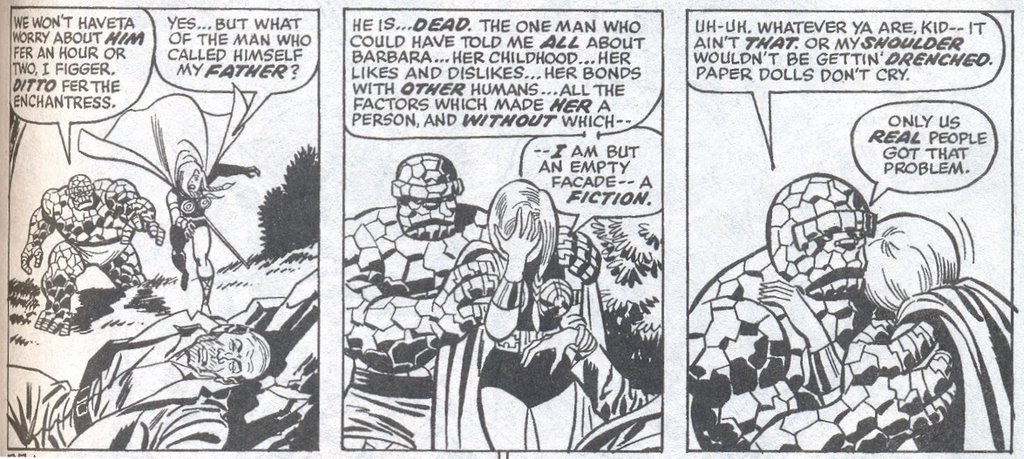
In comics, however, many characters are granted a level of omniscience that is impossible for us to truly fathom. There's a certainty in Ignatz's or Sluggo's or She-Hulk's knowledge that they are, at the end of the day, drawings on a piece of paper. We don't have that luxury. For as much as you may know that God exists or doesn't, your certainty in that "fact" is just an act of faith. We don't have the actual knowledge because our creator/s (if indeed we even have them in the larger context -- I'm not talking about your parents here) have not imbued us with it in the way Windsor McCay might have done with Little Nemo. The act of creating a character -- a paper doll to pick up on Roeg's metaphor -- gives the creator the right to implant as much or as little knowledge into him/her as is appropriate. Reed Richards is a genius because Stan Lee said he was. Dr. Manhattan was omniscient because Alan Moore wanted him to be.
This, of course, can lead to what is considered bad writing. Can you imagine the uproar among fans if, for example, Commissioner Gordon asked Batman about how Alfred the butler was doing? The relationship between Batman and Alfred is one that Gordon should have no knowledge of because his character has never been given that information within the context of continuity. But a writer, being the unseen force behind that exchange, does have omniscience of that world and can give that specialized piece of knowledge to any character at any time. It wouldn't make sense within how the story is presented, in all likelihood, but it's still the creator's prerogative.
Of course, there's the rub. For any story that presents free will and/or existentialism as "correct" the characters in the story are following a prescribed destiny. For any knowledge that a character might possess about the nature of free will -- for that matter, any knowledge the character possesses at all -- they are inherently bound by the will of their creator(s). The paper dolls simply cannot exist, much less have any meaning, without someone to create them. You can say Kang chose to defy Destiny itself in Avengers Forever but Kang really didn't have any say in the matter; his course of actions were laid down by writers Kurt Busiek and Roger Stern. "All the world's a stage, and all the men and women merely players."
Where does that leave us? That free will simply cannot exist because nothing we humans create is capable of it? Of course not. As noted earlier, we humans are stuck with limitations that make us decidedly less than all-powerful. Once upon a time, we couldn't create apples that tasted like grapes, either, but look where we are now. Who's to say that creating independent, free will characters is that far off? Wasn't that part of the reason why Phineas Horton created the original Human Torch? Why Noonien Soong created Data? Why Sivasubramanian Chandrasegarampillai created HAL 9000?
(As a curious aside, all those characters I just cited were used, in part, to explore the very notion of self. Is a being's own quest for life's meaning sufficient to consider it "alive"? Is life and a sense of self strictly limited to biological organisms? Does the origin of one's existence truly impact whether or not one can have free will?)
Man's quest for life's meaning is, for all intents and purposes, perpetual. Every day, we wake up and try to muddle our way through life, acting on a nearly infinite number of judgment calls. The next day, we do the same thing. Comics -- and, indeed, any media -- can show us possible alternatives that other people have considered; they can pass along messages about what other people think life means. They can go so far as to give us a taste of omniscience, seeing events through the eyes of any number of characters. But, again, the ultimate irony of the situation is that the very mouthpieces that we see as proponents of self-direction and choice are they themselves shackled to the will of others.
The problem we have, as mere mortals, is a lack of omniscience. We simply can't know anything beyond our immediate realm of experience. Even our learning from the experience of others is something that we have to undertake ourselves, whether by reading or listening or some other method of knowledge transfer. And even then, there's still the matter of interpretation -- the original experience is recounted to us in some manner by someone(s) who will invariably leave out some level of detail and we, in the process of absorbing the information, will process and filter it based on our own personal experiences. We cannot know, with any accuracy, what it's like to walk on the moon unless we actually go there ourselves.
In comics, however, many characters are granted a level of omniscience that is impossible for us to truly fathom. There's a certainty in Ignatz's or Sluggo's or She-Hulk's knowledge that they are, at the end of the day, drawings on a piece of paper. We don't have that luxury. For as much as you may know that God exists or doesn't, your certainty in that "fact" is just an act of faith. We don't have the actual knowledge because our creator/s (if indeed we even have them in the larger context -- I'm not talking about your parents here) have not imbued us with it in the way Windsor McCay might have done with Little Nemo. The act of creating a character -- a paper doll to pick up on Roeg's metaphor -- gives the creator the right to implant as much or as little knowledge into him/her as is appropriate. Reed Richards is a genius because Stan Lee said he was. Dr. Manhattan was omniscient because Alan Moore wanted him to be.
This, of course, can lead to what is considered bad writing. Can you imagine the uproar among fans if, for example, Commissioner Gordon asked Batman about how Alfred the butler was doing? The relationship between Batman and Alfred is one that Gordon should have no knowledge of because his character has never been given that information within the context of continuity. But a writer, being the unseen force behind that exchange, does have omniscience of that world and can give that specialized piece of knowledge to any character at any time. It wouldn't make sense within how the story is presented, in all likelihood, but it's still the creator's prerogative.
Of course, there's the rub. For any story that presents free will and/or existentialism as "correct" the characters in the story are following a prescribed destiny. For any knowledge that a character might possess about the nature of free will -- for that matter, any knowledge the character possesses at all -- they are inherently bound by the will of their creator(s). The paper dolls simply cannot exist, much less have any meaning, without someone to create them. You can say Kang chose to defy Destiny itself in Avengers Forever but Kang really didn't have any say in the matter; his course of actions were laid down by writers Kurt Busiek and Roger Stern. "All the world's a stage, and all the men and women merely players."
Where does that leave us? That free will simply cannot exist because nothing we humans create is capable of it? Of course not. As noted earlier, we humans are stuck with limitations that make us decidedly less than all-powerful. Once upon a time, we couldn't create apples that tasted like grapes, either, but look where we are now. Who's to say that creating independent, free will characters is that far off? Wasn't that part of the reason why Phineas Horton created the original Human Torch? Why Noonien Soong created Data? Why Sivasubramanian Chandrasegarampillai created HAL 9000?
(As a curious aside, all those characters I just cited were used, in part, to explore the very notion of self. Is a being's own quest for life's meaning sufficient to consider it "alive"? Is life and a sense of self strictly limited to biological organisms? Does the origin of one's existence truly impact whether or not one can have free will?)
Man's quest for life's meaning is, for all intents and purposes, perpetual. Every day, we wake up and try to muddle our way through life, acting on a nearly infinite number of judgment calls. The next day, we do the same thing. Comics -- and, indeed, any media -- can show us possible alternatives that other people have considered; they can pass along messages about what other people think life means. They can go so far as to give us a taste of omniscience, seeing events through the eyes of any number of characters. But, again, the ultimate irony of the situation is that the very mouthpieces that we see as proponents of self-direction and choice are they themselves shackled to the will of others.
For as long as I can recall thinking about such things, I've been a big proponent of free will. The notion that I, and I alone, control my actions and that any consequences of those actions are mine to bear. As near as I can determine, it was this firm belief in free will that has guided/directed my thinking towards religion, politics, entertainment, and just about everything else. After college, I began mentally exploring that notion further and have come to think of myself as something of an existentialist. While there are any number of variations of existentialist philosophy, the basic premise takes free will a step further by stating that the meaning(s) of our very existence is entirely up to the individual.

I seem to recall seeing/reading an article some years back discussing Krazy Kat in an existentialist (instead of the more typical surrealist) light, but I can't seem to find that at the moment. This particular strip (from December 25, 1919) speaks directly to the two characters' differing approaches to what is or isn't their respective realities. But it's certainly not the only comic that brings up the notion of existentialism.
Time travel is a notion that comes up frequently in comics -- as well as other media, but I'm talking comics here. The two primary notions that tend to come up in some fashion are A) that anything a character does in his/her past is in fact already a part of his/her part and s/he was destined to carry out those actions, and B) history is mutable and subject to change -- a media-centric shortcut to explaining that position is Back to the Future. (There are variations on these ideas, obviously, with alternate timelines and such, but they still tend to generally follow one of those two premises.) It should be needless to say that I tend to favor stories that dismiss the notion of destiny or inevitability. Because of my fairly strong feelings on the matter, I tend to approach stories involving time travel with some trepidation, especially with properties that haven't previously taken a definitive stance on the issue of time travel. Both DC and marvel have wavered back and forth on the issue repeatedly, seemingly dependent on the whims of the writer and/or editor of any particular story.
That said, I can still appreciate a time travel story that holds to the notion of determinism, if it's done well. Steve Englehart, for example, did a fine job in West Coast Avengers #17-24. Technically, it holds together extremely well, keeping multiple storylines/timelines straight and still tying into established continuity on any number of points. I don't agree with the basic premise, but I have to admire the skill with which the story was executed. By contrast, Roberto Aguirre-Sacasa's Knights 4 #15-17 is fraught with plot holes stemming precisely from the time travel aspects of the story, and I disliked that story despite his holding up the notion of free will and some excellent artwork by Jim Muniz.
 But that's only an obvious way to see existentialism in comics. Another issue that stands out for me is one that was never published: Captain America #14 by Mark Waid and Andy Kubert. The issue, as written by Waid, recounts a history of the Red Skull -- as told by the Red Skull himself. (Editor Bob Harras re-wrote much of the script before it was published, putting Red Skull in a more typical -- and safe -- role as the bad guy. I wrote about this all in more detail here.) The original narrative is insightful because it is that of a character who believes in what he himself is doing, regardless of the fact that most people would consider those actions "evil." He doesn't consider his actions anything less than justified because of his own goals and that Captain America is an obstacle to them. Although the Skull's thoughts themselves don't necessarily relay an existentialist message, the very notion that his perception of events differs from the title's usual protagonist speaks to the idea that each man is creating a reality based on his own thoughts and opinions.
I think that one of the (subconscious) reasons I took to the Fantastic Four early was that it readily exposed the difference in approaches with Mr. Fantastic and Dr. Doom. Doom's very character is based in large part on revenge against Reed Richards for a perceived slight back in college. Reed, by contrast, always takes the opinion that the error was Doom's himself and he has never acknowledged that fact -- Doom is, in effect, absolving himself of any responsibility for his situation. The difference in characters are further highlighted by Reed repeatedly taking responsibility for the accident that caused his friends' conditions -- most notably that of his best friend, Ben Grimm. And similarly, Ben does NOT blame Reed for his own state (at least, he didn't by the time I started reading the book; the first dozen or so issues, Ben very clearly and adamantly did blame Reed). Ben has accepted that he elected to take on the risk of piloting that fateful space flight, fully knowing that there was a great amount of risk. The Fantastic Four (the good guys) believe they created themselves, while Dr. Doom (the bad guy) believes he was created by others.
Now whether or not you agree with me on how much responsibility we have for our own actions is immaterial here. But I think it's an especially intriguing notion to examine how some of my core belief system ties in to what I like to read. As I write this, I am the product of every decision I've ever made, and so I'm left to wonder who would I be if I had made different choices? Would I have taken to the Fantastic Four -- or, indeed, comics in general -- if I was more determinist in nature? Would I be reacting differently to events in my personal life the way I am? Would I even need to be dealing with the same things with a different outlook? Certainly interesting, if ultimately unanswerable, questions.
But let me put the question to you: how do your personal philosophies impact your choice of comics reading? I don't expect answers here, mind you -- I can only address the issue now because of the insane amount of navel-gazing I've done on the topic -- but it might be something worth examining for your own personal edification.
Self-actualization through comic books! Who knew?

I seem to recall seeing/reading an article some years back discussing Krazy Kat in an existentialist (instead of the more typical surrealist) light, but I can't seem to find that at the moment. This particular strip (from December 25, 1919) speaks directly to the two characters' differing approaches to what is or isn't their respective realities. But it's certainly not the only comic that brings up the notion of existentialism.
Time travel is a notion that comes up frequently in comics -- as well as other media, but I'm talking comics here. The two primary notions that tend to come up in some fashion are A) that anything a character does in his/her past is in fact already a part of his/her part and s/he was destined to carry out those actions, and B) history is mutable and subject to change -- a media-centric shortcut to explaining that position is Back to the Future. (There are variations on these ideas, obviously, with alternate timelines and such, but they still tend to generally follow one of those two premises.) It should be needless to say that I tend to favor stories that dismiss the notion of destiny or inevitability. Because of my fairly strong feelings on the matter, I tend to approach stories involving time travel with some trepidation, especially with properties that haven't previously taken a definitive stance on the issue of time travel. Both DC and marvel have wavered back and forth on the issue repeatedly, seemingly dependent on the whims of the writer and/or editor of any particular story.
That said, I can still appreciate a time travel story that holds to the notion of determinism, if it's done well. Steve Englehart, for example, did a fine job in West Coast Avengers #17-24. Technically, it holds together extremely well, keeping multiple storylines/timelines straight and still tying into established continuity on any number of points. I don't agree with the basic premise, but I have to admire the skill with which the story was executed. By contrast, Roberto Aguirre-Sacasa's Knights 4 #15-17 is fraught with plot holes stemming precisely from the time travel aspects of the story, and I disliked that story despite his holding up the notion of free will and some excellent artwork by Jim Muniz.

I think that one of the (subconscious) reasons I took to the Fantastic Four early was that it readily exposed the difference in approaches with Mr. Fantastic and Dr. Doom. Doom's very character is based in large part on revenge against Reed Richards for a perceived slight back in college. Reed, by contrast, always takes the opinion that the error was Doom's himself and he has never acknowledged that fact -- Doom is, in effect, absolving himself of any responsibility for his situation. The difference in characters are further highlighted by Reed repeatedly taking responsibility for the accident that caused his friends' conditions -- most notably that of his best friend, Ben Grimm. And similarly, Ben does NOT blame Reed for his own state (at least, he didn't by the time I started reading the book; the first dozen or so issues, Ben very clearly and adamantly did blame Reed). Ben has accepted that he elected to take on the risk of piloting that fateful space flight, fully knowing that there was a great amount of risk. The Fantastic Four (the good guys) believe they created themselves, while Dr. Doom (the bad guy) believes he was created by others.
Now whether or not you agree with me on how much responsibility we have for our own actions is immaterial here. But I think it's an especially intriguing notion to examine how some of my core belief system ties in to what I like to read. As I write this, I am the product of every decision I've ever made, and so I'm left to wonder who would I be if I had made different choices? Would I have taken to the Fantastic Four -- or, indeed, comics in general -- if I was more determinist in nature? Would I be reacting differently to events in my personal life the way I am? Would I even need to be dealing with the same things with a different outlook? Certainly interesting, if ultimately unanswerable, questions.
But let me put the question to you: how do your personal philosophies impact your choice of comics reading? I don't expect answers here, mind you -- I can only address the issue now because of the insane amount of navel-gazing I've done on the topic -- but it might be something worth examining for your own personal edification.
Self-actualization through comic books! Who knew?
Here are this week's links to what I've had published recently...
Kleefeld on Comics: Redux: Earning a Living in the 21st Century
https://ift.tt/qIbrgLt
Kleefeld on Comics: STILL Studying at Transylvania Polygnostic
https://ift.tt/sgn2pRO
Kleefeld on Comics: Robert Zuppke, Cartoonist?
https://ift.tt/At9gfSm
Kleefeld on Comics: RSS is Not Dead
https://ift.tt/3yEV0cu
Kleefeld on Comics: On Reed Crandall
https://ift.tt/6TeY2xz
https://ift.tt/qIbrgLt
Kleefeld on Comics: STILL Studying at Transylvania Polygnostic
https://ift.tt/sgn2pRO
Kleefeld on Comics: Robert Zuppke, Cartoonist?
https://ift.tt/At9gfSm
Kleefeld on Comics: RSS is Not Dead
https://ift.tt/3yEV0cu
Kleefeld on Comics: On Reed Crandall
https://ift.tt/6TeY2xz
I suspect that, like many folks, I don't know much about Reed Crandall. His most prominent work was through the 1940s and '50s, and he moved over to work on the oft-overlooked Treasure Chest in 1960, where he remained for just over a decade. Although he did work on some notable characters like Blackhawk and Doll Man, not having not actually created them means his contributions often get glossed over as well. Further, when he went over to EC, he was working in the shadow of guys like Wally Wood, Jack Davis, Will Elder, Frank Frazetta, Graham Ingels and Jack Kamen. That's a tough crowd to stand out in.
 Which means that, not only do we not have a book-length biography of him to refer to, it doesn't seem as if there have been any substantial articles about him. The references I'm seeing in Alter Ego (the magazine when it comes to Golden Age creators and characters) seems to only talk about Crandall in relation to broader discussions of Quality Comics, who ran Blackhawk and Doll Man. The longest biography I can seem to find of him is his Wikipedia listing.
I'm vaguely familiar with his work, first seeing it cited in Ron Goulart's The Great Comic Book Artists back in 1986. But the era Crandall was in the industry, combined with his never really worked on anything I was especially interested in, meant that I know little more about him now than I did decades ago. I've picked up a few reprints of his EC stuff, but that he worked on the pieces was incidental.
So it's only been compartatively recently that I became aware of any details of Crandall's final years. Here's the Wikipedia version...
There are biographies out there of Mort Meskin, Matt Baker, Nick Cardy, and Jackie Ormes. All very, very talented individuals, but also ones whose names do not immediately strike one as commercially viable biography subjects. So how about Crandall? Who's up for writing a biography of him? He's definitely a creator we should know more about, if for no other reason than to make sure his final days aren't repeated by any other comic artist! Someone, get on this!

I'm vaguely familiar with his work, first seeing it cited in Ron Goulart's The Great Comic Book Artists back in 1986. But the era Crandall was in the industry, combined with his never really worked on anything I was especially interested in, meant that I know little more about him now than I did decades ago. I've picked up a few reprints of his EC stuff, but that he worked on the pieces was incidental.
So it's only been compartatively recently that I became aware of any details of Crandall's final years. Here's the Wikipedia version...
Crandall, who had left New York City in the 1960s in order to care for his ailing mother in Wichita, Kansas, had developed alcoholism. Recovering by the time of his mother's death, he nonetheless suffered debilitated health and left art in 1974 to work as a night watchman and janitor for the Pizza Hut general headquarters in Wichita. After suffering a stroke that year, he spent his remaining life in a nursing home and died in 1982 of a heart attack.Wow. Talk about tragic. Crandall did get some recognition of his contributions during his lifetime when he was a guest at the Multicon-70 convention in 1970, but any other accolades he received were posthumous ones.
There are biographies out there of Mort Meskin, Matt Baker, Nick Cardy, and Jackie Ormes. All very, very talented individuals, but also ones whose names do not immediately strike one as commercially viable biography subjects. So how about Crandall? Who's up for writing a biography of him? He's definitely a creator we should know more about, if for no other reason than to make sure his final days aren't repeated by any other comic artist! Someone, get on this!
Jey Pawlik posted on Mastodon yesterday


And on the off chance that you're wondering, I've always included an RSS link to this very blog at the bottom of every page! But to be abundantly clear, the link to my blog feed is: http://kleefeldoncomics.blogspot.com/feeds/posts/default?alt=rss
* I actually do know why: capitalism
"I was commissioned by filthyfigments.com to draw up a BRAND NEW RSS COMIC!I've been using RSS for ages and still rely on it for reading webcomics. (Even the ones where creators don't even realize they've accidentally set up RSS feeds!) I don't know why RSS fell out of favor* so I thought I'd share Pawlik's two-page comic here as well.
With all the Tapas news, I thought this would be the perfect time to post the full comic.
This is an up-to-date comic with what I'm using, how I'm using it, and how you can too!"


* I actually do know why: capitalism

One of the other strips there, though, appears to be a football-related story by Bob Zuppke -- the title of the strip is blocked from view. It turns out that Bob Zuppke in fact only did one strip, called Ned Brant that ran from 1930 to 1948. It was occassionally subtitled "A Story of College Athletics" so the football theme makes sense. And indeed, when you look up Zuppke himself, he was in fact the head football coach the University of Illinois at Urbana–Champaign from 1913 until 1941. He took the team to national titles four times, beginning his second year at the school! He is sometimes creditted with the invention of the huddle, although forms of it were in use before his version of it.
Zuppke was also an avid painter and had one-man shows at least as early as 1937. He mostly did landscapes of the American West and presumably spent even more time painting once he retired from football. So where did he find time to do a daily comic strip as well?
Well, even though this strip is creditted only to him, it was actually drawn by Walt Depew. At least some of the strips do give Depew co-credit. Lambiek notes that Depew also worked on Flying to Fame, Off Campus, and Dick Ember but he seemed to be primarily a staff photographer and artist for the Des Moines Tribune. So Ned Brant wasn't Zuppke toiling away at the drawing board after the big game!
But wait, there's more!
A few years ago, Tom Heintjes dug up a clipping from a Q&A from a circa-1980s Tribune where someone asked about whether it was true that Ned Brant was drawn by a local. The response was mostly about a gent by the name of Ted Ashby, who used to be a reporter and columnist for that paper from 1928 until 1945. It's then noted that it was actually Ashby who wrote the strip, and that they just attached Zuppke's name to it. Zuppke had just come off three incredible seasons (including winning the National Championship in 1927 and the Conference title in 1928) when Ned Brant started, so attaching his name to the strip was almost certainly a marketing ploy to bring in more readers.
The clipping also notes that Ashby took inspiration from his own life, at one point writing a story about a physically handicapped boy who strove to become a college athlete... which closely resembled his polio-stricken son. That Ashby lived/worked at the Des Moines paper that also employed Depew would've made collaboration a HECK of a lot easier than trying to work with Illinois-based Zuppke in the 1930s and '40s!
Zuppke clearly had talent as a football coach, but it's interesting to see how much else he's given credit for that really he had little to do with.
In the mail yesterday, I received the two Girl Genius books from Phil and Kaja Foglio's most recent Kickstarter. The package, like many Kickstarters, contained some additional goodies like bookmarks and stickers and -- most significantly for me -- a 2026 student ID card for Transylvania Polygnostic University,...

(To be clear, the card arrived blank. I added the personal information in the above image digitally.)
I'm particularly amused by the "accelerated learning program" notation on the card. Because I've been a student at TPU since 2001! I still have my acceptance letter and first report card...
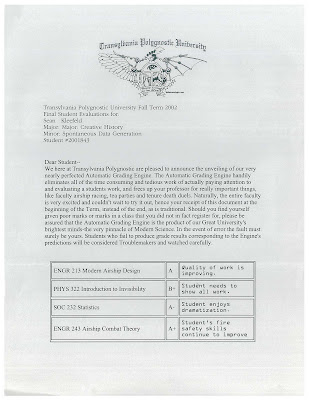
Personally, I always like this kind of promotional material. Real world artifacts of a fictional place. Particularly when you, as a reader, are able to become a part of it. I've created a small shelf display of my comic book alter ego's adventures. You can see here various coins, some badges and ID cards, a folder of "Above Top Secret" material, and a Tesladyne field guide among other things. Relative to Girl Genius in particular, you can see three medals in the back identifying me as a "Monster Wrangler," an "Aetheric Machinist" and a member of the "Incorruptuble Library." (So yeah, I have been at TPU for a quarter century, but it's not like I haven't been doing anything during my time there!)
 When combined with the appearances I've made as a character in various comics over the years, I think it makes for an exciting story trying to weave together all of these elements into a single narrative. I've had others comment in recent years that my actual life has been interesting and exciting and cool -- climbing volcanos and running marathons and getting struck by lightning and saving people from drowning in the ocean... But I'm only able to do those types of things because I'm trying to live up to the potential my fictional alter ego has shown through these half-seen adventures. I can push myself to do cool stuff in real life because I've got hints like these of what my fictional self has been able to achieve.

I'm particularly amused by the "accelerated learning program" notation on the card. Because I've been a student at TPU since 2001! I still have my acceptance letter and first report card...


Personally, I always like this kind of promotional material. Real world artifacts of a fictional place. Particularly when you, as a reader, are able to become a part of it. I've created a small shelf display of my comic book alter ego's adventures. You can see here various coins, some badges and ID cards, a folder of "Above Top Secret" material, and a Tesladyne field guide among other things. Relative to Girl Genius in particular, you can see three medals in the back identifying me as a "Monster Wrangler," an "Aetheric Machinist" and a member of the "Incorruptuble Library." (So yeah, I have been at TPU for a quarter century, but it's not like I haven't been doing anything during my time there!)

I came across this piece that I wrote way back in 2009, not even a decade into the 21st century. And while a lot has changed in that time and even some of the people I quote below have passed away, the thrust of my point here still stands. Possibly even moreso than it did when I first wrote it.
Despite some of the specifics being a little dated, I've kept the original text intact, other than to add a few notes where links appear to have died.
Without getting into editorial cartoons, I've just pulled together a small collection of December comments from comic industry folks, reflecting on the current state of the economy, their finances and health care...
Harvey Pekar, via Graphic NYC [dead link]...
Steve Greenberg, via The Steve Greenberg Blog [dead link]...
Joey Manley, via Facebook [dead link]...
Julia Wertz, via Time's YouTube channel...
Erik Larsen, via Twitter [dead link]...
Some of this has to do with the nature of freelancing; there's an inherent instability in income. But as Greenberg noted (if you read through his entire piece) the stability that once was taken for granted in corporate America is no longer quite so assured. Further complicating matters is that increased specialization means that the bills we pay go in more and more different directions simultaneously. (Consider almost any health procedure: where you once just paid a single doctor, payments now need to go to the hospital, the surgeon, the anesthesiologist, the pharmacist, the lab technicians, your primary care doctor, etc.)
Given that high degree of uncertainty and complication, it would seem that no one person can rely on a single revenue stream any longer. This really started back in the 1970s when a single income family was simply unsustainable and many housewives found they had to go back to work in order to bring in enough money into the household to survive. If one member of the household lost their job, there'd be another to at least keep things going for a little while. This has gotten more pronounced in recent years where we see people working two or three jobs in order to keep up.
Now what strikes me as particularly interesting is when you start looking at successful webcomic creators in this context.
Many (I daresay "most") successful webcomic creators essentially follow the same basic business model: give your comic away for free, and make money via advertising and selling books and t-shirts and whatnot. Charlie Trotman's upcoming book, Poorcraft, specifically speaks to being able to live comfortably while earning a viable living as a cartoonist in this manner. (Check the link for a better explanation from Trotman herself.) But look at that business model more closely. Folks like Trotman are making comics, but they're making money through multiple, simultaneous revenue streams. Some fans read the comics online for free and buy a t-shirt or mousepad or something. Others don't care about a silly tchotchke, and would prefer to have a printed copy of the book. Still others won't read anything online anyway, and stumble across a creator's booth at a comic convention. And still others don't care about the creator's own work per se, but would love to have a really cool sketch of Batman. While all of the income associated with that creator is centered around his/her comic in some way, they're all from different sources. Now, if your t-shirt vendor suddenly goes under, you've still got book sales to go on for a while until you can locate another one. If your transportation craps out and you can't drive to all the conventions you planned on having a booth at, you can still have money coming in from online sales.
These creators make their own form of security through diversification. Much the same way mutual funds have more security than individual stocks because they have a little money in a lot of different companies. "Don't put all your eggs in one basket."
I think freelancers, at least to a degree, have known and acted on this idea for many years. But it's a lesson that now needs to be carried over to the classic 8-to-5er as well. Admittedly, this is NOT an easy way to change to make! I've been struggling for YEARS trying to develop additional means of income for myself beyond my day job and I can tell you first-hand that is incredibly difficult to even think of, much less develop, multiple viable income streams! (I'm hoping my book alleviates that somewhat, but we'll have to wait to see how that goes.)
But the more I think about it, the more it seems to me that it will become increasingly difficult for one person to live on a single source of income. We've been seeing a trend (at least here in the States) of households including more extended family members; I think that's likely to continue to increase and broaden to something that begins to resemble a commune. (Clarification: That is NOT to say I think we're heading towards Communism! But I think more people will try to take advantage of living in greater numbers to diffuse common costs like, say, shelter. Think of the Fantastic Four: a man, his wife, her brother, and some guy they all know but aren't actually related to.)
One of my personal concerns is that of relevance. I see the speed with which technology is changing and how it's changing society, and to remain viably employed in any capacity means that I need to at least keep pace. Not too much of a problem now, but I question whether I can continue when I'm 70. (As much as I'm trying to save for retirement, I've pretty well resigned to working until I die. I don't think retirement as we know it today will be a realistic option 30 years from now.) Am I adaptable enough to flow with an ever-changing economy?
I think that people are starting to get that at some level. That's where Pekar's comments stem from. The plans he may have had for retirement 25 years ago when he agreed to appear on The Late Show are completely out the window now. This is a guy who didn't just freelance -- he had a regular, paying job with benefits and social security and all that. But he still needs to keep developing new forms of income at 70 years old to live. Granted, he didn't have a great-paying day job as a file clerk and American Splendor never netted him huge amounts of cash either, but that's going to be the dilemma more and more people face. Can you juggle multiple ways of earning income as you get older?
AND NONE OF THAT REALLY EVEN SPEAKS TO HEALTH CARE!
I don't claim to have the answers here. But I think the webcomic creators are on to something real and practical, and that more people are going to have to start taking their cues from them. You need to develop something current than has legs enough to build on for years. You need to be adaptable. You need to get creative. It doesn't necessarily have to be comics, but I think there are good lessons to be learned there.
Pay attention to the Charlie Trotmans and Jennie Breedens and Ryan Sohmers that are out there. Not just their comics, but their business models and ethics. What are they doing BEYOND just creating good comics? And how can that be adapted to fit the talents you personally have? How can you leverage your assets with others' to benefit everyone?
That, I believe, is going to be what it takes to live in the 21st century. I think there was another drummer a few years back who said something about getting by with a little help from his friends. Just something to think about.
Despite some of the specifics being a little dated, I've kept the original text intact, other than to add a few notes where links appear to have died.
Harvey Pekar, via Graphic NYC [dead link]...

Steve Greenberg, via The Steve Greenberg Blog [dead link]...

Joey Manley, via Facebook [dead link]...

Julia Wertz, via Time's YouTube channel...
Erik Larsen, via Twitter [dead link]...

Some of this has to do with the nature of freelancing; there's an inherent instability in income. But as Greenberg noted (if you read through his entire piece) the stability that once was taken for granted in corporate America is no longer quite so assured. Further complicating matters is that increased specialization means that the bills we pay go in more and more different directions simultaneously. (Consider almost any health procedure: where you once just paid a single doctor, payments now need to go to the hospital, the surgeon, the anesthesiologist, the pharmacist, the lab technicians, your primary care doctor, etc.)
Given that high degree of uncertainty and complication, it would seem that no one person can rely on a single revenue stream any longer. This really started back in the 1970s when a single income family was simply unsustainable and many housewives found they had to go back to work in order to bring in enough money into the household to survive. If one member of the household lost their job, there'd be another to at least keep things going for a little while. This has gotten more pronounced in recent years where we see people working two or three jobs in order to keep up.
Now what strikes me as particularly interesting is when you start looking at successful webcomic creators in this context.
Many (I daresay "most") successful webcomic creators essentially follow the same basic business model: give your comic away for free, and make money via advertising and selling books and t-shirts and whatnot. Charlie Trotman's upcoming book, Poorcraft, specifically speaks to being able to live comfortably while earning a viable living as a cartoonist in this manner. (Check the link for a better explanation from Trotman herself.) But look at that business model more closely. Folks like Trotman are making comics, but they're making money through multiple, simultaneous revenue streams. Some fans read the comics online for free and buy a t-shirt or mousepad or something. Others don't care about a silly tchotchke, and would prefer to have a printed copy of the book. Still others won't read anything online anyway, and stumble across a creator's booth at a comic convention. And still others don't care about the creator's own work per se, but would love to have a really cool sketch of Batman. While all of the income associated with that creator is centered around his/her comic in some way, they're all from different sources. Now, if your t-shirt vendor suddenly goes under, you've still got book sales to go on for a while until you can locate another one. If your transportation craps out and you can't drive to all the conventions you planned on having a booth at, you can still have money coming in from online sales.
These creators make their own form of security through diversification. Much the same way mutual funds have more security than individual stocks because they have a little money in a lot of different companies. "Don't put all your eggs in one basket."
I think freelancers, at least to a degree, have known and acted on this idea for many years. But it's a lesson that now needs to be carried over to the classic 8-to-5er as well. Admittedly, this is NOT an easy way to change to make! I've been struggling for YEARS trying to develop additional means of income for myself beyond my day job and I can tell you first-hand that is incredibly difficult to even think of, much less develop, multiple viable income streams! (I'm hoping my book alleviates that somewhat, but we'll have to wait to see how that goes.)
But the more I think about it, the more it seems to me that it will become increasingly difficult for one person to live on a single source of income. We've been seeing a trend (at least here in the States) of households including more extended family members; I think that's likely to continue to increase and broaden to something that begins to resemble a commune. (Clarification: That is NOT to say I think we're heading towards Communism! But I think more people will try to take advantage of living in greater numbers to diffuse common costs like, say, shelter. Think of the Fantastic Four: a man, his wife, her brother, and some guy they all know but aren't actually related to.)
One of my personal concerns is that of relevance. I see the speed with which technology is changing and how it's changing society, and to remain viably employed in any capacity means that I need to at least keep pace. Not too much of a problem now, but I question whether I can continue when I'm 70. (As much as I'm trying to save for retirement, I've pretty well resigned to working until I die. I don't think retirement as we know it today will be a realistic option 30 years from now.) Am I adaptable enough to flow with an ever-changing economy?
I think that people are starting to get that at some level. That's where Pekar's comments stem from. The plans he may have had for retirement 25 years ago when he agreed to appear on The Late Show are completely out the window now. This is a guy who didn't just freelance -- he had a regular, paying job with benefits and social security and all that. But he still needs to keep developing new forms of income at 70 years old to live. Granted, he didn't have a great-paying day job as a file clerk and American Splendor never netted him huge amounts of cash either, but that's going to be the dilemma more and more people face. Can you juggle multiple ways of earning income as you get older?
AND NONE OF THAT REALLY EVEN SPEAKS TO HEALTH CARE!
I don't claim to have the answers here. But I think the webcomic creators are on to something real and practical, and that more people are going to have to start taking their cues from them. You need to develop something current than has legs enough to build on for years. You need to be adaptable. You need to get creative. It doesn't necessarily have to be comics, but I think there are good lessons to be learned there.
Pay attention to the Charlie Trotmans and Jennie Breedens and Ryan Sohmers that are out there. Not just their comics, but their business models and ethics. What are they doing BEYOND just creating good comics? And how can that be adapted to fit the talents you personally have? How can you leverage your assets with others' to benefit everyone?
That, I believe, is going to be what it takes to live in the 21st century. I think there was another drummer a few years back who said something about getting by with a little help from his friends. Just something to think about.
Here are this week's links to what I've had published recently...
Carl Thomas Anderson is the cartoonist behind the comic strip, Henry. He had actually created other strips before then, including Raffles and Bunny, the Amateur Cracksman and Herr Spiegelberger. He freelanced for Judge, Life , and Puck. In 1935, he wrote How to Draw Cartoons Successfully which was republished repeatedly over the next decade. Throughout all of this, Henry was unquestionably his most successful cartoon, but it's clear that, despite not really taking up drawing until his 20s, he worked hard at it throughout his lifetime.
But one of the things that often gets lost when discussing cartoonists from Richard Outcault to Charles Schulz to Stephan Pastis is their lives outside of cartooning. These people are all multi-faceted individuals, and pursue interests beyond what they're famous for. Even in David Michaelis' comprehensive biography Schulz and Peanuts, he continually resorts to tying the events in Schulz's life to what happened in the strip.
So it's kind of interesting to come across items that aren't directly related a cartoonist's comic strip. In the case of Anderson, he actually holds a design patent in the U.S. for a desk he created. He was actually a carpenter before becoming a cartoonist and used those skills in his 50s to craft a different design for a desk. The patent filing isn't terribly elaborate in its description, but it includes a wondefully done illustration...

My best guess is that it doesn't "fold", so much as "come apart easily." I suspect the legs and the drawing surface itself aren't actually connected, but are held in place with friction and gravity. This would certainly require a bit more ingenuity and craftsmanship than simply screwing the pieces together, and points to Anderson's continued interest in carpentry decades after he supposedly would have given it up.
Not a huge discovery, but a fascinating contextual one that puts a more colorful light on someone who might otherwise be thought of as just a cartoonist.
But one of the things that often gets lost when discussing cartoonists from Richard Outcault to Charles Schulz to Stephan Pastis is their lives outside of cartooning. These people are all multi-faceted individuals, and pursue interests beyond what they're famous for. Even in David Michaelis' comprehensive biography Schulz and Peanuts, he continually resorts to tying the events in Schulz's life to what happened in the strip.
So it's kind of interesting to come across items that aren't directly related a cartoonist's comic strip. In the case of Anderson, he actually holds a design patent in the U.S. for a desk he created. He was actually a carpenter before becoming a cartoonist and used those skills in his 50s to craft a different design for a desk. The patent filing isn't terribly elaborate in its description, but it includes a wondefully done illustration...


My best guess is that it doesn't "fold", so much as "come apart easily." I suspect the legs and the drawing surface itself aren't actually connected, but are held in place with friction and gravity. This would certainly require a bit more ingenuity and craftsmanship than simply screwing the pieces together, and points to Anderson's continued interest in carpentry decades after he supposedly would have given it up.
Not a huge discovery, but a fascinating contextual one that puts a more colorful light on someone who might otherwise be thought of as just a cartoonist.
Peanuts was established as a staple of the comics page long before I was born. Indeed, the Christmas and Halloween specials were already expected viewing on their respective holidays by that point as well. Snoopy, for me, has always been in the Macy's Thanksgiving Day Parade. The comic, for me and my generation, was not the revelation in comics that it was when it came out. Nor was it unique any longer. Ziggy bore many physical characteristics to Chuck, The Born Loser seemed to run into adult versions of the same problems that the Peanuts gang did, and Johnny Hart's various strips bore many of the (then) quasi-religious overtones shared by Schulz's work.
That said, though, Charlie Brown still stood out. He was the perpetual outcast that I could readily and regularly identify with. My Halloween costumes sucked. I never got Valentines. I was laughed out of the auditorium for not fitting in. I never had the courage to ask out the pretty redhead. I just could not seem to win. Ever.
Naturally, it was that sense of alienation that all children feel that Schulz was able to tap into. I'm more than certain I wasn't alone in my thinking. (I actually had a conversation several years ago with one of the most popular girls in my grade/high school. She was pretty, athletic, smart, talented, friendly... everyone liked her. But it turns out that despite being popular, she too felt estranged from her classmates!) What Schulz mastered was allowing us to see the pain of isolation and rejection, filtered through the printed page to make it more humorous. (Tragedy + time = comedy.) His drawing style was so simple that it was incredibly easy for readers to project themselves into the characters. What is Charlie Brown, after all, but a smiley face with a nose and ears?
 But you've read/seen those types of comments in numerous places by now. Since Schulz's death, there has been plenty of artwork honoring/capitalizing on his work. I'm sure you've seen drawings of various superheroes drawn in Schulz's style. Or Michael Paulus' skeletal studies of Charlie, Linus, Pigpen, Patty and Lucy. Or the Peanuts crew drawn as manga characters. Jason Yungbluth's Weapon Brown, which recasts Chuck as a post-apocalyptic mutant cyborg. Not mention the endless Photoshop riffs that give the old strips new (and often off-color) dialogue.
But, you know what I find particularly striking in absorbing all this material? That I still absolutely connect with the originals. Those comics that feature Charlie Brown not being particularly funny, but making pointed statements about who we are, how we think, and how we react to the crap Life throws at us? I'll be damned if those don't get to me.
For that matter, Schulz himself got to me. When I was watching that "American Masters" documentary on Schulz from 2007, I found myself wiping tears off my cheeks towards the end. Not because it was a particularly sad story in and of itself -- although Schulz's death was indeed quite sad -- but because I could see far too much of myself in Peanuts all of a sudden. I could almost see that iconic zig-zag strip running across my shirt: the tread tracks from Life effortlessly running me over. (Crap, that's almost literal as I think about how I was actually struck down by an SUV back in 2017!) I saw myself paying a nickel for psychiatric advice from the closest thing I have to a female friend. I saw myself running towards that football and landing smack on my back, causing little physical pain but more than enough mental anguish to prevent me from even bothering to get up.
After work today, I'm probably going to have some leftovers for dinner and read comics for a bit. Probably play with the dog. Much like Chuck would. And maybe sometime over the weekend I'll watch A Charlie Brown Christmas and shed a few tears when I hear, "I've killed it."
At least, though, I'm not the only one.
That said, though, Charlie Brown still stood out. He was the perpetual outcast that I could readily and regularly identify with. My Halloween costumes sucked. I never got Valentines. I was laughed out of the auditorium for not fitting in. I never had the courage to ask out the pretty redhead. I just could not seem to win. Ever.
Naturally, it was that sense of alienation that all children feel that Schulz was able to tap into. I'm more than certain I wasn't alone in my thinking. (I actually had a conversation several years ago with one of the most popular girls in my grade/high school. She was pretty, athletic, smart, talented, friendly... everyone liked her. But it turns out that despite being popular, she too felt estranged from her classmates!) What Schulz mastered was allowing us to see the pain of isolation and rejection, filtered through the printed page to make it more humorous. (Tragedy + time = comedy.) His drawing style was so simple that it was incredibly easy for readers to project themselves into the characters. What is Charlie Brown, after all, but a smiley face with a nose and ears?

But, you know what I find particularly striking in absorbing all this material? That I still absolutely connect with the originals. Those comics that feature Charlie Brown not being particularly funny, but making pointed statements about who we are, how we think, and how we react to the crap Life throws at us? I'll be damned if those don't get to me.
For that matter, Schulz himself got to me. When I was watching that "American Masters" documentary on Schulz from 2007, I found myself wiping tears off my cheeks towards the end. Not because it was a particularly sad story in and of itself -- although Schulz's death was indeed quite sad -- but because I could see far too much of myself in Peanuts all of a sudden. I could almost see that iconic zig-zag strip running across my shirt: the tread tracks from Life effortlessly running me over. (Crap, that's almost literal as I think about how I was actually struck down by an SUV back in 2017!) I saw myself paying a nickel for psychiatric advice from the closest thing I have to a female friend. I saw myself running towards that football and landing smack on my back, causing little physical pain but more than enough mental anguish to prevent me from even bothering to get up.
After work today, I'm probably going to have some leftovers for dinner and read comics for a bit. Probably play with the dog. Much like Chuck would. And maybe sometime over the weekend I'll watch A Charlie Brown Christmas and shed a few tears when I hear, "I've killed it."
At least, though, I'm not the only one.


