Latest Posts

I was going to write about the little-known Hocus & Pocus characters from the early days of Superman, but it turns out that I already wrote that in 2007. (And I only came across that because I was trying to do research on the characters! Completely forgot that I wrote it!)

What I wondered at the time I wrote the piece, and still wonder today, is whether these stories were influenced by Captain Marvel. That character debuted a few years before Hocus & Pocus, and his more whimsical stories seemed to prove more popular than Superman's. Plus the two characters shared a number of writers, and there seemed to be a sense of cross-pollination between the two. The Hocus & Pocus stories seem more suited to Captain Marvel than Superman, so I'm left wondering if the original was a rejected Captain Marvel script in which Superman was simply substituted in place.

The last of Hocus & Pocus' appearances was in 1947, and while National had started their infamous lawsuit against Fawcett in 1941, the trial did not begin until early 1948. It's only after that that Hocus & Pocus' roughly yearly appearances dropped down to nil. It's circumstantial at best, but I can't help but think that the lawsuit helped kill the two magicians.
Joe Sinnott, who served in the U.S. Navy during World War II after his losing his brother brother in the Army in 1944, posted this eloquent piece on Facebook this morning...
Here are this week's links to what I've had published recently...
Kleefeld on Comics: On Business: Books-A-Plenty
http://ift.tt/20qo0K6

Comics Alternative: Webcomics: Reviews of Power Nap, Necropolis, and Look Straight Ahead
http://ift.tt/1OIR3SJ

Kleefeld on Comics: On History: Earliest Comic Biography
http://ift.tt/1YVgxlN

Kleefeld on Comics: Weekly Comics Links
http://ift.tt/1WOhrme

FreakSugar: Webcomics Wednesday: Online Longevity
http://ift.tt/20Bmi8w

Kleefeld on Comics: On -isms: SUPER-Ingrained
http://ift.tt/20G9yxB

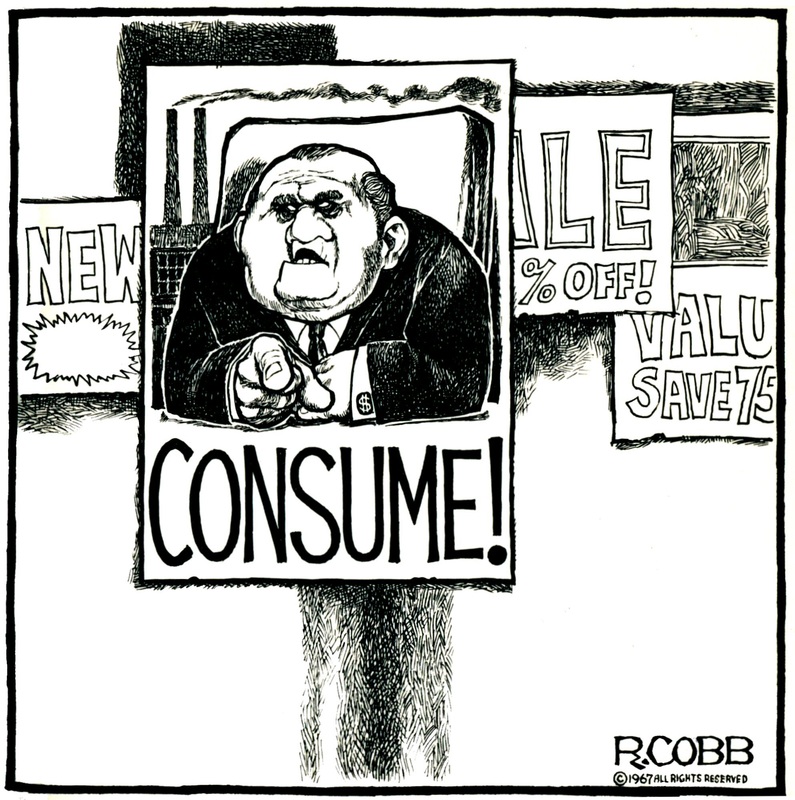
Kleefeld on Comics: On Strips: Cobb Clippings
http://ift.tt/1ORq8En


Ron Cobb was an active cartoonist from about 1965 until around 1972, when he moved to Australia. Coincidentally, this overlaps the period when my father was in college and most interested in exploring new ideas. He picked up obscure art magazines and experimental book projects. He was on board with National Lampoon when it launched. And he became a fan of Cobb's cartoons.

I didn't actually know that last bit until maybe 5-10 years ago, when he found a couple of old paperback collections of Cobb's comics in his basement. (There were six ever published, three of them I know to be basically reprints of earlier volumes and a fourth I suspect is as well.) But along with them, he had filed away a manila folder with about two dozen Cobb cartoons clipped from the Los Angeles Free Press to which my father subscribed.

My thought here is this: does that happen any more? Bill Blackbeard famously saved EVERY comic for decades, and I know many people used to collect their favorite strips in scrapbooks, but does that happen any more? In the first place, newspaper subscriptions are down so there's fewer people who might even consider it. In the second place, there are fewer new strips on a daily basis -- both due to a shrinking comics section generally, but also because newspaper editors are electing to re-run past favorites like Peanuts, For Better or Worse, and Boondocks; and creators who are still doing new strips on Sundays are resorting to old material for dailies like Foxtrot, Doonesbury, and Get Fuzzy. If people did clip those strips once, there's no need to do it again. And in the third place, many of the strips that are popular enough to warrant clipping are collected in nice, official bound collections.

Up until about three years ago, before I started working from home more often than not, that I would print amusing comics out and tape them around my cubicle walls. Mostly to break up the sea of beige, and give me something to look forward to when I entered my cube. But most of those were webcomics, and the few newspaper strips I had were pulled from the syndicates' websites, not the newspapers. They were whatever struck me as funny or entertaining, originally helping to give me something to smile about during my divorce. But in a building of 2000 or so people over the course of 6-7 years, I never saw anyone else who had more than one comic strip posted. (And that was usually a Dilbert strip photocopied from one of the books.) Clipped newspaper strips simply did not appear.

I don't know that this is a bad thing. At least, not beyond how that might signify a decline of the newspaper industry in general. The Cobb clippings I have are on cheap newsprint, which has yellowed and is noticeably brittle after four decades. The printing is decent for most, but not all, of the strips and the ink from the reverse side has bled through in places. Some of the corners are dog-eared. The edges are generally cut straight, but not always. There are many better reproductions of these comics out there, even in the limited book runs Cobb's cartoons had.

This collection of clippings is interesting to me personally because it tells me something about my father, and who he was a couple before I was born. But mostly in an abstract sense. I could get much the same thing from him just saying, "I used to clip Ron Cobb cartoons out of the LA Free Press when I was in college."

So to add to my "Does anyone clip comics any more?" question, I might add, if answered in the affirmative, "To what end?" When it's readily available in both online and better print formats already, why continue clipping them from newspapers? I don't mean that to be snarky, I'd be genuinely curious.
Here's a short story from my youth...

I was 11, 12, 13 and just starting to really get into comics and noticing creator names. Between a lack of mobility and being a pre-internet age, I didn't know a lot about most of the creators beyond their names, though. I saw a few articles about the superstars of the era -- John Byrne, Frank Miller, Chris Claremont, etc. -- but most creators were largely an enigma.

At some point, I recall being surprised to learn that Julie Schwartz, whose name I saw on many DC comics, was a man. Julie was a girl's name, after all. I hadn't seen a photo of him, though, and I know I actively resisted the idea very briefly, thinking "Well, they obviously got the pronouns wrong!" But after re-reading that a time or two, sure, Julie Schwartz was a guy. It made sense since so, so many other creators I knew of were men. In fact, as I thought about it, I didn't know of ANY women creators back then.

So when I later came across Jenette Kahn's name, the name of publisher and president of DC comics, I assumed it was another man. Because the comics industry was JUST men. Because publishers and presidents were JUST men. I'd already discovered that this well-known editor with a girl's name was actually a guy, so it made sense that his boss could also be a guy with a girl's name. I think I was well into my 20s before I realized Kahn was, in fact, a woman.

Think about that. The notion of comics being exclusively the realm of men was so ingrained in me by the time I became a teenager that it usurped my previously ingrained notions of what was or wasn't a girl's name. We're taught, almost from infancy, that Jenette, Julie, Ann, Wendy, and Marie are girls' names. And despite that, I found the comics industry to be so patriarchal that in just a year or three of being immersed in it, I readily dropped any notions of women even being in the industry. Bobbie Chase clearly must be a guy, using a nickname for Robert. Dann Thomas? Totally a guy. I'd never heard the name "Weezie" before, but Weezie Simonson must be a guy too. Cat Yronwode? Guy. Ramona Fradon? Guy.

It wasn't until I saw ElfQuest, probably 7-8 years later, that I discovered women could do comics. I spent most of my teenage years, and my formative years in comics fandom, believing that women simply could not make comics. Not that I ever thought there was a law against it or anything like that, but it was just something they couldn't do. Men can't bear children, women can't make comics. I don't know how exactly I got past that notion with Pini, but it took me several years to reset my mental images of Kahn, Chase, Thomas, etc.

That's kind of fucked up.
Random question of the moment: What was the earliest biography written in comic book form? Or rather, in comic form. Maybe a comic strip or sequential narrative mural or something. Who was the earliest subject?

Wikipedia has an entry for autobiographical comics. The earliest one they cite is Mangaka Zankoku Monogatari by Shinji Nagashima circa 1961. (The article also notes that, while Justin Green is considered an autobiographical comics pioneer, Binky Brown Meets the Holy Virgin Mary didn't appear until 1972.) That surely can't be the earliest, right?

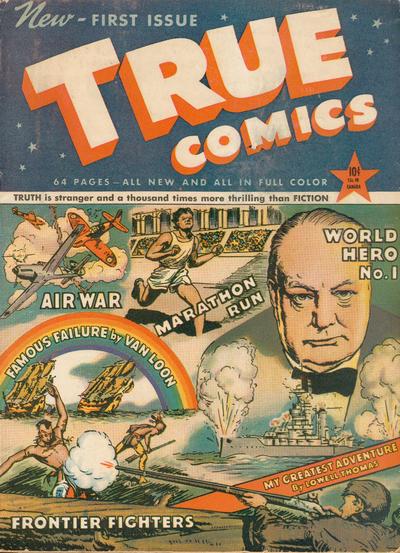
Well, let's check out some other "obvious" candidates. Parents' Institute, Inc. published a book called True Comics from April 1941 until August 1950. Each issue had several, not surprisingly, true stories told in a comic format. The lead story was usually a little shy of 20 pages, and the others ranged between five and ten pages. And there we have, in the first story of the first issue, a 17-pager called "World Hero No. 1." It's a biography of Winston Churchill.

(The same group put out Real Heroes several months later with the lead story being a 16-pager about "The Most Important Man on Earth" -- Franklin D. Roosevelt.)

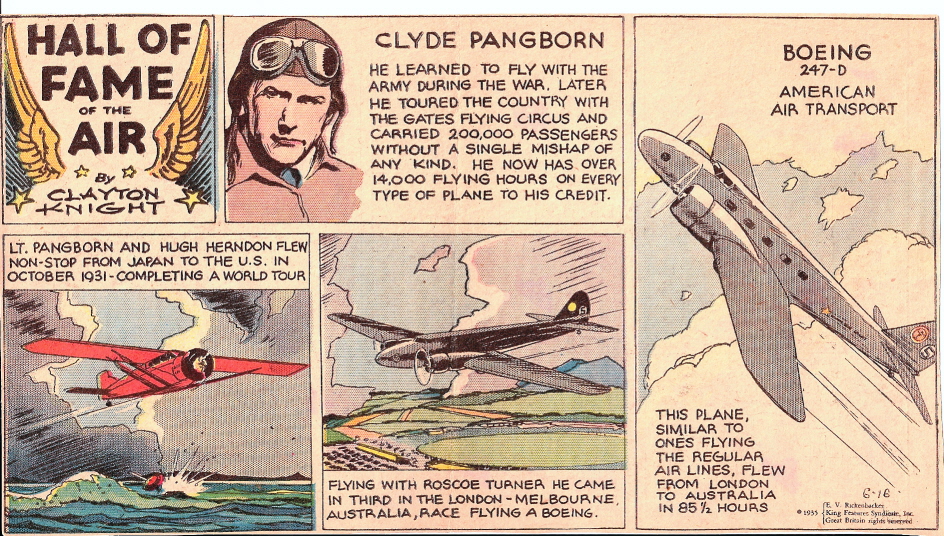
In 1935, a cartoonist by the name of Clayton Knight put out a comic strip called The Hall of Fame of the Air in which he spotlit aviators, starting with Charles Lindbergh. He only used one strip per aviator, so they're incredibly short and truncated as far as biographies go, and whether or not what he did are actual comics could be debated. Personally, I'd liken these strips to Ripley's Believe It or Not! (it debuted in 1919) which featured more quick vignettes than actual biographies. Knight's work is clearly more involved, but still seems to fall short of "biography."
I can't find anything earlier. Does True Comics #1 really contain the first biography in comic form? What am I missing?