

 Here are this week's links to what I've had published recently...Here are this week's links to what I've had published recently...
Richard Outcault is frequently given credit for "inventing" the modern comic strip. That's not really an accurate claim, but he did do some innovative work in the field and deserves some credit for that. I've always been more partial to Winsor McCay, who worked not only in the same field in the same time frame, but also for the same employers. In fact, both Outcault and McCay ran in to legal issues with publisher William Randolph Hearst with regards to who owned the comics they drew, and both artists went on to other publishers taking the essence of their strips, if not the original title, with them.
It was pointed out to me recently, though, that McCay in fact drew one of Outcault's strips for a time. From 1906-1908, McCay worked on "Buster Brown" after Outcault left the New York Herald, where he first developed the strip in 1902. There's several things to be fasincated by in this, but the thing that immediately struck me was how we can directly compare the two arists' work as they were working on the same material. Here's a panel of "Buster Brown" from each of them...

This isn't to say Outcault was necessarily an inferior cartoonist than McCay, but I would easily posit that McCay was a better artist. I would've said so before, but having the direct and immediate comparison of having had both of them work on the exact same strip, the comparisons are even more inevitable than before.
Now I'm going to have to track down reprints of McCay's "Buster Brown" comics! (h/t Peter Sattler)
It was pointed out to me recently, though, that McCay in fact drew one of Outcault's strips for a time. From 1906-1908, McCay worked on "Buster Brown" after Outcault left the New York Herald, where he first developed the strip in 1902. There's several things to be fasincated by in this, but the thing that immediately struck me was how we can directly compare the two arists' work as they were working on the same material. Here's a panel of "Buster Brown" from each of them...


This isn't to say Outcault was necessarily an inferior cartoonist than McCay, but I would easily posit that McCay was a better artist. I would've said so before, but having the direct and immediate comparison of having had both of them work on the exact same strip, the comparisons are even more inevitable than before.
Now I'm going to have to track down reprints of McCay's "Buster Brown" comics! (h/t Peter Sattler)
Some of the earliest comic books I had were some mid-1970s era DC books. Mostly featuring Batman and/or Superman. I loved those stories. But in the back of some of those books, by all that editorial nonsense that I never read, was a small comic strip. It was formatted and drawn like a strip you'd see in the newspaper, but this one was sitting by itself in a comic book. They usually featured DC heroes in doing some silly gag or pun. I thought it was a great feature. But it was evidently gone by the time I started actually buying my own comics.
 But a couple years later, at a local convention, I stumbled across a magazine featuring much the same style of artwork. It was a collection of full-page strips by Fred Hembeck. (Fred, as you may well know, has a particularly distinctive drawing style, and he was probably one of the first artists I came to recognize by their artwork.) Rather than just featuring DC characters, though, Fred himself was the main character as he went through various comics universes interviewing all sorts of characters. Or sometimes, he'd just talk about some wacky comic book stories of the past. And I knew just enough comics history recognize he wasn't just making jokes about those old books. He clearly loved them and thought they were a lot of fun but, while he also clearly spent a lot of time studying them, he didn't take either them or himself too seriously.
Fred's work continued popping up throughout my life in comics fandom. He popped up pretty regularly in Marvel Age and even got to write several one-shots, including the why-hasn't-it-ever-been-reprinted Fantastic Four Roast. All of his work, regardless of how/when/where I encountered it bore that same sense of both reverence and whimsy. He loved all comics it seemed, but he wasn't above poking fun at how absurd they could sometimes be.
Any you know, from my fairly isolated fannish life as the only comics fan I knew, Fred was the first one to show me what fandom was like. That you could bury yourself in these arcane histories, but still have fun doing it. That you could interact with the medium on multiple levels. And it could really be a hoot! He was the first comic book fan I knew of that was actually making money like a professional! A Pro Big Name Fan!
At some point, too, I realized that he was getting paid for the work he was doing. At the time, I still had this vague notion of the old Marvel Bullpen and drawing Amazing Spider-Man was a 9-to-5 job, but Fred's work was the first that really registered as freelance gig. (Obviously, all those comics jobs were freelance gigs, too, but it didn't seem like it to my 8-9-10-11 year old brain.) I can't say exactly how/why I understood Fred's role to be as a freelancer, but he seemed decidedly more like free agent compared to, say, Curt Swan or John Romita. They were company men, but Fred was his own man, talking about the comics he liked, and getting paid to do it.
What a fantastic idea!
I eventually learned that Fred managed to carve a truely unique path for himself, and he holds an equally unique spot in comics fandom. And while I've studied fandom more estudiously over the past decade or so, I still try to keep Fred's basic idea at the forefront. These are comics, man, and they're a hoot!

Fred's work continued popping up throughout my life in comics fandom. He popped up pretty regularly in Marvel Age and even got to write several one-shots, including the why-hasn't-it-ever-been-reprinted Fantastic Four Roast. All of his work, regardless of how/when/where I encountered it bore that same sense of both reverence and whimsy. He loved all comics it seemed, but he wasn't above poking fun at how absurd they could sometimes be.
Any you know, from my fairly isolated fannish life as the only comics fan I knew, Fred was the first one to show me what fandom was like. That you could bury yourself in these arcane histories, but still have fun doing it. That you could interact with the medium on multiple levels. And it could really be a hoot! He was the first comic book fan I knew of that was actually making money like a professional! A Pro Big Name Fan!
At some point, too, I realized that he was getting paid for the work he was doing. At the time, I still had this vague notion of the old Marvel Bullpen and drawing Amazing Spider-Man was a 9-to-5 job, but Fred's work was the first that really registered as freelance gig. (Obviously, all those comics jobs were freelance gigs, too, but it didn't seem like it to my 8-9-10-11 year old brain.) I can't say exactly how/why I understood Fred's role to be as a freelancer, but he seemed decidedly more like free agent compared to, say, Curt Swan or John Romita. They were company men, but Fred was his own man, talking about the comics he liked, and getting paid to do it.
What a fantastic idea!
I eventually learned that Fred managed to carve a truely unique path for himself, and he holds an equally unique spot in comics fandom. And while I've studied fandom more estudiously over the past decade or so, I still try to keep Fred's basic idea at the forefront. These are comics, man, and they're a hoot!

The basic plot revolved around a generic "evil" Professor Grimsby who wanted to remove laughter from the world so he could win a "Meanie" award. His solution (or, rather, his computer's solution) was capture all of the characters from the Sunday funnies because a lot of people laugh at them. (There are several flaws with this plan already, as you can guess.) The characters all get conned into a free cruise, and Grimsby captures them easily. The President then asks several adventure heroes from the funny pages to save them, but their plans backfire ending up with them getting captured as well. It's ultimately the children characters who convince Grimsby to let them go by getting him to laugh at himself. The all then escape the erupting volcano (what?!?) and the are all invited for a party at the White House.
The story is... mostly coherent, I guess? The internal logic falls apart repeatedly and, coupled with some really cheap animation (Hell, most of the backgrounds are little more than a single line between the floor and wall, if there's a background at all!) makes this eminently forgettable. But it is notable in that brought a large number of comic strip characters together in a single story, with many of those characters appearing in animated form for the first time!
Characters from the following comics made appearances...
- Barney Google and Snuffy Smith
- Blondie
- Beetle Bailey
- Bringing Up Father
- Flash Gordon
- Henry
- Hi and Lois
- The Katzenjammer Kids
- Little Iodine
- The Little King
- Mandrake the Magician
- The Phantom
- Popeye
- Prince Valiant
- Quincy
- Steve Canyon
- Tiger
- Tim Tyler's Luck
I think my biggest curiosity is in the villain. Grimsby, as I said, was created for this cartoon, but his henchman is Brutus. I kind of understand Brutus being included since Popeye is given a heavy role in the story, but why create a new villain in Grimsby? I suppose someone like Ming the Merciless or Madame Lynx might have been thought to be too serious a villain to come up with such a ridiculous plot, but they couldn't pull out one decent antagonist from any of these strips?
There are probably any number of reasons why this hasn't been brought back to TV or made it to the home video market. At least we have the internet to give us a peak at weird curiosities like this...
The TV show Suspense debuted in early 1949 on CBS on ran for six seasons. It was an anthology series based on a radio show where each episode presented an entirely different story, related only by the broad "suspense" genre. The TV show was sponsored by Auto-Lite, and host Rex Marshall regularly hawked spark plugs, headlights, and other car parts. Several stories (particularly early in the series) were adapted from the radio show, while several others were lifted from the likes of Edgar Allen Poe, Agatha Christie, and Charles Dickens.
 Of particular interest here is the September 27, 1949 episode entitled "The Comic Strip Murder." In the story, Julia Stetson's husband, Mark, draws an adventure strip called Buzz O'Keefe, which seems to be something of Dick Tracy knock-off. The female lead in the strip is based off Julia, and after nine years of working on the strip, Mark decides he's going to kill off the character in a particularly gruesome manner. This convinces Julia that Mark is out to kill her as well, so she calls on the police. I'll leave you in "suspense" about what actually happens in the story...
But one of the things I find interesting about these types of works is that they have to show at least some samples of the comic in question. And, more to the point, they have to get someone to draw them. So I watched through the episode to see if I could make out any tell-tale markers of who might have worked on it -- I was skeptical, though, and went in assuming it was whoever was already working on the show and could kind of draw a bit. So imagine my surprise when the end credits actually featured a credit for the cartoonist! And imagine that I was doubled surprised to see a name I recognized: Dick Ayers!
Ayers is probably primarily known as an inker from the early days of Marvel Comics, but he had been in the comics industry for many years as a penciller by then, doing a lot of work on Westerns for Timely/Atlas. Including the creation of the original Ghost Rider. He would later have an extended run on Sgt. Fury and his Howling Commandos beginning in 1963.
But in 1949, at the age of 25, he was only a couple years out of school and had already begun working in comics, getting his start with Dell Comics. In fact, his original Ghost Rider character debuted in Tim Holt #11 (from Magazine Enterprises) shortly before "The Comic Strip Murder" aired. I can't seem to find any information about how he landed the TV gig, but I suspect it was through some connection editor Vin Sullivan had.
There's not much of Ayers' work shown in this episode, but certainly enough to showcase that he was already an extremely talented artist...

But one of the things I find interesting about these types of works is that they have to show at least some samples of the comic in question. And, more to the point, they have to get someone to draw them. So I watched through the episode to see if I could make out any tell-tale markers of who might have worked on it -- I was skeptical, though, and went in assuming it was whoever was already working on the show and could kind of draw a bit. So imagine my surprise when the end credits actually featured a credit for the cartoonist! And imagine that I was doubled surprised to see a name I recognized: Dick Ayers!
Ayers is probably primarily known as an inker from the early days of Marvel Comics, but he had been in the comics industry for many years as a penciller by then, doing a lot of work on Westerns for Timely/Atlas. Including the creation of the original Ghost Rider. He would later have an extended run on Sgt. Fury and his Howling Commandos beginning in 1963.
But in 1949, at the age of 25, he was only a couple years out of school and had already begun working in comics, getting his start with Dell Comics. In fact, his original Ghost Rider character debuted in Tim Holt #11 (from Magazine Enterprises) shortly before "The Comic Strip Murder" aired. I can't seem to find any information about how he landed the TV gig, but I suspect it was through some connection editor Vin Sullivan had.
There's not much of Ayers' work shown in this episode, but certainly enough to showcase that he was already an extremely talented artist...
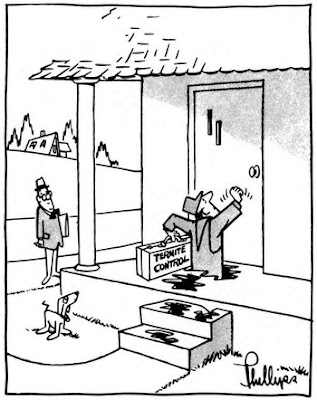
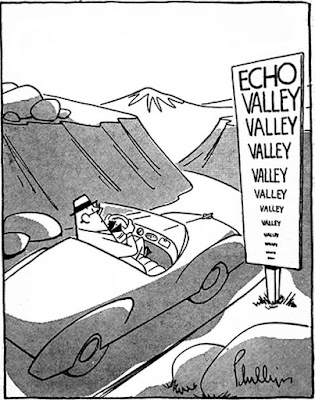
The Strange World of Mr. Mum was a comic strip by Irv Phillips and ran from 1958 to 1974. It's largely a pantomime strip (hence the "Mr. Mum" part of the title) in which the protagonist witnesses strange and humorous things as he goes about his daily business. The bizarre, sometimes downright surreal, happenings are sometimes credited as a predecessor to the likes of Gary Larson's The Far Side and Dan Piraro's Bizarro, although personally, I find Phillips' style of humor more in line with Charles Addams, albeit without the macabre elements. The character of Mr. Mum consistently bears passive witness to whatever events are unfolding, whereas Larson's and Piraro's characters tend to be more actively involved.
Prior to cartooning, Phillips was actually a relatively busy author, writing for motion pictures and television, perhaps his most notable work being Song of the Open Road which featured W.C. Fields and the film debut of Jane Powell. Perhaps presciently, in 1955 he also penned a play called The Funnyman in which a cartoonist who elects to discontinue a comic, much to the chagrin of the lead character in the comic itself!
In any event, I thought I'd share a few of the strips, given that most everyone under 45 probably hasn't seen these at all. They seem to have largely aged pretty well, and there seem to be a couple not-terribly-hard-to-find collections from within the past decade, so it might be something you find worth hunting for.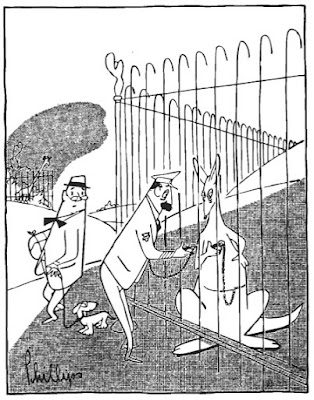



Prior to cartooning, Phillips was actually a relatively busy author, writing for motion pictures and television, perhaps his most notable work being Song of the Open Road which featured W.C. Fields and the film debut of Jane Powell. Perhaps presciently, in 1955 he also penned a play called The Funnyman in which a cartoonist who elects to discontinue a comic, much to the chagrin of the lead character in the comic itself!
In any event, I thought I'd share a few of the strips, given that most everyone under 45 probably hasn't seen these at all. They seem to have largely aged pretty well, and there seem to be a couple not-terribly-hard-to-find collections from within the past decade, so it might be something you find worth hunting for.


 Here are this week's links to what I've had published recently...


