Latest Posts

interrobang
So the question came up recently, when writing dialogue, which is correct: using a question mark and then an exclamation mark, or using an exclamation mark and then a question mark?

Well, the snarky answer is neither; you should use an interrobang. That's what the accompanying graphic here is. It's literally the two independent marks superimposed on each other specifically to convey both a question and an exclamation. "What‽"

Except that it's pretty hard to read in a lot of situations and not very common, so it would probably confuse more readers than not.

The next answer is question mark/exclamation mark. According to Nate Piekos, that is what Marvel insists on. My guess is that that's because it tends to read more distinctly. A ?! is very much two different, distinct punctuation marks, but !? could be read as a capital P if the kerning is too tight or the ink bleeds a bit or something.

Personally, though, I think printing standards have improved sufficiently that, since we no longer have to worry about the word FLICK any more, why should !? be a concern?

My suggestion -- and what I always do in my writing -- is use the both, but their specific usage is dependent on the context or situation. Namely, whichever mark comes first is the primary mark and highlights the emphasis of the dialogue. Are we talking about an question that's posed with a lot of energy or excitement, or is it more of an exclamation that happens to be phrased as a question? So, for example...

What!? Why did you do that?!

Here, the speaker isn't actually asking someone to repeat themselves by asking "What?" They're expressing surprise and alarm, using a questioning phrase. Hence, it uses !?

By contrast, "Why did you do that" is an actual question. It continues to have the excitement and alarm of the exclamation, but an answer or response is expected. Thus ?!

To my thinking, you can add one more mark to either if you really want to hammer the point home, but it should always be a duplicate of the first mark. Using the same example...

What!?! Why did you do that?!?

More than three marks is unecessary, however.

A lot of this boils down to context and, indeed, different writers might approach the same phrase a little differently. Maybe they do think "What?" is a legitimate question here, and there's an expected response either to confirm or repeat the questioned statement. But if that is the case, I -- as the reader -- continue following the guidelines above and assume that "What?!" demands an answer whereas "What!?" does not. This adds further clarification to the reader that an interrobang does not. And isn't that usually the point -- to give as much clarity to the reader as possible?
Evidently last year, Rebellion put out a collection of the "Fran of the Floods" strips that ran in Jinty throughout most of 1976 in Great Britain. I only recently heard of the strip and/or the collection, and the premise sounded interesting so I picked it up.

The basic story is that the polar ice caps have largely melted, and much of the world is experiencing torrential, seemingly never-ending rains. At the start of the story, newscasters are already noting how the Sahara Desert has already become fairly green and lush, so it's not too long before pretty much all of England finds itself underwater. The titular Fran is at a school assembly when the water comes crashing in, and she finds herself separated from pretty much everyone in short order. Much of the story then revolves around her adventures trying to make her way up to the Scottish highlands where her older sister lives. Along the way, she encounters a variety of characters; some helpful, some in need of help, and some downright dangerous. She eventually does make it to her sister, and reunites with her family just as the sun comes out and everything is fine again.

What struck me about the premise here was that it was warning about the dangers of climate change back in 1976, and I wondered how it was presented. The overall approach writer Alan Davidson generally takes is to focus on the social consequences. Which ties in pretty well with the serial nature of how the story was originally published. Fran would encounter one group for several installments, and we'd get to see how they live and are dealing with the massive flooding, and then Fran would head off and encounter another group that handle things differently. Davidson is able to showcase a variety of scenarios, rather than give a definitive "this is what will happen" suggestion that could get knocked down more easily.

There's a couple problems, though. The first thing that struck me is a pretty comprehensive misunderstanding of anything resembling science. The increased heat that's metling the ice caps is repeatedly blamed on "an extra flicker of warmth" from the sun. No mention of greenhouse gasses or global warming or anything. He's got the rain so torrential that virtually all of Great Britain is submerged in literally just a few days. The water is shown to be high enough to reach the clock face on Big Ben, so I think we're talking about 200-250 feet above sea level. It's estimated that if all the ice on the planet melted, sea level would rise about 230 feet. I'm certainly no climate scientist myself, but I would think that if you got that much ice to melt inside a week, your concerns would be more along the lines of spontaneous combustion, not flooding. At the other end, he has the floodwaters completely recede in about a week as well, which he mostly attributes to evaporation from the sun. Again, the heat needed for that kind of rapid evaporation is going to cause houses, forests, and even people to just randomly burst into flames.

So maybe you're thinking he's just expiditing the timeline for the reader's sake. I'm almost certain that's deliberate on his part, in fact, but it's almost comically fast for everything. One of the first groups that Fran runs into is some men who've captured locals and forced them into slave labor. Two days after the flooding starts. She finds another group who've taken up residence in a series of caves, and they already have built an electric generator from a nearby waterfall that's powerful enough to provide enough light for underground farming -- which they've apparently done very well at since they're already harvesting crops just over a week after evacuating their original homes. And how about the town that's self-isolating because of some mysterious "plague" that the local doctor can't figure out? Fran accidentally stumbles on the cure -- eating an orange -- that has people completely healed in just a few minutes! (Also, what kind of shit doctor are you that you don't recognize scurvy? I mean, I know it's not exactly common any more, but still..!)

Between the super-accelerated timeline and the lack of anything approximating reasonable science, Davidson manages to completely undermine whatever climate change message he might've been aiming for. Now, granted, we know more now that we did in 1976, but nearly everything in here could've been dismissed as bunk even back then!

From a craft perspective, the story starts off a bit weak, but noticeably improves as it goes along. Davidson's dialogue is pretty stiff at first, but he does better once he gets rolling. Phil Gascoine's art doesn't improve as noticeably but he was turning in some solid illustrative work right from jump. Most of his improvement comes in the page layout area -- there's a few pages earlier on that can be pretty confusing in terms of panel sequencing, but he seems to recognize what works and what doesn't as he goes along.

All that being said, I still found it an interesting read. Probably in part because I'm not super familiar with British weeklies, and I was able to pick up a bit on the structure and rhythm. But it's a generally enjoyable story overall, as long as you set aside any environmental intents and just run with it as a kid's adventure.
Here are this week's links to what I've had published recently...

Kleefeld on Comics: It's Time to Unlearn the Hero's Journey

Kleefeld on Comics: What's the Impact of Comics Visuals?

Kleefeld on Comics: Lost Rituals 

Kleefeld on Comics: Darmok and Jalad at Tanagra

Kleefeld on Comics: Charlie Everyman Brown


Peanuts was established as a staple of the comics long before I was born. Indeed, the Christmas and Halloween specials were already expected viewing on their respective holidays by that point as well. Snoopy, for me, has always been in the Macy's Thanksgiving Day Parade. The comic, for me and my generation, was not the revelation in comics that it was when it came out. Nor was it unique any longer. Ziggy bore many physical characteristics to Chuck, The Born Loser seemed to run into adult versions of the same problems that the Peanuts gang did, and Johnny Hart's various strips bore many of the (then) quasi-religious overtones shared by Schulz's work.

That said, though, Charlie Brown still stood out. He was the perpetual outcast that I could readily and regularly identify with. My Halloween costumes sucked. I never got Valentines. I was laughed out of the auditorium for not fitting in. I never had the courage to ask out the pretty redhead. I just could not seem to win. Ever.

Naturally, it was that sense of alienation that all children feel that Schulz was able to tap into. I'm more than certain I wasn't alone in my thinking. (I actually had a conversation several years ago with one of the most popular girls in my grade/high school. She was pretty, athletic, smart, talented, friendly... everyone liked her. But it turns out that despite being popular, she too felt estranged from her classmates!) What Schulz mastered was allowing us to see the pain of isolation and rejection, filtered through the printed page to make it more humorous. (Tragedy + time = comedy.) His drawing style was so simple that it was incredibly easy for readers to project themselves into the characters. What is Charlie Brown, after all, but a smiley face with a nose and ears?

Charlie Brown by Micahel Paulus
But you've read/seen those types of comments in numerous places by now. Since Schulz's death, there has been plenty of artwork honoring/capitalizing on his work. I'm sure you've seen drawings of various superheroes drawn in Schulz's style. Or Michael Paulus' skeletal studies of Charlie, Linus, Pigpen, Patty and Lucy. Or the Peanuts crew drawn as manga characters. Jason Yungbluth's Weapon Brown, which recasts Chuck as a post-apocalyptic mutant cyborg. Not mention the endless Photoshop riffs that give the old strips new (and often off-color) dialogue.

But, you know what I find particularly striking in absorbing all this material? That I still absolutely connect with the originals. Those comics that feature Charlie Brown not being particularly funny, but making pointed statements about who we are, how we think, and how we react to the crap Life throws at us? I'll be damned if those don't get to me.

For that matter, Schulz himself got to me. When I was watching that Schulz documentary from about a decade ago, I found myself wiping tears off my cheeks towards the end. Not because it was a particularly sad story in and of itself -- although Schultz's death was indeed quite sad -- but because I could see far too much of myself in Peanuts all of a sudden. I could almost see that iconic zig-zag strip running across my shirt: the tread tracks from Life effortlessly running me over. I saw myself paying a nickel for psychiatric advice from the closest thing I have to a female friend. I saw myself running towards that metaphoric football and landing smack on my back, causing little physical pain but more than enough mental anguish to prevent me from even bothering to get up.

After work today, I'm going to have some leftovers for dinner and read comics for a bit. Probably play with the dog. Much like Chuck would. And sometime over the weekend I'll likely watch A Charlie Brown Christmas and shed a few tears when I hear, "I've killed it."

At least, though, I'm not the only one.
Today we're talking about metaphors. Just like similes, but without the prepositions.

There was an episode of Star Trek: The Next Generation entitled "Darmok" in which the crew encountered a race whose language completed confused them. The translators kept spitting out phrases that were interpretable, but not understandable. Things like, "Darmok and Jalad at Tanagra." The Enterprise crew eventually realized that these aliens' whole concept of speech revolved around metaphors. They used the example: "Romeo and Juliet at the balcony." That phrase will almost immediately conjure a particular scene and mood and set of emotions, but ONLY if you happen to know the story of Romeo and Juliet!

How about an example from music? You ever see somebody's update on Facebook or Twitter that just includes a few lyrics from a song? It speaks to that individual's tastes in music, of course, but the song itself also carries with it a series of meanings and emotions. The song lyrics, even removed from the full context of the music, carry a connotation with them and can serve as an abbreviated shorthand for the emotional state of the person doing the quoting. They might not be literally feeling or expressing the exact words they cite, but the overall emotive quality of the song (often, a short 2-3 minute rock song focusing on a single theme) suggests whatever complex set of emotions the individual might have difficulty putting into words.

The same holds true for visual metaphors as well. Take, for example, this image... Two girls, one with a violent nosebleed.

Now, if you're familiar with manga and anime, you probably have a pretty good idea of what this scene is about even if you don't know anything about the origins of this particular image. If you're not quite so familiar with them, you likely don't realize that the nosebleed is not literal, but metaphoric. It symbolizes the girl's emotional state. I don't know for sure, but I'd be willing to bet that in the story, no one comments on the nosebleed itself and, in subsequent scenes, there's no visible remnants of the spilled blood on either the girl or the surrounding furniture.

(I won't go into the precise meaning of the symbolism here, but I'll warn people who might try to look it up: do NOT run a search on "manga nosebleed" while you're at work!)

All of the "classic" visual devices in comics follow the same pattern. Motion lines, dollar signs in someone's eyes, thought balloons, a figure breaking out of the confines of a panel... these are all visual metaphors that are only understandable if someone is cognizant of what the metaphor is meant to convey. We don't literally see lines tapering away from someone as they run quickly, but we know the use of such lines implies motion.

My point here is that, as a creator, you need to keep your audience in mind when writing and drawing your work. The nosebleed reference wouldn't work very well in a Superman comic because that audience isn't "trained" in that particular metaphor. That's not to say that you CAN'T train your audience to understand the metaphors you use, just that you need to make sure that when you use a metaphor that might be unusual for them, they might some additional clues to help in understanding your piece.
2020 has brought with it... well, a lot! And one thing that has really thrown people has been the loss of the regular rituals. Their morning commute, regular dinners with friends, movie night at the theater, New Comic Day... almost everything has been disrupted. And while it's necessary for everyone's safety, I do understand why it's been so traumatic for so many people.

Rituals of all sorts have been with man since... well, the dawn of man. We use them as a stabilizer in our lives. Back in the day, mankind simply didn't understand much of what was going on around him, so he fell back on rituals to provide some continuity in his life. He wasn't sure if he would be able to even find a mammoth, much less be able to kill and eat it. So he developed a ritual to perform in advance of the hunt because it was a way to give him security and confidence before taking steps outside his cave into the unknown. He knew that, even though he couldn't count on the outcome of the hunt, he could count on the activities proceeding it.

By the twentieth century, man had figured out a great many things. Everything from fire and the wheel to creating and harnessing electricity to bring a small amount of daylight to the city streets at night. But while man's knowledge has increased, providing a great many answers to what was previously unknown, we keep raising new questions at an increasingly rapid pace. So while I -- a resident of the 21st century -- can rest pretty comfortably knowing that I can reliably get something to eat any time I step outside my dwelling, I don't have any clue what my long-term future looks like. In effect, my future is just as uncertain as that of our Australopithecus afarensis friend, Lucy -- the only difference is that my future extends further out than my next meal.

Alvin Toffler, back in the early 1970s, noted this and began touting the notion of "future shock." The idea being that life is indeed moving much faster than at any point in man's history (and, indeed, man's prehistory!) and we, as human beings, are being forced to constantly adapt ourselves to ever-changing status quo; further, that some people simply cannot keep up mentally and experience a form of culture shock within the very culture they've been living in. In extreme cases, future shock can resemble post-traumatic stress disorder.

A man living in the 1800s could pretty well assume that his day-to-day activities weren't likely to change that radically over the course of his lifetime. He still had to question whether or not he could earn enough of a living to buy food and keep his belongings secure, but he knew that if he was a cobbler, his job wasn't going to appreciably change. At all. By contrast, today's jobs are radically different than they were even ten years ago. A decade ago, people found it amusing to see Leonard Nimoy with a cell phone, unintentionally mimicking Mr. Spock using a communicator. But that visual is not only passe but it's out of date, as it's almost common to see people wearing wireless earbuds. Compare the political landscape of 2010 and that of today? We truly live in a completely different world than the one we inhabited a decade ago.

All of which points back to mankind's ability to adapt. We can, collectively, push societies and cultures forward with leaps and bounds on many levels but, as individuals, it becomes increasingly difficult to keep pace as we affronted from all sides by different forces, of which we may have only the most peripheral knowledge. Check out the latest Mindset List if you have any doubts about the wide range of changes going on in our lives. And do you know HOW we're able to keep up and adapt?

Rituals.

In an age when the jobs we have today will not be functional in tomorrow's economy, in an age when whole nations are leap-frogging themselves in technological revolutions, in an age where planning for anything beyond next week is almost laughable, we use rituals to keep ourselves sane. It provides that sense of stability and comfort in our lives so that we know there's at least that small portion of our life that we can rely on to be there over and over. The ritual gives us a focal point to relax and unwind -- however briefly -- from the rest of the world racing past us. Some people have a routine/ritualistic approach to how they get ready in the morning. Others focus around their favorite TV show on a weekly basis. Holidays provide annual outlets that work on a decidedly longer-term basis. And those of us who live and breath comic books have New Comic Day.

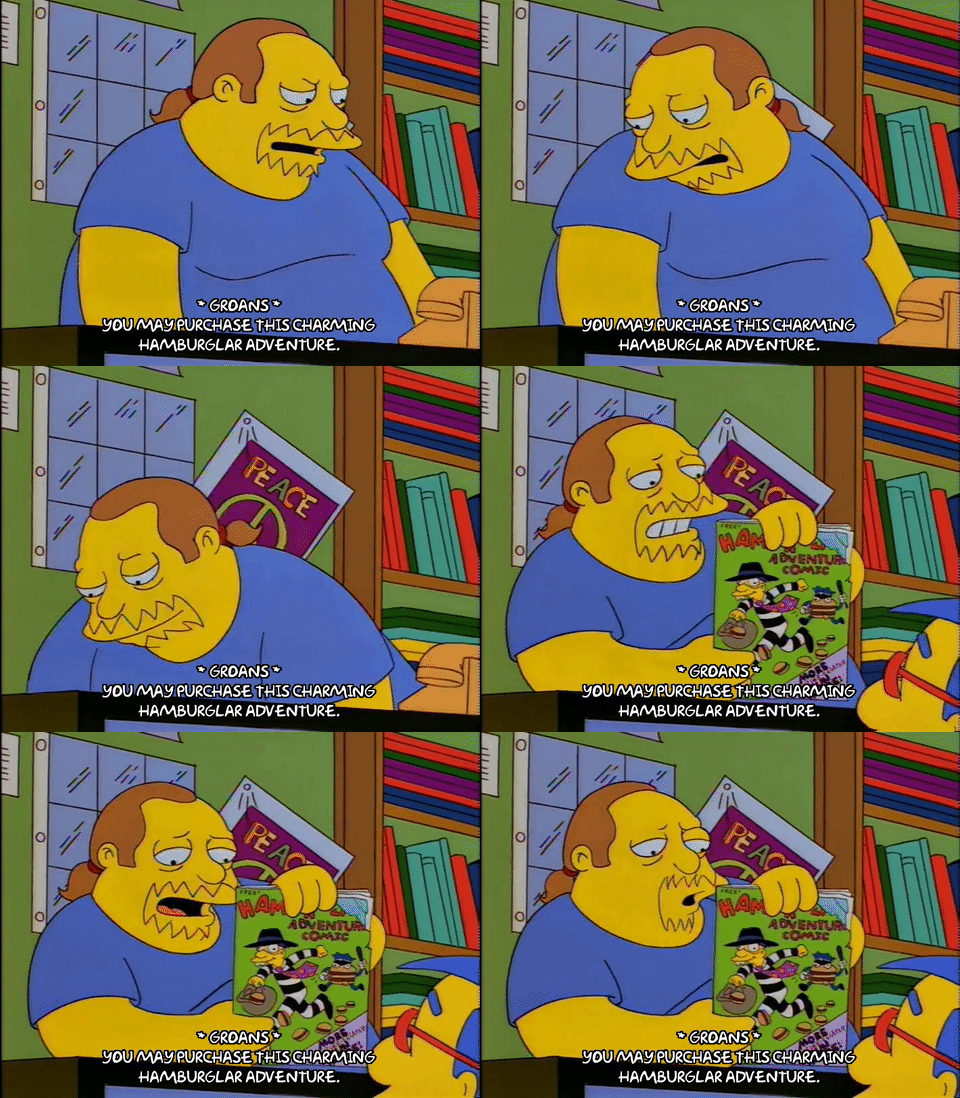
Comic Book Guy
New Comic Day gives us an oasis for our lives' stresses. Whether you go on your lunch hour or after work or whenever, you stop by your Local Comic Shop for some period of time during which you can drop whatever's troubling you on their doorstep. You can, for the time you're in the shop, have your biggest worry be whether or not the new Wonder Woman costume sucks. If you hit the shop at the same time every week, you're likely going to run into the same folks week after week as well, all doing the same thing. They've checked their concerns at the door, too, and can discuss "Identity Crisis" instead of the real ones in the rest of your life.

Maybe you take that a step further, and you scan through the wall of new comics in ritualistic manner as well. Maybe you take an extra few moments in every visit to admire the CGC 7.5 Detective Comics #27 beneath the glass counter. Maybe you flip through the latest issue featuring Spider-Man, even though you don't have any intent to buy it. It's all about creating a mental comfort zone for yourself, so that you can forget -- for a short while -- about their job security and Trump and COVID and climate change and...

It's pretty well documented now that the more life changes you might face in a short period of time, the more at risk you are to physical illness. With life speeding up on the whole, it's increasingly more likely for you to experience more and more of these life changes. Marriages don't last as long as they used to. Knowing more people almost inevitably leads to going to more funerals. Changing jobs, if not whole vocations, is commonplace. We're in a society now that reshapes itself on an almost daily basis, and I think that helps account for the seemingly increased problems we're collectively having. People are using more drugs to fight off sicknesses because their immune systems are collapsing under the weight of the life stressors. Crime, especially violent crime, is becoming harder to combat because more and more people are not able to adjust to the world changing around them and flip out by going on a shooting spree.

Many people still need New Comic Day. But where I used to think they needed it to keep their favorite stories from getting spoiled or being more "in the know" than the rest of the comic book community, I now know they need New Comic Day for their mental and physical health. An anchor with which they can tether their rowboat of sanity for an hour or so, not having to battle the increasingly turbulent societal waves crashing down on a daily basis.
I grew up in an area of the country where a sugary carbonated beverage was called "pop." I can't imagine not having heard "soda" before college, but it was around that time that I consciously decided that "pop" was an ugly word, and "soda" was rolled off the tongue much more easily. I suspect the change had something to do with drinking more soda in college than I had previously, and possibly being in a more diverse environment where I heard different slang from other parts of the country, but it was a deliberate choice on my part. I made active choice to change my internal dictionary to reflect my thoughts.

Several ago, my (at the time) brother-in-law came out of his kitchen with something he called an I.C.D -- improvised chocolate desert. It was my birthday, and he knew my penchant for chocolate so he put together this combination of chocolate ice cream with chocolate chips, chocolate syrup and a Kit Kat bar. He handed it to me, wishing me a happy birthday, and I responded "Cheers!" It's not a word used much in the "hey, thanks" sense here in the United States. In fact, I think, prior to that utterance, I had only heard it on British TV shows and movies. But I had watched enough of them over the years that it slipped into my personal vocabulary. That was the first time I'd actively noticed that my own word selection had been surreptitiously affected by media consumption.

More recently, I was trying to explain a technical problem to a group of non-technical people at work. Technical jargon obviously won't work in this instance, so I believe I said something to the effect of, "If the two computers have trouble talking to each other, the data gets all wonky." Someone stopped me immediately. "Did you just say 'wonky'?" The word has since cropped up in a number of other meetings.

My individual word choices are based on a combination of conscious and subconscious decisions. If I hear a word or phrase that I like, I might decide to adopt it. If I hear a word or phrase that I don't necessarily like, but hear repeatedly over an extended period, I might adopt that as well.

Todd McFarlane drawing of Spider-Man
What I'm wondering, in light of that, is what kind of impact visuals have on our language. Does seeing drawings of Spider-Man swinging by a web with his arms and legs going every which way influence how we think about... something? I don't know what that something might be, but it seems like there ought to be some effect based on the repetition of seeing that same type of image over and over. I'm sure it would influence how other artists draw Spidey, but what about people who don't draw?

Not just Spidey, of course. How do all of the repeated images of our favorite characters impact how we see? I'm not just talking about how being able to read comics impacts our thought process, but how do specific images -- or types of images, like the Superman akimbo pose or the brooding, wrapped in his cape Batman pose -- impact how we express ourselves?