Spent the weekend mostly on airplanes, so I didn't have a chance to update the blog here. I did get some solid reading done, and I'll try to post some reviews of the first two Animal Man TPBs and Death Jr. #1 in the next day or so.
In the meantime, I thought I'd share this cartoon by Pete Von Sholly courtesy of TwoMorrows...
 My lunch hour(ish) reading today was M. Alice LeGrow's first volume of Bizenghast. I bought it mostly on the strength of the LeGrow's linework; I find it rather elegant and somewhat reminiscent of Aubrey Beardsely. I've also been on something of a steampunk kick lately, and the gothic flavor of the art is (for me, at least) currently appealing.
I didn't know what to expect with the story going into it, but I have to say that I was pleasantly surprised by it. Young Dinah, whose doctor is worried about her fits and convulsions, finds some quiet and rest on secret excursions with her friend Victor. The two accidentally stumble upon a graveyard and are conscripted into returning on a nightly basis to help the trapped spirits on their way.
I really like the set-up here. It's a pretty flexible concept and allows the author to flex her abilities in different ways in different stories. Some adventures are going to be scarier than others; some problems are going to be solved more intellectually, while others are going to be physical and/or emotive ones; some stories can focus on the protagonists and others can focus on the spirits... There's a wealth of possibilities there, and this first volume already shows that LeGrow plans to explore many of them.
The book has a dream-like quality, not unlike Alice in Wonderland or Wizard of Oz but with a gothic twist. At the same time, though, it hasn't lost the romanticism of those originals, too, in the way that American McGee's Alice or Frank Beddor's Looking Glass Wars do. (Not to disparage either of those works, mind you! There's a lot of good in both of them; they just don't carry the romanticism of the originals.)
I'm finding it difficult to put into words the good things about the story. Not that there aren't plenty, just that it's hard to articulate them coherently. There's lots to take in and process, and most of it is quite attractive, and what isn't particularly attractive is still ornately intriguing. Both in the art and in the story.
If you're looking for something different, and simply well done, Bizenghast is worth a peek. It might not be your cup of tea, but it has uniqueness that you ought to at least be personally and directly aware of.
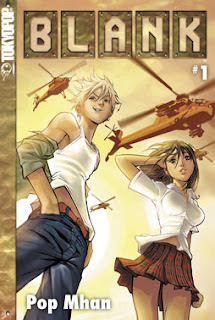 I just stumbled across Pop Mhan's Blank the other day. I'd heard about it a couple of times, but hadn't actually seen it anywhere. I enjoyed his work on SpyBoy, so I figured I'd give this a shot.
I read it last night and the strangest thing occurred to me about two-thirds of the way through. What I liked best about the book was -- are you ready for this? -- how Mhan draws hair. Not the story, not the fairly gratuitous T-and-A, not the humor, not the concept... the hair. Mhan did a really excellent job drawing hair on this book. In just a few lines, he was able to convey exceptionally well what each person hair was actually doing. When one character commented on another's appearance, it made totally sense but she had clearly NOT done much with her hair. And yes, I realize that is one of the most trivial and obscure things about the book to lead off a review, but I did say it was "the strangest thing."
Anyway, the basic plot is that Aki Clark is a 17 year old in a normal school. Her dad is raising her by himself, but his work demands him to be away from home most of the time. So Aki busies herself with school and friends. She then discovers that she's being stalked by another teenager claiming to be a secret agent... except that he can't remember who he is. Things start getting hairy when somebody DOES try to kidnap Aki, and we start learning just who really is looking out for her!
The story is pretty solid, which was pleasantly surprising -- I'm usually skeptical about artists trying to write their own stories. It's also freshingly different than SpyBoy which, since Mhan worked on that as well, is going to invite some obvious and immediate comparisons. It certainly has some of the same elements as that series, but they're mixed together in a wholly different manner and it did not at all feel like I was reading a re-hash of that.
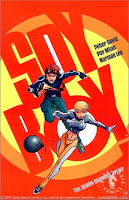 But one of the things that really attracted me to SpyBoy was Peter David's writing. Now, as I said, Mhan turns in a solid story here, but it wasn't quite as nuanced or polished as what David typically turns in. David, I think, does a better job blending action and humor, and all of the characters have a clearly defined purpose for being in the story. Mhan's humor is a bit more abrupt -- not wholly out of place, mind you, just not as woven into the story and characters as with SpyBoy -- and some of his characters are less defined from a storytelling standpoint. Now that may be because I'm only looking at one volume of Blank (192 pages) as opposed to multiple series of SpyBoy (floating somewhere around 600 pages), but I don't think that's the case here; I seem to recall being more aware of the SpyBoy's characters' raison d'etre early in the series.
All in all, it was a worthy read. I think fans of Mhan won't be disappointed, and I think people who haven't read SpyBoy (and, therefore, won't have something to directly contrast to it) will be pleased. I suspect the people who will appreciate this the least will be those who already read SpyBoy on the strength of David's writing. But I figure, if that's the bar you're going to set for yourself -- as Mhan obviously did -- it's not a bad foray.
 I just went through A Dummy's Guide to Danger during lunch. It was part of the loot that I mentioned last week.
The basic premise is that Alan Sirois and his partner, Mr. Bloomberg, are detectives. They get caught up in the case of a killer who's stealing body parts of famous celebrities after killing them in horribly brutal fashions. The twist is that Mr. Bloomberg is actually a ventriliquist dummy (hence, the title) who's been paralyzed from the neck down. Yes, paralyzed. As in, he used to be able to walk around on his own two feet until a gun-shot pierced his spine.
There are three significant elements about the series I want to cover here.
First, the lettering. I was blogging just yesterday about problems in the comic book lettering, and there's a number of exactly those types of issues on display here. There are several instances where word balloons are mis-placed. Not placed poorly, but placed well enough only to be shifted (presumably by accident) somewhere in the production process. Not whole pages that one might be able to blame on the production crew, either, but individual panels indicative of problems of the letterer himself. There was also a noticeable instance in issue #2 where the same word balloons were repeated on two separate pages. I don't want to call the letterer out by name here, but I can't find any other books that he's worked on. It's pretty clear that lettering is NOT his main vocation, and this is a prime example of why comics, if they want to appear professional, should hire good letterers.
The second thing I'd like to address is what I liked about the concept. Throughout the series, Mr. Bloomberg is treated as a bona fide person, who just happens to be a vent dummy. Not unlike Pinnochio. What I think was well-done throughout the whole series is that there's something of a question on whether this is the reality of the situation or Alan is just plain nuts and throwing his voice into the puppet. As Bloomberg is "paralyzed", it provides a perfect excuse for him to simply sit there, doing nothing. There are no instances of him talking when Alan is not around or unconscious, and he is only shown moving on his own in a flashback Alan has. Is he just crazy and everybody is (generally) humoring him, or is the dummy for real? It's not a wholly original concept, mind you, (what is?) but it's handled very well throughout the book.
I was less keen on the main plot of the book, though. The dialogue was fine, the characterization was solid -- if modest -- and the story did flow fairly smoothly. What didn't work for me were the inconsistencies within the plot. The killer turns out to be a loon who's creating his own Frankenstein monster type of creature using random parts from other people. Except his second victim, he just left a hole in her throat. And his third, he just took her liver instead of an appendage.
The other problem with the story reminded me of why Steve Ditko originally quit Amazing Spider-Man. Legend has it that, when Ditko and Stan Lee got to where they wanted to reveal the identity of the Green Goblin for the first time, Ditko thought it should be a complete nobody that had hitherto not been seen because that's how real life worked. Lee felt that wasn't good storytelling and had the Goblin reveal himself to be a character already established in the book. Ditko took that as the last straw and left Marvel soon afterwards. A Dummy's Guide to Danger explores that "controversy" in a way that... well, for the sake of spoilers, let's just say it proves to me who was right and who was wrong in the Osborn-as-Green-Goblin debate Lee and Ditko had all those years ago.
It was an adequate story overall. An interesting combination of elements to make something unique and solid enough to prevent me from saying it was bad, but it wasn't that well executed for me to suggest rushing out to the back issue bins to hunt for it.
Here's a quick discussion about lettering among Greg Rucka, Richard Starkings, and J. Babcock. The reading is relatively short and interesting, but one nugget in particular caught my attention: "DC purchased multiple licenses of pretty much every font in our [Comicraft's] catalogue and... edged us out of the business of lettering DC comics."
Here's what that means: it means that DC Comics (generally) does not use professional letterers any longer. With everything done in-house, there's no need to hire an Art Simek or a Todd Klein or a Bill Oakley or a John Costanza. For that matter, there's no need for an Albert Deschesne or a Rus Wooton. What that implies (and I have no confirmation of this, mind you) is that DC is handing their lettering over to the cheapest (i.e. least experienced and/or knowledgable) workers they can. In most cases, those are interns.
Anyone here ever do an internship? These are, for the most part, totally green students with little to no practical experience with what they're doing. They've probably had a few courses on writing/color theory/layout/whatever-they're-majoring-in but the realities of day-to-day operations of a business are wholly new to them. Don't get me wrong, it's an incredible learning opportunity for the student (I usually claim that I learned more during my internships than I did in the classrooms) and they often have the very best of intentions; however, by their nature, they are inexperienced and are prone to mistakes that stem from that inexperience.
Let me reiterate, I have zero knowledge of DC (or anyone else) handing over their lettering chores to the interns. It's only the barest tacit assumption of an implication suggested by Starkings. But it certainly would make sense, given Rucka's intial rant on the subject!
Tom Brevoort blogged a while back about his time as an intern. He talks about making copies and running between offices and such. And that pretty well falls in line with my experiences as an intern at Kenner. So I have to wonder, if DC's books are being lettered by interns, when did so much responsibility get passed down to interns?
Have you seen this...?
That's right, Scott Hinze and Oliver Tull have launched an IPTV show aimed squarely at the comic industry, and they're calling it, appropriately enough, Fanboy TV. Scott and Oliver have been doing Fanboy Radio/ for a few years now, and have garnered some success with it, so they're branching out.
I'm simultaneously pleased and baffled. Pleased, of course, because the mere existance of the show suggests an improved state of the industry as a whole. Baffled because... well, I've heard Fanboy Radio.
Don't get me wrong -- I think FBR does an excellent job with what they are. Especially in lieu of using the term "fanboy" in their name -- it conveys an unbridled excitement and enthusiasm for the comics medium. That's exactly what FBR does. There's no misconceptions about what type of show they are at any level. They are comic book fanboys and they're on the radio.
But what baffles me is why a show like that is as popular as it is. They have on a slew of comic creators which run the gamut from Joe Quesada to Alan Moore to Neal Adams to Scott McCloud to... well, there's a lot of folks there. Which is great, except that Scott and Oliver repeatedly come to the table as themselves, as fanboys. Now I appreciate that in interviewing an Alan Moore or Scott McCloud -- they don't generally associate with a fanboy type of crowd, so it's interesting to see the juxtaposition. But guys like Kevin Smith and Joe Quesada and Brian Michael Bendis... they do this type of thing all the time. I can read/hear/see almost any interview with them and get the exact same thing. So, in that sense, FBR -- and, I presume FBTV, by extension -- doesn't really have anything new or different. More of the same that I can get on Newsarama or Comic Book Resources or any of a zillion comic-related blogs out there.
So, what's the attraction? Why are they more popular than... well, any comics podcast? Seriously. I'm not trying to knock them at all, but I just don't get it.
 Sorry about not blogging this weekend -- the 'rents were visiting.
I've taken the brief moments of free time I've had the past several days to start reading The Adventures of Luther Arkwright. (Samples of which can be viewed for free online here.) I've only made it throught the first four issues so far, but to anyone who's considering picking this up, I highly recommend not reading it until you have time to focus on it. I won't get into things here -- honestly, I don't know that I could -- but it's got a complex plot, and trying to watch TV or check your e-mail or whatever while you're reading is going to make things EXCEEDINGLY difficult for you. That's not a bad thing, the storytelling is much more involved and layered than most comics and I think that, given the challenge Bryan Talbot evidently set for himself with these stories, it works exceedingly well. But it's NOT simple linear storytelling, and NOT something I'd recommend leaping lightly into.
I'll post a more full review once I finish the series.


