Latest Posts

Showing posts with label upcoming. Show all posts
Fantastic Future Stories pulp cover
I try to be a forward-thinking guy. I try to look out down the road to see what's coming, so that I have a better chance to zig and zag as needed. I'm by no means a futurist, though; I'm nowhere near adept enough at predicting sociological behaviors or extrapolating wide-spread trends based on current technologies. I have my moments of insight, but they're not as frequent as I'd like. I was forecasting wide-spread cloud computing years before the term was commonly known and saw "video blogging" coming a few years before YouTube was founded. I had a "win" yesterday by predicting Embracer Group would close all their Things From Another World locations before they announced they were planning to do just that. But I was also completely side-swiped by social media when that came on the scene; I had no inkling anything like that was coming.

On the plus side, I think even the most prescient futurists aren't exactly batting 1000 either! 😊

But guys like Marshall McLuhan and Alvin Toffler (both of whom I've referenced on this blog before) were able to see some of the broad strokes coming down the pipe. McLuhan didn't know what the internet was but he saw a vast communications network that reduced our entire planet to the equivalent of a single community: a "global village." And that's the type of thing I try (in my decidedly unprofessional and seriously inadequate way) to do. I try to look at the information of today and figure out not only what's going to happen tomorrow, but also in the next several years.

At some level, many people do that. Whether you're planning a wedding or booking gigs for your band or saving up to buy a house, that's all about looking toward the future by extrapolating as much as you can from what you know right now.

How all that relates to comics is, of course, the question of what's going to happen to comics as a whole? Where is the industry headed? What will overall sales look like? What technologies will enhance production and distribution of digital comics? What properties will become "hot" and garner population attention? Those are the questions a lot of folks in comicdom are asking.

The problem, obviously, is that we're all speculating. We don't know the future, so we all have to guess. And we're all making these guesses with incomplete data. Sales numbers are often a big blind spot for us. Retailers know their own numbers, but not for the industry at large or any of their direct competitors. Publishers know their own numbers, but not specific retailers or other publishers. Creators don't provide their financial information (notably, income from making comics) to anyone. Bloggers like myself don't know any of that. So any predictions any of us make are based on less than ideal information.

That's where a lot of arguments come from. A retailer can say, "Listen: I make X amount of money selling just Marvel comics and I'm doing fine. I don't see what the deal is about DC distributing separately." While the next retailer might say, "I've seen a decline in sales because of COVID, and many have switched to digital." And yet another retailer might say, "New people are coming into the store because of comics they read online." Those three retailers are going to see the future of comics differently, based on the information they have that is biasing their view.

I use "bias" deliberately. I don't mean to suggest that they're actively altering their opinions to fit what they're seeing in their respective stores, but the information at their disposal will push their thoughts and ideas in a certain direction. I'm very cognizant that my constant work in web development focuses my attention toward online behaviors over print, and colors my outlook.

But it's not just a single factor like that impacting my thought process. I pay more attention to independent creators than the larger publishers any more. I got hooked on comics in the early 1980s. I went to college for design. I went to graduate school for an MBA. I have an 8-to-5 job in a beige cubicle. (Or, at least, it was in a beige cubicle up until the pandemic!) I've done freelance work. I am familiar with printing processes from previous jobs, but my knowledge there is primarily based on technologies from 25 years ago. I don't drink. I got a divorce after ten years of marriage, and eventually married someone else and moved to a different state. I have a dog. My favorite color is green.

All of that, regardless of how irrelevant it seems to comics, has some measure of impact on how I think about the medium. The same holds for everyone else. Their first car. The parent that abandoned them at age 7. The house that burned down across the street a week ago. The childhood friend who they hadn't talked to in 30 years committing suicide after a long struggle with PTSD that originated with their military service. The Spelling Bee their cousin won in fifth grade.

All of those things, many of which you're probably not aware of, have an impact. Which is to say: take EVERYTHING with a grain of salt. I'm certainly going to talk and act in what seems to be my best interests, and that's one of the reasons I'm bullish on webcomics in general. If you see/hear someone else speaking with a contrary point of view, there's almost certainly a reason for that.

I think my point here is that you, as a consumer of information, need to keep alert of not only what people are saying about the future of comics, but who is saying it and where they're coming from. As much as I like and respect guys like Brian Hibbs and Joe Field, I always keep in mind that these guys are both retailers and have a retailer perspective. Nothing wrong with that, of course! I'm just saying that it's different than a creator or a fan perspective.

But the future is a big question mark for all of us, and our backgrounds and current situations are going to impact our outlooks. Just something to keep in mind the next time you see someone talking up their new digital comics platform or the company press release announcing a "coporate realignment" shortly after laying off a bunch of employees.
Back in December, Heidi MacDonald asked a bunch of comic creators to offer some reflections on the comics news of 2025 and what they might expect in 2026. In particular, she asked what they thought the biggest news story would be. And while MacDonald didn't solicit my input in any capacity, I offered up my thoughts on this very blog. Here's what I had to say...
2025 was insanely turbulent just in general. Not only was distribution radically disrupted, but publishers has to figure out on-again-off-again tariff issues repeatedly as many of their vendors and suppliers had radical shifts in how much they had to charge thanks to that walking shitstain in the White House. On top of which, we're in a Jenga-style economy where a single nervous brick can spell disaster. All of this means a great deal of business uncertainty. To mitigate that, I think publishers are going to lean into known quantities and we will see a large number of licensed and cross-licensed material. We're going to see more Batman/Deadpool type books. I recall seeing an announcement about a Fantastic Four/Planet of the Apes crossover for early in the year already. We're going to see more publishers farm out previously licensed material to other publishers as well -- Titan just announced they're going to put out an omnibus edition of some of Marvel's Conan comics. There's going to be a lot more blurring of lines of who's allowed to print what characters because publishers are looking for more known quantities that have an inherent fanbase built in from another IP holder.
I was reminded of this when I saw this week's release of Romeo & Juliet and Godzilla and I received my copy of The Rocketeer: The Island #1 (which features the Rocketeer in a fight against King Kong) in addition to seeing the announcement of It's Jeff/Aquaman and Supergirl/Blade crossovers. Of course, four books hardly makes a trend, so I went to see what's actually in the current solicitations list. A casual perusal turns up the following (in no particular order)...
Avengers JLA Facsimile Edition #2
The Justice League and the Avengers battle one another across two Earths for possession of the 12 weapons that will determine the fate of both universes! While their teammates put everything they've got toward winning this most desperate game, Batman and Captain America join forces to investigate those who've set up the board... and determine if there isn't yet another game in play.

DC X Sonic The Hedgehog The Metal Legion #1
The worlds of DC Comics' Justice League and SEGA's Sonic the Hedgehog collide once more in another thrilling crossover filled with action, adventure, laughs, and perils! Mysterious mechanical rings have appeared on both worlds, linking them together and leading to all things wonderful, worrisome, and weird! The heroes are happily reunited, but little do they suspect there's a sinister origin to their reunions.

Jay and Silent Bob: Jays of Future Past #1
DOOM DECREES "THE DIM-WITTED DUO MUST DIE!" Capped, tan American Jay and friendly neighborhood wider-man Silent Bob make a quick stop in the Marvel Universe! But when Doctor Doom decrees these Jersey guys must die, the Fantastic Four, the Avengers, the X-Men and and a whole hoary host of heroes must team up on a joint mission to save the dim-witted duo from a lethal case of super-hero fatigue! "From the moment in Mallrats when they made the very first reference to Wolverine in cinema history, I've always wanted Jay and Silent Bob to meet their Marvel heroes in a comic book crossover - so much so that I pitched it to Stan the Man himself the day he shot his cameo in the movie way back in 1995. Thirty years later, Jays of Future Past represents both a love letter to the magic and mayhem of Marvel as well as giggle-inducing proof that our childhood dreams can still come true, even at age 55." - Kevin Smith

The Rocketeer: The Island #4
Kong has kidnapped Betty, but he must protect her from the only beast on the island scarier than him—a giant T. rex named King Bloodscale! And all the Rocketeer can do is try to keep up! Will there be a new king of the island? Or will Beauty kill the Beast? John Layman and Jacob Edgar bring you a final fight you never saw coming!

Conan and Dragonero #1
Two worlds collide in a savage crossover years in the making! CONAN OF CIMMERIA and DRAGONERO meet for the first time in an epic clash of steel, sorcery, and survival. Pulled to the mysterious land of Erondár by dark forces, Conan comes face to face with the famed dragon slayer, Dragonero, and the two warriors must set aside suspicion to stand back-to-back against a supernatural force poised to doom both their worlds. Published for the first time outside of Italy, this landmark crossover brings together two legendary heroes in a story that honors classic sword-and-sorcery while forging something bold and unforgettable. The barbarian and the dragon hunter draw their swords together!

Thundercats/The Powerpuff Girls
In the greatest crossover since peanut butter met jelly, The Powerpuff Girls travel from Townsville to Third Earth and discover the world of the ThunderCats! After being trapped in a runaway rocket by Mojo Jojo, the Townsville Trio find themselves on a strange planet where their super-powers don’t work. Luckily, someone named Snarf is there to provide a situation report — and wouldn’t you know it, there’s evil that needs defeating! But without their Chemical X-enhanced abilities, what can Bubbles, Blossom, and Buttercup do against a foe like Mumm-Ra? Find out as writer PAULINA GANUCHEAU and artist COLEMAN ENGLE open up the Treasures of Thundera in ThunderCats/The Powerpuff Girls!

Thundercats X Silverhawks #3
The greatest crossover event in the galaxy continues! Cheetara and Tygra are overwhelmed by invading Darkbird forces, and the SilverHawks are desperate for interplanetary backup to arrive. But everything on Third Earth stops when there’s a massive explosion in the sky...

Iron Man Super Smash
(published by Abrams)
In this action-packed and heartfelt second original graphic novel in the Iron Man: Mighty Marvel Team-Up series, Iron Man must work with the Incredible Hulk to save a group of innocent monsters from being used for destructionIt’s monster mayhem! When Iron Man looks to connect with the Hulk outside of super heroing, Tony Stark creates a new suit big enough to keep up with Hulk’s desire to smash! But when a group of monsters are unleashed across the world, Stark realizes that all of that smashing might be doing more harm than good. And when it seems like there is more to these monsters attacking at random, Hulk and Iron Man must put their heads together and find out who is really behind these monster attacks and calm the monsters at large!

Marvel Dimensions
(published by Abrams)
Alex Ross, the award-winning and bestselling creator of Marvels, Kingdom Come, and Fantastic Four: Full Circle, takes readers through the Marvel Universe—but all is not as it seems Marvel Dimensions is legendary artist Alex Ross’ second book in the Marvel Arts series, following the national bestselling, critically acclaimed, and award-winning Fantastic Four: Full Circle. The story opens with a sweeping tour through the classic origins of Marvel’s most iconic characters. Spider-Man, the Incredible Hulk, Iron Man, Wolverine, and many others appear in dramatic, fully painted spreads that echo their earliest stories. A narrator describes each moment with confidence, guiding the reader through these touchstones of Marvel’s history. But as the story moves forward, the tone begins to shift. The voice behind the narration is not who the readers expect and carries a motive that slowly pushes the narrative somewhere darker and far more unpredictable. Once this change becomes clear, the book expands into something larger and more surprising. Storylines twist in on themselves, characters behave in unexpected ways, and events ripple across the Marvel Universe with growing tensions. Ross uses the structure of the book to create anticipation and pull the reader deeper into a mystery that keeps widening. Every new sequence reveals another layer, building toward a final act that reframes everything that came before it. A bonus 32-page comic book is included that is pivotal to the storyline. With Marvel Dimensions, Ross approaches the Marvel Universe from a new angle with new character invention that invites readers to question what they think and what they know. Marvel Dimensions may be the latest title in the Marvel Arts line . . . but it is only the beginning.

X-Men Elsewhen Vol 01
(published by Abrams)
Legendary comic book creator John Byrne returns to the title he first drew 50 years ago, Uncanny X-Men, with this one-of-a-kind new graphic novel series, X-Men: Elsewhen. This three-volume graphic novel series picks up the story from Byrne's original run, taking the characters in new and unexpected directions. In Volume 1 of X-Men: Elsewhen, the Dark Phoenix Saga is over and Phoenix is . . . alive?!Diverging from the epic finale of the original storyline from 1984, X-Men: Elsewhen presents a universe where Jean Grey's powers and intellect have been greatly reduced, and from there, everything you thought you know about the X-Men is forever changed.John Byrne's monumental return to the X-Men heads in entirely new and surprising directions, as the X-Men head back to the Savage Land, face their climactic adventure with the Sentinels, and contend with special guest–stars such as the Avengers and the Fantastic Four along the way. X-Men: Elsewhen is a three-volume graphic novel series in the Marvel Arts line that sees the return of acclaimed X-Men artist Byrne decades after his last work on the series. Byrne has written and penciled every page and inked multiple chapters, all of which pick up the story from where his first go–round ended, taking this beloved lineup of characters—and his fans—in exciting new directions.

DC Silver Age Covers and Stories Artists Edition
(published by Image Comics)
A COLLECTION OF DC SILVER AGE ART UNLIKE ANY OTHER! A one-of-a-kind look at artwork from DC Comics’ Silver Age that redefined The Flash, Green Lantern, The Atom, and more in this gorgeous, oversized Artist’s Edition! Dive into some of DC Comics’ finest stories and covers from the Silver Age in this massive Artist’s Edition, featuring all the interior pages from beloved comics like the 1960s Green Lantern #1, complete stories from CARMINE INFANTINO’s run on The Flash and SHELDON MAYER’s run of Sugar and Spike, and even more Silver Age treasures. With a unique look into an era that changed comics forever, DC Silver Age Covers and Stories Artist’s Edition also features over 75 classic covers from a Who’s-Who of iconic artists like JOE KUBERT, CARMINE INFANTINO, GIL KANE, and more. Although appearing to be in black and white, all the art is scanned in color, enabling the reader to see the work as close to the original as possible—ink gradients, blue pencil, and all the unique nuances that make original art so special—are all clearly visible and printed at the same size as drawn. The Artist’s Edition featuring comics and covers from DC Comics’ Silver Age is an art book disguised as a comic collection. The only better way to see these pages is by looking over the artist's shoulder at their drawing board!

King Conan The Original Comics Omnibus Vol 03
(published by Titan Comics)
This mammoth volume includes one of the more rarely collected stories from the conclusion of John Buscema’s first long tenure on the Conan line of books as presented here and in the Conan of the Isles graphic novel. The rest of this collection includes the remaining run of issues of Conan the King as penned by Don Kraar and then Jim Owsley (aka Christopher Priest) with notable artistic runs by Mike Docherty and Geoff Isherwood. Collecting: Conan the King (1984) #36-55 and Conan of the Isles graphic novel (1988) Marvel Graphic Novel #42
I'll also note that, although I'm not 100% sure on the current status of the Star Wars license, I'm also seeing Star Wars comics being published by Marvel, Dark Horse, Titan Comics, and VIZ. And let me iterate again that this is just a casual perusal of the April previews for me to find all this.

This is not just Marvel and DC playing the game; this is most of the major publishers/IP holders getting involved. These are people saying, "Can we sell enough to justify a Thundercats comic? Maybe, maybe not. But we'll definitely get extra customers from Powerpuff Girls fans that will help make it profitable!" Publishers who are putting out other publishers' work because they decided they don't have enough original material themselves that will sell, so they borrow on the IPs of other companies.

It's obviously way too early into 2026 to say if this indeed a trend, much less a notable story for all of 2026. But I certainly wasn't wrong in predicting we were going to see an increase in this type of thing! Expect to see more of this throughout the year.
Heidi MacDonald, over at The Beat, asked "people from across the spectrum of the comics industry" some questions " to talk about the year coming and the year past, and to give us a preview of what they have cooking for 2026." Not surprisingly, Heidi didn't ask me, but I thought I'd take a moment to answer the questions on my own here.

What was the biggest comics industry story in 2025?
The whole Diamond Distribution mess, hands down. I saw some folks answer the attacks on free speech; those are absolutely a big deal and indeed a much larger story... but it's also much larger than just the comics industry. We have indeed seen cartoonists' speech clamped down on in 2025, and I don't think that should be taken lightly, but they weren't singled out any more than any other journalists. So the entire Diamond Distribution saga -- everything from the original Chapter 7 to driving publishers out of business to newer distributors trying to fill the gaps to lawsuits about back stock and payments to... -- that strikes me as the biggest comics industry story of 2025.

What will be the biggest comics industry story in 2026?
2025 was insanely turbulent just in general. Not only was distribution radically disrupted, but publishers has to figure out on-again-off-again tariff issues repeatedly as many of their vendors and suppliers had radical shifts in how much they had to charge thanks to that walking shitstain in the White House. On top of which, we're in a Jenga-style economy where a single nervous brick can spell disaster. All of this means a great deal of business uncertainty. To mitigate that, I think publishers are going to lean into known quantities and we will see a large number of licensed and cross-licensed material. We're going to see more Batman/Deadpool type books. I recall seeing an announcement about a Fantastic Four/Planet of the Apes crossover for early in the year already. We're going to see more publishers farm out previously licensed material to other publishers as well -- Titan just announced they're going to put out an omnibus edition of some of Marvel's Conan comics. There's going to be a lot more blurring of lines of who's allowed to print what characters because publishers are looking for more known quantities that have an inherent fanbase built in from another IP holder.

What guilty pleasure (of any kind) are you looking forward to in 2026?
I don't harbor guilt about any of the pleasures I indulge in. I don't hide something I like or feel embarrassed about liking it because I'm not the intended and/or typical audience.
That said, I haven't seen/heard about any upcoming comics projects that I'm especially excited about. I still enjoy the comics I regularly read, but I'm not aware of anything out of the ordinary in the works there. I have seen several announcements about some upcoming action figures from Fresh Monkey Fiction that have me pretty interested, though. They have a not-Buckaroo-Banzai they've shown off a prototype for, and there are some digital renders of their Red Riding Hood that could be easily repainted into an Alice in Wonderland. (I'll do the custom myself if they don't make an official one.) Plus they're planning on some generic thug/criminal types characters that will be useful as well. I've been happy with the handful of their figures I already have, so I'm looking forward to seeing what things materialize from them.

Do you have a local comics shop? What do you like (or love) about it?
I haven't done a local comic shop since COVID started. I'm still very concerned about my health and try not to go anywhere I don't have to. Virtually all of my comic purchases these days come from either MyComicShop.com or Bookshop.org. Between the two of them, pretty much everything is available and it's all delivered to my front door, so I don't have to worry about catching COVID again just in order to read some new comics.
Lion Man is argueably the first Black superhero, first appearing in All-Negro Comics #1 back in 1947. Rosarium Publishing just launched a crowd-funding project to bring new adventures featuring this old character back to the public thanks to the creative talents of John Jennings, Yvette Lisa Ndlovu, and David Brame on the main story and including contributions from Damina Duffy, Nate Powell, Joel Christian Gill, Christa Cassano, Ezra Claytan Daniel, Jamie Noguchi, Ben Passmore, and Fabrice Sapolsky among others.

While the project hasn't formally kicked off yet -- Bill Campbell noted, "We are a little behind in launching the project (I'm still new to this whole BackerKit thing)" -- you can still check out the campaign and pledge to any of the different tiers available. Rosarium has published some good works before, and there are some really powerful creators on this project, so I'm personally really eager to see this one come to fruition.
I stumbled across this post of mine from 2007 in which I complain about the state of comic news. Namely, that I was making a few active attempt to follow as much as I could and I still missed even the basic announcements about some book releases. I've been noodling the idea again recently because I saw that Ryan Estrada posted a short video last week in which he and his wife are unboxing their latest book... which I hadn't even heard about yet.

He followed that up the other day with an entire song that he and a friend had written for the book!

I double checked many of the "usual suspects" when it comes to comics news and found nothing about the book at all. (As a curious aside, many of the specific references in my 2007 piece feel incredibly dated. Wizard Magazine ended in 2011, Newsarama is technically still around but has been a shell of its of former self for at least a decade, Jen Contino stopped writing for Sequential Tart five years ago after two decades -- I don't know what she's doing now. Amazon had back then recently started their "You Might Also Like" feature which was nacent enough to be lousy, but it got better only to have since gotten much worse. Google Alerts is supposedly still a thing, but I haven't seen/heard of anyone who's found it functionally useful for a decade.) I had a come to the conclusion some years back that my best option was to follow creators I was interested in directly on social media as there was by no means any guarantee that any 'normal' comics news outlets would have any coverage of what I'm personally interested in. That's proved challenging, however, since I dropped Facebook and Twitter (before it was rebranded as X), both of which started serving up more garbage than useful/interesting creator updates anyway.

I'm opting to pass on BlueSky since everything I've heard paints it as having all the same problems Twitter had before I left. I can't stand the TikTok and Instagram formats. I follow a few comics people on LinkedIn, but that's hardly a mecca of creator content. I'm on Mastodon, which also isn't used very heavily by the comics community. As you can see, I've gotten some updates from creators on YouTube, although based on the trends I've seen in what they've been serving up over the past six months or so, I expect I'll be presented with more garbage than anything useful within the next year. I'm seeing more creators get back to email newsletters and re-adding RSS feeds to their own sites; I'm hoping those trends continue before we get to the point where social media becomes useless to me.

Logically, I get why all this is happening, and the basic challenge of being a creator and trying to get the word out about your next/current project in an absolute avalanche of information and announcements. It's all indicative of larger problems with news and communication more broadly and, as I've already suggested, a problem that I know I've certainly been wrestling with for several years now. And because I've been wrestling with it for so long already and haven't resolved it since the landscape has been constantly shifting, I don't expect to resolve it any time soon either.

I suppose my point here -- besides just taking some time to vent -- is to suggest that you keep an active eye/ear out for comics news beyond a handful of websites, and that you continue to search for news, that you don't assume it'll be served up to you through your favorite outlet. It is indeed more work on your part, but you get -- for my money -- better, more satisfying results. Because I can guarantee you right now that reading about a single night without a curfew in Korea is going to be more interesting to me than whatever it is the Justice League are doing.
Rina Piccolo -- formerly of Six Chix and Tina's Grove, currently working on Rhymes with Orange -- recently announced that she'll be returning to an idea that she ran as a webcomic a little over a decade ago: Velia, Dear. With the characters notably older, Velia Comic Stories will probably show up from an "alternative comics publisher" instead of online but I'm reminded of an interview I conducted with Piccolo way back in 2011 shortly after she launched Velia, Dear. Since this interview was for the now-dead-buried-dug-up-and-then-incinerated MTV Geek, I thought I re-run it here for posterity.


Sean Kleefeld: It's been noted in several places (including on your own site) that your first published comic was in 1989. But your "big break" was about a decade later when you took up the Wednesday slot for Six Chix. I understand that, in the past, you've noted that decade was filled with "trillions of rejections" but how did the strip come about? Was that something you and the others took to King Features yourselves after doing a lot of individual submissions, or did the idea come from one of the editors there, or...?

Rina Piccolo: Six Chix was Jay Kennedy's idea. Jay was the comics editor at King Features Syndicate and he was well known as a promoter of women's comics. He saw that the newspaper comics page was lacking humor from a woman's perspective, and decided to increase the percentage of women cartoonists on the page in one shot. He had a pretty good idea from the beginning who he'd choose to be in the strip, and I was one of the names on his list. Like any good editor, he had his finger on the pulse of the cartoon industry, and so it wasn't too difficult for him to find us.

Kleefeld: At least from my seat, it would seem that Six Chix provided you with a great opportunity to work closely with King editors, who could help get Tina's Groove started. Was Tina something you already had already been working on prior to 2000, or was that a matter of wanting to expand on some ideas that didn't fit into the Chix format?

Piccolo: Tina's Groove (although it didn't have a title at the time) was underway before 2000 and long before Six Chix was born. (I realize that, on the surface, it's logical to assume that it was the other way around.) Jay called me sometime in the early 90s to ask if I'd like to develop my own strip. It took years for me to actually do it! Anyway, we'd go back and forth with work, and ideas, and different premisses, and then sometime around 1998 he asked if I wanted to be in Six Chix. He told me it would demand only one gag a week and that it totally left room for me to continue working with him in developing my own strip. By the way, the reason Jay was aware of my work in the early 90s is because I was selling gag cartoons to a feature King was running called The New Breed. The New Breed was a daily single panel gag cartoon that hosted a different cartoonist every day of the week. It no longer runs.

Kleefeld: What was the process of getting Tina syndicated like, compared to Chix?

Piccolo: The administrative/contract process was basically the same. The creative process was different -- for one, it took me YEARS to get things right with Tina, and no time at all for the Six Chix gags! The reason behind that had a lot to do with the fact that, at the time, my strengths leaned toward gag cartooning, which I had been doing for years. And so, I really had to work hard to learn new tricks and figure out how to write for a comic strip. I had never before worked with characters, and I'll be honest with you, doing a strip forced me to learn new tricks, and it didn't come easy at first.

Kleefeld: Unlike many, if not most, newspaper strips currently running, yours have come about after the internet became fairly well-known. It was around that same time, too, that I think people started realizing that a business model that might work in print might not work online. There was a fair amount of experimentation going on, at all levels of the process, from creators to syndicates to newspapers. I'm curious, first, what your take on things were since you were first getting into syndication right when a lot of this was happening and, second, what types of things were you hearing coming from the syndicate back then. Were you, for example, being told and/or offered different types of agreements than a cartoonist who may have been in the business even just a few years longer because of what was happening online? Was anyone thinking they'd have to change their business models or marketing plans at that point?

Piccolo: Six Chix launched in 2000, and Tina's Groove launched in 2002. At the expense of looking like a total cavewoman I have to be really honest with you here -- I didn't even own a computer back then! I think I got my first email address in late 2002, or 2003! The internet, at least to ignorant me, had absolutely no bearing on what I was doing with my comics. That said, I'm well aware now in retrospect, that King Features was a bit more on top of things than its cartoonists were (thank God!). Anyway, my contract for Tina's Groove was the standard contract that King had been offering for years. (Here's a good place to dispel a myth common amongst some cartoonists: I want to make it clear that I own Tina's Groove. Those days of syndicates owning cartoonist's strips are long gone. I don't know of any contemporary syndicated cartoonist who doesn't own their strip. Syndicates just do not own peoples' strips anymore. People should know this.) So, in short, I really didn't become aware of the whole digital vs print thing until I was well into my 5th or 6th year of Tina's Groove. (And to tell you the honest truth, although I realize the business models have changed, I'm still waiting for the sky -- that everyone's saying is falling -- to fall.) Who knows, maybe it'll fall next week, and everyone can point to this interview and say "She had no idea it was just around the corner"! What I'm saying is this: if the syndicates were thinking of changing their business models as early as 2000, then I certainly wasn't aware of it. As for my contract, it was a smart one. There's a clause that covers any future technologies and platforms that will come into existence during the duration of the contract. So, yeah, they had the whole digital thing covered -- right from the beginning -- in the language of the legalese. Now that's a contract with foresight!

Kleefeld: I'd like to fast-forward a bit to shortly before you started work on Velia, Dear. When Velia first launched, you expressed an interest in having more creative freedom than in traditional venues. What was it that prompted thinking along those lines? Were you just really energized by seeing what other webcomic creators were doing, or were you running into issues with either Chix or Tina, or...?

Piccolo: I started it because I have a lot of ideas. And I think it's good to have a lot of ideas. The thing is, not all of your ideas are going to work well in the available markets. Some ideas are transferable, but not all. So I created a project for myself to have complete creative freedom in. I had no idea about web comics -- I only knew that I could write and draw strips with paper and ink, and scan them into a computer, and load them up onto the internet for people to see. A couple of months into it, I started leaning toward telling stories, and I began to look at the whole thing as an experimental learning process (I still do). It isn't simply a case of having issues with the syndication markets -- sure, I get frustrated now and then when I'm forced to behave in a family-friendly manner, but it doesn't happen too often, and I really can't complain. I just wanted to learn some new tricks, and exercise my funny bone in a fantastic new way. As a creator what makes me happy is to be creating a bunch of different things -- not just one or two things. And since I've gotten really fast and efficient with drawing and writing, it takes me less time to do one job, leaving more time for new projects.

Kleefeld: Being a bit behind the curve on computers -- at least prior to getting an email account! -- did you have any technical challenges on starting Velia, Dear? I'm guessing you'd already been submitting Tina's Groove to King electronically by then, so how new/different was getting Velia started for you just from a technology perspective?

Piccolo: Oh, boy did I have technical challenges with Velia, Dear. Although I knew the basics from scanning and emailing my Tina's Groove strips, there were a lot of things I had to learn in order to get the strips on the web. I hired a friend of mine (Tea Fougner, a cartoonist/editor/website wiz) to develop the Velia website, and to tutor me on how to get the images from the drawing board to the site, and how to manage the pages, and all that. So, yes -- I had to learn all that stuff. I'm not going to say that I like doing it, but it's a necessary step in the process of doing a web comic.

Kleefeld: In reading Velia, it's obvious to me at least that it couldn't run as a syndicated newspaper strip. While I expect the occassional swear word or sexual reference could be tweaked for a more "family friendly" audience, I also note that Velia has some dark undercurrents to it that would probably make it a hard sell in newspapers. Has the difference in tone, do you think, brought in a new type of audience to your work, or does it seem like there's a lot of overlap with Chix and Tina?

Piccolo: Yes, you're right -- Velia, Dear has a tone, and undercurrents, that would make it a tough sell for today's newspaper market. From the feedback I'm getting, I think it's safe to say that the readership of Velia, Dear is culled from both Tina's Groove readers, and those readers who are new to my stuff in general. So I would say, yes, there is a bit of an overlap there.

Kleefeld: How does your creation process compare across the three strips? I know you've noted Velia gets planned out months in advance, in part because you're working with longer storylines, but in terms of laying out a page or trying to figure out the pacing or anything. With the different styles and tones across the strips, do you have set aside blocks of days to work on one versus another, or are you able to switch gears fairly easily?

Piccolo: The creation process, and how it differs between Tina's Groove, Velia, Dear, and Six Chix…… wow, now that's a question I can write a book on! I'll try to be brief. Let me start out by saying that Tina's Groove has been part of my repertoire for so long that the strip's characters have become an intimate part of me. I can put those guys on the stage and make them do anything. There's a level of comfort in writing Tina's Groove that I really enjoy and have fun with. I block out one day to write a week (or more) of strips, and then schedule one and a half days to draw 6 dailies, and 1 sunday. Sometimes, when I'm in the mood, I'll write dialogs for Tina in the evenings, and use the material later on, when I need it.

For Velia, Dear the process is a little different for two reasons: number one because there are longer story lines, and number two, because I'm just now learning about effective storytelling, and character arcs, and things of that nature. It's a lot like writing a screenplay in which there is a beginning, middle, and end, and there are scenes that make up the structure. I feel that writing and drawing Velia, Dear presents a bigger challenge for me right now. (That's not saying much. In 2002, Tina's Groove provided all the challenge I needed!) I guess that means I'm learning, right?

As for Six Chix -- As I've said before, gags were my first passion in cartooning, and after 24 years of writing these things, I think I've pretty much gotten to a point where it's so much a part of me that it just comes to me naturally. I don't want to say it's easy -- it's never easy. But I can say it comes naturally.

Unlike a decade ago, I now find it easy to switch gears between different jobs. I guess it all just comes with practice? You do this stuff for years and years, and after a while you're just kind of hardwired for it. Does that make sense?

Kleefeld: I wonder if you could elaborate a bit more on writing for Velia. Obviously, with the longer story arcs, there's more planning that goes into it, so I suspect writing a week's worth of strips probably can't be exclusive to one day a week for you. Or do you still handle the individual strips that way, but do the broader plotting separately?

Piccolo: When it became a continuity strip with story arcs, writing for Velia, Dear became radically different from writing for Tina's Groove. There is more planning that goes into writing a story. I work with a loose outline, and determine what's going to happen. Once I know what's going to happen in the story, I arrange those events into scenes. The trick is to have each strip carry the story and reward the reader with something at the end of it -- a joke, a funny situation, a cliffhanger, or insight into the story. On a good day, I can write 9 or 10 strips. I set aside a block of hours to write, and shut down the internet -- no distractions! The plotting or planning happens on the same day that I write the actual scripts for each strip. It's a long day, and the work is hard, but it's engaging and fun.

I should add that the story I'm working on right now is not as outlined as the previous stories. I wrote a blog post about it. This is pure experimentation on my part -- I want to see where the characters are going to go with it, and what happens when I work without a definite outline in mind. Kind of scary!

Kleefeld: What about differences between Chix, Tina and Velia in terms of execution at the drawing table? It looks like you're using less brush work and more pens in Velia, but then adding ink washes? I can see why the washes might not be something you could use effectively in a newspaper strip, but I'm curious about what your thinking was in using different tools.

Piccolo: Yes, I use different tools for different things, and I have to be honest here -- it's all to amuse myself! When you use a brush for years and years, picking up a nib feels refreshing, and new. I enjoy both the brush, and the pens, and I'm happy to have different projects in which to use them. So that was my thinking behind using pens for Velia, Dear is that I just wanted to try something new (it's drawn with a Nikko "G" nib). As for the wash -- I've always loved the look of washes. When done properly a wash enriches a simple line drawing and gives it tone. When I was younger I used to look at the cartoons in the New Yorker and I'd tell myself to learn how to do that.

It's true that ink washes don't translate very effectively on newsprint, and the only half-tones you can get with newspaper comics are with the old zipitone or ben day speckling, or cross-hatching -- and still the results are different. This being so, I couldn't exercise my "wash-muscle" in that venue. However, I've been using washes on my magazine gags over the years, and so I was well into using them by the time I started Velia, Dear. I love working with washes, and I really like the results -- so when I started drawing Velia I wanted the strip to have a certain look -- I wanted some of the panels to somehow float on the page, vignette style, when I wanted them to. I believe that how a comic strip "looks" contributes to the character of the strip as much as the content does.

Kleefeld: You're almost two years into Velia; how do feel it's been going? Has it been successful -- however you may define it? Has it changed your approach to your other strips?

Piccolo: Nearly two years in, Velia, Dear makes zero money, as I had imagined. For me, it's been a two-year graphic and fiction-writing course. How much would it have cost me to do that at a university? The plus side is that I get to show my work, and get feedback. In one way, I foresee an end for Velia, Dear, but seen in another way, this project will never be finished.

Kleefeld: By "this project will never be finished", are you suggesting that Velia will be haunted by Nancy's ghost after she passes?

Piccolo: Nancy's ghost -- ha! Nancy doesn't have to be a ghost to haunt people, especially family members! Anyway, I mentioned in my blog that "this project will never be finished" because, well, I've got some stock characters here that seem to work well with each other, and a world that is in a lot of ways close to my own (minus the flying nuns) and well, I really can't finish, can I? Although I don't want to say anything definite about the future of the web comic Velia, Dear just yet, I will say that I will forever be making up stories for its characters, who don't seem to want to stop getting into trouble.

Kleefeld: Thanks so much your time, Rina! I really appreciate it!

Piccolo: Thank you so much Sean -- It's been a real pleasure.
I haven't seen much in the way of promotion for this yet, so I wanted to take a moment to highlight an upcoming comics convention: Webcomicon. It's a convention specifically focused on, not surprisingly, webcomics. As you can see from the promo image at the right, it'll take place August 3-4 in the Detroit area and will feature a number of well-known webcomikers.

I believe this is the show's inaugural year (the web domain was only registered last month) and, given the heavy promotional support from The Awkward Store, I presume it's largely been set up by Nick Seluk. I think it's fantastic that we finally get a webcomics-focused convention and I hope it's wildly successful so we get more.

(I'd love to be able to go, but I continue to be very concerned about COVID and am still not attending any conventions. "Con crud" was not uncommon before the pandemic in the first place; I'd not like to layer COVD on top of that. But that's me -- do your own risk assessments.)

Best of luck to Seluk and I hope everyone who's able to go has a brilliant time!
Things are looking pretty busy at Kleefeld on Comics headquarters this week, so I'm taking a little time off from blogging to play catch-up. I'll be back on May 6 with something clever and witty and insightful then. (Well, maybe not all of that, but it will be something!)

Stay tuned!
OK, we're in the final days of Black History Month; let's see what's going on over at Kickstarter so folks can put their money where their mouth is...


Just a handful of Black creators with their comic book projects on Kickstarter -- check them out!
This weekend sees Cartoons Crossroads Columbus (CXC) in the middle of Ohio again. The show itself is really impressive, and has pretty much everything I'm looking for in a comics convention these days. (Well, except being more than an hour's drive away.) There's a really solid mix of creators there, in terms of racial/ethnic diversity as well as age/length of time in the business, plus a good mix of different aspects of comics, running from monthly pamphlet creators who've worked at Marvel and DC to editorial cartoonists to webcomikers to small, indie press folks. There are lots of creators tables, but also some setups from publishers and comics retailers. The panels, too, seem to reflect the mix as well.

Despite some big name talents like Raina Telgemier, Daniel Clowes, and Keito Gaku and being in the center of Ohio's capital, the show still seems fairly intimate. I'll see people I know while I'm parking my car the first day, and run into a few other people I knew before getting into the show itself. And throughout the whole festival, I'm able to spent a good deal of time catching up with people I know. One of the show's organizers noted to me a few years ago that was deliberate; trying to give a comfortable atmosphere for professionals who know other people in the business.

Interestingly, one of the other creators I spoke with noted that the show seems quieter than many others, but not in a bad way, like there's nobody there. Rather, it seems like people were pretty intent on checking out what people had and are invested in finding new things. And, while I do see many people I know, there are many more than I don't, or only by reputation.

I've talked to multiple organizers who said that they had very much actively checked out other conventions to see what they did right and wrong, and it very much shows there. Everything seems to be laid out fairly well, and traffic seems to flow pretty smoothly most of the time. (Although it will get busy enough periodically that you might have to do some odd side-stepping, it certainly won't be the completely-blocked-aisles that I've encountered at other shows.) That's not to say there are never problems, but the ones that I've seen come up strike me (as a visitor) as largely inconsequential and ones I would scarcely have noticed if I didn't actually know some of these people who told me the issues they ran into. This speaks a lot to the benefit of checking out and critically analyzing what other people are doing. Steal from the best, as they say.

The show is free to visitors. I gather the show's income comes more from the tabling fees and some sponsorships. I did some back-of-the-envelope math, based on some guestimated numbers and it doesn't strike me as a show that's going to get either the organizers rich any time soon. (I'm having trouble imagining they had any more than $100,000 in annual revenue; the number is probably much closer to $50,000. I have no first-hand, or even second-hand knowledge on this but for a show of this size/caliber, that strikes me as an incredibly small amount to work with.) But that's not the point either. From everything I know about them (and the other folks involved) they're very much more interested in making it a genuine celebration of comics. Not the commercialized version of a celebration of comics, but a heart-felt celebration of the medium.

I think it's a fantastic show, and I would encourage everybody who can to go so they are able to keep things going here. I've had a great time when I have been able to attend, and I've found a wealth of material to explore. I've told several people, truthfully, that I could drop at least $20 at every single table if my bank account would have allowed it. Seriously, the only real complaint I can lodge would be that I'm not able to attend this year. But don't let that stop you! If you're able to swing it, I highly recommend checking CXC out this weekend! It's already up and running, and will be open through October 1.
I have a post that's been sitting in various forms of draft mode for a couple years now. It's not about comics, but more of a general rant against people higher up the food chain than you and I who have no real concept of what kind of struggles anyone else is dealing with. I've returned to work on that piece several times, but it always seems to turn into an unfocused, old-man-shouting-at-the-clouds rant that doesn't really have a point. I used examples ranging from people I have to work with on a regular basis to Soylent Green.

Rather than try to explain everything I was trying to touch on, though, let's just take it as read that, by and large, the people running the governments and the corporations care about you not at all. They don't hate you, or even dislike you; you are just so insignificant to them that you never even enter their thoughts. If you're not pulling down at least a half million every year, you do not rate.

I hate that. Not so much that there's someone out there who feels so superior as to never even consider me, but that any human can be so casually dismissive of another. To think and feel so selfishly that the very notion that someone has a set of experiences different from their own is mind-boggling. I've seen this first-hand.

One thing I've actively tried to do in recent years is cultivate more empathy in myself. Rather than slough off someone's words or actions with cynicism and satirical jokes, I've tried focusing more on what kind of mindset a person might have to be in to say or do those things. I'm not always successful, of course, and I can get maddeningly frustrated when someone is actively dismissing my point of view, but the attempt is to be more empathetic.

My wife has been a big driver in that. She's the most open-hearted, optimistic, forgiving person I've ever met. But she's still only able to offer her perspective on things. I've tried complementing that by reading a diverse selection of comics.

That sounds a little hokey, but I really have spent much of my time over the past several years actively seeking out different voices in comics to better understand different types of experiences. It can be awkward flatly asking even close friends about difficulties and hardships they've faced in coming out, or how they've dealt with being raped, or how they spent their life ridiculed or dismissed because of their accent or skin color, or the practical challenges in transitioning, or what it was like to live homeless on the street for a year, or... By actively looking for creators who use their comics to share those experiences, it not only provides them with a degree of financial support but it helps me to appreciate where people who aren't me are coming from. I can't ever know what it was like to do any number of things because I'm not a woman, I'm not Black, I'm not gay, I'm not Latino, I'm not anything other than the cis-hetero white guy I've always been. But I can at least read about those other people, and absorb their stories. And, in absorbing them, I can better understand why people might act the way they do.

"Oh, so that's what it's like to live with depression!"

"Wow, I didn't realize how body dysmorphia might impact someone who's trans!"

"Wait, so their self-destructive behavior is a result of PTSD from being raped?"

It's easier than ever now to cocoon ourselves in an echo chamber, and filter out any ideas and opinions that don't match our own. And in doing so, that cuts off wide swaths of people from our empathy. If we don't seek to even try to understand them, how can we possibly even sympathize with them, much less empathize? It's innately walling off their thinking, their feeling from our very perception and allows us to dismiss them as non-beings.

I'm not one of New Year's resolutions. I find it's a pretty arbitrary time to try to change something about yourself; if you want to make a change, you have to be emotionally ready for it. And that comes when you've wrapped your head around the whole thing, not because the calendar says it's one number higher than last year. So now that we're well into February, something to think about might be tracking down different comics espousing different points of view for the sake of exposing yourself to those different outlooks. You could do that in any number of ways of course, but comics' pervasiveness, particularly webcomics, means there's plenty out there to work with, and the visual aspect tends to hit home harder than if you were just dealing with words. So if you've already chucked out the New Year's resolutions you made and want to still make some changes in your life, I might suggest trying out some different comics for the express purpose of understanding people who have a notably different background (and perspective) than you.
Science fiction is NOT about what lies in our future. People can dream up all sorts of wondrous technology like phasers and A.I. computers and whatnot, but the actual implementation of said technologies will certainly differ. Sometimes for technological reasons, sometimes for commercial reasons, sometimes just because of a different sense of style. No, the reason -- well, one of the reasons -- we have science fiction is to explore how mankind reacts to those new and upcoming technologies. What if no one used cash any more, and every transaction was conducted electronically? What if cybernetics were so inexpensive as to be ubiquitous? What if our government was a technocracy? How would we be different because of that?

There's been plenty of discussion lately about the death of newspapers and what might happen to editorial cartoonists. There's been plenty of discussions about traditional comic book publishing, and whether the decades-old business model is still viable. There's been plenty of discussions about exclusively digital comics and whether there's an "ideal" format for them.

The thing is: all of these discussions -- and certainly many more -- are talking about the future. The root question at every one of these discussions is: what will tomorrow be like? Will my comics -- the flattened wood pulp splattered with colored chemicals -- be impacted by what's changing in the world right now? Some people's interest is their very livelihood -- comic creators and retailers for example. Others' interests are simply nostalgic -- "I want my kids to love comics they way I did." Others are just being selfishly lazy and don't want to even consider having to change their weekly habit of heading down to their Local Comic Shop. (And I really hope those people are in a distinct minority.) I'm sure there are any number of completely valid reasons to question the future of comics.

Now, we can speculate from now until the cows come home about what the face of editorial cartooning will look like in ten years, or whether or not there will be an electronic book device that displays comics better than anything currently on the market. But whatever we'd predict, we'd be wrong. Because we (mankind) always are.

I remember about 25 years ago, trying to figure out what file format worked best for playing songs digitally. Since there was essentially no such thing as a portable MP3 player (the first ones were introduced in 1998) I tended to simply continue using CDs. Naptser -- the original Napster -- was still a year or two away, and the iPod another couple years after that. Sure, we had portable CD players back then, and I'm sure somebody dreamed of having what was essentially a portable hard drive to carry that many more songs than a CD could hold. But did anyone figure on a device that fits into your shoe? And then is also able to track your workout data?

What will comics look like in ten years? In five years? In two? Will we have a souped-up Kindle or a toned-down tablet PC? Will we have electronic paper? Will we have comics beamed directly into our brains? No one has those answers. Think about how much the comic industry has changed just since 2020 when Diamond was literally the only national pamphlet comics distributor.

But what I can tell you is that comics as a medium will continue. You'll be able to continue reading about Superman and Garfield and Judge Dredd. And you'll be able to find reprints of Tintin and Asterix. And there will almost assuredly be another generation of Kuberts and Romitas, drawing comics in a manner befitting the reproduction technology of their time.

It's terrible that individuals have to experience massive industry shake-ups, as their professions are being redefined out from under them. But the planet isn't going to stop just to make sure the last newspaper editorial cartoonist can keep his job. Things are going to move onward, like it or not, and your best bet is to stay as informed as you can and try to morph with the industry before it leaves you behind.

Guys like me, who are big proponents of advancing technologies, can't see the future. No matter how hard I strain, things are a hazy blur at best. But, as long as I continue to look, I'll be able to see where things are heading the moment those blurs begin to come into focus. I can kind of make out some outlines now, which is why I'm big on webcomics, but I can tell that won't be ultimate expression of comic art in years to come. At least, not as we know webcomics today! But keep looking; maybe your vision is better than mine!
You know, I was going to write a piece today that held up some old comics from the first half of the 20th century, showing blatantly racist caricatures of different types of people. They're sadly easy to find. I was going to show each of the major types of people being caricatured and say, "Look, here's how comic artists used to depict Black people" and "Look, here's how writers used to script Chinese accents" and "Look, here's how gay men were portrayed in comics" and so on. And each one would be so absurdly offensive that you'd have difficulty even understanding that someone would be willing to commit something like that to paper.

After I'd gone through a bunch of those, then I was going to point out that they all look/sound absurd now because we, collectively, have gotten a better understanding of those cultures. We understand where the stereotypes came from, why we white people created them, and how (deliberately) insulting they were. You'd be glad that most people don't think of those groups like that any more anyway, and you might have a little better understanding of the climate grandpa was raised in and why he still thinks it's okay to use offensive slang terms in casual conversation.

And then I was going to say make the comparison to today's comics, showing "Look, here's how comic artists depict Black people now" and "Look, here's how writers script Chinese accents now" and "Look, here's how gay men are portrayed in comics now" and so on. But this time -- since the examples would be more contemporary -- with some color commentary about how they're relying on different stereotypes, but stereotypes nonetheless. And how do you suppose those stereotypes will look in fifty years' time? Probably just as absurd as the 1940s' caricatures look to us today.

I was going to write all that up to make the point that you don't want to be remembered for some really bad representations of different minorities. Especially since, by many estimates, the United States will see Caucasians become a minority around the middle of the century with what are currently minorities rising to around 56% of the population.

I was going to write all that.

But then I wondered, "For who?"

I mean, if I hear/see something racist/misogynistic/ablest/homophobic/transphobic, I will usually call the person on it. I've called out co-workers, friends, and even relatives (both mine and my wife's). It's as often as not unintentional, and I try to point out how/why something they said is wrong. Sometimes they listen, sometimes not. But that's a response to action, usually done within a very short time of the incident. Basically, it's immediate behavioral modeling based on whatever the current situation is.

But that whole bit I outline above? That's a little different. It's more long-term and requires at the very least an acknowledgment that social demographics are changing and will continue to change. And the reason that's significant here is that the people who need to hear that message are already refusing to acknowledge those changes and, strangely concurrently, are actively fighting against them. That's partly what's fueling the rise of all these hate groups -- people who think things are better with less diversity and more homogeneity. As they see it, they are going to be viewed as martyrs for trying to revert the country to a status quo from before anyone besides cishetero white men had rights. And they're so committed to that belief that they will never see themselves as being on the wrong side of history; rather, they think they are right and if they're not acknowledged thusly, then it's history who is wrong.

And frankly, I do not have the energy for that discussion this week.

Suffice it to say that all those socially ugly comics from the 1940s that make you cringe when you realize it was a favorite artist or writer who caricatured some group so badly? Fifty years from now, readers are going to cringe at the socially ugly comics you're making today. So step up to the plate now, and make your work more progressive in terms of representation. Not only is it the right thing to do for today, but it's the right thing to do in the future.
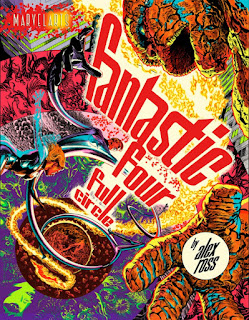
Yesterday's news included the announcement that next year, we'll see the release of a new Fantastic Four story written and drawn by Alex Ross. Given that Ross is quoted as saying this is a story he's wanted to do for years, the logo presented on this new art is one of the ones shown in Ross's 2017 "reboot" pitch, and that he's very clearly using Fantastic Four #51 as a jumping off point (another piece of art showcases the retroactively-named Ricardo Jones from that issue) it's a fair bet this is basically a re-working of the idea that was written up in Marvelocity. Ross looks like he might be keeping the undershirt idea he noted then, but the costume design seems much more in line with what Jack Kirby was drawing back then than any of the new designs Ross had worked up, so it seems unlikely we'll see any more art from that earlier project here.

But that's not what I want to talk about!

The most interesting aspect of all this, I think, is: Marvel isn't the one publishing this. It will actually be a new imprint of Abrams ComicArts called MarvelArts. Taimur Dar in their reporting on this noted it's the first time Marvel has licensed graphic novel publishing to another company in forty years. That specific point is debatable, based on how you define a lot of this, but the notion that Marvel is subbing this out to another company and it's a project that would normally be very much in their wheelhouse is still unusual and noteworthy. Further, Charles Kochman -- who has edited Ross' work many a time before -- will be co-editing the book alongside Tom Brevoort, the editor of the current ongoing Fantastic Four title.

I've noted before -- and I don't think many people fully understand this -- Marvel stopped being a comic book publisher around 1999-2000. They had historically always viewed themselves as a comic book publisher. But right around 2000, shortly after they came out of bankruptcy, they formally stopped being a comic book publisher and became a character licensing company. People argue about whether Marvel's movie success began with Blade or X-Men or Spider-Man or whatever, but that fundamentally misses the point. Marvel had licensed their characters out for movies before; what made the difference is they finally began viewing their characters in terms of the long-term revenue they could generate. These were characters that had power in the way Mickey Mouse or Luke Skywalker or Kermit the Frog or Captain Kirk had. It was that realization, and the subsequent act of formally pushing their publishing arm very much to the side in favor becoming a licensing company (with the accompanying lawyers and sales and marketing teams that knew the characters' actual financial value), when Marvel started becoming really successful. Within a year or two of the change, their income from comics had dropped to about one-third of their overall revenue with another third coming from toys and another third from licensing. By 2005, licensing represented 70% of their income!

That's why Disney bought them. I mean, yes, they were bringing in lots of money by then, but what Disney saw was a company that had proved it understood the marketplace and what their real value really was. Disney said, "Yeah, these guys finally grew up and are starting to run their business like an actual business instead of a hobby."

In the past decade or so since Disney purchased Marvel, we've actually seen them farm out a number of projects to other publishers. Dark Horse has re-published the Star Wars comics Marvel began in the 1970s, IDW has re-published a variety of Marvel's comics under their Artist's Edition line, not to mention the various publishers who've done more kid-friendly versions of the characters. All of which is in addition to Marvel farming out the entire production of their Heroes Reborn line back in the 1990s. I expect we haven't hit a tipping point yet, but a fair amount of Marvel comics being put out into the market any more are NOT actually published by Marvel. And the number of non-published-by-Marvel Marvel comics seems to be growing. It was in fact Abrams themselves that published reprints of Marvel's mini-comics from the 1960s and the recent Fantastic Four #1 Panel by Panel.

So at what point does Marvel stop publishing entirely? We don't have insight into their revenue breakdown since they were purchased by Disney, but given that comics accounted for probably only 15% of their income in 2005 and the Marvel movies have only gotten more successful since then, how long will it be before someone looks at the numbers and thinks, "You know, if we just moved all the comics production under the licensing folks and famred out everything, we could make more money with fewer people doing less work"? I can easily forsee a setup in the not-too-distant future where several different publishers are putting out new comics featuring Marvel characters, potentially each having distinct and unrelated continuities.

Given how much money Marvel is making in venues OTHER than making comics, I can't imagine it's a direction they'll pursue much longer. This Alex Ross book, for them, is a test to see how well the idea goes over with the usual fanbase. I suspect we'll start seeing similar types of announcements beginning next year around the time the book comes out. Those will continue for a few years until Marvel secures a deal to let others publish either some monthly titles or an ongoing string of graphic novels. It won't happen overnight, but that goes back to why Disney purchased Marvel -- they're now a business playing the long game with 5, 10, and 20 year plans.
I haven't done a Comics Calendar post since June, so it's high time we get back to them! As usual, please check the time zones noted below and adjust to your location as appropriate.
  • August 3, 4:00pm PT
    Jerry Craft : From Reluctant Reader to Newbery Medal

    The Sacramento Public Library in partnership with the California State Library presents: Newbery Medal Winner Jerry Craft. The Artist’s journey from being a reluctant reader to a published author/illustrator.
  • August 5, 2:00pm BST
    Workshop: Manga

    They’ll be looking at the basics of drawing manga, creating our own character, and then featuring them in a page of manga artwork. Free worksheet: a page of blank manga panels for the final exercise. Ages 8-14. Registration: £12 UK.
  • August 6, 10:30am ET
    Draw like a Comic Book Artist

    "Draw like a Comic Book Artist" is a virtual program that will show you how simple, fun and relaxing it is to draw, communicate and tell stories with illustrations. Using our graphic novel collection as inspiration, we will practice with tools we already have at home and leave you with awesome ideas to explore. Ages 8 - 12.
  • August 6, 7:00pm BST
    David Lloyd talks V for Vendetta

    Illustrator of the iconic V for Vendetta, David Lloyd, will be live at Hull Central Library and streamed to an online audience. V for Vendetta by Alan Moore and David Lloyd was first published as a comic strip in 1982. The story reflected the political climate of the time exploring themes of power, fascism, anarchy and freedom. 40 years later V for Vendetta still resonates, with the iconic V mask symbolising protest and rebellion around the world. Ages: 18+
  • August 7, 10:00am CT
    DGPL Library Con

    ALL THE FUN OF A CONVENTION... AT HOME! Attend the library's first-ever library con virtually on August 7! Acclaimed panelists (including Tim Seeley, Katie Cook, Monica Gallagher, David Gallaher, Robin Ha, and Mark Crilley) will discuss comics, teach new drawing techniques, and more! Winners of the Cosplay Contest and Trivia will receive prizes!
  • August 7, 7:00pm BST
    V for Vendetta: Behind the Mask

    The Cartoon Museum presents an exclusive showcase of their 2021 exhibition V for Vendetta: Behind the Mask. Ages: 16+
  • August 8, 1:00pm PT
    Intro to Digital Coloring - Free Workshop with Marissa Louise

    Professional color artist Marissa Louise will teach an introduction to digital coloring, with a focus on graphic novels. She'll cover some basic color theory, the difference between RGB and CMYK color, how contemporary colorists are now making comics, what tools to use, and the basics of printing.
  • August 11, 2:00pm BST
    Workshop: Create a Comic Strip

    Learn how to design your own cartoon characters and then draw them in a one-page comic strip story. Great for beginners, and fun for those with a little more experience. Free worksheet: a page of blank comic panels for the final exercise. Ages 8-14. Registration: £12 UK.
  • August 14
    FREE COMIC BOOK DAY

    Free Comic Book Day is traditionally held the first Saturday in May each year. However, in 2021, the event has been pushed to August in the hopes that much of the disruption related to COVID-19 will be behind us. As such, FCBD 2021 will take place on Saturday, August 14! Check your local comic shops and libraries for online and in-person events!
  • August 14, 2:00pm BST
    Yuricon 20th Anniversary Discussion - Global Yuri Fandom

    Join Yuricon founder Erica Friedman and Yuri researchers Verena Maser and James Welker for a conversation about global Yuri fandom!
  • August 18, 6:00pm ET
    Howard Chaykin - Part II: PARADIGM BEYOND

    Whether you’re a beginner trying to find your artistic voice or seasoned artist looking to hone your visual language skills, comic book artist/writer Howard Chaykin’s Paradigm art classes exclusively on TalentTalk teaches aspiring artists what shapes, distance, and movement tell us about time and journey. In this visual exploration, Chaykin takes you inside storytelling to walk you through page layout and show you WHAT works and WHY. Registration: $30 US.
  • August 19, 2:00pm BST
    Workshop: Manga

    They’ll be looking at the basics of drawing manga, creating our own character, and then featuring them in a page of manga artwork. Free worksheet: a page of blank manga panels for the final exercise. Ages 8-14. Registration: £12 UK.
  • August 23, 7:00pm BST
    LDC Monthly Online

    A live LDComics online event with guests sharing illustrated presentations about their comics work, career-life tips, latest graphic novels and more! Guests this month are Anarya, Dominique Duong, and Carol Isaacs (aka The Surreal McCoy).
  • August 25, 2:00pm BST
    Workshop: Create a Comic Strip

    Learn how to design your own cartoon characters and then draw them in a one-page comic strip story. Great for beginners, and fun for those with a little more experience. Free worksheet: a page of blank comic panels for the final exercise. Ages 8-14. Registration: £12 UK.
  • August 26, 6:00pm ET
    Howard Chaykin – Part III: PARADIGM IN PRACTICE

    The Paradigm in Practice deals with writer tools for story breakdown, and also the hidden nuances of comic storytelling. How should you format a script, regardless if you’re working with an artist or drawing it yourself? Why do panel borders MATTER? How can a conversation become the greatest action? How do you best bring the reader into the time-and-place setting of your story? All this and more is addressed by one of comics’ greatest storytellers! CRUCIAL information for pros, and deeper appreciation for enthusiasts! Registration: $30 US.
  • August 27, 12:00pm ET
    Charlie Adlard: Q-and-A and Original Art

    Your purchase of this Talk gets you access to a limited, private 50-minute Q&A session with Charlie Adlard! Charlie is happy to answer questions about the process, his experiences in comics, or art in general! Only FIVE seats are available for this exclusive session! ALSO: Your purchase includes an original drawing by Charlie of a character of your choice on a 6.5-by-10 inch high-quality 3-ply board provided by TalentTalk! BONUS: Charlie is donating his proceeds from this talk to Hero Initiative. Registration: $325 US.
  • August 29
    Boise Comic Arts Festival

    Boise Comic Arts Festival (BCAF) inspires creators of all ages, cultivates a comics community, showcases local and international artists, and creates opportunities for discovery and collaboration. For the health and safety of our community, Boise Comic Arts Festival 2021 will be a hybrid in-person and virtual event this year. All panels will be hosted on Zoom and are FREE to attend, but registration will be required. More information coming soon!
  • August 30, 8:00pm ET
    Matt Wagner: Q-and-A and Original Art

    Your purchase of this Talk gets you access to a limited, private 45-minute Q&A session with Matt! Matt is happy to answer questions about the process, his experiences in comics, or art in general! Only FIVE seats are available for this exclusive session! ALSO: Your purchase includes an original bust sketch by Matt of a character of your choice on a special, high-quality, 6.5-by-10 inch 3-ply illustration board provided by TalentTalk! Registration: $275 US.
I'm weirdly anxious and distracted by the Eisner Awards ceremony tonight. Even though I'm reasonably confident my Webcomics book won't win -- webcomics as a topic is still broadly dismissed by academia -- I still find myself nervous about hearing the results tonight. Nervous enough that I don't have much coherent to ramble on about here.

If you want to watch tonight's ceremony and hear my name as a nominee announced by Green Lantern (host Phil LaMarr), you can find all the info for the official online ceremony here.
Comic Con International begins on Friday. Yesterday, they finally updated the programming schedule to include the Eisner Awards Ceremony. But here's the description they posted with it...
The “Oscars” of the comics industry honor comics creators and their works in 33 categories, including the Will Eisner Hall of Fame. Your host for the evening is Phil LaMarr, the actor/voice actor/comedian known for roles in animated series including Green Lantern/John Stewart and Ed Reiss in Justice League and Justice League Unlimited, Hermes Conrad in Futurama, and the title characters on both Samurai Jack and Static Shock. His film and TV acting credits include Pulp Fiction, Free Enterprise, Veep, Get Shorty, and Supergirl. Sergio Aragonés will be announcing this year’s Hall of Fame recipients. Also being presented: the 2021 Bob Clampett Humanitarian Award and the Eisner Spirit of Comics Retailer Award.
It seems fine at first glance, but there are a few things that give me pause.

First, there aren't 33 categories; there are only 32. My best guess for this error is that someone looked at the Wikipedia entry for the Eisners and saw this: "As of 2019, awards are presented in 32 categories for works published in 2020." That sentence, as it is currently written, doesn't make sense. Because one of the award categories is new this year, so it could not have been in place "as of 2019." This is probably a case of someone editing the entry by unintentionally only updating parts of an existing sentence. I suspect whoever updated the programming entry read the first part of the sentence ("As of 2019, awards are presented in 32 categories...") and simply added 1 to the total, knowing there was a new category.

That's a minor issue, really, but hints at the reasoning for this next question. Namely, LaMarr and Aragonés were the hosts last year. The creative director of Bongo Comics, Bill Morrison, used to emcee the event every year but they switched to a rotation of celebrity hosts beginning in 2011. George R. R. Martin, Brandon Routh, Samuel L. Jackson, Joss Whedon, Patton Oswalt, and others. To have LaMarr and Aragonés two years in a row seems... odd. Furthermore, there hasn't (as of this writing, at least) been any formal announcement about the ceremony or hosts. Nothing on the Comic Con website or any of their social media outlets. None of the comic news outlets has anything about it either. Not even any rumors posted on Bleeding Cool.

What this suggests to me is that the Comic Con International folks didn't get any advance information from anyone on the Awards Committee. Last year, there was a formal announcement noting LaMarr's involvement and the actual date/time of the ceremony about two weeks before the event itself. But this year, we found ourselves entering the week the convention kicks off with nothing. I don't doubt that led to some very panicked folks at Comic Con, and someone decided that having something out on the site -- even if it was incorrect -- was better than nothing.

Awards organizer Jackie Estrada has confirmed the date/time of the ceremony on Twitter, but didn't speak to any other details. Between this lack of transparency in even basic information, and the voting problems they ran into last year, it does make me wonder how much value the industry will continue to bestow on the award. We like to speak about them as "The Oscars of Comics" but they haven't been around nearly as long or have nearly the history. I guess we'll find out how things go on Friday one way or another, and we'll all be able to do some Monday morning quarterbacking to discuss how things went and what that might mean going forward.

UPDATE: The Comic Con site was updated late in the day after I posted this with a notice saying that LaMarr and Aragonés will indeed be hosting again this year, also adding that Ruth Clampett will be announcing the Bob Clampett Humanitarian Award and Jackie Estrada will be opening and closing the ceremony.