The S.O. recently pulled out the Duran Duran video for "Rio" from the archives, and caught this image in the middle of it...
The comic he's reading is Charlton's Fightin' Army #157, cover dated April 1982. Cover art is by Sam Glanzman. The interior stories were reprints from Army War Heroes #33-34.
 The song "Rio" was released as a single in November 1982; however, the music video was shot over the course of three days in May 1982 on the island of Antigua. Which means that that issue of Fightin' Army was probably the most current one available at the time.
The Wikipedia entry for "Rio" states: "It is one of the band's most recognizable songs, mostly due to its famous music video, which is widely regarded as symbolic of 1980s glamour and excess." That is, of course, despite the appearance of one of the last comic books from a publisher that would barely survive another few years. And then, only after an infusion of cash from when DC bought the rights to most of their superhero characters.
Here's a random Peanuts strip...
If you were reading this aloud to someone else, you'd probably just read the dialogue with each line preceded by a "Linus says" or "Sally says". Pretty simple and straightforward, right?
How about this one...?

Would you read it the same way? Or would you maybe add something else to indicate Charlie Brown's somersault in the last panel? Maybe something descriptive like "And then Charlie Brown gets flipped over" or maybe just a sound effect like "Whooop!"
Here's another...
Charlie Brown's speech in the third panel is technically illegible. As readers, we know from his posture alone that he's feeling alone and rejected, but as speakers, how do we convey that? It would seem that Charlie Brown is actually saying something, so maybe we could simply provide a string of unitelligible mumbling? Or maybe add audible dialogue that would still fit his character and the situation: "Rats!"
One more...
You could explain Sally walking up to the house and ringing the doorbell. You can relay her dialogue from the last panel. But how do you explain that comedic beat in panel 3? It needs to be there for the joke to work, but it's just a visual pause. We don't know (or, for that matter, need to know) if someone has answered the door or not. We don't know what Sally's thinking. We don't even know how much time elapses.
A friend of mine has been reading a Peanuts collection to his four-year-old in lieu of "traditional" bedtime stories. His daughter really seems to enjoy them, but he's repeatedly struck with how to articulate what Shultz has drawn on the page precisely because of these types of situations. He frequently resorts to adding his own dialogue, although I imagine in this last case, one would be hard-pressed to come up with anything remotely appropriate. (Maybe some idle humming, but that doesn't really work here that well.)
To add an interesting dimension to things, reading to your child isn't just reading generally. Lots of parents effect different voices and ask questions ("What do you think happens next?") and use hand gestures. Would acting out the same actions as the characters be appropriate? Especially the listless staring into space bit to emulate the visual comedic beats of the comic strip.
Clearly, comic strips aren't designed to be read aloud. The combination of words AND pictures to tell a story makes translation to words only often awkward and/or difficult. But I do like the idea of reading bedtime comics to kids, as it can inspire a lifetime of not only reading, but also an appreciation of the comic medium. With that in mind, are there any other suggestions for how to tackle the surprisingly difficult process of reading comics to your kids?
Stan Lee has used "excelsior" as his signature sign-off line for decades, and it's largely permeated the comic book industry's collective subconscious. Lee, when asked, will usually define the word as meaning "onward and upward to greater glory." But how many people know about it's real meaning and origin?
It actually stems from the Latin word excellere meaning "to rise, surpass, be eminent." Broken down: ex- meaning "out from" and -cellere meaning "rise high." It's the same root from which we get the English words, excel and excellent. The word excelsior itself was the adjective form of excellere and means, simply, "higher" or "superior."
 The State of New York adopted the word for their official seal (and flag) in 1778. The definitions at that time were generally given as "ever upward" or "ever higher" -- as someone apparently mistook the word as an adverb. The seal has remained essentially unchanged to this day.
This seal was allegedly seen by Henry Wadsworth Longfellow in 1841, and was the inspiration for his poem Excelsior...In happy homes he saw the light
Of household fires gleam warm and bright;
Above, the spectral glaciers shone,
And from his lips escaped a groan,
Excelsior!
"Try not the Pass!" the old man said:
"Dark lowers the tempest overhead,
The roaring torrent is deep and wide!
And loud that clarion voice replied,
Excelsior!
"Oh stay," the maiden said, "and rest
Thy weary head upon this breast!"
A tear stood in his bright blue eye,
But still he answered, with a sigh,
Excelsior!
"Beware the pine-tree's withered branch!
Beware the awful avalanche!"
This was the peasant's last Good-night,
A voice replied, far up the height,
Excelsior!
At break of day, as heavenward
The pious monks of Saint Bernard
Uttered the oft-repeated prayer,
A voice cried through the startled air,
Excelsior!
A traveller, by the faithful hound,
Half-buried in the snow was found,
Still grasping in his hand of ice
That banner with the strange device,
Excelsior!
There in the twilight cold and gray,
Lifeless, but beautiful, he lay,
And from the sky, serene and far,
A voice fell, like a falling star,
Excelsior!
It was this repeated use of the refrain "Excelsior!" that caught people's attention. In 1855, Walt Whitman penned a poem of the same name, as did Alexandru Macedonski in 1895. The Excelsior Brigade was a military unit in the Union Army during the American Civil War. In 1861, Sam Loyd applied the name to a unique chess problem he devised. In 1893, the name was given to the then-world's-largest diamond. Two car manufacturers took the name around the turn of the century and several motorcycle companies used the name in the early 20th century. P. G. Wodehouse penned a short story called "Excelsior" in 1948. In 1959-60, USAF Capt. Joseph Kittinger was involved in a "Project Excelsior" that was testing new parachute equipment and, in the process, set several still-standing world records. Not to mention several cities and townships that have been named "Excelsior" over the years.
Among those who read Longfellow's poem was, not surprisingly, Stan Lee. Although I can't seem to find the reference now, I recall Stan saying that he appropriated the catch phrase from Longfellow.

Interestingly, it was a surprisingly late addition to the Lee-style hyperbole that ran rampant through those old Marvel comics. While there are plenty of "Face Front"s and "Nuff Said"s peppered through the earliest comics, the first instance of an "Excelsior" I can find is from a "Stan's Soapbox" in Fantastic Four #71 circa 1968. Of course, once he DID start using it, he never stopped! And, when questioned about it's meaning, naturally added his own unique spin to the definition by adding the "to greater glory" that's partially implied in Longfellow's poem.
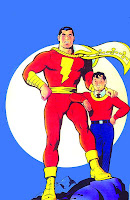 Quick history to make sure we're all on the same page... In answer to the success of Superman, Bill Parker and C.C. Beck created Captain Marvel in 1939 for Fawcett Publications. Captain Marvel stories were soon outselling Superman's, and in 1941 DC Comics (then National) sued Fawcett on the grounds of copyright infringement. The lawsuit took years and it was eventually settled out of court, and in 1953 Fawcett stopped publishing Captain Marvel stories. In 1972, DC licensed the character from Fawcett and began publishing new Captain Marvel comics. In 1991, DC finally purchased the rights to the character entirely and now definitively owns Captain Marvel.
What all that means is that Captain Marvel has been published by DC Comics exclusively for my entire lifetime. I have exactly one Captain Marvel comic book NOT published by DC Comics, and I only obtained that in the past year. Captain Marvel has been appearing alongside Superman, Batman and Wonder Woman for as long as I've known about the character.
So why is it that I don't think of Captain Marvel as a DC character? He was something of a Superman knock-off in the first place, and has been a part of the DC Universe for 30-some years, but I still consider him a Fawcett character, separate and distinct from DC.
 Jehanzeb Dar continues examining female Muslims in comic books. Part 2 focuses on the extraordinarily great work in The 99 (which I've highlighted before) and Part 3 chastises AK Comics for their poor representations in Jalila: Protector of The City of All Faiths and Aya: Princess of Darkness. Although I haven't personally read AK's books, I have seen multiple summaries and a fair amount of art from the issues, and was left duly unimpressed even disregarding the allegedly poor representations of Islam. They look like, at best, mediocre knock-offs of any "bad girl" comic from the 1990s.
Dar's conclusion thus far is that The 99 features not only the best depiction of female Muslims in comic books, but it's also the only one that doesn't suck.
Miriam Libicki (creator of jobnik, which I reviewed here) will be teaching a class on creating comics at Emily Carr University beginning in October. It sounds interesting in that Libicki is expressly stating that she's deliberately trying to focus more on storytelling than drawing or writing. I'm often skeptical of "how to make comics" classes because they seem to focus a little too intently on one particular creator's style, but Libicki sounds like she's making an earnest attempt to really go beyond that.
More details here.
 So, what does a rock star think of Comic-Con? Amanda Palmer (of The Dresden Dolls; also girlfriend of writer Neil Gaiman) had a few things to say...
comic-con was, in a nutshell, a huge fuckshow dork-fest of 200,000 people in a big air-conditioned metal box.
but it had it’s high points. the signings were good, i hugged many, though i did feel overwhelmed by the fucked-up mall feeling.
She does go on to say some more positive things, especially when it came to dealing with the more creative folks in attendance. (And for those who aren't familiar with Palmer, no, she's not cos-playing in the picture to the left. That's fairly normal attire for her.)
She also has a picture of "mr. writer-man" sleeping on the beach.


 The song "Rio" was released as a single in November 1982; however, the music video was shot over the course of three days in May 1982 on the island of Antigua. Which means that that issue of Fightin' Army was probably the most current one available at the time.


